Inbound Lead Reply Email Templates: Eleven First Replies
Eleven first-reply templates for an inbound lead, one per trigger: demo, pricing, form, download, trial, referral, event, chat, non-fit, out of hours, handover.
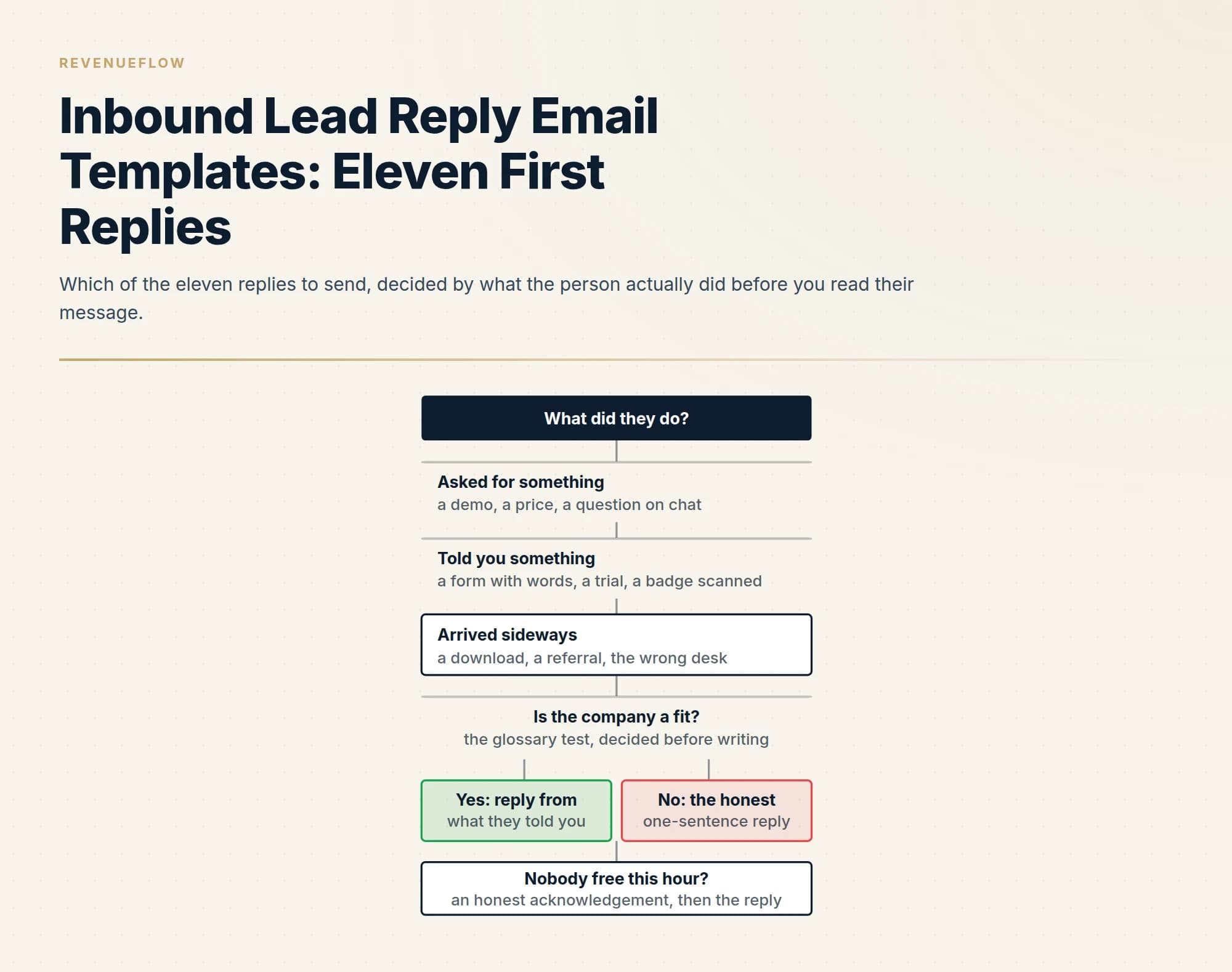
An inbound lead reply is the first message to a person who initiated contact, sent inside the first hour by a named person and written from what they told you. Sort it by trigger, carry an answer, one question or a time, keep the subject on their thread, and treat everything after their answer as correspondence rather than a cadence.
Key takeaways
- Sort the reply by what the person did: a demo request, a pricing question, a form with a written situation, a download, a trial, a referral, a badge scan, a dropped chat, a non-fit, an out-of-hours note and a handover each get a different first message.
- Paste their own words back into the first sentence and ask one question, the one that decides the next message; a reply that opens with thanks for your interest tells them nobody read the form.
- Keep the subject line on their thread with Re: in front, and let it describe what the reply carries, so a person scanning a preview pane can tell a real reply from a marketing send.
- Send the first reply inside the first hour from a named person, then treat everything after their answer as correspondence; a person who read a real reply and went quiet is not chased, and a genuine later change is a new campaign.
Reviewed and updated September 18, 2026
A form comes in at ten past four on a Thursday. Somebody at a company you have never spoken to typed two sentences about a problem, gave a name and an address, and pressed send. What they receive next decides whether they think they reached a company or a queue. This page is that one message: the first reply to a person who wrote first.
It is not the after-demo page, which is demo follow-up email templates, and it is not cold email. The mechanism behind the first hour, who owns the reply and why an automated acknowledgement is not one, is in the inbound lead entry and not restated. Every template below is invented for this article, every company and person in a worked example is invented, and none reports a result.
What the first reply has to carry
The galleries that rank for this search agree on timing and on little else. Reply.io's inbound lead email template page, read on 18 September 2026, offers three short options that open by thanking the person for their interest and advises sending "within 24 hours of the lead's action". TextExpander's page, updated 27 December 2024, carries five emails that each open on a recent inquiry and ask for a call. Tomba's guide of 10 September 2026 is the one that sorts by trigger, nine templates from demo request to breakup, and its structure is the useful part: a trigger line, a bridge, one proof point, a single ask, a human signature.
A demo request, a gated download and a chat that dropped are three different amounts of intent, and one reply written for all of them is written for none. So the eleven templates are one per trigger, sorted by what the person did: they asked for something (a demo, a price, a question on chat); they told you something (a form with words, a trial started, a badge scanned); or they arrived sideways (a download, a referral, a note to the wrong desk). Two more rules decide the branches: the glossary's fit test is decided before writing, and a non-fit gets the honest one-sentence reply; when nobody is free this hour, the acknowledgement goes first and the reply follows.
Three merge fields recur. {{first_name}} is the name they gave you. {{their_words}} is the exact phrase they typed, pasted back, not paraphrased. {{sender}} is a real person's first name and role, because a reply signed by a team, or sent from an automation domain, is a queue announcing itself. The worked example under template three is invented: Marisol Achebe at Torvane Logistics, whose form said her dispatch team re-keys every order twice, which usually comes with a backlog on Monday mornings, is asked whether the second entry goes into a carrier portal or her own system, and the reply is signed by Dana, an invented account lead.
The eleven templates, one per trigger
1. The demo request
Subject: Re: your demo request, two times and one question
Hi {{first_name}},
Your demo request came in a few minutes ago. One question first, because it changes what I show you: is this for {{their_words}}, or for something wider?
Two slots that work on our side: {{slot_one}} and {{slot_two}}. If neither does, send a window and we will fit it.
{{sender}}
Why it works: the reply arrives while the request is still open on their screen, the question proves the demo will be built around them, and two slots turn a calendar negotiation into a yes or no.
2. The pricing request when the scope is unknown
Subject: Re: pricing, and the one thing it depends on
Hi {{first_name}},
Happy to give you a number. Pricing here moves on {{the_scoping_variable}}, so one question before I quote anything: roughly how many {{unit}} are you working with today?
Send that and you will have a figure back within the hour. If you would rather see the whole ladder first, it is here: {{pricing_page}}.
{{sender}}
Why it works: a price given before the scope is known is either wrong or padded, and the reader knows it; naming the variable shows the number is real, and the promised hour stops the question reading as a stall.
3. The contact form with a written situation
Subject: Re: {{their_words}}
Hi {{first_name}},
You wrote that {{their_words}}. That usually comes with {{the_consequence_you_see}}, and it is the part we work on.
One question so I answer the right thing: {{the_one_qualifying_question}}?
{{sender}}
Why it works: quoting what they typed proves a person read it, the consequence sentence, stated as usual rather than certain so they can correct it, shows you understood it, and a single question is answerable in one line; it takes the time a thank-you takes.
To: Marisol Achebe, Torvane Logistics. Subject: Re: our dispatch team re-keys every order twice
You wrote that your dispatch team re-keys every order twice. 1
That usually comes with a backlog on Monday mornings, and it is the part we work on. 2
One question so I answer the right thing: is the second entry into your carrier portal or your own system? 3
Dana, account lead 4
- 1Their own words, pasted back. The reader sees that a person read the form.
- 2The consequence you see, stated as usual rather than certain, so they can correct it.
- 3One question, answerable in a line, that decides what the next message says.
- 4A named person with a role. No team signature, no automation domain.
4. The gated content download
Subject: Re: the {{asset_name}} you downloaded
Hi {{first_name}},
The {{asset_name}} went out to you a moment ago. The part worth reading first is {{the_section}}, which is the part that changes anything.
Out of interest, how is {{company}} handling {{the_topic}} today: by hand, or is there something in place?
{{sender}}
Why it works: a download is the softest signal on this page, and Tomba's guide lists "Asking for a meeting on the first touch after a content download" among its most common mistakes. The reply gives one thing from the asset and asks one question about their world; the meeting ask waits for an answer.
5. The trial or signup
Subject: Re: your {{product}} trial is live
Hi {{first_name}},
Your workspace is on. The three things worth doing in the first session: {{action_one}}, {{action_two}}, {{action_three}}.
If any of them sticks, reply here and we will unblock it the same day. No pitch until you have seen it work.
{{sender}}
Why it works: a trial user wants the product to work, and a sales conversation before it has is how you lose them; three first actions and a named person who clears blockers are the whole reply.
6. The referral introduction
Subject: Re: intro from {{referrer}}
Hi {{first_name}},
{{referrer}}, thank you for the introduction. Moving you to bcc so you are spared the rest.
{{first_name}}, {{referrer}} mentioned {{their_words}}. Before I assume anything, what does that look like from your side today?
{{sender}}
Why it works: the reply-all etiquette is the template; the referrer is thanked and released, and the introduced person is asked, rather than told, what the problem is.
7. The event badge scan
Subject: Re: {{event_name}}, the thing you asked about at the stand
Hi {{first_name}},
You stopped by at {{event_name}} and asked about {{their_words}}. The short answer: {{two_sentence_answer}}.
If it is worth a proper conversation once you are home, say so and we will send times. If not, good to have met.
{{sender}}
Why it works: a badge scan is consent to one message, and it answers the question asked at the stand. The wider set of event messages is in event outreach email templates; this reply is for a person who came to you.
8. The website chat that dropped
Subject: Re: your question on chat, answered
Hi {{first_name}},
Our chat cut off before we answered you. The answer: {{direct_answer}}.
If that raises anything else, we are around today. Reply here, or grab a time: {{booking_link}}.
{{sender}}
Why it works: the reader asked a question and did not get the answer, so the reply leads with it; the booking link comes after a sentence, never instead of one.
9. The honest non-fit reply
Subject: Re: {{their_words}}
Hi {{first_name}},
Thank you for writing. From what you describe, we are not the right fit: we work with {{who_we_serve}}, and {{the_reason}}.
{{alternative_pointer}}. Good luck with it.
{{sender}}
Why it works: most inbound is not a fit, and a single honest sentence keeps the database honest and occasionally produces a referral; a pointer to somewhere useful costs one line.
10. The out-of-hours acknowledgement that is not the reply
Subject: Re: {{their_words}}, read, reply by {{time}}
Hi {{first_name}},
We have read your message about {{their_words}}. It is {{local_time}} here, so you will have a proper reply from us by {{time}} tomorrow rather than a rushed one tonight.
{{sender}}
Why it works: it is honest about being an acknowledgement, naming the person, the time and the fact that the real reply is coming. Tomba's guide argues that "An instant templated acknowledgment beats a thoughtful email sent tomorrow" and to send both; this page's position is that the acknowledgement is worth sending only when the person who will write the reply signs it.
11. The reply that routes to a colleague
Subject: Re: {{their_words}}, handing you to {{colleague}}
Hi {{first_name}},
Your note landed with us, and the person who actually runs {{the_area}} is {{colleague}}, copied here. {{colleague}} has your message and will pick it up today.
Nothing for you to resend.
{{sender}}
Why it works: the handover is visible, the colleague is named and copied, and the enquirer does not repeat themselves. Who owns an inbound record, and its route to an owner, is in lead routing.
The grid below reads the eleven replies across the three things a first reply can offer; partial means the reply carries it in part, such as a pricing page in place of a figure.
| Row | Booking link or times | One question | The answer itself |
|---|---|---|---|
| Demo request | Yes | Yes | No |
| Pricing, scope unknown | No | Yes | Partial |
| Form with a situation | No | Yes | No |
| Content download | No | Yes | Partial |
| Trial or signup | No | No | Yes |
| Referral intro | No | Yes | No |
| Event badge scan | Partial | No | Yes |
| Chat that dropped | Yes | No | Yes |
| Honest non-fit | No | No | Yes |
| Out-of-hours note | No | No | No |
| Route to colleague | No | No | No |
Subject lines: on their thread, almost always
A reply to an inbound message keeps the sender's own subject with Re: in front, because that is the line they recognise and the one their mail client threads. The lines are grouped by what they assume.
They wrote to you, so the subject is theirs:
- Re: {{their_words}}
- Re: {{their_words}}, one question
- Re: {{their_words}}, answered
- Re: {{their_words}}, handing you to {{colleague}}
They filled a form or clicked, so the subject names the thing:
- Re: your demo request, two times and one question
- Re: pricing, and the one thing it depends on
- Re: the {{asset_name}} you downloaded
- Re: your {{product}} trial is live
- Re: your question on chat, answered
Somebody else started the thread, so the subject names them:
- Re: intro from {{referrer}}
- Re: {{event_name}}, the thing you asked about at the stand
The rule each group follows: the subject describes what the reply contains, so a preview pane shows a real reply rather than a marketing send; nothing creates urgency, because the person already has some.
Cadence: the first hour, then correspondence
The first reply goes inside the first hour, and the reason is a mechanism rather than a statistic: whatever made the person act is perishable, and a reply the next day reaches somebody who has gone back to their week. How to instrument the clock, and why the median hides the tail, is in lead response time.
After the first reply there are two paths. They answer, and now it is correspondence: you answer what they ask, send what you promised, and confirm what was agreed. Or they go quiet, and on our side the moment has passed: we send no reminder, we put no bump on the thread, and the record stays honest. That is our own practice, not a rule that one further note to a person who wrote first is wrong; the next section says where the alternative sits. A real change later, on their side or yours, is a new campaign, its own premise.
Where we differ from standard practice
The galleries assume a chase. Reply.io's page says that if there is no response you should "send a gentle reminder in 2-3 days" and, in its questions, that "Two well-spaced follow-ups are effective without overwhelming the lead". Tomba's comparison table puts an inbound sequence at three to five touches over eight to ten days. That is the market's practice, described rather than recommended.
We do not chase an inbound person who read our reply and said nothing. One message per campaign, and here the campaign is the reply. A person who received a real answer from a named human and went quiet has told you that whatever made them act is no longer in front of them, and a reminder attaches your name to that without changing it. The full argument, with the figures from our own campaigns, is in why we stopped using follow-ups. The cost is real: a person who was busy that week and would have answered a nudge is lost, and we accept that to keep the sending domain and the record honest. A team that does follow up a warm inbound person should front-load the touches and end with a close-the-loop note, as set out on the sales cadence page, and what it must never become is the scheduled programme.
What not to send
The automated acknowledgement as the reply. A message that thanks the person for their interest and promises somebody will be in touch is the queue announcing itself; if nobody can write the reply this hour, send template ten.
"Thanks for your interest." It tells the reader you did not read what they wrote. The first sentence of every template above is about the thing they typed, and takes the same time to send.
The five-question qualification form. A reply that asks for company size, budget, timeline, role and current tools before offering anything is a form sent to someone who already filled one in; ask the one question that decides the next message.
The bare calendar link. A link with no sentence in front of it asks the person to decide whether a meeting is worth it with nothing to decide on; every booking link on this page follows an answer or a question.
Routing by territory when the clock is running. A record assigned to a regional owner who sees it when they next work their queue has lost the hour; the named owner by time of day is in inbound lead generation.
Before you send
The person wrote first, so the standard is higher than cold email's: a named human, inside the first hour, their own words in the first sentence, and an answer, a question or a time. If too few of the right companies ever write in, reaching the ones that never will is a different job, and a first campaign against that list is where it starts.
Frequently asked questions.
Frequently asked questions- How quickly should I reply to an inbound lead?
- Inside the first hour, from a named person, and written from what they told you. The reason is a mechanism rather than a statistic: whatever made the person act is perishable, and a reply the next day reaches somebody who has gone back to their week. Name an owner by time of day rather than by territory, so the record does not wait in a queue nobody is watching.
- Should I send an automated acknowledgement to an inbound lead?
- Only when it is honest and signed. An instant templated thank-you answers the question the enquirer is actually asking, whether they reached a company or a queue, in the wrong direction. If nobody can write the real reply this hour, send a short note signed by the person who will, naming the time the proper reply arrives, and then send that reply.
- What do I say when an inbound lead asks for pricing?
- Name the one variable the price depends on and ask for it, then promise a figure inside the hour once you have it. A number given before the scope is known is either wrong or padded and the reader knows that. If a public pricing page exists, point to it in the same message so the person who wants the whole ladder can read it without waiting.
- How many follow-ups should I send to an inbound lead who does not reply?
- None on the same thread. The template galleries recommend a reminder within a few days and two or three further touches, and that is the market's practice. Our position is one message per campaign: a person who received a real reply from a named human and went quiet has told you the moment passed, and a genuine later change on their side or yours is a new campaign with its own premise.
About the author.

B2B cold email experts helping companies generate qualified leads through done-for-you outreach campaigns.
RevenueFlow Team
Explore more.
Ready to scale your outreach?
We build GTM engines that book real meetings. See the receipts.
Related articles.
8 Meeting Reschedule Email Templates and When to Send Each
Eight meeting reschedule email templates for moving a booked sales meeting before it happens, from either side, each with the reasoning line by line.
Roundtable Invitation Email Templates: Eight Invitations
Eight roundtable invitation templates by seat: the cold first invite, the invite via a member, the seat confirmation, the waitlist reply and the guest expert.
Multi-Threading Email Templates: Ten Second-Person Emails
Ten multi-threading email templates for the second and third people in a live deal: the user, the blocker, the economic buyer, the sceptic and more.
9 Bump Email Templates and When to Send Each
Nine bump email templates for threads where the other side owes you something, the three checks that make a bump correspondence, and what never to send.
Customer Check-In Email Templates: Nine Check-Ins by Moment
Nine customer check-in templates for the account owner, one per moment: a closed escalation, a usage drop, a new leader, a release, pre-renewal, news and bad news.
Sample Cold Emails: Six Written to Be the Only One You Send
Most sample cold emails are step one of five, so they underperform alone. Six complete messages, what to change in each, and why the middle is the part to cut.