Customer Check-In Email Templates: Nine Check-Ins by Moment
Nine customer check-in templates for the account owner, one per moment: a closed escalation, a usage drop, a new leader, a release, pre-renewal, news and bad news.
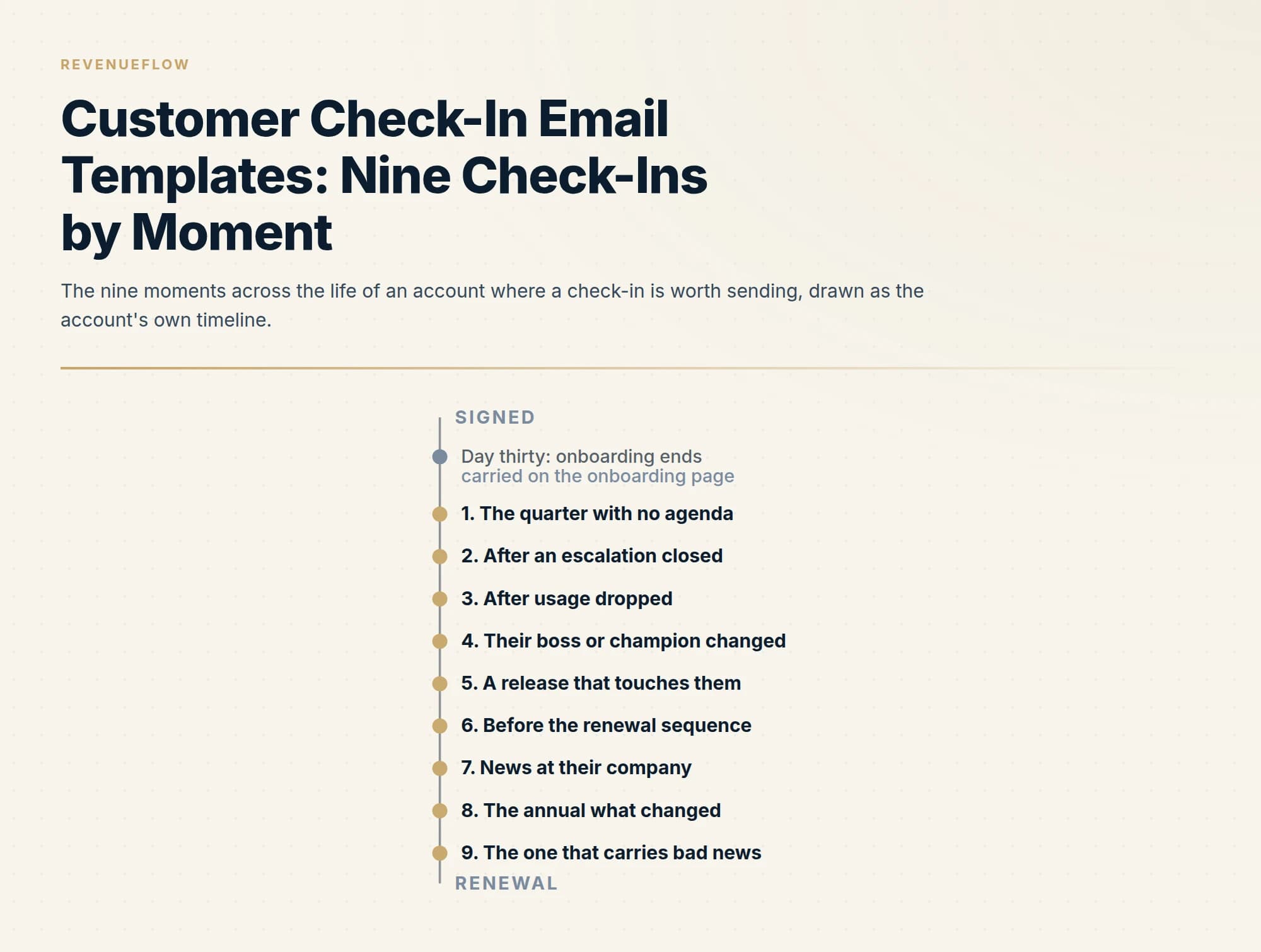
A customer check-in is a note from the account owner to a contact who already knows them, carrying one fact from their account or their company, one easy question and no commercial ask. Send one at each moment the account produces, from a closed escalation to a usage drop to a new leader, and never because a quarter passed.
Key takeaways
- Carry one fact the contact can check, from their own account or their own company, and ask one question that a no can answer; a check-in with nothing in it tells the customer the sender had nothing to say.
- Name the account and the fact in the subject line, and say no ask where there is none, because the contact already knows who you are and reads the preview pane for a campaign.
- Keep every commercial ask off the page: the pre-renewal check-in names the renewal and disclaims it, the release check-in says there is nothing to buy, and the expansion messages live on their own pages.
- Send a check-in when the account produces a moment and never chase it with another; a contact who did not answer the quarterly note has nothing to say this quarter, and the next message waits for the next fact.
Reviewed and updated September 18, 2026
The account has been live for seven months, the invoices are paid, nobody has raised a ticket since spring, and the person who signed has not written to you since the day the contract was countersigned. That silence is where accounts are lost, and the message that ends it is a customer check-in: a note from the account owner to a customer contact who already knows them, carrying one fact and no ask.
This page is the templates for that message across the life of an account. It is not a support macro, which is what most of the ranking galleries carry; it is not the quarterly check-in with a prospect, which is Template 10 of the follow-up email templates page on this site; and it is not the first approach to somebody inside a customer who has never heard of you, which the customer success manager templates page covers with the cold rules that approach needs. The reader here is the account owner, and the recipient is a person they have already worked with. The day thirty check-in that ends onboarding is carried in customer onboarding template and is not re-printed. Every template below is invented for this article, every company and person in a worked example is invented, and none reports a result.
What a check-in has to carry
Read the top of the search results for this phrase on 18 September 2026 and the reader you find is mixed. Maestro Labs's nine check-in samples, dated 22 September 2024, run from a check-in after a job interview to a customer check-in, and their advice is that "these short email feels abrupt and impersonal" when the message is one line. Copper's page, dated 11 November 2022, is a customer service template set that files checking in as one of eighteen support templates. GoDaddy's, dated 23 August 2021, is written for somebody with a stalled client project. AFPA's six templates are for personal trainers writing to gym clients. Fyxer's guide, dated 20 January 2026, is the closest to the account owner's problem, and its diagnosis is right: "Most check-in emails fail for one simple reason: they're vague".
The fix for vague is a fact. Every check-in below carries one thing you know about their account that they may not, one question that is easy to answer, where a yes or a no is a fine answer, and no commercial ask. It goes to a contact who already knows the sender, from the sender's own inbox, and nothing that appears anywhere in it is for sale. The market's version of the usage check-in, EverAfter's customer success templates dated 27 January 2025, opens by noting that the customer has not logged in recently and offers a call; the templates here state the number, say what it might mean, and ask which reading is right.
Three merge fields recur. {{first_name}} is the contact you already know. {{the_fact}} is one thing from their account or their company that you can state and they can check. {{sender}} is the account owner's first name. The worked example under template three is invented: Ines Okonkwo at Halvorsen Dental Supply, whose team ran about forty orders a week through the product in July and about twelve a week in September, written to by Rafael, an invented account lead, who asks whether the drop is a seasonal lull, a process that moved elsewhere, or a problem nobody raised.
Nine check-ins, one per moment
1. The quarter with no agenda
Subject: {{company}}, one thing from your account this quarter
Hi {{first_name}},
Nothing to ask. One thing we noticed: {{the_fact}}, which is the strongest it has been since you started.
Is there anything on your side that would make next quarter easier than this one? If not, ignore this and carry on.
{{sender}}
Why it works: the first sentence says there is no ask, and the message keeps that promise. The fact is from their account, so it could only have come from someone who looked, and the question is answerable with a no.
2. After a support escalation closed
Subject: Re: {{ticket_subject}}, closed on our side, one check
Hi {{first_name}},
Support closed {{ticket_subject}} on {{day}}. Before I take it off my list: is it actually fixed from where you sit, or only on our board?
If it is fixed, the cause was {{root_cause_in_one_line}}, and {{what_changed}} so it does not come back.
{{sender}}
Why it works: a closed ticket and a solved problem are different things, and the account owner asking which one it is shows that the escalation reached someone who owns the relationship rather than the queue. Naming the cause and the change is the part the support closure rarely carries.
3. After usage dropped
Subject: {{product}} at {{company}}: {{the_number}} this month, one question
Hi {{first_name}},
Your team ran {{the_number}} {{unit}} in {{product}} last month against {{the_earlier_number}} in {{earlier_month}}. That is usually one of three things: a seasonal lull, a process that moved elsewhere, or a problem nobody raised.
Which is it? Each has a different fix, and the answer decides where we start.
{{sender}}
Why it works: the number is the trigger and it is theirs, with the earlier figure beside it so the drop is visible without adjectives, and the message cannot be mistaken for a broadcast. Offering three readings, the harmless one first, lets the contact answer without defending anything. The signature is the account owner's first name, because the contact already knows the rest.
To: Ines Okonkwo, Halvorsen Dental Supply. Subject: your orders in the product: about twelve a week this month, one question
Your team ran about twelve orders a week through the product in September against about forty a week in July. 1
That is usually one of three things: a seasonal lull, a process that moved elsewhere, or a problem nobody raised. 2
Which is it? Each has a different fix, and the answer decides where we start. 3
Rafael 4
- 1The fact, from their own account, with the earlier figure beside it so the drop is visible without adjectives.
- 2Three readings, the harmless one first, so the contact can answer without defending anything.
- 3One question, and the reason it is being asked: each reading has a different fix.
- 4The account owner's first name. The contact already knows the rest.
4. After their boss or champion changed
Subject: {{new_leader_name}} joining, anything you want me to know?
Hi {{first_name}},
We noticed {{new_leader_name}} has taken over {{the_function}}. New leaders usually ask what every tool costs and what it does in their first month, so you may get that question about {{product}}.
If it helps, we can send you the one-page summary of what is live and how it is used, for you to forward or not. Anything you would want said differently?
{{sender}}
Why it works: it is written to the person you know, about the change on their side, and it answers the new leader's likely first question for them rather than asking for an introduction. The cold note to the new leader is a different message with different rules, and the CSM templates page carries it.
5. After a release that touches them
Subject: {{feature}} shipped, and the one place it touches {{company}}
Hi {{first_name}},
{{feature}} went live on {{day}}. The reason we are writing rather than letting the release note do it: your team runs {{their_workflow}}, and this changes {{the_specific_effect}}.
Nothing to buy and nothing to switch on; it is already there. If you want the two-minute version, reply and we will send it.
{{sender}}
Why it works: a release note reaches everyone, and this message reaches one account with the one effect that applies to it. Saying there is nothing to buy is the sentence that separates it from an upsell.
6. Before the renewal sequence begins
Subject: {{company}}, well before renewal, one honest question
Hi {{first_name}},
Your renewal is {{months}} out, and this is not the renewal conversation; that comes later and we will not hide it inside this one.
The honest question now, while there is time to act on the answer: is there anything about {{product}} that, if it does not change, would make you think twice? We would rather hear it this quarter than in the last fortnight.
{{sender}}
Why it works: it names the months left and disclaims the ask in the same sentence, which is the only way a pre-renewal message reads as a check-in. The renewal messages themselves, from the value review to the final reminder, are carried in renewal email templates and are not re-printed here.
7. After news at their company
Subject: Saw the {{news}} news, no action needed
Hi {{first_name}},
{{the_news}} came through this morning. No action needed from you and nothing we need; this is only to say that if {{the_likely_consequence}} changes what your team needs from {{product}}, tell us and we will make it easy.
Hope the week is a good one.
{{sender}}
Why it works: funding, an acquisition or layoffs each change the contact's week, and the careful message names the news, asks for nothing and offers one specific help. It is the check-in most likely to be read twice, and the one most easily ruined by a pitch.
8. The annual what changed on your side
Subject: A year in: what changed on your side?
Hi {{first_name}},
A year ago the reason for {{product}} was {{the_original_reason}}. Things move, and we would rather run the account against what is true now than against last year's notes.
Three quick ones, in a reply or on a call, your choice: what changed on your side this year, what did we get right, and what would you change first?
{{sender}}
Why it works: it quotes the original reason back, which proves the account owner kept the notes, and it asks three answerable questions in a fixed order. It is the one check-in that invites criticism, and it says so.
9. The check-in that carries bad news
Subject: {{the_change}} from {{date}}: what it means for {{company}}
Hi {{first_name}},
From {{date}}, {{the_change}}. For {{company}} specifically that means {{the_effect_on_them}}, and here is what we can do about it: {{the_offer_or_mitigation}}.
We wanted you to hear it from us before the notice arrives, with the number for your account rather than the general one. Questions, reply and we will answer them today.
{{sender}}
Why it works: a price change or a sunset announced by a general notice reads as something done to the customer; the same change announced by their account owner, with their number and a mitigation, reads as something handled. Sending it before the notice is the whole courtesy, and the only question in it is an invitation to ask.
| Moment | The fact it carries | The one question |
|---|---|---|
| Quarter, no agenda | One figure from their account | What would make next quarter easier? |
| Escalation closed | The cause and what changed | Fixed where you sit, or only on our board? |
| Usage dropped | This month against an earlier month | Lull, moved elsewhere, or a problem? |
| Boss or champion changed | The new leader's likely first question | Anything you want said differently? |
| Release that touches them | The one effect on their workflow | Want the two-minute version? |
| Before renewal | The months left, disclaimed as an ask | What would make you think twice? |
| News at their company | The news, and one likely consequence | None; an offer of help only |
| Annual what changed | The original reason, quoted back | What changed, what worked, what first? |
| Bad news | Their number, and a mitigation | None; an invitation to ask |
Subject lines: by what they assume
A check-in subject line names the account and the fact, because the contact already knows who you are and does not need warmth in the preview pane. The lines are grouped by the state of the thread.
They replied recently, so the thread continues:
- Re: {{ticket_subject}}, closed on our side, one check
- Re: {{last_thread}}, one follow-on from your account
- {{feature}} shipped, and the one place it touches {{company}}
They have been quiet for a quarter, so the subject carries the fact:
- {{company}}, one thing from your account this quarter
- {{product}} at {{company}}: {{the_number}} this month, one question
- A year in: what changed on your side?
- {{company}}, well before renewal, one honest question
Something happened at their company, so the subject names it:
- Saw the {{news}} news, no action needed
- {{new_leader_name}} joining, anything you want me to know?
- {{the_change}} from {{date}}: what it means for {{company}}
The rule across all three groups: the subject says what the message carries and, where there is no ask, says that too. Nothing reads as a campaign, because the contact would notice.
Cadence: how often a check-in is welcome
A check-in is correspondence inside a live relationship, and the frequency rule is the fact rule turned around: send one when you have something they can check, and never because the calendar says a quarter has passed. An account produces several of the moments above in a year, and an account that produces none is an account the owner is not looking at.
The one thing this page does not do is chase a check-in with another check-in. A contact who did not answer the quarterly note is a contact with nothing to say this quarter, and the next message waits for the next fact. Fyxer's guide suggests waiting three to five business days on a client email and holds that two follow-ups is usually reasonable; that is the market's practice for a message that needs an answer, and a check-in by definition does not. Our own doctrine on outbound, one message per campaign with no bumps and no thread replies, governs cold approaches rather than customer correspondence, and the customer onboarding template page sets out why a post-signature sequence is the case where several messages are correct: each one reports something new. The check-ins here follow the same rule, one fact per message, which is what makes a year of them welcome rather than noise.
- Yes: It carries one fact from their account or their company that they can check
- Yes: The question is answerable in a line, and a no is a fine answer
- Yes: The subject says what the message carries, and says no ask where there is none
- Yes: It goes to a contact who already knows the sender, from the sender's own inbox
- No: A price, a plan, or a feature to buy appears anywhere in it
- No: It asks the customer to fill in a survey or do work for you
- No: It is only going out because a quarter passed and nothing happened
What not to send
"Just checking in" with nothing. A one-line note asking how things are going tells the contact the sender had nothing to say, and the CSM templates page on this site makes the same point about customer email: without a fact, a number or a question, do not send.
The disguised upsell. A check-in that ends in a plan comparison was never a check-in, and the contact learns to read every later one as a pitch. The expansion messages belong on the upsell email templates page and say what they are.
The survey as a check-in. Asking for a score out of ten asks the customer to do work for your dashboard. If the account owner wants to know how it is going, template eight asks in words and reads the answer.
The support macro. Copper's checking-in template and Maestro Labs's customer check-in are written for a queue, with a greeting, a general offer of help and a sign-off. The contact of an account owner has a name, an account and a history, and a message that could have gone to any customer says the owner did not look.
The check-in that asks them to do work. A request to review a document, fill in a form or set up a call before anything is offered is an ask wearing a check-in's subject line. Every template above can be answered with one sentence or ignored without cost.
The fact is the message
Nine moments, one fact each, one easy question, and no commercial ask: that is the whole discipline, and it is what makes an account owner's check-in something a customer reads rather than files. If the harder problem is that the accounts you would like to be checking in on were never won in the first place, that is a different job, and a first campaign against the list you want is where it starts.
Frequently asked questions.
Frequently asked questions- How often should an account manager check in with a customer?
- When there is something to say, and the moments an account produces in a year are the ones on this page: a closed escalation, a usage change, a new leader on their side, a release that touches their workflow, the run-up to renewal, news at their company, the annual review and any bad news. A check-in sent because a quarter passed and nothing else happened is the one customers learn to file.
- What should a customer check-in email say?
- One fact from their account or their company that they can check, stated plainly, then one question that is answerable in a line, then the account owner's name. No plan comparison, no survey, no request to do work. If there is no ask, the subject line says so, because the contact reads the preview pane for a pitch and a check-in that is honest about carrying none gets opened.
- How do I check in with a customer whose usage has dropped?
- State the number and the earlier number side by side, so the drop is visible without adjectives, then offer three readings with the harmless one first: a seasonal lull, a process that moved elsewhere, or a problem nobody raised. Ask which it is and say why you are asking, because each reading has a different fix. The contact can then answer without defending anything.
- Is a customer check-in the same as a follow-up email?
- No. A follow-up chases an answer the sender is waiting for, and the market's guidance on it is about spacing and how many to send. A check-in is correspondence inside a live relationship that carries a fact and expects nothing, so it is never chased: a contact who does not answer has nothing to add this quarter, and the next check-in waits for the next moment the account produces.
About the author.

B2B cold email experts helping companies generate qualified leads through done-for-you outreach campaigns.
RevenueFlow Team
Explore more.
Ready to scale your outreach?
We build GTM engines that book real meetings. See the receipts.
Related articles.
8 Meeting Reschedule Email Templates and When to Send Each
Eight meeting reschedule email templates for moving a booked sales meeting before it happens, from either side, each with the reasoning line by line.
Roundtable Invitation Email Templates: Eight Invitations
Eight roundtable invitation templates by seat: the cold first invite, the invite via a member, the seat confirmation, the waitlist reply and the guest expert.
Multi-Threading Email Templates: Ten Second-Person Emails
Ten multi-threading email templates for the second and third people in a live deal: the user, the blocker, the economic buyer, the sceptic and more.
9 Bump Email Templates and When to Send Each
Nine bump email templates for threads where the other side owes you something, the three checks that make a bump correspondence, and what never to send.
Inbound Lead Reply Email Templates: Eleven First Replies
Eleven first-reply templates for an inbound lead, one per trigger: demo, pricing, form, download, trial, referral, event, chat, non-fit, out of hours, handover.
Sample Cold Emails: Six Written to Be the Only One You Send
Most sample cold emails are step one of five, so they underperform alone. Six complete messages, what to change in each, and why the middle is the part to cut.