Roundtable Invitation Email Templates: Eight Invitations
Eight roundtable invitation templates by seat: the cold first invite, the invite via a member, the seat confirmation, the waitlist reply and the guest expert.
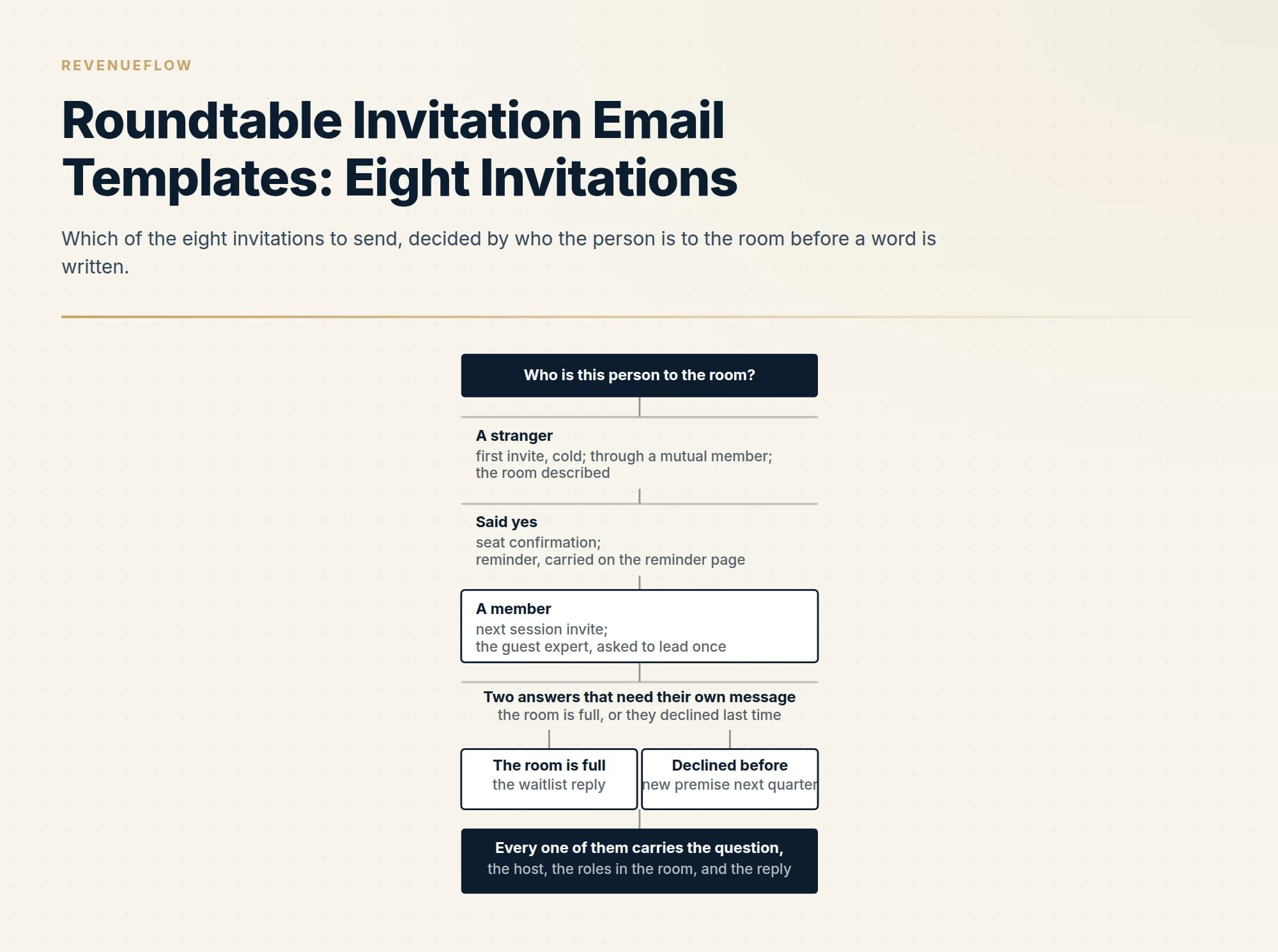
A roundtable invitation is a peer-to-peer message that carries the discussion question, the host and leader, the roles already in the room, the no-pitch format, the date and place, and a reply as the registration. Send the first invitation once, confirm a yes with a short call and a welcome, and re-invite a decliner next quarter with a new question.
Key takeaways
- Put the discussion question in the subject line and describe the room by role, so a peer decides on the topic and the company rather than on the host; names appear only where each person agreed to be named.
- Say in one sentence that the format is discussion with no presentation and nothing sold, and make the reply the registration; a register button and a recording promise turn the invitation into a webinar-shaped marketing send.
- Keep the seat count true and say how many chairs are left only because the number is real; a full room gets an honest waitlist reply that names the day it filled and offers the next date as a fact.
- Send the first invitation once and never remind a person who did not reply; a decliner is re-invited next quarter with a new question and a new room, while confirmations and reminders go only to the people who accepted.
Reviewed and updated September 18, 2026
Twelve chairs, one topic, no slides. A roundtable invitation asks a named person to spend two hours with peers they have not met, on a question they care about, in a room that only works if the right people accept. That makes it a different message from a webinar invitation, which fills seats for a broadcast and has its own templates page on this site, and from the conference dinner invitation, which is Template 8 of event outreach email templates. This page is the invitation set for the roundtable itself.
The format is defined in field marketing: a roundtable is a small room, the audience is a named list chosen in advance, and the guest list is the programme. Everything below follows from that. Every template is invented for this article, every person and company named in a worked example is invented, and none of them reports a result.
What a roundtable invitation has to carry
The publishers ranking for this search split into two groups. Clutch's page of executive roundtable invite templates, read on 18 September 2026, is written by an agency that runs them, and its opening judgement is the right one: "Running the email templates below at a massive scale is impossible" because "They are built for campaigns where you want particular accounts in the room". Its three templates each open with a personalisation line and name the discussion leader. The other group is event marketing: Pipedrive's event invitation samples, Mailtrap's six templates and twenty two subject lines, and iNevent's eleven invitation templates, all read the same day, are written for registrations at volume, with a register button and a reminder sequence behind it. Cura's site, fetched the same day, lists breakfasts and roundtables as a format of twenty to fifty attendees and executive dinners as ten to twenty five, which is the scale this page assumes.
A roundtable invite carries six things, in this order: the question the room will discuss, stated as a question that would interest this person on its own; who is hosting and who is leading the discussion; who else is in the room, by role, with names only where those people have agreed to be named; the format, which is discussion rather than presentation and carries no pitch; the date, time, place and length; and how to accept, which is a reply.
The worked example under template one is invented: Priya Vantrell at Brackenhall Freight, a freight and logistics firm, invited to a room on 14 October in Manchester alongside two founders who made the hire last year, a fractional sales leader and an operations director who inherited one, led by Tomas Reinholt, because she wrote in August that she was deciding between a hire and an agency. Three merge fields recur. {{first_name}} is the invitee. {{question}} is the discussion question, written as a question. {{roles_in_room}} is the list of roles already confirmed, such as two heads of revenue at logistics firms and a founder who sold last year, with no names unless each person has agreed. {{sender}} is a real person's name and role.
Eight invitations, each a complete message
1. The first invitation to a named peer
This is a cold message to somebody who does not know you, so it is one message, sent once, and it has to earn its reply on its own.
Subject: {{question}}
Hi {{first_name}},
We are hosting a roundtable for {{role}} at {{company_type}} on {{date}} at {{place}}: eight to ten of us, two hours, one question on the table: {{question}}.
Around it so far: {{roles_in_room}}. {{discussion_leader}} is leading, and there is no presentation and nothing being sold.
You came to mind because {{the_specific_reason}}. If you would like the seat, reply with a yes and we will send the details.
{{sender}}
Why it works: the subject is the question, so the reader decides on the topic rather than on you. Format, size, length and date come first, so the reader knows the commitment before the reason. The room is described by role, the format rules out a pitch in one sentence, and the reason they were chosen is specific and checkable, where a compliment in the same slot would be a lie. The reply is the registration: no form, no button, no deadline, which is the mechanism Clutch's page also recommends for executives reading on a phone.
To: Priya Vantrell, Brackenhall Freight. Subject: What does a first sales hire actually cost a founder-led firm?
We are hosting a roundtable for heads of revenue at freight and logistics firms on 14 October in Manchester: eight to ten of us, two hours, one question on the table. 1
Around it so far: two founders who made the hire last year, a fractional sales leader, and an operations director who inherited one. Tomas Reinholt is leading, and there is no presentation and nothing being sold. 2
You came to mind because you wrote in August that you were deciding between a hire and an agency. 3
If you would like the seat, reply with a yes and we will send the details. 4
- 1Format, size, length and date in one sentence, so the reader knows the commitment before the reason.
- 2The room by role, one named leader who agreed to be named, and the sentence that rules out a pitch.
- 3The specific, checkable reason this person was chosen; a compliment would be a lie in the same slot.
- 4A reply is the registration. No form, no button, no deadline.
2. The invitation through a mutual member
Subject: {{member_name}} suggested you for the {{date}} roundtable
Hi {{first_name}},
{{member_name}} sits in a roundtable we host for {{role}} and suggested you would add to the next one, on {{date}}. The question this time: {{question}}.
It is a small room, discussion only, and {{member_name}} will be there. If you would like the seat, reply and we will hold it.
{{sender}}
Why it works: the member's name is the whole premise, so it goes in the subject, and it is used only because the member agreed to be named. Everything else stays short because the trust is borrowed rather than built.
3. The invitation that describes the room
Subject: {{question}}: who is in the room
Hi {{first_name}},
The roundtable on {{date}} is about {{question}}, and the reason to come is who else has said yes: {{roles_in_room}}. Two of them have agreed to be named: {{named_guest_one}} and {{named_guest_two}}.
Ten seats, four left. Discussion, no slides. Reply if you want one.
{{sender}}
Why it works: for a peer who decides on company rather than topic, the room is the argument. Names appear only where consent exists, and the seat count is true, which is the only condition under which scarcity is honest.
4. The seat confirmation after a yes
Subject: Re: {{question}}: your seat on {{date}}
Hi {{first_name}},
Good. Your seat is held. Before it is confirmed, {{host_name}} will call you for fifteen minutes this week to hear what you would want from the room, which is how the discussion gets built around the people in it.
After that call you will get the calendar invitation and a short welcome note with how the sessions run.
{{sender}}
Why it works: it turns a yes into a seat with two visible steps, and it explains the short call as being for the room's benefit rather than a screening. This company runs peer roundtables of its own, and its practice is the policy this template describes: a seat is approved before it is added, the welcome carries how often the group meets, the next date and a library of past sessions, and the sessions carry no pitch and no vendors.
The reminder before the session is correspondence with somebody who already accepted, and the six reminder shapes are carried in meeting reminder emails; nothing on this page re-prints them.
5. The next-session invitation to a member
Subject: {{date}}: {{question}}
Hi {{first_name}},
Next session is {{date}}, same time. The question on the table: {{question}}, brought by {{member_who_raised_it}}, who is bringing {{the_thing_they_are_bringing}}.
You are on the invitation already. If you want to bring a peer who has lived this one, reply with a name and we will write to them.
{{sender}}
Why it works: a member owes nothing and is told nothing they need to do, only what the room will discuss and who is bringing what. The invitation to nominate a peer is how the list grows without a broadcast.
6. The capacity-full or waitlist reply
Subject: Re: {{question}}: the {{date}} room is full
Hi {{first_name}},
Thank you, and we are sorry: the {{date}} room filled on {{day_it_filled}}, and we would rather tell you than squeeze a thirteenth chair in.
You are first on the list for {{next_date}}, which is on {{next_question}}. If you would rather we did not hold that, say so and we will not.
{{sender}}
Why it works: the refusal is honest, it names the day the room filled so the scarcity was real, and the next seat is offered as a fact rather than as a consolation.
7. The re-invitation next quarter to somebody who declined
Subject: {{new_question}}
Hi {{first_name}},
The next roundtable for {{role}} is on {{date}}, and the question is one we think is closer to your desk than last time: {{new_question}}. {{roles_in_room}} have said yes.
Same shape as before: a small room, discussion, nothing sold. Reply if this one is worth the two hours.
{{sender}}
Why it works: it is a new message with a new question and a new room, not a reminder that they did not come last time. A person who declined has answered, and the only honest way back is a different premise.
8. The guest-expert invitation
Subject: Would you lead one discussion on {{question}}?
Hi {{first_name}},
We host a roundtable for {{role}}. On {{date}} the question is {{question}}, and you are the person we would most like to open it, because {{the_specific_reason}}.
Leading means ten minutes of your own view, then an hour of the room asking you things. No slides needed, and the group is {{roles_in_room}}.
Would you?
{{sender}}
Why it works: it asks for a specific, bounded thing, it says what leading actually involves, and it tells the expert who will be asking the questions, which is the reason a practitioner says yes.
The two panels below put the shapes side by side. The webinar-shaped invitation opens with the event name and date, lists learning outcomes, says seats are limited, and ends with a register button and a recording promise, so the reader learns what will be presented. The roundtable-shaped invitation opens with the question, names the roles and the leader, rules out a pitch and ends with a reply, so the reader learns who will be discussing what.
Webinar-shaped
Subject: You are invited! Join us for the Revenue Leaders Roundtable
Opens with the event name and date. Lists three learning outcomes. Says seats are limited. Ends with a register button and a promise of a recording.
The reader learns what will be presented and nothing about who else is in the room.
Roundtable-shaped
Subject: What does a first sales hire actually cost a founder-led firm?
Opens with the question. Names the roles already confirmed and the person leading. Says there is no presentation and nothing sold. Ends with a reply as the yes.
The reader learns who will be discussing what, and decides on that.
Subject lines: the question, the member, or the date
A roundtable subject line is doing one job: telling a peer what the room is about, or who vouched for it, before they open anything. Calendly's guide to meeting invitation emails, read on 18 September 2026, advises a subject line under nine words or sixty characters so it survives on every device, and the lines below keep to that.
They do not know you, so the question carries it:
- What does a first sales hire actually cost a founder-led firm?
- Which outbound channel do you cut first when pipeline is short?
- {{question}}: who is in the room
- Ten heads of revenue, one question, {{city}}, {{date}}
They know a member, so the member carries it:
- {{member_name}} suggested you for the {{date}} roundtable
- {{member_name}} is bringing this one: {{question}}
They are already in, so the date and the question carry it:
- {{date}}: {{question}}
- Re: {{question}}: your seat on {{date}}
- Re: {{question}}: the {{date}} room is full
- Would you lead one discussion on {{question}}?
The rule each group follows: nothing about being invited, nothing exclusive, nothing that would read as a marketing send in a preview pane. The question does the inviting.
Cadence: one invitation, then correspondence with the people who said yes
The invitation to a stranger is a cold message and gets the cold rule: one message per campaign, sent once. A yes means an agreement now exists, and from then on every message is correspondence: the confirmation, the reminder, the next session. No reminder is ever sent to somebody who did not reply.
Where we differ from standard practice
The event galleries plan a sequence around the invitation. iNevent's guide, read on 18 September 2026, answers how many emails to send for one event with at least three: the invitation, a reminder about a week before, and a last-chance message in the final day or two, with a save-the-date before the invite for a big event. Mailtrap's guide recommends automated workflows that deliver invitations, follow-up reminder emails and confirmations on a schedule. That is the market's practice for filling a broadcast, and it is described here rather than recommended.
For a roundtable we send the invitation once. A named peer who read it and did not reply has answered, and the field marketing page on this site says the same thing about invitations generally: the honest next move is a different campaign on a different premise, which for a roundtable is the next quarter's room and the next quarter's question. Reminders go only to people who accepted, because they are administering an agreement. The cost is that a person who meant to reply and forgot is lost until next quarter, and we accept it, because a reminder sent to a silent executive is the message that gets the whole series filed as marketing. The reasoning in full is in why we stopped using follow-ups.
What not to send
The webinar-shaped invitation. You are invited, join us, the event name first, three learning outcomes, a register button and a recording for those who cannot attend. It tells a peer they are being marketed to, and the recording line tells them attendance is optional.
"Exclusive" with no real capacity. A room that is exclusive has a number of chairs, and the invitation can say how many are left because the number is true. Without the number, the word is a marketing word.
Guests named without consent. The room by role is always safe. A name is used only when that person agreed to be named in invitations, because a peer who finds their name in a stranger's email has been used as bait.
A pitch inside the invitation. One sentence about what the host's company does is context. A paragraph about the host's product is a sales email with a dinner attached, and the reader can tell.
A broadcast list. Two hundred invitations to a twelve-chair room means either the room was never twelve chairs or the list was never a list of people who were wanted. Clutch's page is right that these emails cannot run at scale, and the list has to be built by hand for that reason.
The reminder to the silent. A second message to somebody who did not reply to the first is the bump this site does not send, whatever the calendar says.
- Yes: The question is written as a question and would interest this person on its own
- Yes: The roles already in the room are listed, and every name used has agreed to be named
- Yes: The format says discussion, no presentation, nothing sold
- Yes: The seat count is true and the reply is the registration
- Yes: The reason this person was chosen is specific and checkable
- No: A register button, a recording promise, or a reminder for people who did not reply
- No: A paragraph about the host's product inside the invitation
The list is the work
The invitation is the easy part once the list exists, and the list is where a roundtable succeeds or fails: the right roles, at companies you chose in advance, each with a checkable reason to be there. That is outbound work. If the part you would rather not build is the half that finds those people, see what a first campaign produces against the list you want in the room.
Frequently asked questions.
Frequently asked questions- How do you write an executive roundtable invitation email?
- Open on the question the room will discuss, written as a question. Name who is hosting and who is leading, list the roles already confirmed, say that the format is discussion with no presentation and nothing sold, give the date, place and length, and make a reply the registration. Add one specific, checkable reason this person was chosen. Keep it short enough to read on a phone.
- Should a roundtable invitation name the other guests?
- By role, always; by name, only when each named person has agreed to appear in invitations. The room described by role is the argument for attending, and it is safe to state. A peer who finds their own name in a stranger's email without having agreed to it has been used as bait, and the host loses both the invitee and the guest.
- How many times should I follow up on a roundtable invitation?
- Once is the whole campaign for somebody who does not know you. A named peer who read the invitation and did not reply has answered it, and the honest next approach is next quarter's room with a different question. Reminders are correspondence with people who already accepted, and those follow the meeting reminder shapes rather than the invitation.
- What is the difference between a roundtable invitation and a webinar invitation?
- A webinar invitation fills seats for a broadcast, so it leads with the event name, the learning outcomes and a register button, and it promises a recording. A roundtable invitation fills a small room of peers, so it leads with the question, describes who is in the room by role, rules out a pitch, and asks for a reply. The first can be sent to a list; the second is written to a named person.
About the author.

B2B cold email experts helping companies generate qualified leads through done-for-you outreach campaigns.
RevenueFlow Team
Explore more.
Ready to scale your outreach?
We build GTM engines that book real meetings. See the receipts.
Related articles.
Inbound Lead Reply Email Templates: Eleven First Replies
Eleven first-reply templates for an inbound lead, one per trigger: demo, pricing, form, download, trial, referral, event, chat, non-fit, out of hours, handover.
Multi-Threading Email Templates: Ten Second-Person Emails
Ten multi-threading email templates for the second and third people in a live deal: the user, the blocker, the economic buyer, the sceptic and more.
8 Meeting Reschedule Email Templates and When to Send Each
Eight meeting reschedule email templates for moving a booked sales meeting before it happens, from either side, each with the reasoning line by line.
9 Bump Email Templates and When to Send Each
Nine bump email templates for threads where the other side owes you something, the three checks that make a bump correspondence, and what never to send.
Customer Check-In Email Templates: Nine Check-Ins by Moment
Nine customer check-in templates for the account owner, one per moment: a closed escalation, a usage drop, a new leader, a release, pre-renewal, news and bad news.
Sample Cold Emails: Six Written to Be the Only One You Send
Most sample cold emails are step one of five, so they underperform alone. Six complete messages, what to change in each, and why the middle is the part to cut.