Vertical Go-to-Market Strategy: What Changes Below the Deck
Going vertical changes the list source, the proof, the problem sentence and the exclusions. Where those are unchanged, an industry filter has been applied instead.

A vertical go-to-market strategy commits a motion to one industry. Four things change: the list source becomes sector specific, the proof names a customer in the sector, the problem sentence uses the sector vocabulary, and the exclusions name sub-sectors where the problem is absent. Product and pricing usually do not.
Key takeaways
- A vertical is real when a sector-specific list source exists, the dominant objection differs from your general market, and you can name who signs and what procurement asks for.
- Count the market before committing. A narrow cut at an unchanged weekly volume exhausts its list in weeks, which is the constraint that bites before the message does.
- Build the list from the sector source rather than by filtering the general list. A trade body roster and a database industry tag rarely contain the same companies.
- Run it as one campaign with one message and read the replies rather than the rate. In a small market the rate is a noisy number over a small denominator.
Reviewed and updated August 28, 2026
A leadership team decides to go vertical and picks logistics. Six weeks later the only observable change is the word "logistics" in the subject line, the same list of anyone with an operations title, and the same case study about a fintech company. The strategy was announced. Nothing underneath it moved.
Going vertical is a set of concrete changes to the list, the proof, the message and the exclusions. Where those four do not change, the vertical exists in the deck and nowhere else, and the results will match the deck's contribution rather than the market's.
What actually changes, and what does not
The useful way to test a vertical decision is to name the artefacts it alters. Four change. Three do not, and pretending otherwise is where the cost overruns come from.
Naming those artefacts on paper is exactly what a founder should test against the room in the go-to-market slide breakdown, which lists the five lines any credible slide must carry.
- The list source: an industry directory, an association roster, a trade-body membership
- The proof: a named customer in that sector, or a specific mechanism you can describe
- The problem sentence: the sector's own words for the failure
- The exclusions: sub-sectors and company shapes where the problem is absent
- The product, at least at first
- The pricing model
- The motion and the channel capacity you can actually staff
The proof line is the one that decides whether the bet is real. A vertical claim without a customer in the vertical is a claim about intention, and buyers in tight sectors are unusually good at detecting it, because a message with the industry word pasted into it is a familiar thing to receive.
There is an honest version for a company with no sector customer yet. Describe the mechanism rather than the outcome: what you do, why the sector's specific constraint makes it relevant, and what you do not yet know. That is a weaker message than a named reference and a stronger one than a borrowed case study with the industry word swapped in.
The test that separates a vertical from a filter
Adding an industry filter to a list is not a vertical strategy. It is a filter, which is a perfectly reasonable thing to do and should be described as such.
A vertical is real when three things hold. Someone outside the team can build the target list from the definition, using a source specific to the sector. The objection you get is different from the objection you get elsewhere. And the buying process has a shape you can name: who signs, what procurement demands, what the seasonality is.
The middle one is the sharpest test. If the sector's buyers raise the same objections as everybody else, the sector is not a market segment for you. It is a label on a list, and the segmentation concept underneath that distinction is set out in the market segmentation entry.
- Yes: A sector-specific list source exists and you have seen it
- Yes: You can name a customer in the sector, or state honestly that you cannot
- Yes: The dominant objection differs from your general market
- Yes: You can name who signs and what procurement will ask for
- Yes: The sector has enough companies to support your weekly volume for a quarter
- Yes: Someone on the team can hold a ten-minute conversation in the sector's vocabulary
- No: The only change is an industry filter on the existing list
Count the market before you commit to it

Vertical bets fail quantitatively more often than they fail qualitatively. The message is fine. The market is too small to run the motion you planned.
The arithmetic below is invented for illustration and describes no client. Suppose the general definition matches forty thousand companies and the vertical cut leaves nine hundred. At four hundred contacts a week, the general list lasts most of a year and the vertical list is exhausted in nine weeks, counting one contact per company. Two contacts per company buys eighteen weeks. That is the real constraint, and it arrives long before anybody has read a result.
Three consequences follow from that shape. The vertical needs either a wider geography or a second buying role inside each company to sustain a quarter. The message has to be better, because you get one pass rather than five. And the campaign calendar matters, because in a small market everyone eventually talks to everyone.
Illustrative figure
Illustrative figure
One contact per company, invented arithmetic
That constraint is also the argument for treating the vertical as a test with a stated end date rather than a repositioning. A quarter is long enough to read replies and short enough that a wrong sector does not cost a year.
How to run the test
One vertical, one campaign, a single message. The comparison you want is between sectors, and it only exists if the sectors are not sending the same thing.
Build the list from the sector-specific source rather than by filtering the general list, because the source is part of what you are testing. A trade association roster and a database industry tag rarely contain the same companies, and the difference between those two populations is frequently the whole result.
Write the first line from the sector's own vocabulary. The strongest opening in a vertical campaign names a situation that only occurs in that sector, which is why the persona and problem work has to come before the send rather than after it. The five decisions this sits inside, and the test that finishes each one, are in the go-to-market strategy guide, and the company-level criteria that decide who enters the list are in the ideal customer profile guide.
Read the replies rather than the reply rate. In a market the size of the illustration above, the rate is a noisy number over a small denominator, while the content of ten replies will tell you whether the objection is the one you predicted. Early-stage teams face exactly this problem when the segment is still a hypothesis, and the approach that fits is described in startup lead generation.
Then let the campaign end. We run a single message per campaign and we do not send bumps. A second angle in the same sector becomes a new campaign with a new first line, built from the same list minus the people who replied. That structure also keeps the comparison clean, because each angle has its own result rather than a result blended across a sequence.
When to go vertical, and when it is a mistake
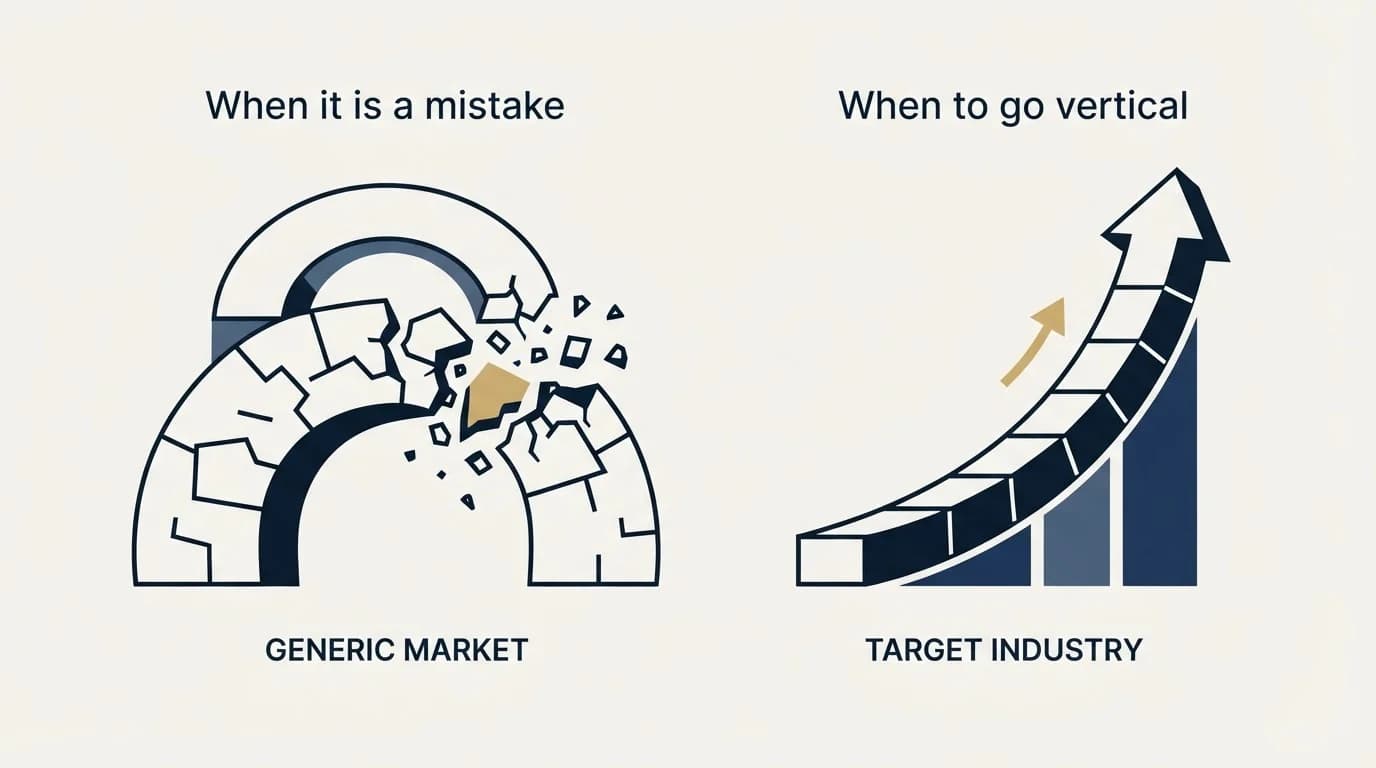
Three conditions make the bet sensible. Your existing customers already cluster in a sector without anyone having planned it, which is evidence rather than ambition. The sector has a shared, nameable constraint that your product addresses. And you can reach the people who buy in it, through a list source that exists.
Two conditions make it a mistake. The first is going vertical to escape a message problem: a weak general message becomes a weak sector message with jargon in it. The second is going vertical before the general motion works at all, which removes the volume you need to learn anything while adding vocabulary you do not have.
The second-vertical decision deserves as much scrutiny as the first. Two verticals mean two lists, two messages, two proof sets and two objection scripts, and a team of three cannot hold both without one of them quietly reverting to the general message. Where the motion itself is being chosen rather than the market, that is a separate and prior decision, and the practical layer beneath it is covered in the outbound sales playbook.
Horizontal and vertical are a capacity question
The debate usually gets conducted as a matter of identity, with one side arguing that focus wins and the other that a horizontal product should stay horizontal. Both positions are answerable with the same question: how many distinct messages can this team build, send and read in a quarter.
A horizontal motion sends one message to a broad definition and accepts that it fits nobody exactly. A vertical motion sends a specific message to a narrow definition and accepts that the list is finite. Neither is inherently stronger. The failure comes from choosing the vertical shape while retaining the horizontal volume target, which forces the list to widen until the specificity that justified the bet has gone.
Deciding between that broad or narrow shape only matters once the underlying system is fixed, and choosing a repeatable acquisition motion is the commitment that decision sits on top of.
The version that survives contact with a quarter names the volume first. Decide the weekly capacity you can genuinely run with the people you have, then choose the number of verticals that capacity supports, which for most teams under ten people is one.
What breaks in month three

The predictable failures are organisational rather than strategic.
Sales reverts to the general pitch, because it is the one they can deliver without preparation. The fix is a single sector call script with the sector's objection in it, not a training session about commitment.
The list runs out faster than anyone forecast, and someone widens the definition to keep volume up, which quietly ends the experiment while the label stays. If the vertical needs widening in week six, that is a result worth recording rather than a problem to be papered over.
The proof stays generic because the first sector customer has not landed yet, so every message carries a case study from another industry. That is the hardest one, and the honest mechanism description is a better answer than a borrowed logo.
The short version
A vertical go-to-market strategy changes four artefacts: the list source, the proof, the problem sentence and the exclusions. Where those are unchanged, an industry filter has been applied and a strategy has not.
That test also settles the wider question of whether lead generation techniques differ by industry. The techniques that genuinely differ by industry are the list source, the reachable channel and the buying process, all of which are properties of the market rather than of a playbook. What does not differ is the order of the decisions or the mechanics of the send. A firm documenting best practice by sector is usually recording those three, which is worth doing, and it produces a sourcing note rather than a different method.
Test it before committing. A sector-specific list source, a different dominant objection, a nameable buying process, and enough companies to sustain your weekly volume for a quarter. Count the market first, because the runway arithmetic bites well before the message does.
Run it as one campaign carrying a single message, built from the sector's own list source and written in the sector's own words, and read the replies rather than the rate. Let it end on its stated date, and treat a second angle as a new campaign rather than a follow-up.
If the vertical you are considering is one you could test with a single well-built list this month, that is usually the cheapest way to find out whether the objection is really different. You can see what a campaign would look like for your market.
Frequently asked questions.
Frequently asked questions- What is a vertical go-to-market strategy?
- It is a decision to aim a motion at one industry, expressed as four concrete changes: a sector-specific list source, proof from inside the sector, a problem sentence in the sector vocabulary, and exclusions naming the parts of it where the problem does not exist. Without those changes, only an industry filter has been added.
- How is vertical different from horizontal go-to-market?
- A horizontal motion sends one message to a broad definition and fits nobody exactly. A vertical motion sends a specific message to a narrow definition and accepts a finite list. The choice is a capacity question: how many distinct messages a team can build, send and read in a quarter, which for small teams is usually one.
- When should a company avoid going vertical?
- When the general motion does not work yet, because the vertical removes the volume needed to learn anything while adding vocabulary the team does not have. Also when the move is an escape from a weak message, since a weak general message becomes a weak sector message with jargon added to it.
- What if we have no customer in the vertical yet?
- Describe the mechanism instead of borrowing a case study from another industry. Say what you do, why the sector specific constraint makes it relevant, and what you do not yet know. Buyers in tight sectors see that pasted-in industry word often and are unusually good at spotting it, so an honest gap beats a borrowed logo.
About the author.

B2B cold email experts helping companies generate qualified leads through done-for-you outreach campaigns.
RevenueFlow Team
Explore more.
Ready to scale your outreach?
We build GTM engines that book real meetings. See the receipts.
Related articles.
Appointment Setting for Business Brokers: The Seller Meeting
What a bought meeting with a business owner has to be for a brokerage: the three-part qualification, the confidentiality rules, the licence line and the owner's reasons.
SDR Outsourcing for Logistics Companies: The Brokerage Line
What an outside sales development team may do in a freight company's name, the calling and email rules it inherits, and which arrangement survives a bid-shaped market.
SDR Outsourcing for Business Brokers: The Fee Timing
Whether a success-fee brokerage should rent sales development at all: the fee timing, the texts that limit what an outside person may say about value, and who signs.
Cold Calling for Chemical Companies: Who Picks Up
A chemical cold call rarely arrives first. It reaches a formulator who has already been comparing suppliers on a screen, for one of three published reasons.
Cold Calling for PPC Agencies: What You Can See First
A paid media prospect is partly readable before the call and has already been told by the platform what to do when a stranger rings about its ads.
SDR Outsourcing for Financial Services: The Third Party
What a bank, broker-dealer, adviser or agency's regulators say about an outside team that speaks for it, the licensed line, and which arrangement survives due diligence.