Startup Lead Generation When the ICP Is Still a Hypothesis
Early outbound does two jobs on one budget: producing conversations, and finding who the customer is. Building the first list so the result can name a winner.
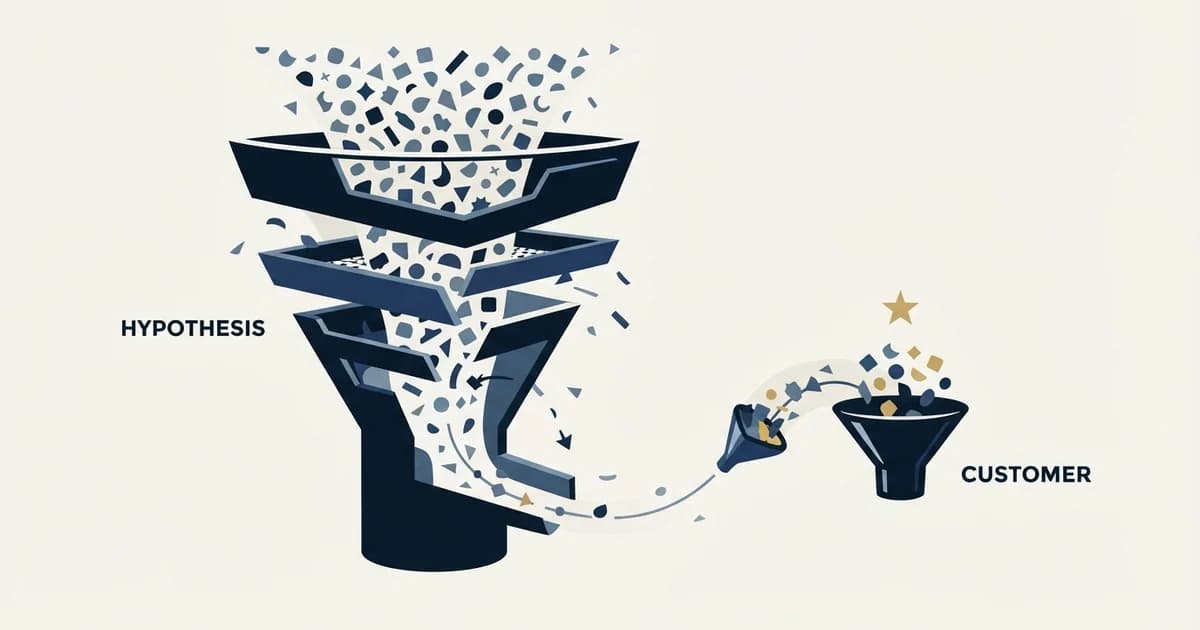
At startup stage the ideal customer profile is a hypothesis, so build the first list as separated groups testing different theories rather than one blended batch. Keep the campaign small enough that a wrong answer is recoverable, send from warmed separate domains, and read the replies rather than the reply rate.
Key takeaways
- A blended list producing a weak result teaches nothing, while separated groups producing the same total still name which theory failed.
- Mechanism substitutes for case studies, the founder substitutes for brand, and nothing substitutes for domain warming.
- At startup scale the market is finite, so a badly aimed campaign spends a meaningful share of the only audience you have.
- The moment to hand outbound over is when three consecutive campaigns stop changing your answers, not when it becomes tedious.
Reviewed and updated August 28, 2026
A startup running lead generation is doing two jobs with one budget, and only one of them is on the plan. The stated job is producing conversations that turn into revenue. The unstated job is finding out who the customer actually is, because at this stage the ideal customer profile is a hypothesis somebody wrote in a deck rather than a fact anybody has verified.
Almost every piece of startup lead generation advice ignores the second job, which is why the advice reads well and produces so little. It assumes the target is known and the problem is reach. For most startups the target is a guess and the problem is that the guess is expensive to test badly.
Your list is an experiment before it is a list
Treat the first few hundred companies you contact as a set of deliberate bets rather than as a batch.
That means building the list in visibly distinct groups. Not one list of four hundred companies that broadly fit, but four groups of a hundred that differ on one axis you actually care about: company size, or whether they have a specific role on staff, or which system they run, or which segment they sell into. Each group gets a message written for it.
An agtech startup draws those groups by crop, farm size class and channel, and the census, the crop calendar and the retailer and co-op channel that draw them are in B2B sales for agtech startups.
The point is that a result you cannot decompose teaches you nothing. A single blended list producing a handful of replies tells you the campaign was mediocre. Four distinguishable groups producing the same total tells you which of your four theories about the customer has any life in it, and that answer is worth more than the meetings.
A separate concern once the ICP stops being a hypothesis is how HubSpot splits fit from engagement scoring, and which subscription tier unlocks it.
- 400 companies that broadly fit
- One message, lightly varied
- Produces a reply rate
- A weak result is uninterpretable
- Next round repeats the same guess
- 4 groups of 100, differing on one axis
- A message written for each group
- Produces four reply rates
- A weak result still names the loser
- Next round narrows on evidence
What you do not have, and what to do about each gap
A startup arrives at outbound missing four things a larger company takes for granted. Each has a workable substitute and none of the substitutes is the thing itself.
No case studies. The substitute is specificity about the mechanism. You cannot say a named client got a result, and you can describe precisely how the thing works and what it replaces. A prospect evaluating an unknown company is trying to decide whether you understand their problem, and a detailed grasp of the problem is a form of proof.
No brand. The substitute is the founder. A message from a founder is read differently from a message from a sales development rep at a company nobody has heard of, and at this stage the founder is genuinely the most credible sender you have. This is temporary and worth using while it is true.
No domain history. The substitute is patience, and this is the one startups most often skip. A domain with no sending history that begins mailing strangers at volume gets filtered, and the damage lands on the company domain you also use for investor mail and customer support. Send from separate domains, warm them first, and accept the weeks that costs.
No idea what the objection will be. There is no substitute. You find out by talking to people, which is an argument for the phone earlier than the volume-first advice suggests.
Volume is the wrong first dial
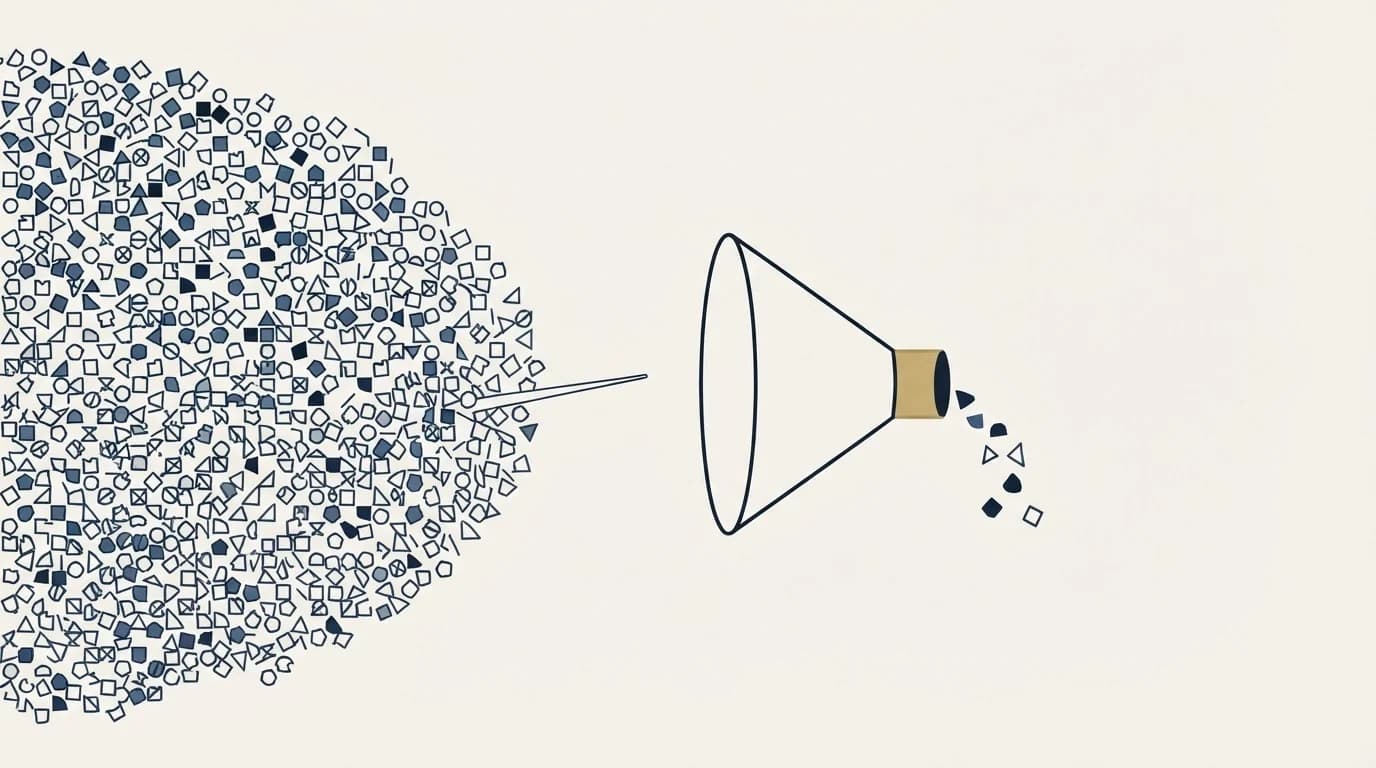
The instinct is to get to scale fast, on the theory that outbound is a numbers game and the numbers need to be large. That is true once the message is right and actively harmful before it is.
Sending a wrong message to five thousand people burns the addresses, the domain and the segment simultaneously. The people are not renewable at startup scale; if your total market is four thousand companies, a bad first campaign has spent a meaningful fraction of the only market you have. The company with twenty thousand accounts to work through can afford to learn in public. You cannot.
Start small enough that a bad result is recoverable and slow enough that you can read what happened. Scale the volume after the message has produced replies you did not have to squint at.
- Step 1Count your real market
How many companies could genuinely buy this, not the TAM slide
- Step 2Spend a small fraction
Enough for a readable signal, little enough to be recoverable
- Step 3Split by hypothesis
Separate groups so the result decomposes
- Step 4Read the replies, not the rate
Twelve words of objection beat a percentage
- Step 5Scale the winner
Volume after the message works, never before
Where the first list comes from when you have no data
Startups routinely stall here, because the tooling advice assumes a budget and a defined segment and you have neither. Three sources cover almost every early case and none of them requires a platform contract.
The companies your first users came from. Even a handful of customers or design partners describes a shape: the size, the sector, the system they had already bought, the role that championed it. Building a list of companies that resemble them is the highest-yield thing you can do on day one, and it needs a spreadsheet rather than a data vendor.
Public lists that imply the qualifying condition. Association member directories, conference exhibitor lists, permit and licensing registers, review-site categories, job boards where a posting implies the problem exists. These are unglamorous and they are precise, because membership of the list is itself the qualification.
Where a qualifying condition must be visible before spending anything, tracking HR buying windows through hiring signals shows how renewal timing can be approximated without insider access.
Companies that visibly have the problem. If your product addresses something observable from outside, the observation is the list. A missing capability on a website, a system detectable in a page, a role advertised repeatedly, a location count that crossed a threshold.
What all three share is that the qualifying condition is visible before you spend anything, which is what lets the first campaign carry a specific premise instead of a generic one. Buying a broad contact file inverts that: you get volume first and have to invent a reason for the message afterwards, which is the origin of most bad early outbound.
Read the replies, not the reply rate

At startup volumes the reply rate is a number computed from too few events to mean much, and teams read enormous significance into the difference between two of them.
The replies themselves are the asset. A prospect writing back to say they already solved this with a spreadsheet has told you something a percentage cannot. Five people misreading what you sell the same way is a positioning finding. Someone forwarding you to a role you had not considered is a targeting finding worth more than the meeting they declined.
This is the actual justification for outbound at the earliest stage, and it is why doing it in house first is usually right even when outsourcing is affordable. The learning has to land with the people who can change the product and the pitch. Once the answers are known and the job becomes throughput, the calculation about where the learning should live changes.
What we would not recommend
We send one message per campaign, built on one premise, sent once. For a startup that constraint does more work than it does for anyone else.
The obvious reason is that your market is small and your domain is new, so persistence against silence costs a scarce resource to buy a marginal chance. The better reason is experimental. When a person receives one message on one premise, their non-response is attributable to that premise. When they receive several messages carrying different arguments, you have contaminated the only clean signal you were going to get, and the result cannot tell you which theory failed.
A different premise later is a separate campaign against a fresh selection, and it produces a second clean reading rather than a muddied one.
- Yes: Sending from a domain that is not the company's main domain
- Yes: The list splits into groups that test different theories
- Yes: The founder is the sender while that still means something
- Yes: The size is a small fraction of the total reachable market
- No: Waiting for a case study before starting
- No: Scaling volume before any message has produced real replies
When to hand it over, and to whom

The point to stop doing it yourself is not when it becomes tedious. It is when the answers stop changing.
While every campaign teaches you something about who buys and why, the founder or an early commercial hire should run it, because the value is arriving as understanding rather than as meetings. Once three consecutive campaigns produce the same profile, the same objection and the same winning premise, the job has become execution and somebody whose whole role is execution will do it better.
Two adjacent situations are commonly confused with this one and are genuinely different. A one-person business selling a service has a different constraint set entirely, and what one person can realistically run is the more useful frame there. A funded company selling software has an arithmetic that turns on contract value, and where the motion flips by deal size matters more than stage does.
The short version
Treat early outbound as an experiment that happens to produce meetings. Split the list by the theories you hold about the customer so the result can name a winner. Substitute mechanism for case studies, the founder for brand, and separate warmed domains for sending history, since there is no substitute for the last one.
Keep the first campaign small enough that being wrong is recoverable, because at startup scale the market is finite and a burned segment does not come back. Read the replies rather than the rate. Send once per premise so the non-responses stay interpretable. Hand the work over when it stops teaching you anything, and not before.
If you want a first campaign built and run against your market while you keep the learning, we will run one and hand you what comes back.
Frequently asked questions.
Frequently asked questions- How many prospects should a startup contact first?
- A small enough fraction of your real reachable market that being wrong is recoverable, and large enough that the result is readable. If four thousand companies could genuinely buy, a first campaign into five thousand addresses is not ambitious, it is spending the entire market on one untested message. Size against your market rather than against a target.
- Should the founder send the cold emails?
- Early on, yes. A message from a founder is read differently from one sent by a sales development rep at a company nobody has heard of, and that advantage is real while it lasts. It is also the founder who needs to hear the objections, since the value arriving at this stage is understanding rather than meetings.
- Can a startup do outbound without case studies?
- Yes, by substituting specificity for social proof. You cannot say a named client got a result, and you can describe precisely how the thing works and what it replaces. A prospect assessing an unknown company is trying to work out whether you understand their problem, and a detailed grasp of that problem functions as evidence.
- When should a startup outsource lead generation?
- When the answers stop changing. While every campaign teaches you something about who buys and why, the learning has to land with the people who can change the product and the pitch. Once three consecutive campaigns return the same profile, the same objection and the same winning premise, the job has become execution and a specialist will run it better.
About the author.

Ben Carden is CRO at RevenueFlow, which builds and operates outbound revenue engines for B2B companies. Previously at Gartner Enterprise. Studied at London School of Economics.
Ben Carden · CRO
Connect on LinkedIn →Explore more.
Ready to scale your outreach?
We build GTM engines that book real meetings. See the receipts.
Related articles.
5 ABM Campaign Examples and How Each One Is Built
Five worked account-based campaign examples, each built on the same five fields: account set, tier, plays in order, owner and handoff, and the exit condition.
Field Marketing in B2B: What a Programme Costs Per Meeting
Two different practices answer to the name field marketing. The B2B one runs dinners and roadshows for named accounts, and it divides like any other channel.
Average Landing Page Conversion Rate: What It Measures
Four published answers to one question span more than four to one. What each dataset actually counted, and why none of them applies to a page fed by cold outbound.
Two Agencies, One Target List: Who Owns Which Accounts
Two outbound suppliers on one market will contact the same companies unless the buyer splits it first. How to cut the list, run the exclusion feed and check the overlap.
Define Content Syndication: Two Purchases Behind One Word
One budget line, two different purchases. Republication buys reach; lead syndication buys contact records produced by a download. The deliverable tells you which.
Last Outbound Agency Did Not Deliver: Locating the Failure
The leads were bad names a symptom and no stage. Four places an outbound engagement fails, the counts that separate them, and what to change in the next purchase.