Go-to-Market Motion: Pick One and Fund It Properly
Four motions at a quarter of the budget each is not balance. It is four routes that never reach the volume at which their own economics become readable.

A go-to-market motion is the repeatable route by which a company acquires a customer: who initiates, through what channel, with how much human involvement, at what cost. It names a system rather than a tactic, so adding one is an organisational commitment with its own cost structure, headcount shape and asset base.
Key takeaways
- Each motion has a precondition that decides whether it is available at all: outbound needs a definable segment with enough companies, product-led needs value delivered before a human conversation, partner-led needs a partner whose customers already have the problem.
- A partnership agreement creates permission rather than motion, because nothing in a signed agreement gives a partner's individual seller a reason to spend a call on your product instead of their own quota.
- Every motion has a threshold volume below which its outputs are noise, and below it a motion does not produce a small result, it produces an unreadable one.
- Switching motion is a rebuild rather than a reallocation, because list definitions, sending infrastructure, onboarding instrumentation and partner enablement do no work for each other.
Reviewed and updated September 2, 2026
Go-to-Market Motion: Pick One, Fund It Properly, and Name What Would Kill It
A board deck lists four go-to-market motions and assigns each of them a quarter of the budget. Everyone in the room reads that as balance. What it actually describes is four motions, none of which will reach the volume at which its own economics become visible, running simultaneously for long enough that when the year ends nobody can say which of them worked.
A go-to-market motion is the repeatable route by which a company acquires a customer: who initiates, through what channel, with what human involvement, at what cost per acquisition. The word matters because it names a system rather than a tactic. A tactic can be added to a quarter. A motion has a cost structure, a headcount shape and a set of assets behind it, and adding one is an organisational commitment rather than a line item.
Lists of go-to-market approaches usually name nine or ten of them; the four below are the ones that differ in what they cost to staff, which is the only difference that decides anything.
A go-to-market channel is the visible half of a motion, and choosing one runs the same way: contract value, list size and time to evidence rule channels out before preference rules any in.
A go-to-market model and a go-to-market motion both name the same thing: the repeatable route by which a customer is acquired, with its cost structure and headcount shape attached.
The lists that enumerate types of go-to-market strategy are mostly naming these same motions, and the count varies with how finely somebody splits partner-led and product-led.
The motions, described by what they require rather than what they are called
Most taxonomies list between five and nine. The differences between them are mostly naming. What is worth attending to is the precondition each motion has, because that is what decides whether it is available to you at all.
- Precondition: a definable segment with enough companies in it
- Cost is people and data, and it scales roughly linearly
- Produces conversations in weeks
- Fails when the addressable list is small or undefinable
- Precondition: value delivered before a human conversation
- Cost is engineering, front-loaded and largely fixed
- Produces compounding volume over quarters
- Fails when the product needs configuration to be useful
- Precondition: a partner whose customer already has the problem
- Cost is relationship management plus margin given away
- Produces trust you did not have to build
- Fails when the partner's rep has no reason to prioritise you
Two further motions sit alongside those three and are worth naming even though they resist a clean column. Content and community-led acquisition, where an audience is assembled around a topic and a fraction of it converts, has the lowest cost per customer and the longest time to first customer of any route. And founder-led sales, which is not a permanent motion but is the correct one for almost every company at the start, because it is the only route where the person selling can change the product in response to what they hear.
Partner-led, which is a motion rather than a favour
Partner-led go-to-market gets discussed as though it were free distribution, and it is the motion most often adopted without its cost being counted. A go-to-market partnership takes several forms, and they differ more than the shared label suggests.
Hiring outside help to run any of these motions raises a separate question worth settling first: what a go-to-market agency actually sells you.
Referral. A partner points customers at you and takes a fee or nothing at all. Cheap to start, unpredictable in volume, and almost never a plan on its own.
Co-sell. Both companies' sellers work an account together. This is the highest-value form and the most operationally demanding, because it requires two sales organisations with different quotas, cycles and comp plans to sequence their work.
Reseller and channel. The partner sells your product as part of theirs, which means margin is given away permanently in exchange for a route you do not have to build.
Marketplace. A platform lists you and handles part of the transaction, which converts distribution into a discovery problem inside somebody else's catalogue.
The failure mode is the same across all four, and it is worth stating plainly: a partnership agreement creates permission, not motion. The partner's individual sellers have their own quota, and nothing in a signed agreement gives them a reason to spend a call on your product rather than on the thing that pays their commission. Partner-led programmes that work do the unglamorous thing, which is to make it easier and more rewarding for one named person at the partner to bring you into a deal than to not. Programmes that fail have an agreement, a launch announcement and a shared folder.
The honest read for most companies under a certain size is that partner-led is a second motion rather than a first one, because it depends on a partner believing you can serve the customers they send, and that belief is usually built on the results of a first motion. It also needs a person whose job it is, and a partner programme owned by somebody part-time is the most reliable way to get an agreement without a pipeline.
Choosing, which is mostly ruling out

The choice is more constrained than it looks, and three inputs do most of the ruling out.
Contract value. What a customer is worth caps how much human attention a deal can absorb, which removes whole motions from consideration at low price points and removes self-serve at high ones.
Capacity forces the same kind of ordering inside a segment, and ranking companies that all passed the profile decides which accounts a team works first.
List size. An outbound motion needs a segment large enough that contacting it takes longer than a couple of months. When the entire addressable market is a few hundred accounts, volume stops being the lever and the answer looks like named-account work, partner introductions, or a founder in rooms.
Time to evidence. Content and partner motions report back in quarters. Outbound reports back in weeks. A company whose runway is measured in months has one instrument available whatever the long-run economics say.
- Step 1Write down contract value
It caps acquisition cost, which caps human involvement per deal, which is what a motion is. This removes rows from the table before any preference is expressed.
- Step 2Count the addressable list
If a data provider cannot return a count, the segment is not defined yet. If the count is small, volume-based motions are already out.
- Step 3State how long you have
Time to first evidence is a hard constraint, not a preference. Name the date by which something has to be observable.
- Step 4Fund one motion to its threshold
Every motion has a volume below which its economics are invisible. Funding two below threshold produces two unreadable results.
The fourth step is the one boards resist, because concentrating the budget feels like concentrating the risk. It concentrates the information instead. One motion funded to the point where its numbers mean something produces a decision at the end of the quarter. Two motions at half funding produce an argument.
Because concentrating funding still leaves the question of order unanswered, sequencing a go-to-market plan explains how to set exit conditions and a readable window for the first result.
The half-funding trap, stated precisely
Every motion has a threshold volume below which its outputs are noise. Outbound at a few hundred touches a month cannot distinguish a bad segment from a bad message, because the reply counts at that volume are small enough that ordinary variation swamps the difference. Content at one post a month cannot distinguish a topic that does not land from a schedule too sparse to compound. Partner-led with two partners cannot distinguish a broken programme from two badly chosen partners.
Below threshold, a motion does not produce a small version of its result. It produces an unreadable one, and the team then makes a judgement call and calls it data. This is the specific mechanism behind the observation that teams reach for more tools and more channels when the honest fix is to run fewer things properly, which stop overengineering your GTM makes the broader case for.
Switching motions, which is a rebuild rather than a pivot
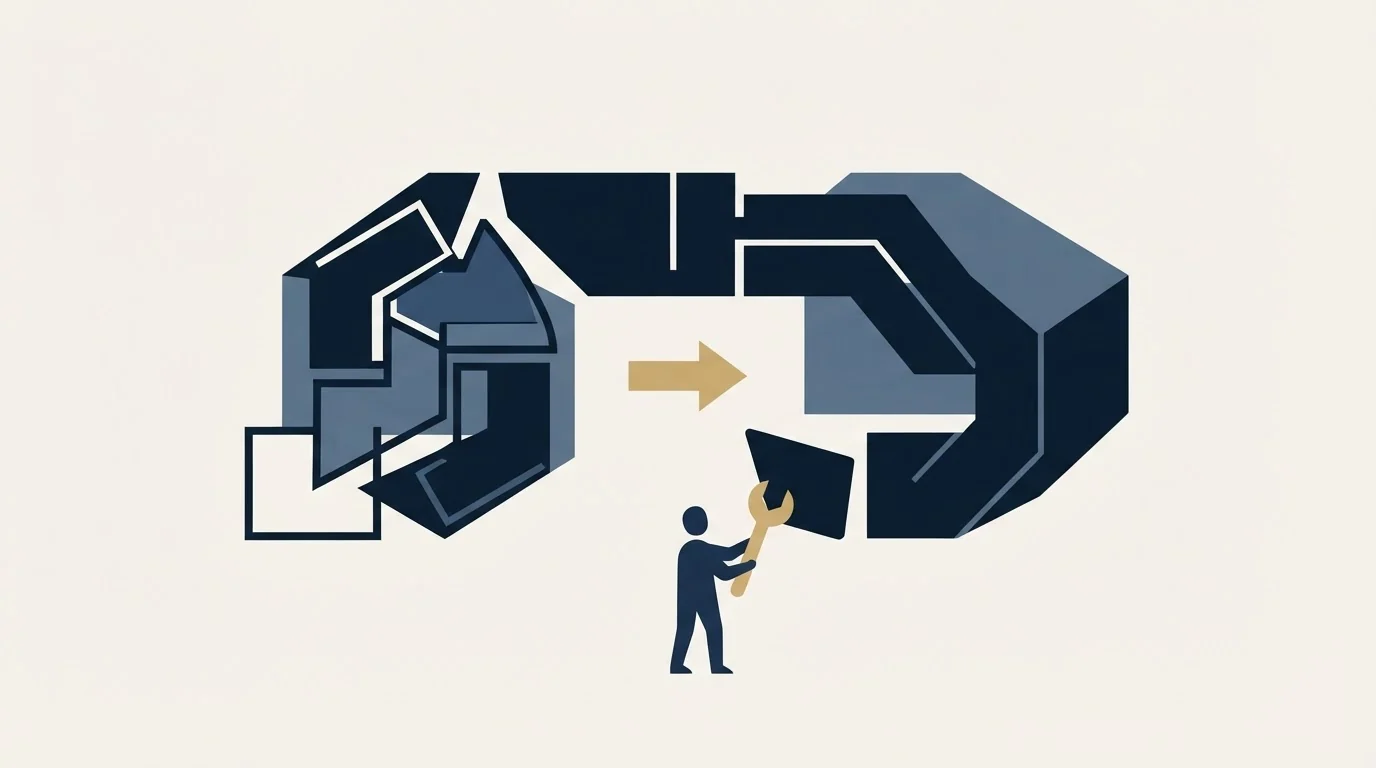
Teams talk about changing motion as though it were a reallocation. It is closer to starting a second company inside the first one, because the assets a motion runs on are not transferable. Outbound is built on list definitions, sending infrastructure, domain reputation and reply handling. Product-led is built on onboarding, instrumentation and a pricing surface a stranger can navigate. Partner-led is built on relationships and enablement material. None of those three asset sets does any work for the other two.
The consequence is that the cost of switching is dominated by the time to build the new asset base, not by the decision. A company that decides in January to move from sales-led to product-led has not made a January change; it has committed engineering capacity for two or three quarters and will keep paying for the old motion throughout, because revenue has to keep arriving while the new one is built.
That is an argument for choosing carefully rather than for never changing. It is also an argument against running a motion at half funding on the theory that it can be scaled up later if it looks promising, since the half-funded version produces neither the result nor most of the assets.
Naming the kill condition
A motion adopted without a stopping condition becomes permanent by default, because there is never a natural moment to end something that was never given an end test. The condition should be written before launch, name a number and a date, and be specific enough that it cannot be argued away in the meeting where it triggers.
Useful conditions look like a floor on the leading indicator rather than a ceiling on cost. For outbound, a reply volume below a stated number after a full cycle at full volume. For partner-led, a count of partner-sourced conversations rather than a count of signed agreements, since agreements are the thing that accumulates while nothing happens. For content, a specific inbound count from the target segment rather than traffic.
The point is not pessimism. A motion with a written kill condition can be funded more aggressively, because the downside is bounded by a decision that is already agreed rather than by whoever has the energy to argue in month nine.
Where the motion sits in the plan

The motion is one line on the one-page artefact a go-to-market strategy should produce, and it is downstream of the segment. Choosing a channel before defining who is in the target set is the most common ordering mistake, and it produces a motion optimised for reaching people whose fit was never established. The segment definition that makes the count possible is the same one an ideal customer profile is supposed to deliver.
Where the honest answer is that demand does not exist yet rather than that you are failing to reach it, the motion question is premature and the demand generation versus outbound distinction is the one to settle first.
Within the outbound motion specifically, our own operating policy is one message per campaign, with no bumps and no thread replies. Re-approaching an account that did not reply happens as a new campaign with a different angle, normally triggered by something that changed at that account, rather than as a follow-up underneath the original message.
The short version
A motion is a cost structure and a headcount shape, not a channel on a slide. Let contract value, list size and time to evidence rule motions out before preference rules any in. Treat partner-led as a real motion with an owner and a cost rather than as free distribution. Fund one route past the threshold where its numbers mean something, and write the kill condition down before launch so the quarter can settle it. If the route the constraints point at is outbound and the missing piece is capacity, we run that motion with qualification criteria agreed in writing before anything sends.
Frequently asked questions.
Frequently asked questions- What is a go-to-market motion?
- The repeatable route by which a company acquires a customer, defined by who initiates contact, through which channel, with how much human involvement, and at what cost per acquisition. It describes a system rather than a tactic, which is why adding one commits headcount and assets rather than a line of budget.
- What are the main go-to-market motions?
- Sales-led outbound, where you initiate. Product-led, where the product initiates by delivering value before a conversation. Partner-led, where someone else initiates through referral, co-sell, reseller or marketplace arrangements. Content and community-led, which has the lowest cost per customer and the longest time to the first one. Founder-led selling sits alongside these as the correct starting motion for most companies.
- How do you choose a go-to-market motion?
- Mostly by ruling out. Contract value caps how much human attention a deal can absorb. Addressable list size decides whether volume is a lever at all, since a few hundred accounts rules out volume-based routes. Time to first evidence is a hard constraint, because content and partner motions report back in quarters while outbound reports back in weeks.
- Why do partner-led programmes fail?
- Because an agreement is treated as distribution. The partner's individual sellers carry their own quota, and nothing in a signed contract makes your product the best use of their next call. Programmes that work make it easier and more rewarding for one named person at the partner to bring you into a deal. Programmes that fail have an agreement and a shared folder.
About the author.

B2B cold email experts helping companies generate qualified leads through done-for-you outreach campaigns.
RevenueFlow Team
Explore more.
Ready to scale your outreach?
We build GTM engines that book real meetings. See the receipts.
Related articles.
Appointment Setting for Business Brokers: The Seller Meeting
What a bought meeting with a business owner has to be for a brokerage: the three-part qualification, the confidentiality rules, the licence line and the owner's reasons.
LinkedIn Outreach for Banks: A Regulated Message
How a bank's relationship managers use LinkedIn to reach business owners: what the FFIEC guidance, FINRA's notices and LinkedIn's own rules require, and where to stop.
SDR Outsourcing for Logistics Companies: The Brokerage Line
What an outside sales development team may do in a freight company's name, the calling and email rules it inherits, and which arrangement survives a bid-shaped market.
SDR Outsourcing for Business Brokers: The Fee Timing
Whether a success-fee brokerage should rent sales development at all: the fee timing, the texts that limit what an outside person may say about value, and who signs.
B2B Lead Lists for Aviation Companies: Build or Buy
Aviation is one of the few industries whose accounts are published by its regulator, which changes what is worth buying and what is worth downloading yourself.
Cold Calling for PPC Agencies: What You Can See First
A paid media prospect is partly readable before the call and has already been told by the platform what to do when a stranger rings about its ads.