The Go-to-Market Slide: Five Lines the Room Will Test
The slide where a deck stops describing and starts committing. Five checkable lines, the arithmetic the room is waiting for, and what a logo grid gives away.
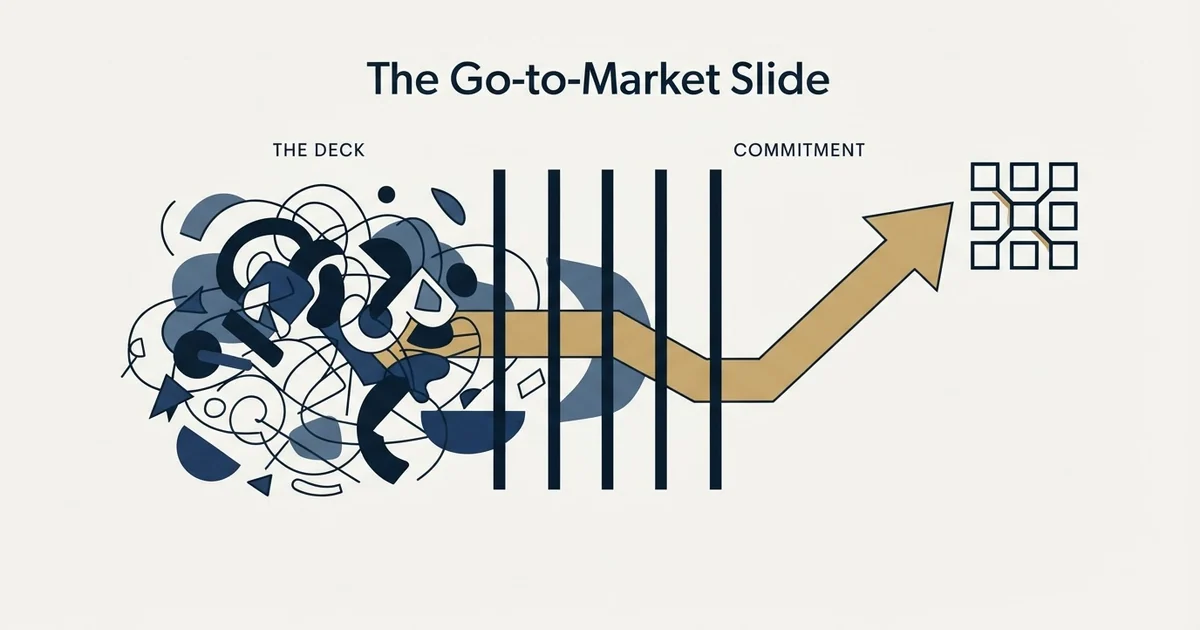
A go-to-market slide carries one segment defined by filterable attributes, one named first route, the condition that makes the problem urgent now, the arithmetic to reach a sample large enough to read, and the result that would make you stop. A logo grid signals the choice has not been made yet.
Key takeaways
- The room reads the slide as evidence about the founder: whether a route was chosen, whether it was costed to the point of producing evidence, and whether failure has a named shape.
- Listing five channels is a deferred decision. Funding four routes at a quarter each usually means none reaches the volume at which its own conversion rate stops moving.
- The channel line is sized by arithmetic. Segment size, the share you have to contact for the rate to be readable, and the time that takes are the numbers the slide is being asked for.
- The fundraising version carries arithmetic and a kill condition. The internal version carries owners, dates and the first list. Presenting one to the other audience lands flat.
Reviewed and updated September 2, 2026
A deck runs cleanly through problem, product and market size, and then reaches the go-to-market slide and the room changes tone. The questions stop being about the idea and start being about arithmetic. That shift is the whole purpose of the slide, and most versions are built as though it were still a slide about ambition.
The common failure is visible from the back of the room. A grid of channel logos, an arrow labelled growth, and three percentages with no denominator behind them. Nothing on the slide is false. Nothing on it can be checked either, which is what the audience is actually there to do.
The same request also arrives as a go-to-market strategy presentation, which is this slide plus the three or four that set it up.
The same five lines are what the rest of a go-to-market deck gets judged against, because this is the slide the room tests first.
The same five lines are what a go-to-market strategy deck is graded on: a longer deck does not add information, it just spreads these five lines over more slides.
Every go-to-market slide example worth studying is checkable line by line, which is the only property that separates the ones that survive a room from the ones that decorate it.
What the room is testing
The go-to-market slide is read as evidence about the founder rather than about the market. Three things are being assessed, and none of them is creativity.
The first is whether a specific route has been chosen. A slide listing five channels says the choice has not been made, and choosing later usually means funding each route at a quarter of what it needs to produce a readable result.
A separate limitation sits earlier than channel choice: what happens before a conversation starts covers target definition, list building and reply routing.
The second is whether the route has been costed to the point where it produces evidence. Not a lifetime cost, and not a blended number pulled from an industry report. The cost of getting enough activity through one channel that the conversion rate stops being noise.
The third is whether the founder can name what would prove the plan wrong. A plan with no kill condition is a plan that cannot be updated, and the room knows that from experience rather than theory.
- A logo grid of five channels
- A funnel with percentages and no denominator
- Total addressable market, again
- The word scalable, at least once
- Which one of these are you actually funding first
- How many of them do you have to reach to learn anything
- What does one conversation cost you today
- What result would make you stop doing this
The lines a go-to-market slide has to carry
Five lines carry the slide. They fit on one page and each of them is checkable, which is the property that separates a plan from a description.
Who, specifically. Not the market. The segment inside it that has the problem now, defined by attributes you can filter a list on. A line naming mid-sized logistics operators with more than one depot is checkable. A line naming forward-thinking operations leaders is not.
Filters settle membership and nothing more, so what a fit score adds after the filters becomes relevant once the qualifying set outgrows the team.
How they first hear from you. One named route, with the mechanism stated. Outbound email to a built list, partner introductions, a self-serve funnel fed by search, or a founder-led network motion are different businesses with different cost structures, and the slide should commit to one as the first.
Why now. The condition that makes the problem newly expensive for that segment. This line is what makes the message writable at all, and its absence is why so many launch plans produce polite indifference.
What it costs to reach the volume that teaches you something. The arithmetic, shown. This is the line the room is waiting for.
What would kill it. The result that would make you stop. Naming it is the strongest signal on the slide, because it is the only line that cannot be written by somebody who has not thought about failure.
- Yes: A segment defined by attributes you can filter a list on
- Yes: One named first route, not a grid of five
- Yes: The condition that makes the problem urgent this quarter
- Yes: The arithmetic to reach a readable sample, shown on the slide
- Yes: The result that would make you stop doing this
- No: A funnel diagram with percentages and no denominator
Sizing the channel line, with the arithmetic shown

The figures below are invented for this example. They are not our results, not a benchmark, and not a promise about any channel. What matters is the shape of the calculation, which is the thing the slide is being asked for.
Suppose the plan is outbound email to a built list, and the segment holds four thousand companies that fit the filter. Suppose the deck claims a one percent conversion from contacted company to booked conversation. To distinguish one percent from half a percent with any confidence, the sample has to be large enough that a handful of extra meetings does not move the rate, which in practice means contacting a substantial share of the segment rather than a few hundred companies.
That is the useful output of the calculation. It converts an assumption into a quantity of work and a length of time, and it usually reveals one of two things: either the segment is too small to prove the rate before the money runs out, or the plan needs a second segment. Both are findings the room respects, and both are invisible on a slide that shows only the percentage.
The real ceiling on the route
Chosen so the rate is readable
At the assumed one percent above
At an assumed half of conversations
The same calculation applied to a partner motion or a search-led funnel produces different quantities and a different clock, which is the point of running it before the channel line is written. Our sorting of lead generation channels by how fast they answer is the frame we use for that comparison, because speed of feedback, rather than cost per lead, is what decides whether a route can be tested inside a runway.
The fundraising slide and the internal one
Two different documents get called the same thing. A go to market strategy slide inside a board or sales-kickoff deck is aimed at people who have to execute it, so it carries owners, dates and the first list. The version in a fundraising deck is aimed at people deciding whether to fund it, so it carries the arithmetic and the kill condition instead. Building one and presenting it to the other audience is a common cause of the flat reception.
The internal version has a further requirement. Every line needs a name against it, because a plan with no owner per line is a plan that survives the meeting and then stops. The failure modes that come from unclear ownership between the sales and marketing halves of a launch are their own subject, and our note on why go-to-market plans get overengineered covers the version of this that produces a thirty-page document nobody executes.
The objection that the slide is trying to survive
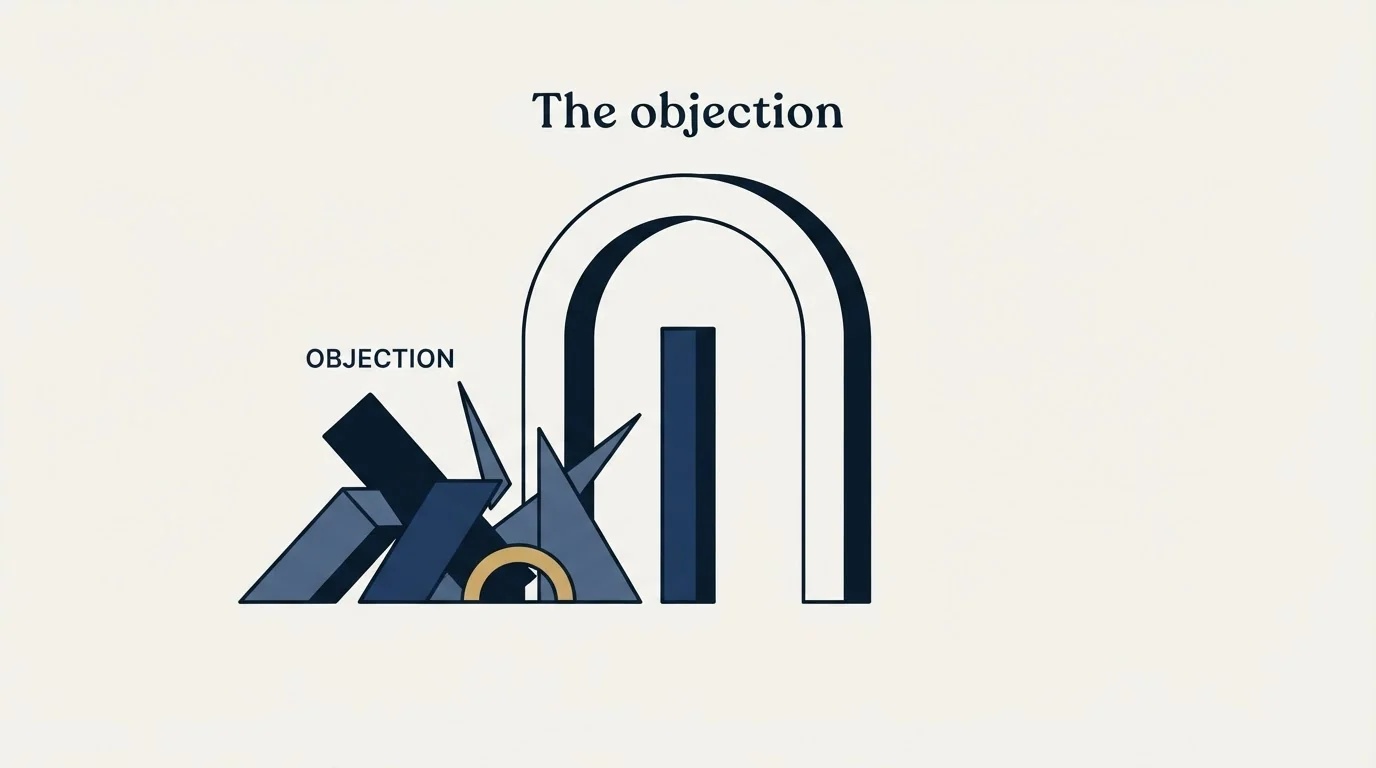
The answer most founders give to the single-route question is that all the routes will run eventually, and that the slide shows the full picture. That answer is usually true about the destination and useless about the next two quarters, which is the period the money covers.
A route becomes readable only once enough volume has passed through it that its conversion rate stops moving. Splitting a fixed budget across four routes means none of them reaches that point, so at the end of the period the team has four rates it cannot trust and no basis for choosing. Naming one route first is not a claim that the others are wrong. It is the only way to be able to say anything about any of them by the next board meeting.
The version of that argument that lands in the room is arithmetic rather than conviction. Show what one route costs to run to a readable sample, multiply by four, and compare that against the raise. The comparison usually makes the case without anyone having to argue about which channel is best.
What should change the slide
A go-to-market slide is a set of assumptions with dates on them, so it should change when the assumptions do. Three events are worth writing into the plan as triggers for a rewrite rather than waiting for a quarterly review to catch them.
The first is the segment failing to answer at all. A route that reaches a substantial share of the segment and produces nothing has usually falsified the why-now line rather than the copy, and rewriting the message is the expensive way to discover that.
The second is the reverse: an unplanned segment answering. Replies from companies that do not match the filter are the cheapest market research available, and a slide that cannot absorb that finding is a slide nobody is reading.
The third is a cost input moving. Channel economics change when a platform changes its rules or a vendor changes its pricing, and a plan whose arithmetic was built on the old numbers keeps producing a confident answer that is no longer true.
Before you open a template
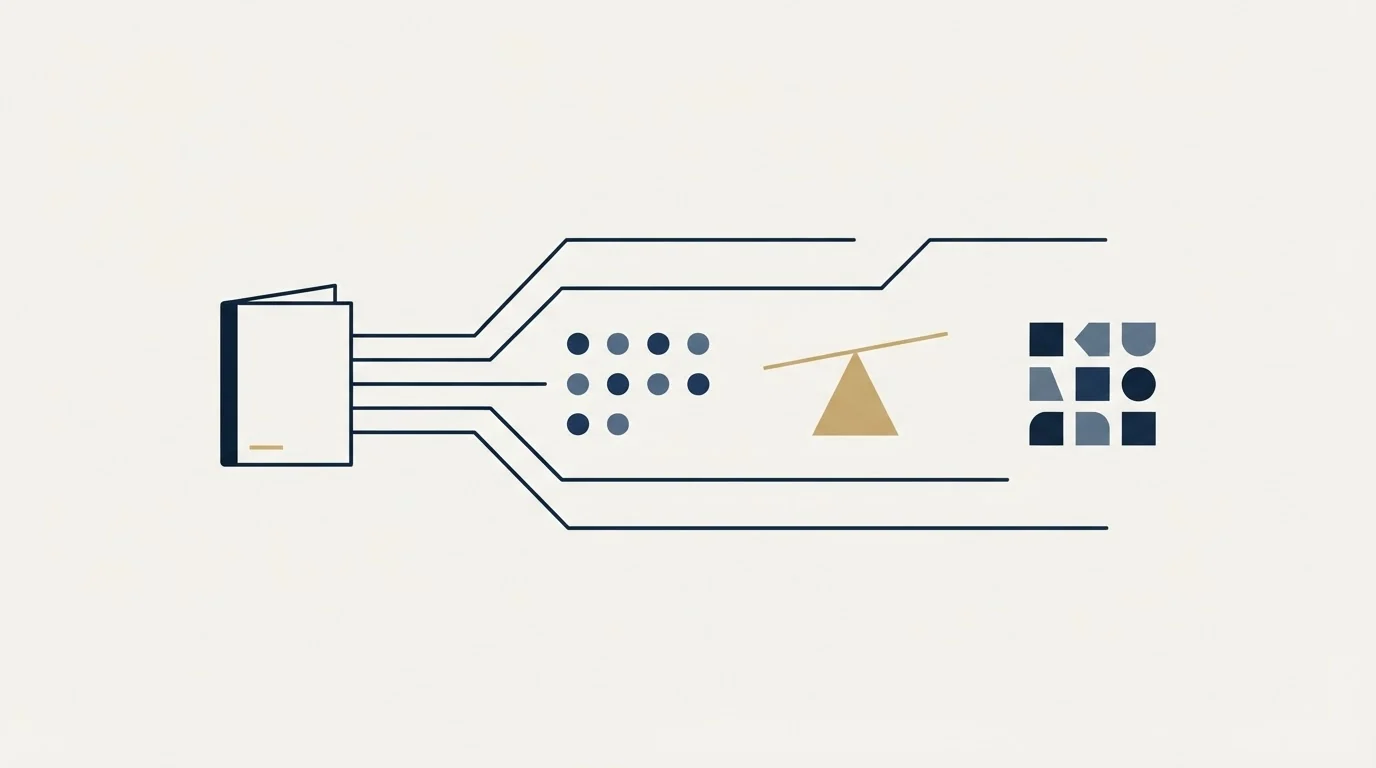
Template galleries sell the slide as a layout problem. The layout is the last ten percent. The five lines above have to be decided first, and the decisions are the same ones the whole plan rests on, which is why our go-to-market strategy note treats them as decisions that fit on one page rather than as a document.
Two of the lines have their own tests. The segment line is only as good as the cut behind it, and the standard a cut has to meet is set out under market segmentation. The claim the slide makes about why anyone should care has to survive being said to a stranger, which is the test in our note on the positioning statement.
If the first route is outbound, the line that decides the slide is the one about what a conversation costs, and that number comes from the list rather than from the copy. The mechanics of writing to a segment once you have one are in how to write a cold email when it is the only one you send, and if you want the arithmetic run against a real list before the slide is drawn, that is what a free campaign build produces. For companies whose first route is outbound at seed stage, startup lead generation covers what the constraint looks like in practice.
The short version
The go-to-market slide is where a deck stops describing and starts committing. It carries one segment defined by filterable attributes, one first route, the condition that makes the problem urgent now, the arithmetic to reach a sample large enough to be readable, and the result that would make you stop. A logo grid and an unsourced percentage are what a slide looks like before those five decisions have been made, and every experienced room can tell the difference within a minute.
Frequently asked questions.
Frequently asked questions- What should a go-to-market slide include in a pitch deck?
- One segment defined by attributes you could filter a list on, the single route you are funding first, the condition that makes the problem urgent this quarter, the arithmetic showing what it costs to reach a readable sample, and the result that would make you stop. Five lines, each of them checkable.
- Why do investors push back on the go-to-market slide?
- Because it is the first slide that can be checked. Market size and product vision are claims about the future, while a channel plan implies quantities, costs and a clock. A slide showing percentages with no denominator behind them invites exactly the questions it fails to answer.
- Is a go to market strategy slide the same as a strategy document?
- No. The slide is the compressed version of decisions taken elsewhere, and it works only when those decisions exist. A slide built before the segment, route and why-now lines have been settled turns into a layout exercise, which is what template galleries sell and what the room sees through.
- How many channels should the slide show?
- One as the first route, with the others named as later candidates if they matter. The purpose of naming one is not to claim the rest are wrong. It is to have something readable to say about any of them by the next board meeting rather than four rates nobody trusts.
About the author.

B2B cold email experts helping companies generate qualified leads through done-for-you outreach campaigns.
RevenueFlow Team
Explore more.
Ready to scale your outreach?
We build GTM engines that book real meetings. See the receipts.
Related articles.
Appointment Setting for Business Brokers: The Seller Meeting
What a bought meeting with a business owner has to be for a brokerage: the three-part qualification, the confidentiality rules, the licence line and the owner's reasons.
LinkedIn Outreach for Banks: A Regulated Message
How a bank's relationship managers use LinkedIn to reach business owners: what the FFIEC guidance, FINRA's notices and LinkedIn's own rules require, and where to stop.
SDR Outsourcing for Logistics Companies: The Brokerage Line
What an outside sales development team may do in a freight company's name, the calling and email rules it inherits, and which arrangement survives a bid-shaped market.
SDR Outsourcing for Business Brokers: The Fee Timing
Whether a success-fee brokerage should rent sales development at all: the fee timing, the texts that limit what an outside person may say about value, and who signs.
B2B Lead Lists for Aviation Companies: Build or Buy
Aviation is one of the few industries whose accounts are published by its regulator, which changes what is worth buying and what is worth downloading yourself.
Cold Calling for PPC Agencies: What You Can See First
A paid media prospect is partly readable before the call and has already been told by the platform what to do when a stranger rings about its ads.