Managing a Remote Sales Team: What Replaces Line of Sight
A shared floor supplied four things nobody costed: an effort signal, ambient coaching, early escalation and a read on the person. What replaces each one.
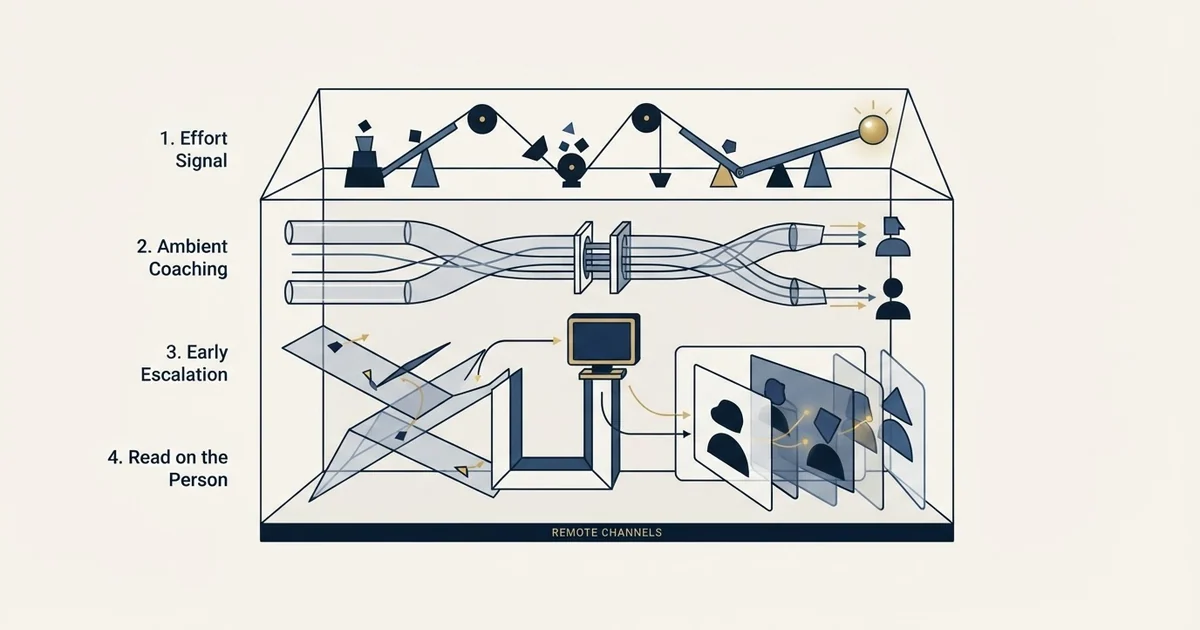
A shared sales floor supplied four inputs without anyone naming them: a continuous effort signal, ambient coaching, early escalation and a read on the person. Distributed teams have to rebuild each as a deliberate artifact. The activity record, a chosen coaching artifact, a written pipeline review and a one to one carrying no deal review.
Key takeaways
- Line of sight was doing four separate jobs, and a daily video standup replaces none of them well.
- The activity record becomes load bearing off a floor, so the unit, account resolution, real timestamps and fixed outcome values stop being optional.
- Coaching survives the move intact when a recorded call or a chosen message replaces the ride along, one named focus at a time.
- Distributed teams need fewer synchronous events than co-located ones, because written artifacts carry the load presence used to.
Reviewed and updated October 1, 2026
A manager who ran a sales floor for a decade could tell on a Tuesday morning which of their reps was struggling, and they could not have told you how. Somebody was quieter than usual. Somebody put the phone down and sat back. Somebody asked a colleague a question at the coffee machine that the colleague answered wrongly. None of that was written down anywhere, and all of it fed decisions about who to sit with that week.
Move the same team onto laptops in eight cities and every one of those inputs disappears at once. The job did not change. The instrument the manager was using without noticing did.
Advice on managing a remote sales team usually treats this as a communication problem and answers it with meeting cadence, chat norms and trust. Communication is the easy half. The hard half is that a set of judgements which used to run on ambient observation now has to run on records that somebody has to deliberately create, and nobody creates them by accident.
What the floor was actually supplying
Line of sight was doing four separate jobs, and they get replaced by four different things rather than by one video call.
An effort signal. Not a good one, and it flattered people who looked busy, but it existed and it was continuous. A manager knew roughly who was working the list and who was reorganising their notes.
Ambient coaching. A newer rep overheard an experienced one handle an objection, and copied it that afternoon. Nobody scheduled that. It was a training channel nobody scheduled, nobody costed and nobody replaced when the floor went.
Early escalation. A deal going wrong surfaced as a muttered complaint two desks away, days before it would have surfaced in a pipeline review. The manager heard it and asked.
A read on the person. Whether somebody was demoralised, overloaded, or about to leave. Managers do not learn this from a status update, because a status update is a performance.
Each of those has to be rebuilt as an explicit artifact, and the artifacts are not interchangeable. A daily video standup is a poor substitute for ambient coaching and a very poor substitute for the read on the person, which is why teams that add one and stop there report that remote management is going fine right up until somebody resigns.
- A rough continuous effort signal
- Overheard objection handling
- A complaint two desks away, days early
- A read on whether somebody is struggling
- An activity record with an agreed unit
- Reviewed artifacts and a shared library of them
- A written pipeline review with next steps and owners
- A recurring one to one that is not a status update
- Screen monitoring or activity surveillance
- A daily video standup as the whole answer
- More reporting requests to the same manager
- Asking people how they are doing in a group call
The activity record has to carry what the floor carried
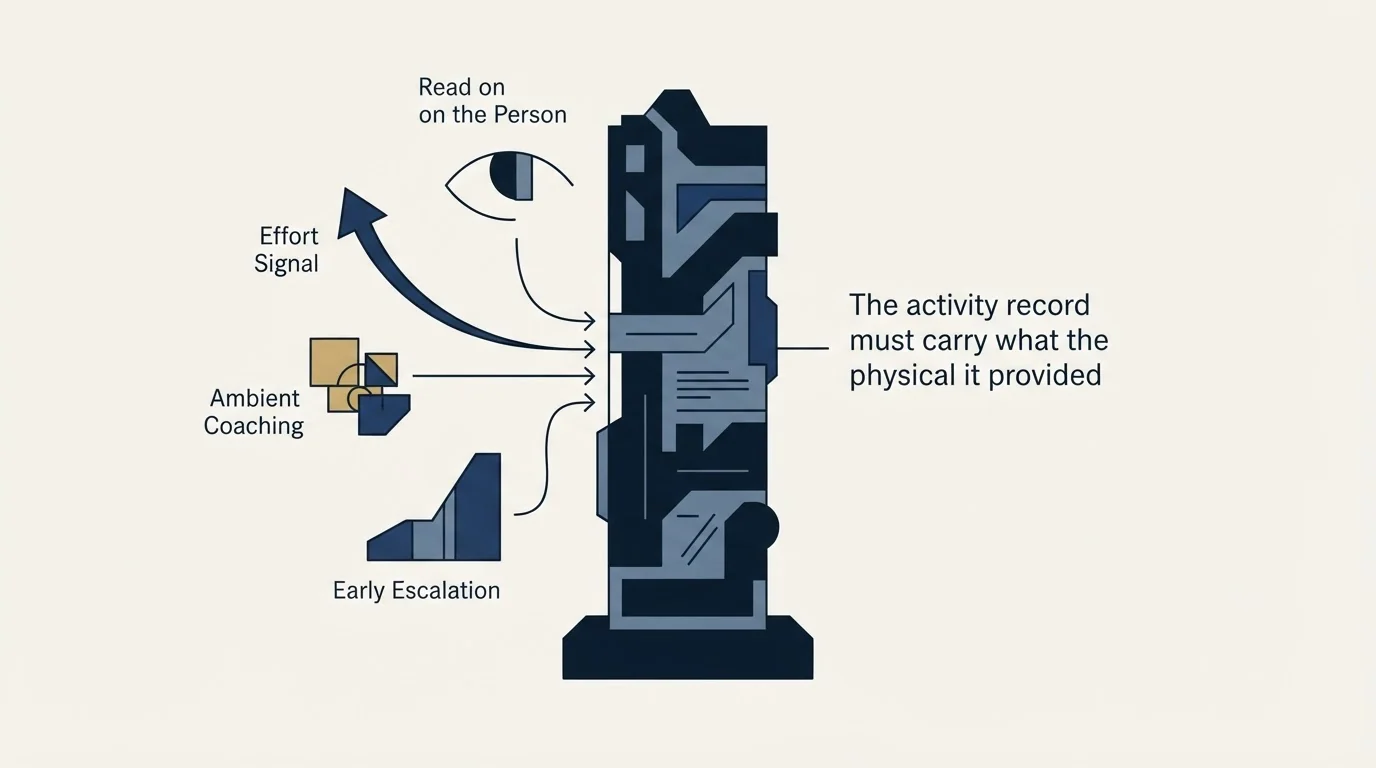
On a floor, the activity record was one input among several. Remotely it is the only continuous one, which raises the bar on it considerably. A record that a co-located manager could afford to treat as approximate is now the thing standing in for observation.
What that means practically is that the choices described in sales activity tracking stop being an analytics preference and become an operating requirement. The unit has to be agreed before anything is counted, because counting touches rewards revisiting a worked list and a distributed team is exactly where nobody will notice that happening. Every record needs to resolve to an account rather than only to a contact, carry a real timestamp rather than the time it was typed in, and say whether it was a first approach or a repeat.
The outcome field is the one that pays for itself fastest here. A short fixed list of outcomes turns a month of work into a distribution a manager can read in a minute, and the alternative, free text, means somebody has to read two hundred notes to learn what a co-located manager would have absorbed by osmosis. That is the cost of the missing floor, paid weekly, by the person who has least time.
Two failure modes bracket this, and both are common.
The first is backfilling. A week logged on Friday afternoon is not a record of the week, and remote teams backfill more than co-located ones because nobody is watching the logging happen. The damage is invisible in aggregate and it destroys exactly the timing signal a distributed manager needs.
The second is reaching for surveillance. Screen recording, keystroke counting and idle-time reporting all promise to restore the effort signal, and they restore something worse than nothing: a number the measured party can move directly, without doing any of the work the number was supposed to describe. It also announces to the team that the manager could not think of anything better, which costs more than the tooling does.
Coaching moves from the ride along to the artifact
The field-sales version of coaching was the ride along, where a manager spent a day observing appointments. The office version was a manager listening to half a call from the next desk. Neither survives a distributed team, and the substitution is the same one either way, which is that a recorded call or a written message the rep chose becomes the evidence.
That substitution is better than it sounds. The pattern set out in sales rep coaching works remotely without modification: one named focus agreed before the session, one artifact the rep picked, four samples of the same behaviour rather than one sample of everything, and a written single change. On an outbound seat it reaches work no ride along could ever have watched, because the decisions on that seat are made before anyone replies, in the list and in the first line.
Recording is the enabling piece and it is worth being precise about what it does and does not give you. A recording plus a transcript is a measurement. What a platform derives from that transcript, including sentiment and deal risk, is an estimate, and the two arrive on the same dashboard in the same font, which is the distinction drawn in conversation intelligence. For a distributed team the measurement half is what matters: the gap between what a rep logged and what was actually said is the thing a co-located manager used to catch by overhearing.
For a written outbound motion there is no recording layer at all, and the artifact is the message and the list it went to. Reviewing four opening lines against the accounts they were sent to is a coaching session, and it needs no tooling beyond the sending platform.
The ambient half, where a newer rep overhears a better one, does not come back on its own. It has to be built as a library: a small, curated set of calls and messages that reps can read, kept short enough that people actually use it. A shared drive of every recording is not that, and it gets used exactly once.
- Yes: The activity unit is agreed and written down, not inherited from the tool
- Yes: Every rep had a coaching session against an artifact they chose
- Yes: Pipeline next steps are written, with a named person and a date
- Yes: A curated library of good calls or messages exists and is short
- Yes: There is a recurring one to one that never carries deal review
- No: Activity is logged in a Friday afternoon session
- No: Screen or idle-time monitoring is part of the visibility answer
- Depends: Whether reps ever bring a call that went badly
The pipeline review has to move into writing

A co-located pipeline review could run on conversation, because the gaps got filled in afterwards at somebody's desk. Remotely the meeting is the whole of it, and a verbal review produces the familiar outcome where four people leave with four accounts of what was agreed.
The fix is that the deal record carries the commitment rather than the meeting. What has to happen next, who agreed to it, on what date, and what would have to be true for the close date to hold. That is the discipline described in pipeline management in a CRM, and it is optional on a floor and load bearing off one.
Written also means the review can be prepared asynchronously, which is what makes it survive time zones. A manager who reads the deals before the call spends the call on the two that are wrong rather than on reciting a list. That change alone usually buys back more time than every scheduling tool a remote team installs.
What does not change, and the trap of thinking everything does
The six things only a manager can discharge, set out in sales manager responsibilities, are unchanged by the medium. Coverage is still the largest lever and still the manager's decision alone. Forecast honesty still comes from inspection. Deal strategy on the deals carrying the quarter, coaching against observed behaviour, and hiring with the exit decision still belong to the role, and escalation authority still has to actually exist or the team routes around the manager within a quarter.
The trap is the manager who reads all the remote-management advice, concludes that the answer is more contact, and fills the calendar with recurring calls. Six weeks later the coaching slot has moved four times, the coverage decision has not been revisited, and everybody has more meetings and less management. Distributed teams need fewer synchronous events than co-located ones, not more, because the asynchronous artifacts carry the load that presence used to.
The related decision, which is often confused with this one, is whether a seller works remotely at all. That is a coverage and deal-complexity question rather than a management question, and it is worked through in outside sales against inside sales.
- Step 1Read the written pipeline before the review
Next step, named person, date. The call is for the two deals that are wrong, not for the list.
- Step 2Run the coverage decision on evidence
What moved in the patch, which accounts nobody has touched, what the team should stop working.
- Step 3Coach each rep against one chosen artifact
One named focus, four samples of it, one written change. Never in the same meeting as deal review.
- Step 4Hold the one to one that is not a status update
The read on the person is the job the artifacts cannot do, and it is the first thing to get cancelled.
Where we sit on this
We run outbound programmes for clients as a distributed team, so the operating position here is our own practice rather than an observation about other companies, and it is narrow enough to state plainly.
Qualification criteria are agreed in writing with the client before a campaign launches. That document does more for a distributed team than any tool, because a disputed meeting becomes a question about a written criterion rather than an argument about somebody's judgement, and an argument about judgement is exactly what a team that never shares a room handles worst.
We also run one message per campaign, with no bumps and no thread replies. That removes an entire class of chasing behaviour, which happens to be the class hardest to supervise remotely, and it puts the weight back on the list and the first message, both of which are written artifacts a manager can review at any hour from anywhere.
When remote is not the problem
One diagnosis is worth settling before any of the above is built. A distributed team with thin pipeline looks identical to a distributed team with a management problem, because both present as reps who seem busy and numbers that do not move, and the remote framing makes the management reading feel more available.
The test is the same one a co-located team would use. Read activity against coverage rather than against last month, and read the distribution across the team rather than the total. If accounts worked is flat while touches are high, the list is exhausted and no cadence repairs that. If the conversations exist and none of them convert, the constraint is the message or the segment.
Where the answer is that the supply of qualified conversations is the constraint, we will run a campaign against your market and you can read the replies rather than the dashboard.
The short version

Managing a distributed sales team is not primarily a communication problem. A shared floor was quietly supplying four things: a continuous effort signal, ambient coaching, early escalation and a read on the person. Each needs a deliberate replacement, and they are not interchangeable.
Make the activity record carry what observation used to carry, which means an agreed unit, account resolution, real timestamps and outcomes from a fixed list rather than free text. Replace the ride along with a chosen artifact, one named focus and a written single change, and build a short curated library so the overheard-lesson channel comes back. Move the pipeline review into writing so a commitment has a name and a date attached. Refuse surveillance tooling, which restores a number rather than the signal.
Everything only a manager can do stays the same. Fewer synchronous events, not more, and one recurring conversation that carries no deal review at all, because the read on the person is the job none of the artifacts can do.
Frequently asked questions.
Frequently asked questions- What actually changes when a sales team goes remote?
- The manager's job does not change. The instrument does. A shared floor supplied a rough effort signal, ambient coaching between reps, early warning of a deal going wrong and a read on how somebody was holding up. All four were ambient and free. Off a floor each has to be rebuilt as a record somebody deliberately creates.
- How do you keep visibility without monitoring software?
- Through the activity record rather than through observation of people. Agree what counts as one activity, resolve every record to an account, keep real timestamps rather than the time it was typed in, and use a short fixed list of outcomes. Screen or idle-time monitoring produces a number the measured party can move directly, which is worse than no signal.
- How often should a remote sales manager meet the team?
- Less often synchronously than a co-located manager, not more. The common failure is filling the calendar with recurring calls to compensate for lost presence, which crowds out coverage decisions and coaching. Keep one recurring one to one per rep that carries no deal review, one written pipeline review prepared asynchronously, and protect both from reporting requests.
- Does coaching work remotely?
- It works when there is an artifact on the table. A recorded call or a written message the rep chose replaces the ride along and gives better coverage on an outbound seat, because the decisions there are made before anyone replies. Name one focus in advance, review four samples of that behaviour, and end with one written change.
About the author.

B2B cold email experts helping companies generate qualified leads through done-for-you outreach campaigns.
RevenueFlow Team
Explore more.
Ready to scale your outreach?
We build GTM engines that book real meetings. See the receipts.
Related articles.
SDR Outsourcing for Business Brokers: The Fee Timing
Whether a success-fee brokerage should rent sales development at all: the fee timing, the texts that limit what an outside person may say about value, and who signs.
LinkedIn Outreach for Banks: A Regulated Message
How a bank's relationship managers use LinkedIn to reach business owners: what the FFIEC guidance, FINRA's notices and LinkedIn's own rules require, and where to stop.
Sales Enablement Charters: What the Published Ones Ask For
Six publishers set out what a sales enablement charter should contain. Five describe a document nobody can check, and one writes a definition with inspection in it.
SDR Outsourcing for Financial Services: The Third Party
What a bank, broker-dealer, adviser or agency's regulators say about an outside team that speaks for it, the licensed line, and which arrangement survives due diligence.
Cold Calling for Chemical Companies: Who Picks Up
A chemical cold call rarely arrives first. It reaches a formulator who has already been comparing suppliers on a screen, for one of three published reasons.
Cold Calling for PPC Agencies: What You Can See First
A paid media prospect is partly readable before the call and has already been told by the platform what to do when a stranger rings about its ads.