Activity Quota: What It Counts, and What It Instructs
An activity quota sets a target for sales actions completed in a period, counted as calls, emails, meetings booked or accounts worked rather than as revenue. It is the only quota a ramping seller can meaningfully hit and the only one satisfiable without anything moving, and both properties follow from measuring inputs instead of outcomes.
Key takeaways
- It measures effort at the input end, which makes it readable weeks before any outcome exists and satisfiable without anything happening.
- The counter is the instruction: counting touches rewards revisiting the same accounts, counting new accounts worked rewards coverage.
- It stops measuring anything the moment compensation turns on it, because the measured party can then move it directly.
- A whole team hitting activity and missing outcomes is evidence about the list or the message, not about the people.
An activity quota is a target for the number of sales actions a person is expected to complete in a period, counted as calls made, emails sent, meetings booked or accounts worked, rather than as revenue produced. It measures effort at the input end of the process instead of the outcome at the far end.
That is the whole definition, and the interesting question is not what it measures but what happens to a team once it is the number that decides something.
Where it sits among the other quota types
Quotas divide into three families, and an activity quota is the only one that does not describe a result.
Outcome quotas count what the business wants: revenue booked, or units, logos or seats where one large deal should not be allowed to carry a year. They measure the right thing and they are heavily influenced by territory quality, and they are unreadable for somebody in their first quarter who has no pipeline yet.
Quality-weighted quotas count margin or product mix, which makes discounting expensive for the seller and pulls effort toward the line the business actually wants. They are slower to compute and they need margin data the sales team can see and trust.
Activity quotas count attempts. They are the only quota a ramping seller can meaningfully hit, they produce a leading indicator weeks before any outcome exists, and they are the easiest of the three to satisfy without anything happening.
| Family | Counts | Weak spot |
|---|---|---|
| Outcome | Booked revenue, or deals, logos or seats | Unreadable for a seller with no pipeline yet |
| Quality-weighted | Gross margin, or a strategic product line | Needs margin data the team can see and trust |
| Activity | Calls, emails, meetings booked, accounts worked | Satisfiable without anything moving |
Teams commonly run a combination, and the combination is where the design work sits. An outcome quota with an activity floor underneath it is common and reasonable. An activity quota that pays the same as an outcome quota is a decision to buy motion, and it should be made deliberately rather than by default.
Why it matters: what the number does to behaviour
An activity quota is an instruction, and people follow instructions. Everything difficult about the instrument follows from that rather than from any flaw in the arithmetic.
Where the quota counts attempts, attempts are what arrive. That is the mechanism working, not a failure of character. The question is whether the attempts that arrive are the ones you wanted, and the answer depends entirely on what the counter counts.
The cheapest way to hit it is usually the least valuable. Counting repeated approaches to the same accounts is the version that does most damage, because it manufactures volume out of a list that has already been worked rather than out of new coverage. The number rises, the market does not.
It becomes theatre the moment it decides pay. As a leading indicator read alongside outcomes, an activity count is genuinely informative: a seller with no pipeline and no activity has a different problem from a seller with no pipeline and heavy activity. As the thing compensation turns on, it stops being a measurement of anything, because the measured party now has a reason to move it directly.
It cannot distinguish a good attempt from a bad one. A researched message to the right person at a fitting company counts once. A generic message to a scraped address counts once. If nothing else in the system separates them, the quota is an instruction to produce the cheaper of the two.
There is one failure that looks like the opposite of all this and is worth naming, because removing an activity quota entirely creates it. A team with no input measure at all cannot tell a seller who is working a hard market from a seller who is not working, and both present as a quiet quarter with no pipeline. The activity count is what separates those two, and that separation is genuinely valuable right up until the count becomes the thing being optimised.
The honest use is therefore narrow and real. An activity quota is a floor, it belongs during ramp and as a diagnostic, and it stops being useful the moment somebody is paid on it.
How an activity quota is used in outbound
Outbound is where activity quotas are most common and where the counter design matters most, because the whole motion is inputs until a reply arrives.
The choice that decides everything is what counts as one unit. Three counters produce three different teams.
Counting touches rewards contacting the same people repeatedly, since a second message to an existing contact is cheaper than finding a new one. This is the counter that produces sequence bloat.
Counting people contacted rewards list volume, which is better, and it still says nothing about whether those people were worth contacting.
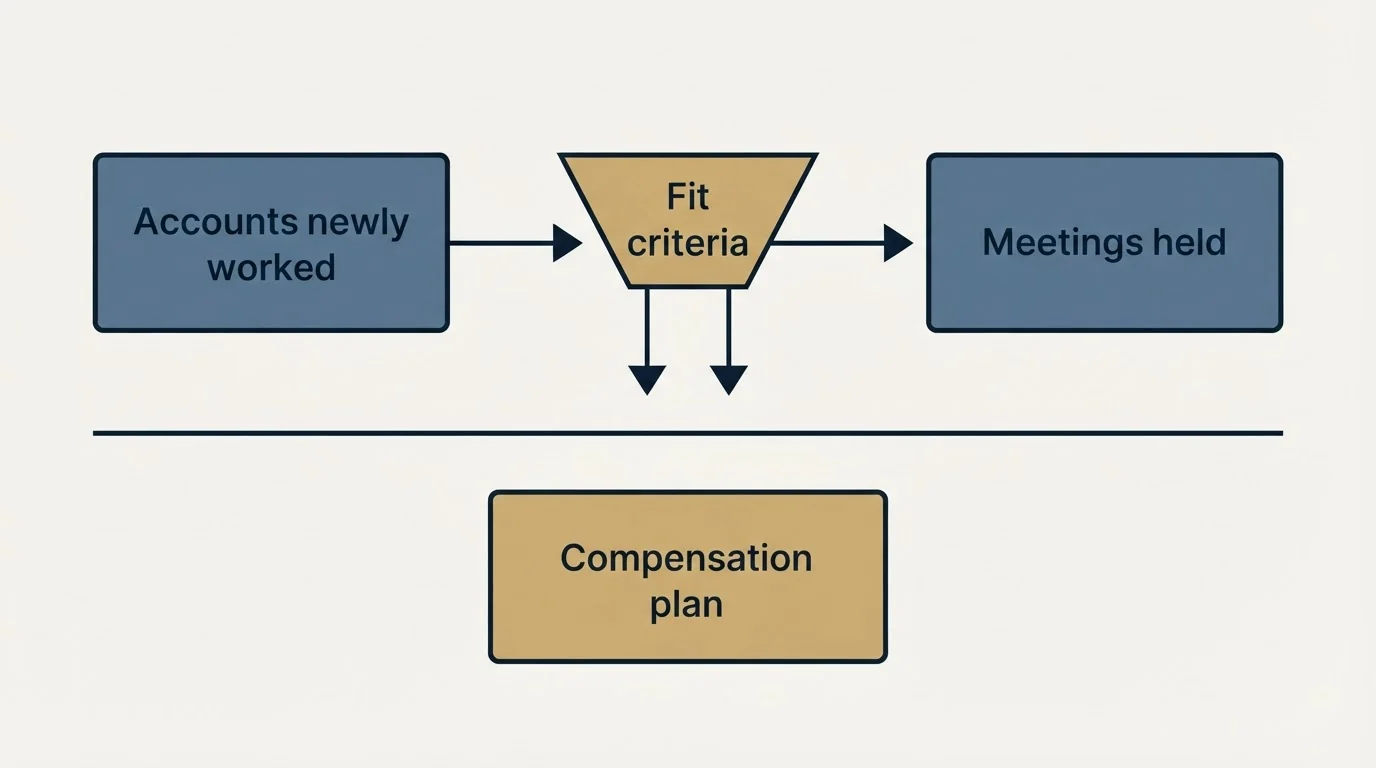
Counting accounts newly worked, with a fit criterion attached, is the version that points at the thing you actually want, because it cannot be satisfied by revisiting the same list. What that criterion should contain is the same question the SDR role definition has to answer before anyone can be held to a number at all.
Accounts newly worked rather than touches sent, so the count cannot rise by revisiting the same list.
Only accounts meeting the written criteria count, so volume cannot be bought by widening the list.
Read beside meetings held, so effort and result sit in the same row.
A floor during ramp and a diagnostic afterwards, never the number compensation turns on.
Our own practice removes one of those options entirely, and it is worth stating plainly because it constrains what a quota can be written against. We run one message per campaign, built on one premise and sent once, with no bumps and no thread replies. A later approach to someone who did not reply is a separate campaign that re-sends the same message, and only when there are no new accounts left to reach; it is never a follow-up in the old thread. A quota written against touches on the same account is therefore an instruction to do something we do not do, and the only counter compatible with the motion is one that counts new coverage.
That constraint is not a limitation dressed up as a principle. It removes the cheapest way of satisfying an activity target, which is the way that produces the number without producing the market coverage, so it forces the work upstream into who gets contacted. The list becomes the constraint rather than the send rate, and the honest version of a capacity plan then starts from the count of companies that could genuinely buy, which is the arithmetic in serviceable addressable market.
Where the textbook definition misleads

An activity quota is not a proxy for effort, it is a proxy for one measurable kind of effort. Research, list building, account planning and thinking about what to say are all effort and none of them increments a counter. A team measured only on outputs of the sending step will produce fewer of the inputs that make the sending step work.
It is described as a leading indicator, which is only true when the conversion behind it is stable. The reasoning is that a fixed number of attempts yields a predictable number of conversations. That holds when the list and the message are unchanged, and it stops holding at exactly the moment the quota changes the list or the message, which is what the quota is for. The metric that holds the whole chain together, and where each input actually sits, is sales velocity.
It is offered as the fair measure for ramping sellers, and it is only fair with a stated end date. A reduced or activity-only quota during ramp is the right treatment, and it tends to outlive the ramp unless the step-up dates are written down in advance. How that adjustment and the others get made explicit is covered in sales quota.
Comparing two periods on activity has the same requirement any period comparison has, which is that the inputs match; the discipline for that is in comparing sales performance across periods.
A team hitting activity and missing outcomes is not a discipline problem by default. One seller in twelve short of the outcome number is plausibly about that seller. Ten of twelve hitting activity and missing outcomes is a statement about the list, the message or the market, and treating it as twelve performance conversations is a decision to keep the plan and change the people. The measure that separates a volume problem from a conversion problem is win rate.
Measuring coverage
- The unit is accounts newly worked
- Only fit-tested accounts count
- Reported beside meetings held
- Ramp relief has a step-up date
Producing motion
- Pay turns on the activity number
- Repeat contact increments the count
Related terms
Quota attainment is how performance against any quota gets measured and reported. Win rate is the conversion figure that says whether more activity would help at all. Sales velocity holds activity, deal value, win rate and cycle length in one expression. Ramp time is the period an activity quota exists to make readable. And qualified appointment is the outcome unit an activity count should be read against.
The short version
An activity quota targets the number of sales actions completed rather than the revenue produced. It is the only quota a ramping seller can meaningfully hit and the only one that can be satisfied without anything moving, and both of those follow from the same property.
Design the counter carefully, because the counter is the instruction. Count accounts newly worked against written fit criteria rather than messages sent, report it beside meetings held so effort and result sit in one row, and keep it off the compensation plan, where it stops measuring and starts being produced.
When a whole team hits activity and misses outcomes, read that as evidence about the list or the message before reading it as evidence about the people.
Producing the conversations an activity number is supposed to lead to is the half we run: RevenueFlow builds and runs the outbound engine and is paid only for meetings that are actually attended. See if you qualify.
Frequently asked questions.
Frequently asked questions- What is the difference between an activity quota and a sales quota?
- Sales quota is the general term for an assigned target, and activity quota is one type of it. Outcome quotas count revenue or units, quality-weighted quotas count margin or product mix, and activity quotas count attempts such as calls, emails or meetings booked. Only the activity version measures inputs, which is what makes it readable during ramp and easy to satisfy without progress.
- Are activity quotas a good idea?
- As a floor during ramp and as a diagnostic afterwards, yes. Removing input measurement entirely means a seller working a hard market and a seller not working look identical, because both produce a quiet quarter. The problems start when the activity number decides pay, at which point it stops being a measurement and becomes something being produced.
- What should an activity quota count?
- Accounts newly worked, tested against written fit criteria, rather than messages sent. Counting touches rewards repeat contact with an already-worked list, which manufactures volume out of coverage you already had. Counting people contacted rewards list size without saying whether those people were worth contacting. A fit-tested new-account count cannot be satisfied by revisiting the same names.
- What does it mean when a team hits activity and misses revenue?
- Read it as evidence about the list, the message or the market before reading it as evidence about the people. One seller in twelve missing is plausibly about that seller. Ten of twelve hitting activity and missing outcomes is a statement about the plan, and holding twelve performance conversations instead is a decision to keep the plan and change the team.