SaaS Sales Funnel: Define Every Stage Exit by Buyer Action
Two reps following the same stage definitions can produce incomparable pipelines. The fix is defining every stage exit as an action a third party can verify.

A SaaS sales funnel is the sequence of stages a software buyer passes through from first contact to a signed subscription, usually lead, discovery, evaluation, proposal, commit and closed won. It only measures anything when every stage exit is an action the buyer took that a third party could verify, and when self-serve and sales-led paths are counted separately.
Key takeaways
- Most SaaS sales funnels need five or six stages, and each stage should be left only when the buyer does something a third party could verify from the record.
- Self-serve and sales-led deals belong in separate funnels, because averaging a nine day trial conversion with a seven month enterprise deal describes no actual customer.
- Read every conversion rate with its denominator: a rate computed over a filtered set improves when the filter tightens, even if nothing got better.
- Make backward movement and coded losses routine, so late stages stop carrying deals that nobody believes in.
Reviewed and updated September 18, 2026
A SaaS sales funnel is only as good as the definitions of its stages, and most are defined by how the rep feels. Two reps forecast the same quarter. One has eleven deals in Evaluation, the other has three. At the review, it turns out the first rep moves a deal to Evaluation after a discovery call goes well, and the second moves it when the prospect has looped in a second stakeholder and asked for security documentation. Both are following the stage definitions, because the stage definitions say things like "prospect is actively evaluating the solution".
Neither rep is wrong and the pipeline number is meaningless. Every conversion rate calculated from it is an average of two different measurement systems, and no amount of forecasting sophistication downstream can repair that.
Most SaaS funnel problems are not funnel-design problems. They are definition problems, and they have one fix: every stage exit is a thing the buyer did, observable by someone who was not on the call.
What is a SaaS sales funnel?
A SaaS sales funnel is the sequence of stages a software buyer passes through between first contact and a signed subscription, with a conversion rate measured between each pair of stages. What makes the sales funnel for SaaS distinct is that it usually carries two motions at once, self-serve trials and sales-led deals, and that the sale continues after close through renewal and expansion.
What are the stages of a SaaS sales funnel?
Most SaaS sales funnels run five or six stages from first conversation to signed contract: lead, discovery, evaluation, proposal, commit and closed won. The names matter far less than the exits. A stage is useful only when leaving it requires the buyer to do something a third party could verify from the record.
A workable sales-led version, with each exit written as a buyer action:
- Lead. Exit: the prospect booked and attended a call.
- Discovery. Exit: they named their current tool and its problem.
- Evaluation. Exit: they introduced a second stakeholder by name, or requested security or legal documents.
- Proposal. Exit: they asked for pricing in writing.
- Commit. Exit: they sent a redline or a PO number.
- Closed won. Renewal and expansion sit beyond it, and change the economics of everything above.
Your stage names will differ, and so may the actions. What should not differ is the form: every exit is something the buyer did. The rest of this page is about why that form is the only one that produces a number two people would compute identically.
Seller feelings versus buyer actions
The distinction is the whole article, so it is worth stating precisely.
A seller-state definition describes what the rep believes: the prospect is interested, the deal is qualified, the champion is engaged. A buyer-action definition describes something that happened and can be checked: a second named stakeholder attended a call, a security questionnaire arrived, a trial account was created and used, a pricing document was requested in writing.
Teams deciding where to enforce these buyer-action definitions will need a system built for it, and the CRM comparison for SaaS teams weighs which platforms actually support that structure.
| Seller state: drifts by rep | Buyer action: dated and checkable |
|---|---|
| Prospect is interested | Booked and attended a call |
| Deal is qualified | Named their current tool and its problem |
| Champion is bought in | Introduced a second stakeholder by name |
| They are actively evaluating | Requested security or legal documents |
| Verbal commitment received | Asked for pricing in writing |
| Deal is in procurement | Sent a redline or a PO number |
The test for any stage definition: could a person who was not on the call determine, from the record alone, whether the deal belongs in this stage? If the answer requires asking the rep how it felt, the definition is a seller state and the stage boundary will move under pressure at the end of every quarter.
The most argued boundary of all is the handoff, and the single event that separates the opening seat from the closing one decides where the value leaks.
This is not a trust issue. A rep with an honest and consistent internal standard still has a different standard from the rep sitting next to them, and the pipeline aggregates both.
The SaaS complication: two paths, one funnel
SaaS carries a structural problem most funnel templates ignore. A self-serve signup and a sales-led enterprise deal are frequently in the same pipeline, described by the same stage names, and they are not comparable.
A trial signup that becomes a paid account in nine days never had a discovery call, a champion, or a procurement step. An enterprise deal has all three and takes seven months. Averaged together, the funnel reports a conversion rate and a cycle length that describe no actual customer.
Self-serve path
- A trial signup becomes a paid account in nine days
- No discovery call
- No champion
- No procurement step
Sales-led path
- An enterprise deal takes seven months
- A discovery call
- A champion
- A procurement step
Separate the paths at the top and never merge their metrics.
Whether a human belongs in that shorter path at all is a separate decision, and where the seller enters a low-touch motion sets the rule for which accounts earn one.
The fix is unglamorous: separate the paths at the top and never merge their metrics, even when the same person works both. If a self-serve account later triggers a sales-assisted expansion, that is a new opportunity on the sales-led path with its own entry, not a continuation of the original one.
Where the two motions genuinely collide, and which one your contract value can support, is worked through in B2B SaaS lead generation.
Denominators, and the rate that flatters you
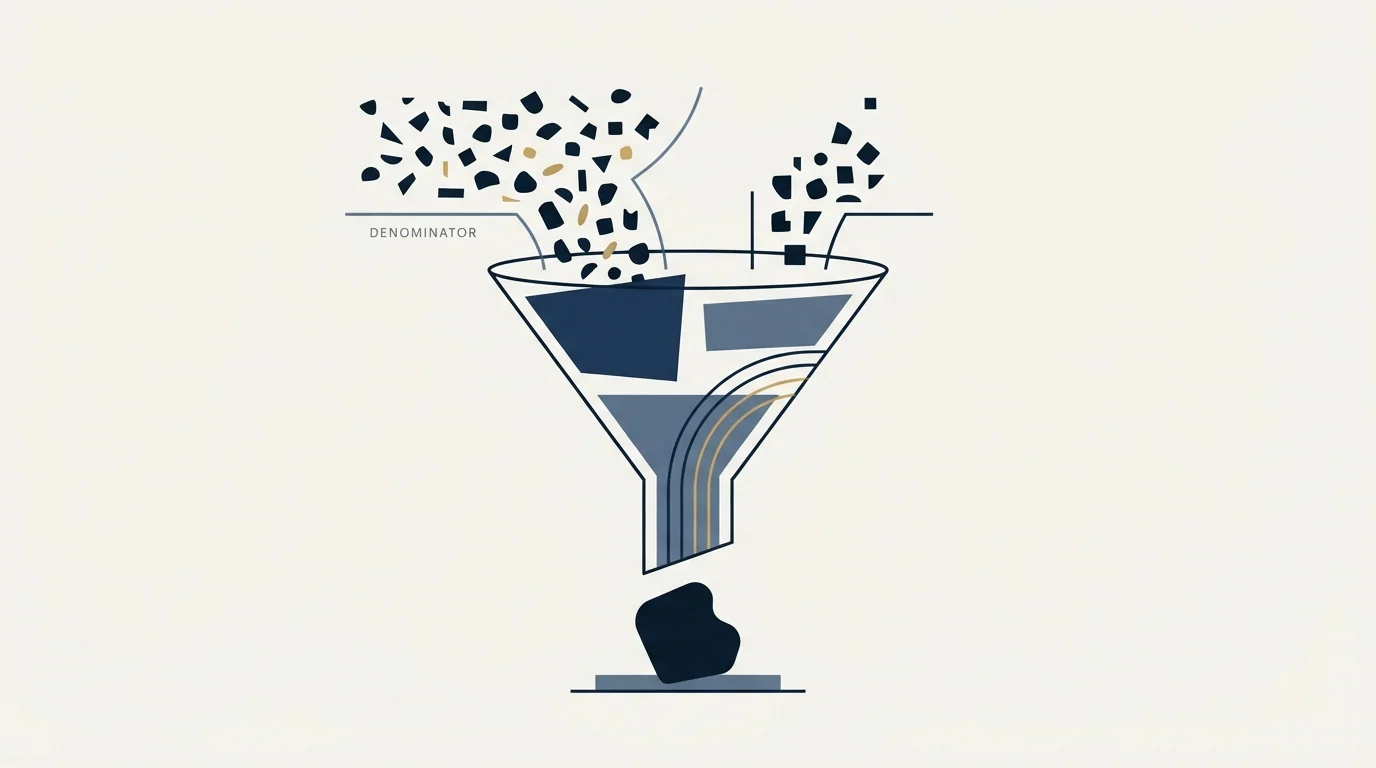
There is a specific arithmetic error worth naming because it is common and it is invisible.
Any conversion rate computed over an already-filtered set reports on the survivors. If your Stage 2 to Stage 3 rate is calculated only over deals that reached Stage 2, and your Stage 1 to Stage 2 filter has quietly tightened, Stage 2 to Stage 3 will improve for reasons that have nothing to do with anything getting better. The team celebrates a rate that rose because the population shrank. Take illustrative numbers. Last quarter 100 deals entered Stage 2 and 30 reached Stage 3, a rate of 30 percent. This quarter the Stage 1 filter tightened, 60 deals entered and 24 advanced, a rate of 40 percent. The rate rose by ten points while the number of deals reaching Stage 3 fell by six.
The habit that catches it: never read a rate without reading its denominator next to it. A stage conversion rate that improved while the count entering the stage fell is usually one number, not two, and the honest reading is that the filter moved.
The same applies to the leakiest measurement in SaaS, which is trial-to-paid. A trial-to-paid rate over trials that activated is a different number from the rate over all trials started, and both are quoted as "trial-to-paid" by people who mean different things.
Must be true
- Every stage exit names an action the buyer took
- Self-serve and sales-led paths are counted separately
- Every conversion rate is reported with its denominator
- Stage entry dates are recorded, so cycle length is computable per stage
- There is a documented rule for when a deal moves backwards
Must be false
- A stage can be entered on the strength of a good call alone
- Deals sit in a late stage indefinitely with no exit rule
The marketing-to-sales handoff is the same bug, one layer up
Everything above applies with more force to the boundary where marketing hands a lead to sales, because that boundary is where two teams with different incentives share one definition.
An MQL defined by a score is a seller-state definition wearing a numeric costume. The score is composed of weights somebody chose, and it moves when the weights move, so "MQL volume is up forty percent" can mean the market improved or that a form field started contributing five points. Nobody outside the team that owns the model can tell which, and the number is reported to people who assume the first.
The buyer-action version of the same boundary is a list of things a person did: requested a demo, attended a live session and stayed past the halfway point, opened a trial and completed a specific setup step, visited pricing three times in a fortnight. Those are checkable, and a rate built from them stays comparable when the marketing team changes its tooling.
Demo requests and trial signups often start as outbound email touches, and picking the right platform for sending those campaigns is covered by tools for sending sales emails.
The second half of the handoff is the acceptance rule. Sales needs a documented right to reject a lead and a required reason, and the rejection rate needs to be visible to both teams. Without it, marketing optimises a number that sales quietly ignores, and both teams report success at the same time. What counts as a genuinely qualified handoff, and how vendors define it when you buy it rather than build it, is covered in qualified lead generation services.
How many stages, and why fewer is usually right
A related failure is stage proliferation. Every quarter somebody adds a stage to capture a distinction that mattered in one deal, and two years later the pipeline has eleven stages, of which four are entered and exited in the same week.
A stage earns its place if deals genuinely sit in it long enough to be counted, and if the conversion rate out of it differs meaningfully from its neighbours. If two adjacent stages convert at nearly the same rate and deals pass through one in three days, they are one stage carrying two names, and merging them makes every downstream number more stable simply by increasing the sample in each bucket.
The practical ceiling for most SaaS pipelines is five or six stages. Below that you lose resolution; above it, each stage holds too few deals for its rate to be readable, which is the same volume problem that makes a monthly channel number unreadable when attempts are low. Small pipelines especially: a team closing twenty deals a quarter across eight stages has two or three deals per stage, and a rate computed on three deals is a story rather than a measurement.
Deals move backwards, and pipelines that forbid it lie
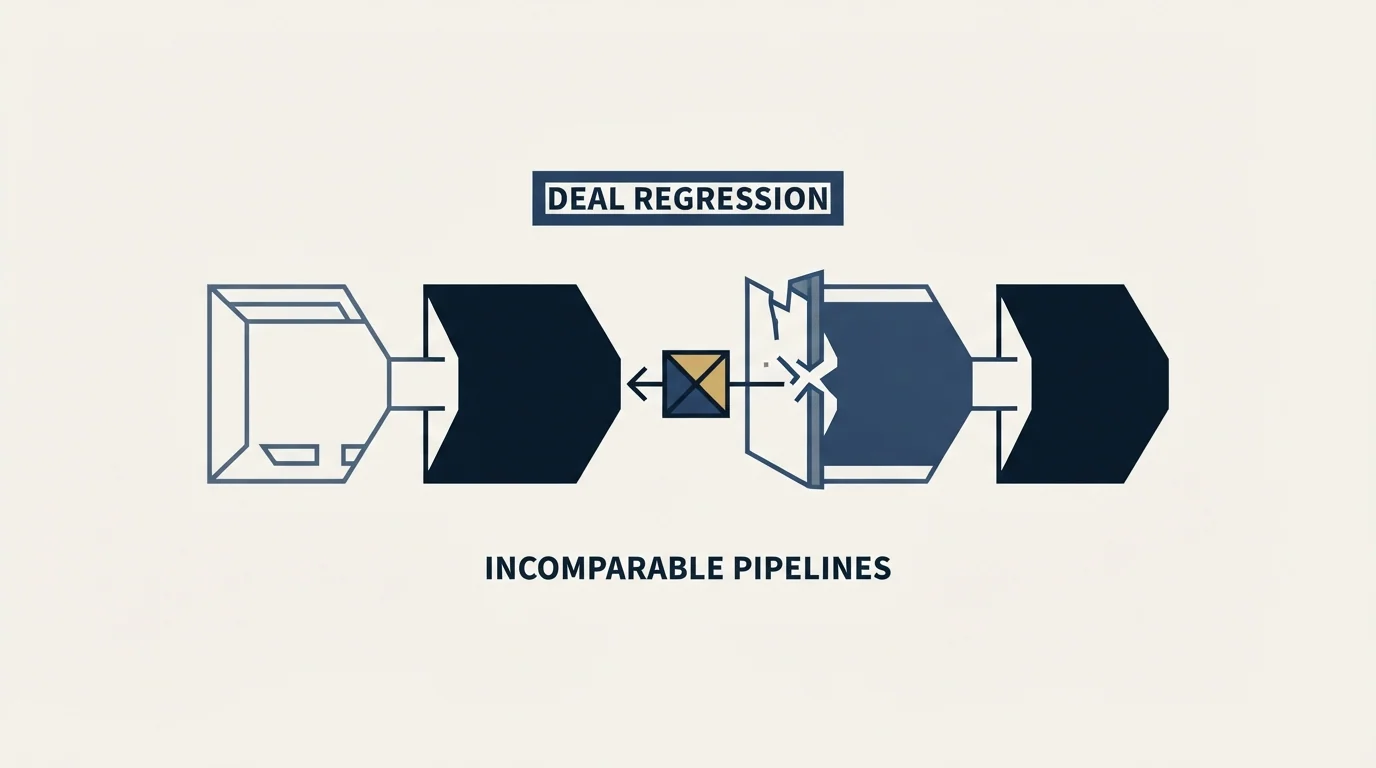
Most CRM configurations make backward movement awkward, so it does not happen, so late stages accumulate deals that stopped being real months ago.
A late-stage deal with no buyer action in sixty days has told you something by its silence, and a pipeline that cannot represent that will carry it into three consecutive forecasts. Write the rule down: define the inactivity window per stage, and make the move backwards or to closed-lost a routine step rather than an admission of failure. The forecast improves immediately, because the number stops including deals nobody believes in.
The related discipline is a documented reason code on every loss. Losses to a competitor, to budget, to no-decision and to wrong-fit are four completely different problems, and only one of them is a sales problem. Without codes they aggregate into a single unhelpful number.
What the funnel does not cover, and why that matters here
The generic funnel ends at close. In SaaS, the closed deal has delivered a fraction of its value, and the rest depends on renewal and expansion. That is not a note about customer success, it has a direct effect on the funnel above it: how much you can afford to spend acquiring a customer depends on how long they stay, so a retention change moves the economics of every stage upstream.
The practical consequence is that funnel targets set from first-year contract value alone will systematically under-invest in acquisition for a product that retains well, and over-invest for one that does not.
Where lead generation sits against all this
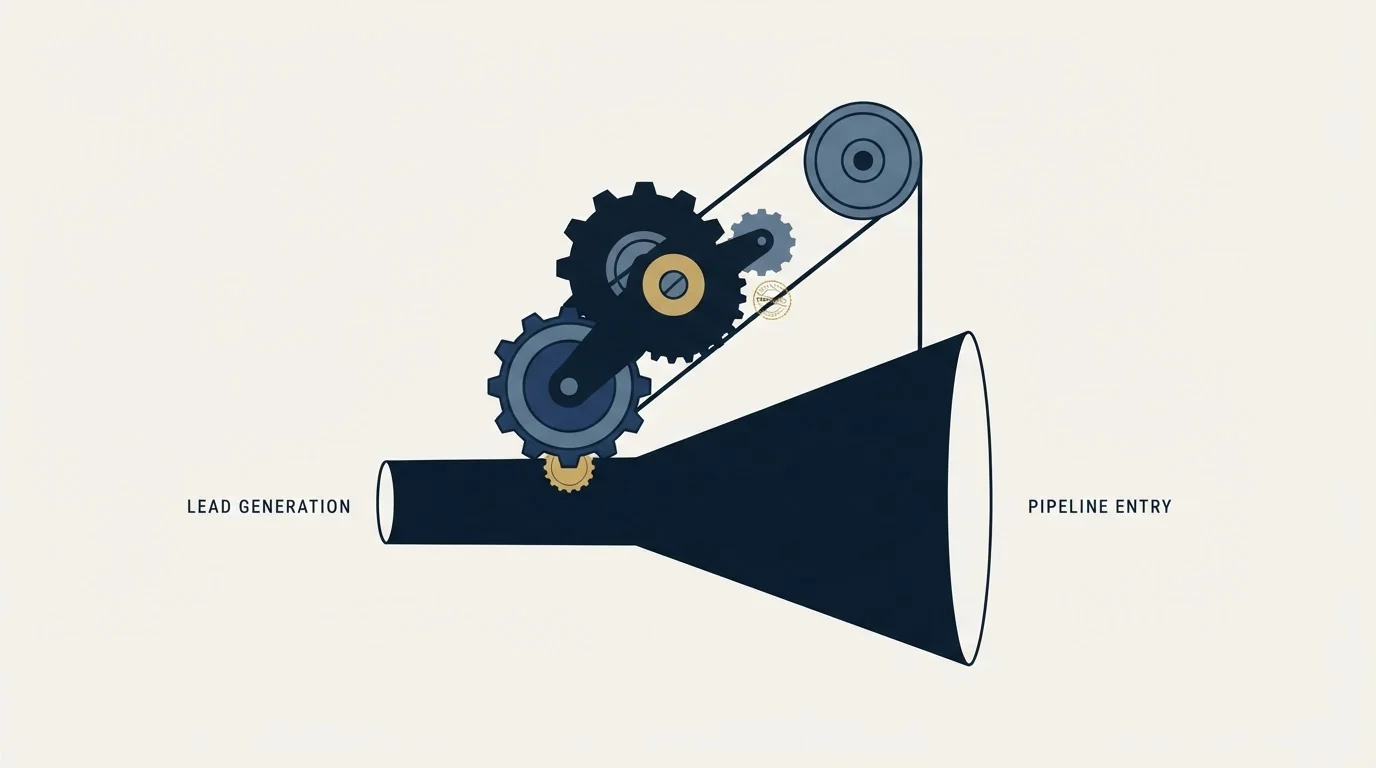
Everything above is measurement of demand you already have. It will not create any, and a well-defined funnel with nothing entering it is a well-defined empty funnel.
For the part that fills it, the outbound channel mix by deal size piece covers what an attempt costs in each channel and where each stops making sense. Our own constraint on that half is that a campaign carries one message, built on one premise, and is sent once, which pairs naturally with a buyer-action funnel: both refuse to count seller activity as progress. A message sent is not a stage, and a stage entered without the buyer doing anything is the same error one layer down.
The short version
Define every stage exit by an action the buyer took that a third party could verify from the record, or your pipeline is an average of as many measurement systems as you have reps. Keep self-serve and sales-led paths in separate funnels. Report every conversion rate alongside its denominator, because a rate over a filtered set improves when the filter tightens. Make backward movement routine and code every loss. And remember the funnel measures demand rather than producing it.
If the problem is what enters the funnel rather than how it is measured, we can put a campaign in front of your market.
Frequently asked questions.
Frequently asked questions- What is a SaaS sales funnel?
- A SaaS sales funnel is the sequence of stages a software buyer moves through between first contact and a signed subscription, with a conversion rate measured between each pair of stages. The SaaS version usually carries two motions at once, self-serve trials and sales-led deals, and the sale continues after close through renewal and expansion, which changes what acquisition can cost.
- What are the stages of a SaaS sales funnel?
- A workable sales-led version has six: lead, discovery, evaluation, proposal, commit and closed won. Each is left by a buyer action. The prospect attended a call, named their current tool and its problem, introduced a second stakeholder or requested security documents, asked for pricing in writing, then sent a redline or a PO number. Stage names vary by team, but the form should hold.
- How many stages should a SaaS pipeline have?
- Five or six is the practical ceiling for most SaaS pipelines. Below that you lose resolution. Above it, each stage holds too few deals for its conversion rate to be readable. If two adjacent stages convert at nearly the same rate and deals pass through one in a few days, they are one stage with two names and should be merged.
- Why does my stage conversion rate improve while revenue does not?
- Usually because the denominator shrank. A conversion rate calculated only over deals that reached a stage reports on the survivors, so when an earlier filter tightens, the later rate rises for reasons unrelated to performance. Always read the count entering a stage beside its rate, and treat a rising rate on a falling count as one signal.
About the author.

B2B cold email experts helping companies generate qualified leads through done-for-you outreach campaigns.
RevenueFlow Team
Explore more.
Ready to scale your outreach?
We build GTM engines that book real meetings. See the receipts.
Related articles.
Command of the Sale: Force Management's Process Programme
Command of the Sale is Force Management's sales process and qualification programme, not its messaging one. What the vendor says it is, delivers and how it runs.
B2B Lead Lists for Aviation Companies: Build or Buy
Aviation is one of the few industries whose accounts are published by its regulator, which changes what is worth buying and what is worth downloading yourself.
LinkedIn Outreach for Banks: A Regulated Message
How a bank's relationship managers use LinkedIn to reach business owners: what the FFIEC guidance, FINRA's notices and LinkedIn's own rules require, and where to stop.
Cold Calling for PPC Agencies: What You Can See First
A paid media prospect is partly readable before the call and has already been told by the platform what to do when a stranger rings about its ads.
SDR Outsourcing for Logistics Companies: The Brokerage Line
What an outside sales development team may do in a freight company's name, the calling and email rules it inherits, and which arrangement survives a bid-shaped market.
SDR Outsourcing for Business Brokers: The Fee Timing
Whether a success-fee brokerage should rent sales development at all: the fee timing, the texts that limit what an outside person may say about value, and who signs.