Best Email Sending Tools for SaaS (2026)
The five email sending tools worth comparing for SaaS in 2026, with prices read off each vendor's own pricing page and an honest read on fit.
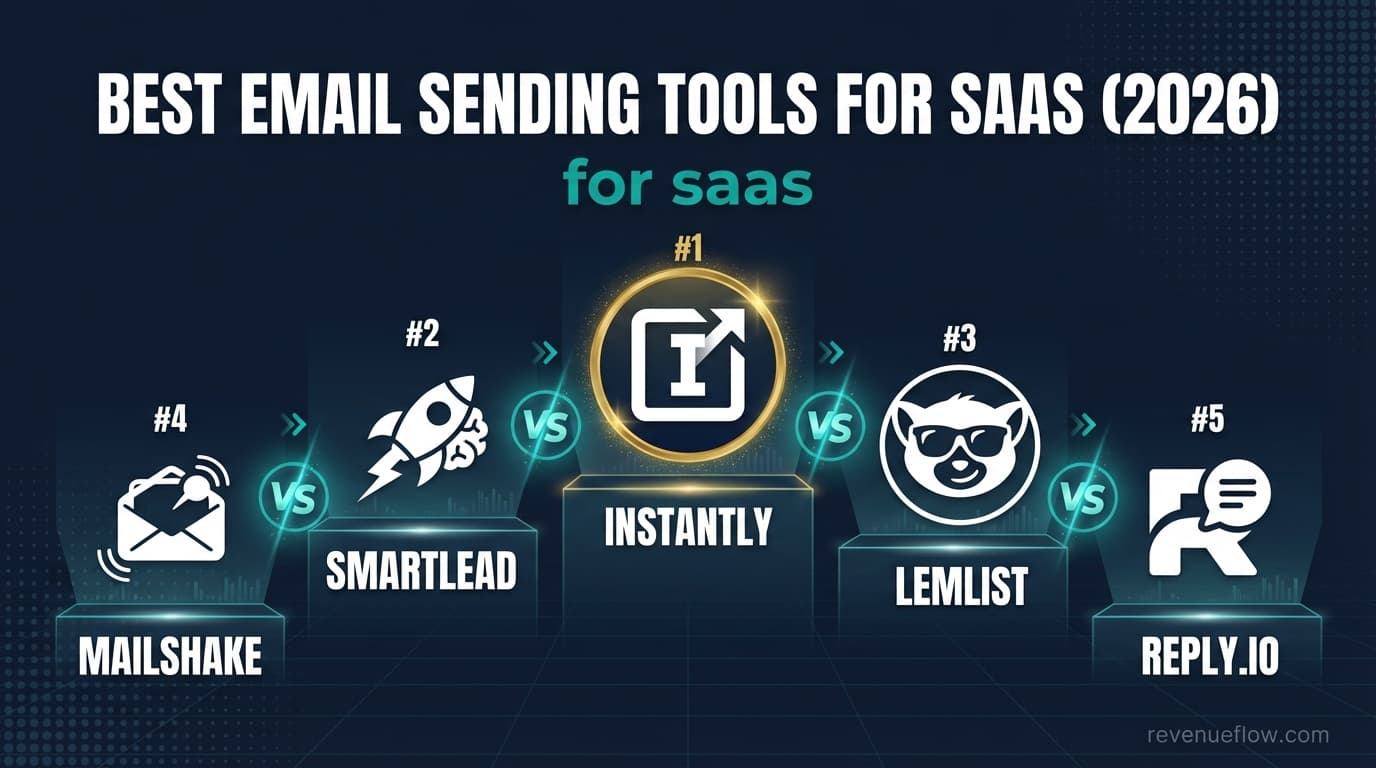
The best email sending tools for SaaS in 2026 are Mixmax, Lemlist, Snov.io, Saleshandy and Woodpecker. Mixmax and Snov.io publish free plans, Saleshandy starts at $34 a month billed annually, Lemlist at $55 yearly, and Woodpecker charges $7.00 per 100 contacted prospects. For SaaS, the deciding factor is whether product context reaches the copy.
Key takeaways
- For SaaS, pricing shape matters more than feature count: seat pricing tracks headcount while a product-led team is usually few people addressing a large trial and prospect base.
- Mixmax publishes a Free plan at $0/mo and Snov.io publishes a renewable free Trial plan, so two of the five tools can be started without a card.
- Saleshandy's pricing page starts at $34/mo billed annually and $41/mo paid monthly, and Lemlist's starts at $55/mo on yearly billing and $69/mo billed monthly.
- Woodpecker prices on people contacted rather than seats, publishing $7.00 per 100 Contacted prospects with warm-up, verification and unlimited email accounts included.
Reviewed and updated September 2, 2026
Best Email Sending Tools for SaaS (2026)
A SaaS sales team usually arrives at an email sending tool with a problem the tool was never designed to solve: the highest-intent person in the list is already inside the product, sitting on a trial that expires on Thursday. The sending platform sees an address. The product sees behaviour. Whether those two facts ever meet in the same message is what separates a useful setup from an expensive one.

What SaaS Companies Need
- Trial-to-paid conversion
- Product usage data
- Integration with product analytics
Trial-to-paid conversion is the demand that bites hardest, because it puts a clock on the send. A trial cohort is only addressable for as long as the trial runs, so a platform that batches sends into slow daily quotas quietly drops the people worth reaching most. Look at how quickly a tool will let you load a list and start sending, and at whether it can hold several small time-boxed campaigns at once rather than one large slow one.
Product usage data and analytics integration are the same requirement wearing two labels. Nothing in this category reads your product database directly. What the better options do is accept a custom field per contact and let you segment on it, so the enrichment work you do upstream survives into the message. Judge a tool on how many custom fields it accepts and how easily they reach the copy, because that is the seam where product context either arrives or is lost.
Two SaaS habits are worth resisting whatever the tool allows. Sending to a trial list from the domains that carry cold outbound mixes two very different reputations on one asset, and a message that opens by reciting what somebody did in the product reads as surveillance unless the next sentence earns it.
How This Guide Was Put Together
Every price, plan name and database size on this page was read off the vendor's own pricing page, from a dated snapshot taken while the guide was written, and each figure is attributed to the page it came from rather than to the vendor in general. That distinction earns its keep: vendors contradict themselves across their own surfaces, and Lemlist does it inside a single page, as the note under its entry explains.
No lab test sits behind this. Nobody here ran a controlled send across five platforms, so the guide makes no claim about which tool lands in more inboxes. What it does judge is fit: what each pricing model rewards, what it punishes, and which shape of team the published plans were drawn for.
Top 5 Email Sending Tools for SaaS

- AI-powered email sequences
- Email tracking and analytics
- Meeting scheduling (1-click)
- and 7 more listed below
- 650M+ lead database
- AI personalization
- Email warmup and deliverability boost
- and 5 more listed below
- Email finder and verifier
- Unlimited email sending
- Drip campaign sequences
- and 7 more listed below
1. Mixmax
Sales engagement platform that lives inside Gmail, with AI-powered sequences, email tracking, meeting scheduling and conversation intelligence.
Starting price on the Mixmax pricing page: $0/mo, on the Free plan. Top per-user price on that page: $105/mo on monthly billing, above which Mixmax for Teams is quoted as Custom.
| Plan (Mixmax pricing page) | Monthly billing | Annual billing |
|---|---|---|
| Free | $0/mo | $0/mo |
| Inbox Copilot | $34/mo | $29/mo |
| Meeting Copilot | $34/mo | $29/mo |
| Engagement Copilot | $65/mo | $49/mo |
| Mixmax Suite | $105/mo | $89/mo |
| Mixmax for Teams | Custom | Custom |
Key Features:
- AI-powered email sequences
- Email tracking and analytics
- Meeting scheduling (1-click)
- Conversation intelligence
Integrations: Gmail, Google Workspace, Salesforce, HubSpot, Pipedrive, Slack, Zoom, Calendly (+1 more)
For a SaaS team already living in Gmail, Mixmax is the least disruptive of the five, and the Free plan means a founder-led motion can start without a procurement conversation. The trade-off is the pricing shape: it charges per seat, so the cost tracks headcount rather than sending volume, which is the wrong direction for a small team addressing a large trial base.
2. Lemlist
Multichannel outreach platform built around a 650M+ lead database, with email and phone finding, LinkedIn automation, and built-in warm-up.
Starting price on the Lemlist pricing page: $55/mo on yearly billing, or $69/mo billed monthly. Top named price on that page: $87/mo per user on yearly billing, with Enterprise quoted as Custom.
| Plan (Lemlist pricing page) | Yearly billing | Monthly billing |
|---|---|---|
| $55/mo | $69/mo | |
| Multichannel | $87/mo | $109/mo |
| Enterprise | Custom | Custom |
Worth knowing before you budget: the Email plan card on that page advertises unlimited users, while the compare-plans table further down the same page prices Email from $55 per user per month. Those two statements sit on one page and do not agree, so confirm which applies before committing a team.
Key Features:
- 650M+ lead database
- AI personalization
- Email warmup and deliverability boost
- Unlimited email follow-ups
Integrations: HubSpot, Salesforce, Pipedrive, Close.io, Zoho CRM, Zapier, Make, n8n (+5 more)
Lemlist earns its place in SaaS when the buying committee is wider than the trial user, because the bundled database and multichannel reach let one campaign touch the champion and the economic buyer without a second tool. Weigh that against the per-user Multichannel pricing and the unresolved per-seat question on the Email plan.
3. Snov.io
Sales automation and lead generation platform with an email finder, an email verifier, campaign automation and a built-in CRM.
Starting price on the Snov.io pricing page: free, on the renewable Trial plan. Top named price on that page: $738/mo on Ultra.
| Plan (Snov.io pricing page) | Monthly price |
|---|---|
| Trial | Free |
| Starter | $39 |
| Pro S | $99 |
| Pro M | $189 |
| Pro L | $369 |
| Ultra | $738 |
Two details on that page shape the real bill. Annual subscriptions are marked Save 25%, so those figures are the top of the range, and LinkedIn automation is not bundled: the page prices LinkedIn account slots separately at $69/mo per slot.
Key Features:
- Email finder and verifier
- Unlimited email sending
- Drip campaign sequences
- Built-in sales CRM
Integrations: HubSpot, Pipedrive, Zapier, Make, Calendly, Phantombuster, Gmail, Outlook
Snov.io is the strongest fit when the SaaS list has to be built as well as sent to, since finding, verifying and sending sit behind one subscription and the CRM is included. The published tiers step up on credits and recipients rather than seats, which suits a small team working a large list. LinkedIn is the gap, and it is a paid one.
4. Saleshandy
Cold email outreach platform with unlimited sending mailboxes, AI-powered sequences, built-in warm-up and a large B2B contact database.
Starting price on the Saleshandy pricing page: $34/mo billed annually, or $41/mo if paid monthly. Top named price on that page: $149/mo billed annually, or $189/mo paid monthly.
| Plan (Saleshandy pricing page) | Billed annually | Paid monthly | Active prospects | Users |
|---|---|---|---|---|
| Starter | $34/mo, $408/year | $41/mo | 2,000 | 1 User |
| Pro | $76/mo, $912/year | $99/mo | 30,000 | 10 Users |
| Scale | $149/mo, $1,788/year | $189/mo | Unlimited | Unlimited |
Seats are the limit that catches people out. The same page states that Starter is a single seat, Pro covers a team of ten and Scale has no seat limit, while sending mailboxes are unlimited on all three with no per-inbox fees. Every plan carries a 7-day free trial, and the page sizes the bundled data at 852M+ contacts and 42M+ companies.
Key Features:
- Unlimited email accounts, with no per-inbox fees
- Unlimited Email Warm-up
- AI-powered email sequences
- Multichannel sequences across email, calls, LinkedIn and WhatsApp
Integrations: HubSpot, Salesforce, Pipedrive, Zoho CRM, Zapier, Make, n8n, Slack (+2 more)
Saleshandy suits a SaaS team that has accepted it needs several sending domains, because unlimited sending mailboxes with no per-inbox fees remove the arithmetic that makes scaling awkward elsewhere. The catch is the active-prospect ceiling on Starter, which a trial base plus an outbound list reaches quickly.
5. Woodpecker
Cold email automation platform priced on the number of people you contact rather than on seats, with warm-up, inbox rotation and email verification included.
Starting rate on the Woodpecker pricing page: $7.00 per 100 Contacted prospects. How the top is published: that page runs a slider rather than named tiers, so there is no ceiling price to quote.
| Woodpecker pricing page | Published figure |
|---|---|
| Contacted prospects, entry rate | $7.00 per 100 Contacted prospects |
| Annual billing | SAVE 33% |
| LinkedIn outreach add-on | $29 /monthly per LinkedIn account connected |
| Extra Lead Finder credits | Starts at 500 credits for $10 |
That page also lists free email verification, free warm-up, inbox rotation, adaptive sending, unlimited team members and unlimited email accounts as included rather than as add-ons. That is what changes the comparison: costs other vendors meter separately sit inside the contacted-prospect rate.
Key Features:
- Unlimited team members
- Unlimited email accounts
- Email warmup included
- Catch-all email address verification
Integrations: HubSpot, Salesforce, Pipedrive, Zapier, Make, n8n, Google Sheets, Calendly (+1 more)
Woodpecker fits the SaaS shape better than most, because a product-led team is usually few people contacting many, and the published rate charges for people contacted rather than for seats. It is the wrong choice if the SaaS motion is a small number of large enterprise accounts, where you are paying a volume price for a low-volume list.
Comparison Table
| Tool (entry price from its own pricing page) | Entry price | Free option | What the price scales with |
|---|---|---|---|
| Mixmax | $0/mo Free plan | Yes | Seats, per plan tier |
| Lemlist | $55/mo yearly, $69/mo monthly | 14-day free trial | Seats on Multichannel |
| Snov.io | Free Trial plan | Yes | Credits and recipients |
| Saleshandy | $34/mo annually, $41/mo monthly | 7-day free trial | Active prospects and email volume |
| Woodpecker | $7.00 per 100 Contacted prospects | Free trial | People contacted |
Recommendation by Budget

Starting at zero. Mixmax publishes a Free plan at $0/mo and Snov.io publishes a renewable Trial plan at no cost, so both let you send something real before any card is entered.
The cheaper seats. Saleshandy Starter is published at $34/mo billed annually, Mixmax Inbox Copilot at $34/mo on monthly billing, and Lemlist Email at $55/mo on yearly billing.
Volume rather than seats. Woodpecker's pricing page charges $7.00 per 100 Contacted prospects with unlimited team members included, the cheapest shape when a small team contacts many people and the most expensive when a large team contacts few.
The upper published tiers. Snov.io Pro S is published at $99, Saleshandy Pro at $99/mo paid monthly, Lemlist Multichannel at $109/mo billed monthly. Above that the pages stop naming prices: Mixmax for Teams and Lemlist Enterprise are both quoted as Custom.
How to Choose for SaaS
Does it carry product context into the copy? Count the custom fields the tool accepts per contact and confirm they render in the subject line, not only the body. Enrichment that cannot reach the subject line is doing less work than it appears to.
Does the pricing shape match the motion? Seat pricing rewards a large team sending a little. Volume pricing rewards a small team sending a lot. A SaaS team is usually the second, and picking the first is how a tool becomes expensive without anyone deciding it should.
Seat-versus-volume arithmetic repeats one category up, and among sales engagement platforms for SaaS teams only one vendor publishes a rate you can buy without a sales call.
Can it hold several small campaigns at once? Trial cohorts, expansion accounts and cold outbound are three audiences with three sending windows. A platform comfortable with one big list and awkward with ten small ones forces batching that hurts the trial cohort.
How does it handle sending domains? Trial and lifecycle mail should not share reputation with cold outbound. Confirm the tool lets you attach separate domains to separate campaigns before you commit, because retrofitting that split later means rebuilding everything.
What happens on reply? The reply is the only outcome that matters, and it lands in a human inbox. Check that replies are routed and visible without a second licence, since a reply nobody sees is worse than a message nobody sent.
Setting It Up Without Burning Your Domains
- Step 1Dedicated domains
Buy sending domains that are separate from the domain carrying client, billing and product mail
- Step 2Warm-up
Run each new inbox at low volume until it has sending history, which is the slow step
- Step 3List and verification
Build and verify the list while the domains warm, so neither waits on the other
- Step 4One message
Send a single message per campaign, then read replies rather than opens
Start with the domain question, because it is the only decision that is expensive to reverse. Buy sending domains that are separate from the domain your product and billing email use, give them a warm-up run before any campaign touches them, and keep the trial lifecycle mail on its own asset. A SaaS brand that burns its primary domain on a cold campaign loses password resets and receipts along with the outbound.
Then ramp the volume rather than opening it. New inboxes should carry a small daily send that grows over weeks, and the tools here differ in how much of that they automate: warm-up is included in the published Saleshandy and Woodpecker plans and is a named Lemlist feature, while a Mixmax setup will want a separate warm-up tool alongside it.
One message per campaign is the house rule, and it applies here regardless of what the platform supports. A single well-aimed email to a trial user, sent once, outperforms a sequence that keeps arriving after the answer was no.
Where the Tool Stops Mattering
The tool stops mattering where the list starts. A SaaS outbound list built from a generic firmographic filter underperforms a smaller list built from a real product signal, and no amount of sequencing rescues the difference. Enrichment quality rather than sending capacity is the binding constraint.
The offer is the other half. A trial user who did not activate is waiting to be told what the product does for the job they were trying to do, and that sentence is written by a human who understands the product.
The Decision Shortcut
Running founder-led and want to send something this week: Mixmax's Free plan, in the inbox you already use. Building the list and sending from one place on a modest budget: Snov.io, where finding and verifying are inside the same subscription. Several domains and real volume ahead of you: Saleshandy for the unlimited accounts, or Woodpecker if the team is small and the list is large. Wider buying committee than the trial user: Lemlist, with the per-seat question settled in writing first.
Related Reading
- Best Lemlist Alternatives in 2026
- Best Saleshandy Alternatives in 2026
- Best Woodpecker Alternatives in 2026
- Email warmup tools for SaaS teams
- Data enrichment tools for SaaS teams
- CRM tools built for SaaS teams
If you would rather have this run for you, RevenueFlow books qualified meetings on a pay-per-meeting basis and publishes client results.
Pricing and features are taken from the vendors' own pages. Verify current terms with the vendor before relying on them.
Frequently asked questions.
Frequently asked questions- What makes an email sending tool suitable for a SaaS company?
- The tool has to carry product context into the message. None of these platforms reads a product database, so what matters is how many custom fields each contact can hold and whether those fields render in the subject line rather than only the body. Speed of campaign creation matters too, because a trial cohort is addressable only while the trial runs.
- Should trial emails and cold outbound go through the same tool?
- They can share a tool, and they should not share sending domains. Cold outbound carries a different reputation risk from lifecycle mail, and mixing them puts trial notifications and password resets behind the same filtering decision as a cold campaign. Attach separate domains to each programme, and confirm the tool supports that split before committing.
- Which of these tools can I use without paying anything?
- Mixmax publishes a Free plan at $0 a month and Snov.io publishes a renewable Trial plan at no cost, so both let you send something real before entering a card. Lemlist and Saleshandy publish trials rather than free tiers, at 14 days and 7 days respectively, and Woodpecker offers a free trial. Only the first two are ongoing free plans.
- Why do the prices on the vendor pages not match what I remember?
- Every figure in this guide was read from the vendor's own pricing page on a dated snapshot, and several of these vendors repriced during 2026. Saleshandy and Woodpecker in particular now publish different plan structures from their earlier ones. Check the page itself before budgeting, because a price quoted anywhere else, including here, is a snapshot rather than a contract.
About the author.

B2B cold email experts helping companies generate qualified leads through done-for-you outreach campaigns.
RevenueFlow Team
Explore more.
Ready to scale your outreach?
We build GTM engines that book real meetings. See the receipts.
Related articles.
Best Time to Cold Call: What the Studies Counted
The best time to cold call figures traced to their originals: one inbound study from six companies, three vendor call datasets, and what survives the read.
Best Time to Send a Sales Email: What Was Measured
The send time studies behind the midweek morning answer, what each one actually counted, and why a broadcast finding does not transfer to a sales email.
Is Clay Free? The Free Plan, the Trial and Where Each Stops
Clay's free plan, its 14-day trial and the no-charge-on-a-miss rule are three different things. What each holds and where it stops, from clay.com on 19 September 2026.
Video Prospecting Tools by Job: What Each One Is For
Ten video prospecting tools sorted by the job each vendor's own page describes: record and share, personalise at volume, avatars, hosting and interactive demos.
Seamless.AI Email Finder: How It Works, What a Credit Buys
How Seamless.AI's email finder resolves a contact in real time, what one Universal Credit buys, the Total AI score on every address, and what the Chrome extension reads.
Social Selling Tools by Job, and the Account-Risk Line
Fourteen social selling tools sorted into six jobs, split by whether each acts through your LinkedIn account or beside it, from the vendors' own pages.