BDR Sales: The Seat That Opens the Conversation
BDR sales is the prospecting front of a B2B sales process: a business development representative sources, contacts and qualifies prospects, then hands each qualified conversation to an account executive who closes. BDR and SDR usually name the same job, and where a company splits them the BDR works accounts that never asked.
Key takeaways
- Titles vary between companies but measurement does not: a BDR is judged on qualified conversations created, an account executive on closed revenue.
- The seat owns four decisions, and account selection moves the outcome further than any of the other three while being the least trained.
- The hand-off standard has to be written down before anyone is measured against it, or the count becomes the target and the closing seat stops trusting the source.
- When inbound and conference leads share a queue with cold accounts, record whether each meeting's interest arrived or was created, and pay every seat on meetings the account executive accepts.
BDR sales is the front end of a B2B sales process: a business development representative, or BDR, sources, contacts and qualifies prospects so that somebody else can carry the resulting opportunity to a signature. The seat creates qualified conversations and leaves the closing to another seat, and it is measured on those conversations rather than on calls made or emails sent.
Two companies advertise a BDR role in the same week. At the first, the person will call and write to strangers at named accounts all day. At the second, the person will answer demo requests within five minutes of the form landing. Both postings are accurate. The letters do not settle what the job is.
The definition is easy and the boundaries are not, and the boundaries are where the confusion and the operational damage come from.
What is BDR sales?
BDR sales is the prospecting stage of a sales process. A rep picks accounts, starts a conversation with the right person at each one, and qualifies that conversation against a written standard before handing it to an account executive. The BDR owns everything before that hand-off, and the account executive owns everything after it, through to the signature.
Job ads write it both ways, sales BDR or BDR sales, and mean the same seat. On floors that split outbound from inbound, BDR names the outbound seat, and the next section draws that line.
BDR, SDR and AE: what the three letters actually divide
The clean way to read the roster is by what each seat is measured on, because titles vary between companies while measurement does not.
A BDR is measured on qualified conversations created. The unit is a meeting that met an agreed standard, not a call made or an email sent. Everything upstream of that meeting belongs to the seat: which accounts get worked, what the message says, and whether the person who took the meeting was the right person.
An SDR is measured on the same unit, and the difference between the two titles is which direction the interest came from. Where companies distinguish them at all, the BDR works accounts that have never heard of them and the SDR handles interest that arrived on its own. The live entry on outbound SDR and inbound SDR works through why that split matters more than the label does, and SDR meaning covers the other seat in full. Plenty of companies use the two words as synonyms, and nothing is wrong with that as long as one person is not quietly doing both jobs.
An account executive is measured on closed revenue. The AE owns the deal from the qualified conversation onward. The boundary between the two seats is a single event, and the argument about where exactly that event sits is the expensive unresolved question on a sales floor that runs both.
The clocks differ as much as the units. A BDR learns within days whether an account was worth the attempt, an SDR handling inbound learns within minutes whether a request was answered in time, and an account executive learns within months whether the deal closes. The failures differ in the same way: the BDR seat fails on targeting and relevance, the SDR seat on response speed and triage, and the account executive on discovery and the buying group.
The same argument runs down the other side of the process, where a technical seat meets the closing one, and presales vs sales works through who owns the demo, who may agree to a proof of concept, and who is allowed to call a deal technically dead.
That is the whole of the difference between sdr and bdr as a working distinction, and the comparison pages that add a salary table to it are quoting ranges from vendor blogs that name no survey and disagree with each other about which seat takes the inbound half.
What the seat actually owns
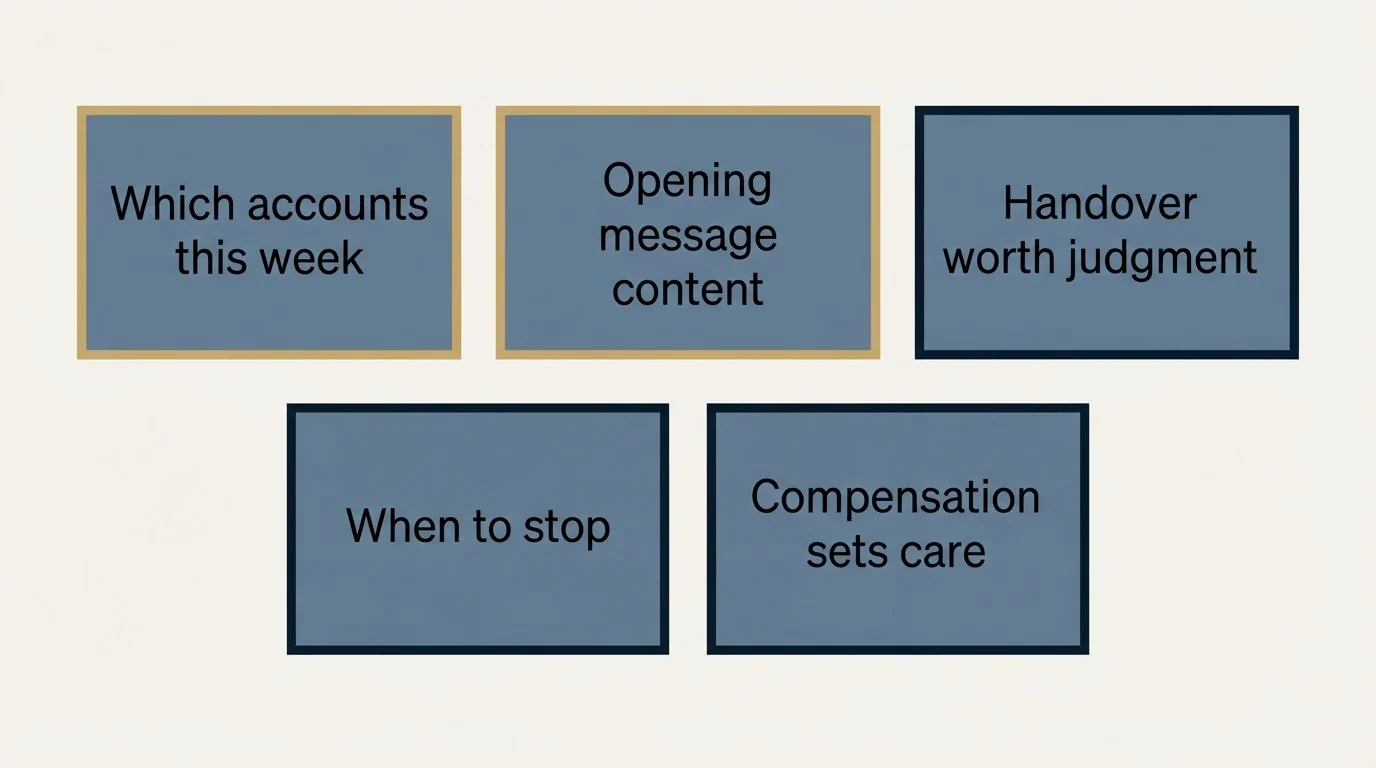
The job description usually lists activities. The useful version lists decisions, because the activities are downstream of them.
Which accounts get time this week. A BDR working a named list has to decide where the effort goes, and this is the decision that moves the outcome furthest. It is also the one least likely to be trained, because it resists reduction to a module. The live BDR training guide argues that this judgement is the hard part of the role and the part most programmes skip.
What the first message says. A BDR who is handed copy and told to send it is not being asked to make this decision, which is a defensible operating model. A BDR who writes their own is making a positioning judgement every day, at volume, on behalf of the company.
Whether a conversation is worth handing over. This is the decision that quietly sets the quality of everything downstream, and it is the one under the most pressure, because the seat is measured on the count.
When to stop. Deciding an account is not worth further attempts is a real decision with a real cost, and a seat measured only on meetings booked has no incentive to make it.
Which of those four decisions actually gets made carefully is settled by the compensation plan rather than by the job description. A plan that pays on meetings booked buys the third decision and neglects the first and the fourth, because the first is slow and the fourth reduces the number being paid on. A plan that pays on meetings accepted by the closing seat buys all four, and it only works where the acceptance standard was written down first. That is the whole design problem in one sentence.
Paid on meetings booked
- Buys whether a conversation is handed over
- Neglects which accounts get time, because that decision is slow
- Neglects when to stop, because stopping reduces the count
Paid on meetings accepted by the closing seat
- Buys all four decisions
- Needs an acceptance standard written down first
Why it matters: the hand-off is where the value leaks
The reason companies separate the seats is specialisation. Prospecting and closing need different skills, run on different clocks and fail in different ways, and one person doing both will do the urgent half and neglect the other.
The reason the arrangement disappoints is almost always the boundary between them.
A meeting is booked, the account executive attends, and afterwards the two of them disagree about whether it should have happened at all. The BDR points at the criteria and the AE points at the conversation. Both are describing the same meeting. What is missing is a written standard agreed before anyone was measured against it, which is the subject of the qualified appointment entry and the single highest-leverage document on a sales floor that runs two seats.
Without it, three things happen in order. The BDR optimises for the count, because the count is what gets reported. The AE loses confidence in the source and starts working their own pipeline, which was the thing the arrangement existed to avoid. And the number the company plans against becomes a meeting count that nobody believes, which makes the whole forecast unreliable one stage further down.
The fix is a definition, written down, with the disagreements resolved in advance rather than in a review meeting after the quarter.
How the BDR seat works in outbound
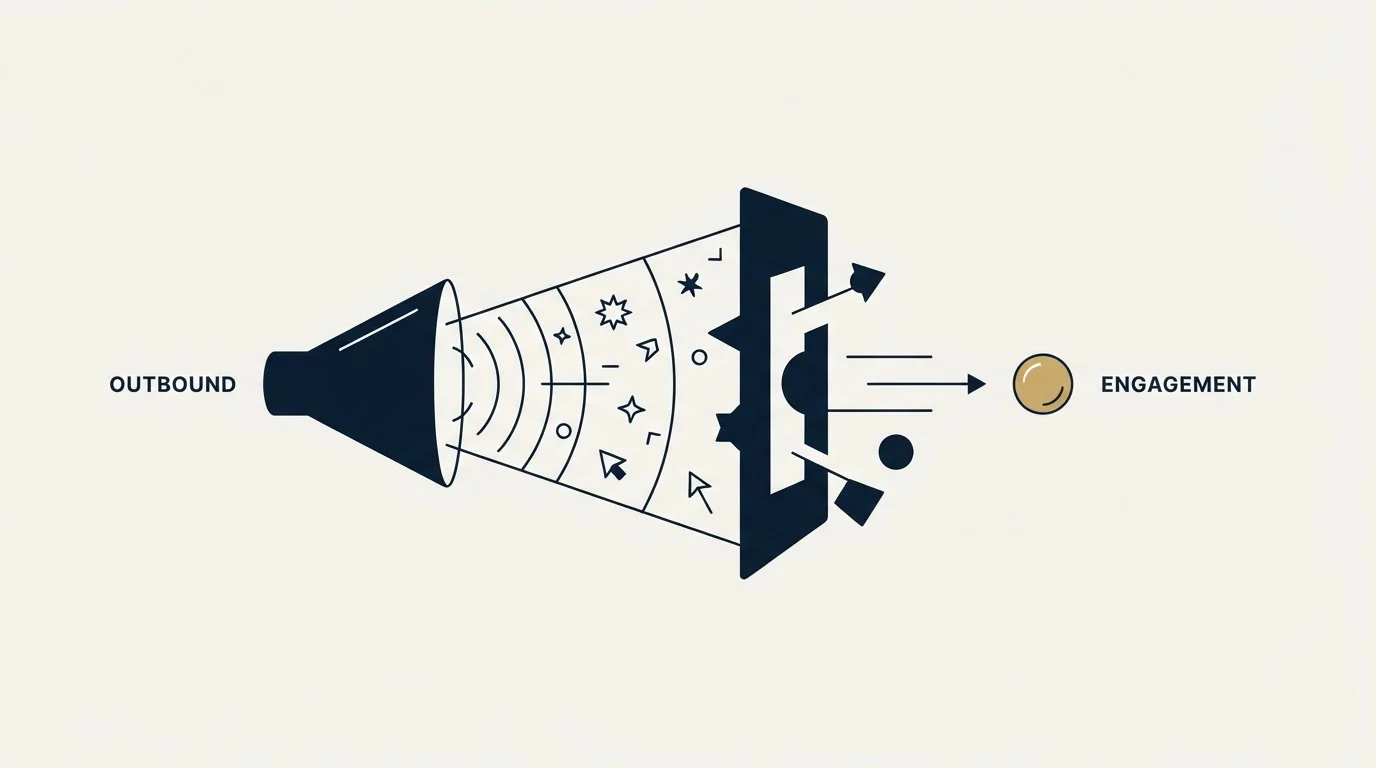
The BDR seat exists because outbound sales needs somebody to start conversations that nobody asked for, and the economics of that are not the economics of closing.
Three consequences follow for a programme rather than for a person.
The seat is a capacity decision before it is a hiring decision. A BDR can only work as many accounts as the list supports, and a list that is too small gets consumed. The failure looks like a performance problem and is a supply problem: the rep contacts everyone worth contacting inside two months, and then contacts the rest. Outbound prospecting sets out what the constraint actually is, and it is almost never rep hours.
A learning rep spends the list. Accounts handled badly early are spent rather than paused, because the next attempt lands on somebody who already formed a view. That is the argument for a certification gate before live contact rather than after it, and it is why ramp is a list problem as much as a training one. Ramp time is the number that gets budgeted; the list damage during ramp is the number that does not.
One message per campaign changes what the seat is for. Our own doctrine is that a campaign carries one message built on one premise, and any later approach is a separate campaign with its own reason to exist. There are no bump sequences and no thread replies. That moves the entire burden onto the decisions above the send, which is exactly where a BDR's judgement is worth paying for, and it removes the activity metric that most BDR scorecards lean on. What is left to measure is qualified conversations and the quality of the account selection that produced them, which is the argument SDR metrics makes about which numbers a rep actually controls.
The management question that follows is when the seat needs a manager of its own rather than an AE supervising part time. That threshold, and what the job owns once it exists, is covered in the SDR manager role.
BDR team incentives when inbound and conference leads are in the mix
A BDR team's incentive structure breaks the first time warm leads land in the same queue as cold accounts. Inbound demo requests and the people who stopped at a conference booth arrived with interest. A named account that never asked did not. Pay both on meetings booked, and the rep holding the warm leads looks like the best performer on the floor while the rep creating conversations from nothing looks like the worst.
Three rules keep the plan honest.
Record the source on every meeting. Arrived or created is decided when the lead enters the system, and never argued about at the end of the quarter.
Route arrived interest to the seat measured on speed. Where the floor splits the two seats, inbound requests and booth conversations go to the SDR, whose job is response speed and triage. A conference attendee list worked cold is created interest, and it belongs to the BDR.
Pay every seat on meetings the account executive accepts, against the same written standard. The standard is the one thing both kinds of lead share, which is what makes the two numbers comparable.
| Lead | Interest | Worked by |
|---|---|---|
| Demo request from the website | Arrived | SDR, measured on speed |
| Conversation at your conference booth | Arrived | SDR, measured on speed |
| Conference attendee list, worked cold | Created | BDR |
| Named account that never asked | Created | BDR |
| Every meeting: accepted by the account executive against the same written standard | ||
Before any of that pays out fairly, whether the person is in house or supplied by a partner, a few things have to exist: a written standard for a qualified conversation agreed before launch, a list large enough that the seat is not consuming it faster than it is replenished, a named owner for account selection, a certification gate before the rep contacts real accounts, and a stated route for the rep to escalate a targeting problem rather than absorb it. A review of accepted and rejected meetings, run jointly with the closing seat, keeps the standard honest once it exists. An activity target used as the primary measure of the seat is the one thing that list leaves out.
Related terms
A BDR works the front of outbound sales and produces the input to outbound lead generation, which is the wider function the seat sits inside. The unit of work is a qualified appointment, and the standard it has to meet is set by lead qualification. The seat downstream is the account executive, and the numbers the arrangement is judged on are quota attainment and ramp time. Where the interest arrived on its own rather than being created, the object being worked is an inbound lead and the job changes shape, which is the split outbound SDR and inbound SDR draws out.
The short version
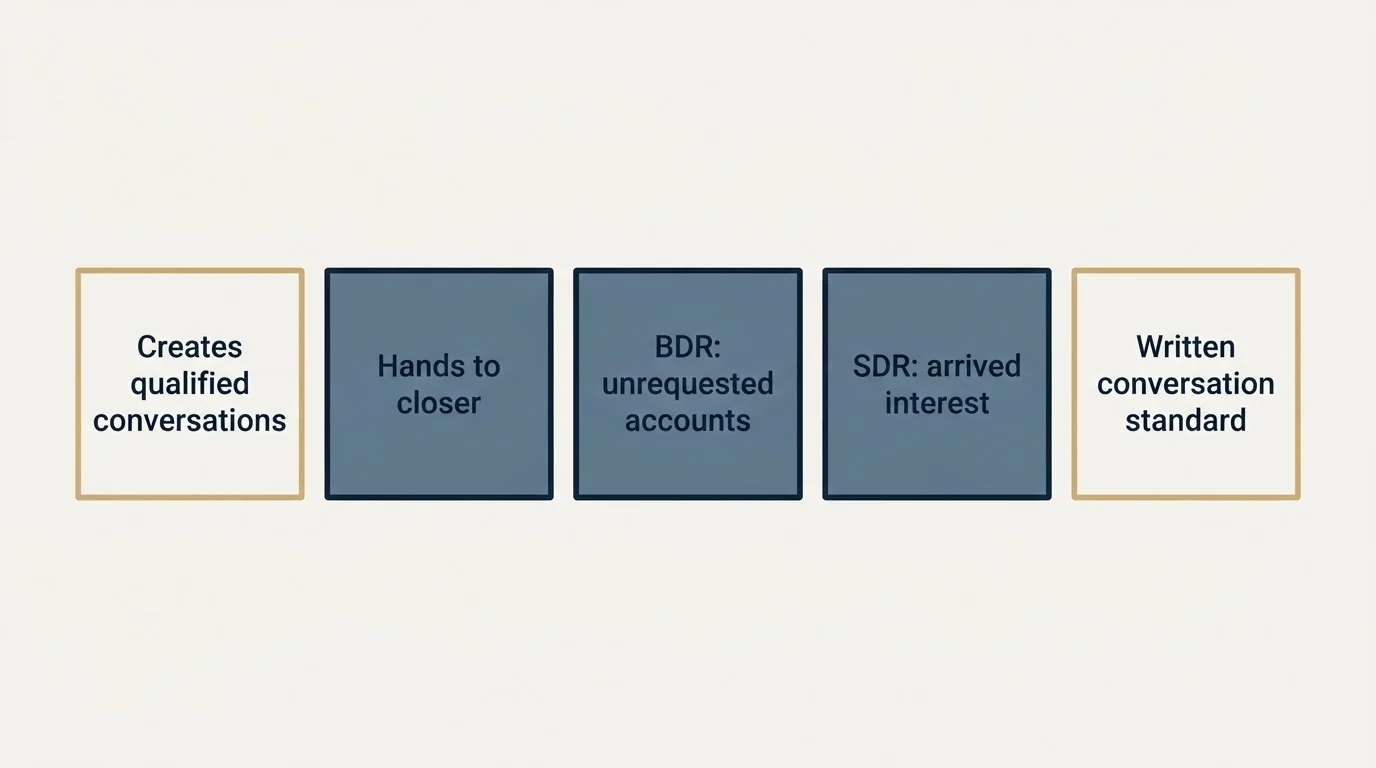
A BDR creates qualified conversations at the front of a sales process and hands them to somebody who closes. The letters BDR and SDR usually mean the same job, and where a company distinguishes them the BDR works accounts that never asked and the SDR works interest that arrived. The seat owns account selection, the first message, the qualification call and the decision to stop, and it is measured on conversations that met a standard. Write that standard down before anyone is measured against it, size the list before hiring against it, and put the certification gate before live contact rather than after the first hundred accounts have been spent.
RevenueFlow runs the front of that motion for B2B teams as a service, one message per campaign, against meeting criteria agreed in writing before launch. If you would rather not build the seat, see how the campaigns work.
Frequently asked questions.
Frequently asked questions- What is BDR sales?
- BDR sales is the prospecting stage of a sales process. A business development representative picks accounts, starts a conversation with the right person at each one and qualifies it against a written standard, then hands it to an account executive who carries it to a signature. The seat is measured on qualified conversations created rather than on calls made or emails sent.
- What is the difference between a BDR and an SDR?
- Most companies use the two words interchangeably. Where the split is real, the BDR works outbound into accounts that have never heard of the company and the SDR handles interest that arrived on its own. The two jobs fail in opposite directions, one on targeting and relevance and the other on response speed and triage, so a single person doing both is a structural problem rather than a training gap.
- How should a BDR team be paid when inbound and conference leads come in too?
- Record on every meeting whether the interest arrived or was created, and route arrived interest, such as demo requests and booth conversations, to the seat measured on response speed. Then pay every seat on meetings the account executive accepts against the same written standard. Paying on meetings booked makes whoever holds the warm leads look like the best rep on the floor.
- How should a BDR be measured?
- On qualified conversations that met a standard written down before launch, and on the quality of the account selection that produced them. Activity targets are the common alternative and they measure the part of the job the rep controls least. Where an activity number is used at all, it belongs in a diagnostic conversation rather than on the scorecard the seat is paid against.