SDR Meaning: What a Sales Development Rep Actually Does
SDR stands for sales development representative, and the defining fact is that they sell nothing. That explains the comp plan, the metrics and the burnout.
SDR stands for sales development representative. The role creates qualified conversations for somebody else to sell into, so an SDR closes nothing. It splits into outbound work that generates conversations from a target list and inbound work that qualifies existing interest, two jobs sharing one title.
Key takeaways
- SDR stands for sales development representative, and the single defining fact about the role is that it does not close anything.
- A BDR is usually the same job under a different name, though some companies use BDR for outbound and SDR for inbound.
- Outbound and inbound sales development share a title and very little else, differing in constraint, metric and hiring profile.
- Because the role hands off before revenue, its metrics measure conversations created rather than deals won, which is what makes compensation design difficult.
Reviewed and updated September 1, 2026
A sales development rep does not sell anything. That single fact explains most of what is confusing about the role: the comp plan, the metrics, why the job burns people out, and why so many companies hire one and then cannot work out whether it is working.
An SDR's entire job is to create qualified conversations for someone else to sell into. Everything below follows from that.
SDR stands for sales development representative, and the question of who is an SDR has a one-line answer that the rest of this page unpacks: the person whose entire job is creating qualified conversations for somebody else to close. Two unrelated meanings dominate the bare acronym outside sales, software-defined radio and the International Monetary Fund special drawing right, and neither has anything to do with this role. SDR stands for sales development representative, and the expansion is worth stating because the same three letters are the standard abbreviation for software-defined radio in engineering and for the International Monetary Fund special drawing right in finance. The SDR abbreviation is context-dependent outside sales, so a reader arriving from a search for the bare acronym may want software-defined radio or a special drawing right instead; in a revenue team it always means the role described here.
What the role actually is
People searching for what an SDR in marketing is are usually asking where the role reports rather than what it does, and the answer is that the function is a sales one that lives at the marketing boundary: it works the interest marketing creates and hands over the conversations account executives close.
Handing over is the whole relationship between the two seats, and the account executive definition describes a role measured on outcomes it cannot create alone.
The sales development rep sits between marketing and the closing team. Marketing creates awareness and interest at scale. Account executives run deals. The SDR bridges the two, by starting conversations that neither of those functions starts on its own.
There are two distinct versions of that job, and conflating them is the most common structural mistake in the function. An outbound SDR generates conversations from nothing, working a target list of companies that have never heard of you. An inbound SDR responds to people who already raised a hand, qualifying them and booking the ones worth a call. Same title, different work, different skills, different metrics. We cover that split in outbound SDR versus inbound SDR.
The role also gets confused with two adjacent ones. A BDR is usually the same job under a different name, though some companies use BDR for outbound and SDR for inbound. An account executive owns the deal from qualified conversation to close. The handoff between SDR and AE is where most pipeline quality problems originate.
What the seat owns where a company does draw that line, and what BDR sales is measured on against the closing seat, is set out in its own entry.
What the day looks like
The honest version is repetitive, and the repetition is the point.
- Step 1Review replies and bookings
Answer anything that came in overnight first. A reply left for four hours is frequently a meeting lost.
- Step 2Research and prepare
Work the target accounts for the day: who to contact, why now, what specifically to say.
- Step 3Contact blocks
Concentrated periods of calling and sending, protected from meetings and admin.
- Step 4Qualify and book
Run the conversations that come from the contact, qualify against written criteria, book the ones that pass.
- Step 5Log and hand off
CRM hygiene and a genuine handoff to the AE, so the deal starts with context rather than a calendar invite.
The part that looks optional and is not is the first step. Reply speed is the highest-leverage variable an SDR controls, and it is the one most damaged by a calendar full of internal meetings.
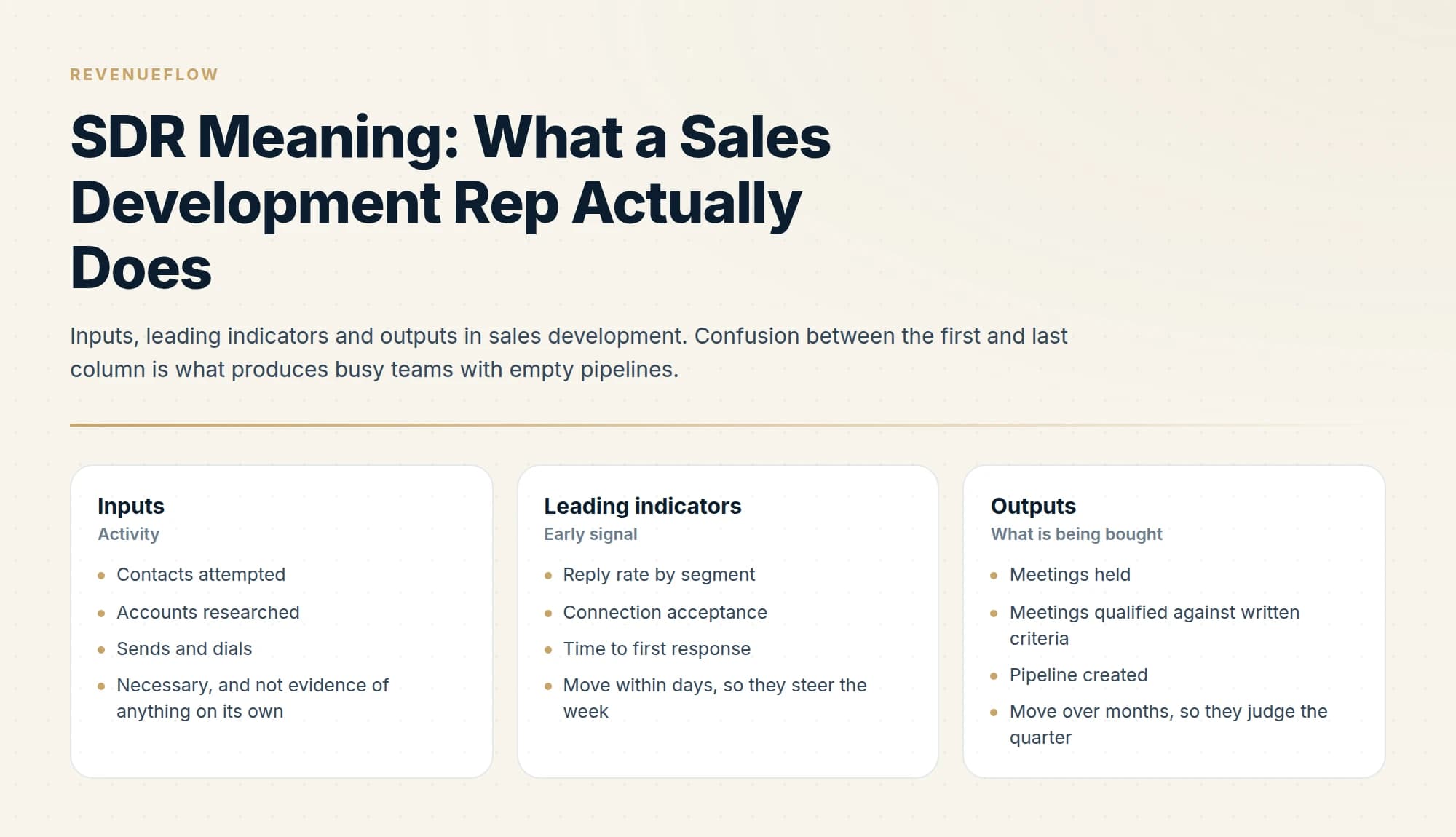
The part that looks productive and often is not is raw activity volume. An SDR sending large volumes to a poorly built list generates bounces, damages sending reputation, and produces the appearance of work. Activity is an input, and it only converts when the list and the message are right.
The metrics that actually matter

Most SDR scorecards measure too many things and weight the wrong ones.
Held meetings is the real output. Not booked, held. The gap between the two is a real number and it is a coaching signal in itself.
Qualified meetings is the output that matters commercially, measured against criteria agreed in writing before anyone starts contacting. Without a written definition, "qualified" drifts to whatever gets the rep to target.
Reply rate is the leading indicator worth watching daily, because it moves long before meetings do and it points at the list or the message rather than at effort.
Time to first response is the most neglected number in the function. It is entirely within the rep's control and it decides a meaningful share of winnable meetings.
Activity counts belong in a diagnostic conversation, not on a scorecard. When dials and sends are the target, the list quality and the message quality are what get sacrificed to hit them.
- Contacts attempted
- Accounts researched
- Sends and dials
- Necessary, and not evidence of anything on its own
- Reply rate by segment
- Connection acceptance
- Time to first response
- Move within days, so they steer the week
- Meetings held
- Meetings qualified against written criteria
- Pipeline created
- Move over months, so they judge the quarter
Why the job is hard in a specific way
The difficulty is not the rejection, though there is plenty of it. It is that an SDR is accountable for an outcome that depends heavily on inputs they do not control.
They do not choose the target list in most organisations. They do not set the offer. They frequently do not own the message. They rarely control the quality of the contact data, and unreachable contacts consume their day exactly like reachable ones. When any of those inputs is wrong, the rep's activity cannot fix it, and the usual response is to ask for more activity.
That is the actual mechanism behind SDR burnout and the function's well-known turnover problem. A rep working a good list with a real offer has a hard job with visible progress. A rep working a bad list has an impossible job that looks identical from the outside.
The practical implication for anyone managing the function: before asking a rep to do more, check contact coverage on their list, check reply rate by segment, and check whether the offer has ever been tested. Those three explain more variance than effort does.
How the role is structured
Three arrangements are common, and they suit different stages.
Founder-led, no SDR. Before product-market fit is clear, the founder does this work because the learning is the point. Handing it over early outsources the most valuable feedback loop in the company.
In-house SDR reporting to sales. The standard shape once the motion is repeatable. It needs a manager who has done the job, which is a genuine constraint covered in the SDR manager role.
Outsourced or hybrid. Buying the function, or buying capacity alongside an internal rep. The cost comparison and the conditions that decide it are in outsourced SDR versus in-house.
There is a fourth arrangement worth naming because it is increasingly common and frequently misunderstood: tooling that automates parts of the role. What that genuinely replaces, and what it does not, is covered in AI SDR.
Ramp, and why it is longer than anyone plans for

A new SDR is not productive on day one and is usually not productive in month one. They need the product, the market, the objections, the tooling and the judgement to know which accounts deserve time.
The cost of that ramp is not only the salary during it. A ramping rep works real accounts, and the ones they handle badly are spent. On a named target list, a poorly executed first contact removes that company from the addressable set for months. That is the strongest argument for structured onboarding with gates before live contact, which we cover in SDR training and ramp.
- Yes: A target list someone in sales has signed off on
- Yes: Verified contact data for the people the rep is asked to reach
- Yes: Written qualification criteria agreed before contact starts
- Yes: A manager who has done the job and can coach the calls
- Yes: A defined handoff to the AE, with context rather than a calendar invite
- No: Activity volume set as the primary target
- Depends: Whether the offer has been tested on anyone yet
How SDRs are paid, and what that does to behaviour
Compensation for the role is usually a base plus a variable component tied to meetings, and the exact structure changes the work more than most people expect.
Paying on meetings booked produces meetings booked. Reps optimise for getting something in the calendar, and the no-show rate climbs, because a booking that never happens still paid.
Paying on meetings held is better and still imperfect. It removes the no-show incentive and leaves the quality question open, since a held meeting with the wrong person at the wrong company counts identically to a good one.
Paying on qualified meetings, judged against written criteria, aligns the rep with the business. It only works where the criteria genuinely exist in writing beforehand and are applied consistently, because otherwise the rep is being paid against a standard that moves when the number is short, which is worse for morale than any of the alternatives.
Paying on closed revenue sounds like the purest alignment and usually misfires at this level. The SDR does not control the deal, cycles run months, and the feedback arrives far too late to change behaviour. It also punishes reps for AE performance they cannot influence.
The practical recommendation is to pay on held meetings that pass written criteria, keep the criteria stable for at least a quarter, and resolve edge cases in the rep's favour. The amount of trust that buys is worth more than the handful of borderline meetings it costs, and a rep who believes the standard is fair will surface their own weak meetings rather than defending them.
Where the role is going
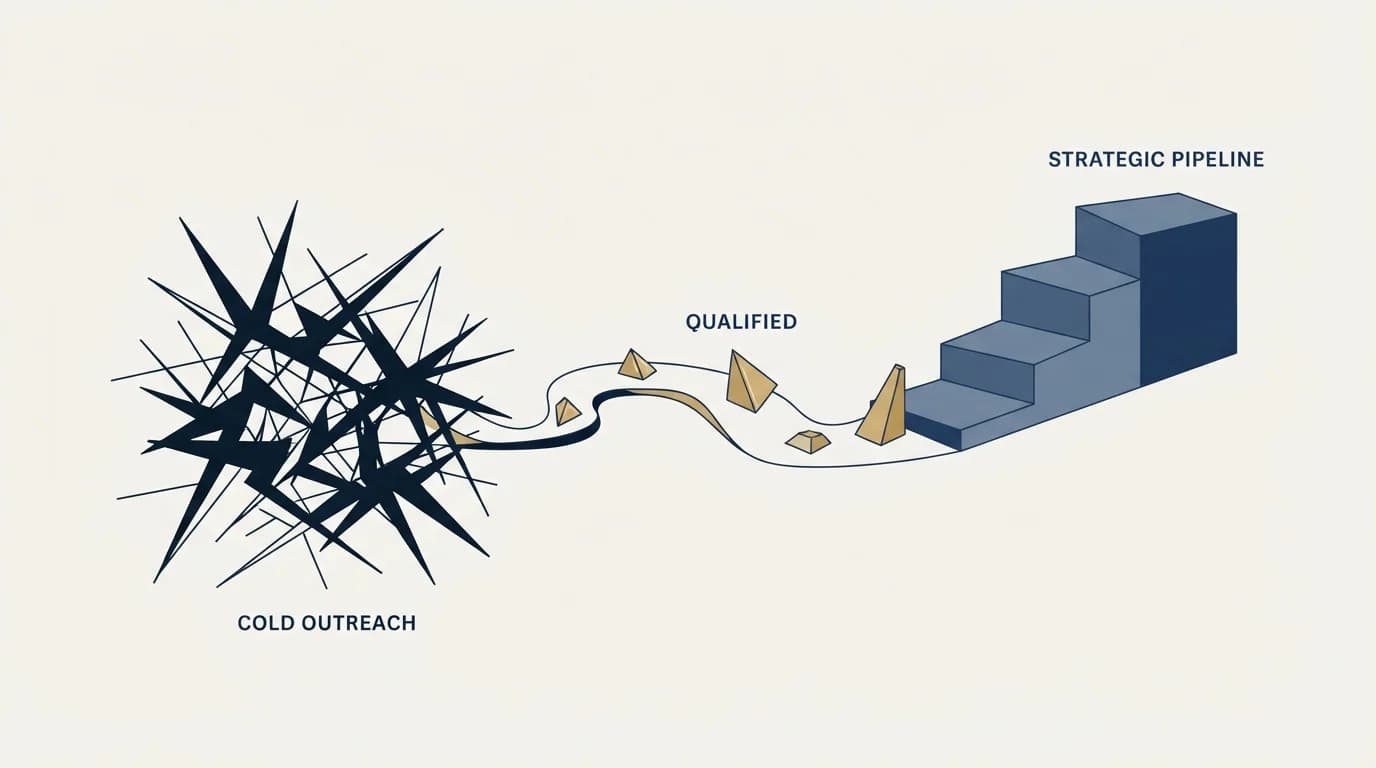
Two shifts are real and worth separating from the noise.
Research and list work, which used to consume a large share of the day, is increasingly automated. That does not remove the rep; it moves the bottleneck to judgement and to the quality of the conversation, which is the part that was always scarce.
The second shift is structural. As tooling handles more of the mechanical work, the remaining human job looks less like volume execution and more like account judgement, which is closer to the emerging GTM engineer role. The comparison between those paths is in SDR versus AI SDR versus GTM engineer.
What has not changed is the underlying constraint. Someone still has to decide which companies are worth contacting and give them a reason to reply, and no amount of automation makes a bad list produce good meetings.
The short version
An SDR creates qualified conversations for someone else to close, which is why their metrics are meetings rather than revenue. The role splits into outbound and inbound work that share a title and little else. Measure held and qualified meetings, watch reply rate and response time as leading indicators, and keep activity counts off the scorecard. Most SDR underperformance traces to list quality, contact data or an untested offer rather than to effort, so check those three before asking for more activity.
If the constraint is that nobody has time to run this function properly, we run outbound on a pay-per-qualified-meeting basis with the definition agreed in writing first, and you can see what a campaign would look like for your market.
Frequently asked questions.
Frequently asked questions- What does SDR stand for?
- Sales development representative. The role sits between marketing and the closing team, and its purpose is to create qualified conversations for an account executive to sell into. An SDR does not carry a closing quota and does not own revenue, which is the fact that explains most of what else is true about the job.
- What is the difference between an SDR and a BDR?
- Usually nothing beyond the name. A BDR is the same job under a different label at most companies. Where the two are distinguished, the common split is BDR for outbound prospecting into a target list and SDR for qualifying inbound interest, but the convention is not consistent enough to assume, so ask what a given company means by it.
- What does an SDR do all day?
- Builds and researches a target list, contacts people on it, handles the replies, qualifies the ones that respond, and books meetings for someone else to run. Outbound work generates conversations from a list the SDR assembles, while inbound work qualifies interest that already exists. The proportions decide what the job actually feels like.
- Is an SDR the same as a salesperson?
- An SDR works in sales but does not sell in the sense of closing. They create the opportunity and hand it over, so success is measured in qualified conversations rather than in revenue. That gap between the work and the eventual deal is why the role is hard to compensate well and why it burns people out.
About the author.

B2B cold email experts helping companies generate qualified leads through done-for-you outreach campaigns.
RevenueFlow Team
Explore more.
Ready to scale your outreach?
We build GTM engines that book real meetings. See the receipts.
Related articles.
The Agoge Sequence: What Sam Nelson Actually Built
A documented 15-touch, 27-day cadence built by Sam Nelson at Outreach. What the primary sources say, which part transfers, and where our own practice differs.
Sales Rep Coaching: The Cadence That Survives a Busy Quarter
Coaching that changes behaviour needs an artifact on the table and one named focus. The weekly loop, and the three layers a flat number can be hiding.
Inbound vs Outbound Sales: How the Two Motions Differ
Inbound and outbound sales compared as motions: what the rep knows at first touch, what each costs, the team each needs, and the metrics that belong to each.
Readymode Pricing: The Seat Is Dear for What Is Inside It
Readymode publishes $199 and $249 per licence per month, near the top of the dialer range. What the seat includes that others bill separately, and when that pays.
PhoneBurner Pricing: What the Seat Price Covers
PhoneBurner publishes all three seat prices in both billing states. The metered resource is contact imports, not minutes, and the spam layer is an add-on at every tier.
Koncert Dialers: Line Counts Published, Price Is Not
Koncert publishes the parallel line ceiling on every tier, which most of this category will not. It publishes no price. What its pages state, and what the quote decides.