The Inbound Marketing Sales Funnel: Four Stages
Attract, convert, close, delight. Three of the four name a mechanism you can point at. The transition everyone fills with a schedule is the one with nothing behind it.
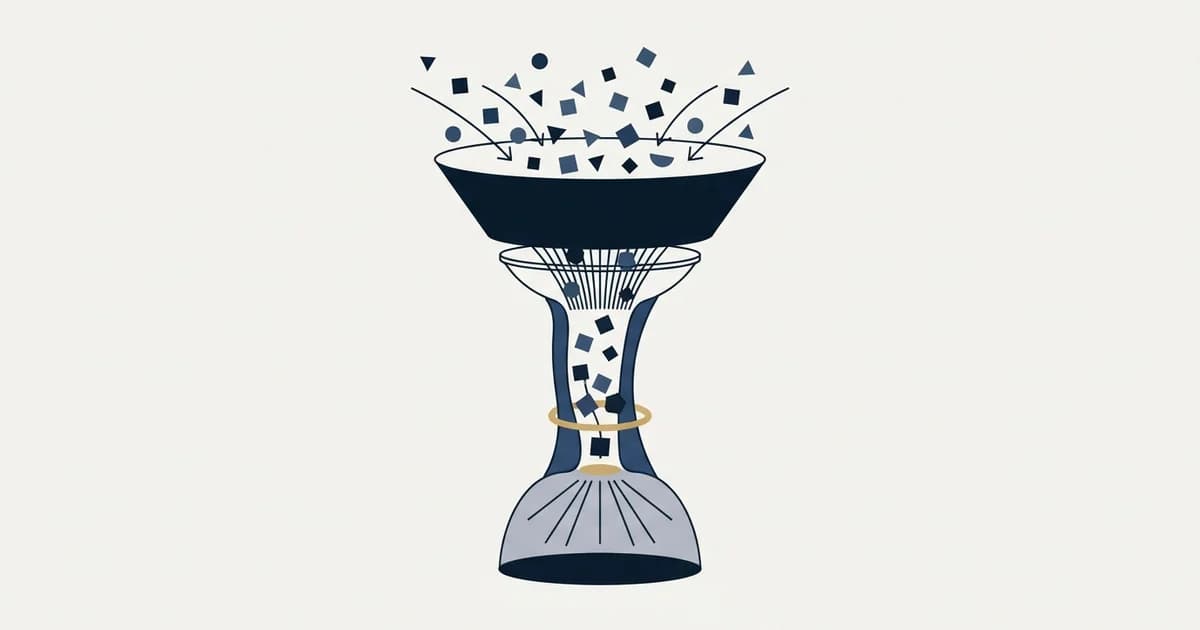
The inbound funnel is a shared vocabulary for handoffs rather than a description of how buyers behave. Three stages name a real mechanism. The move from converted to closed names a hope, usually filled with a scheduled email track. Better mechanisms exist: a reason to return, a product surface to try, and one message when something actually changes.
Key takeaways
- Use the funnel as a filing system for handoffs between owners, and stop expecting it to predict buyer behaviour.
- Every stage boundary is a handoff, and handoffs are where the leaks are: the offer, the response time, and the expectation gap after close.
- Time in stage is the number that exposes a middle-of-funnel with no mechanism, usually long before anybody admits to it.
- Delight is the only stage whose output feeds the top of the funnel, and it is typically measured on retention rather than advocacy.
Reviewed and updated September 2, 2026
The Inbound Marketing Sales Funnel: Four Stages, and One With No Real Mechanism
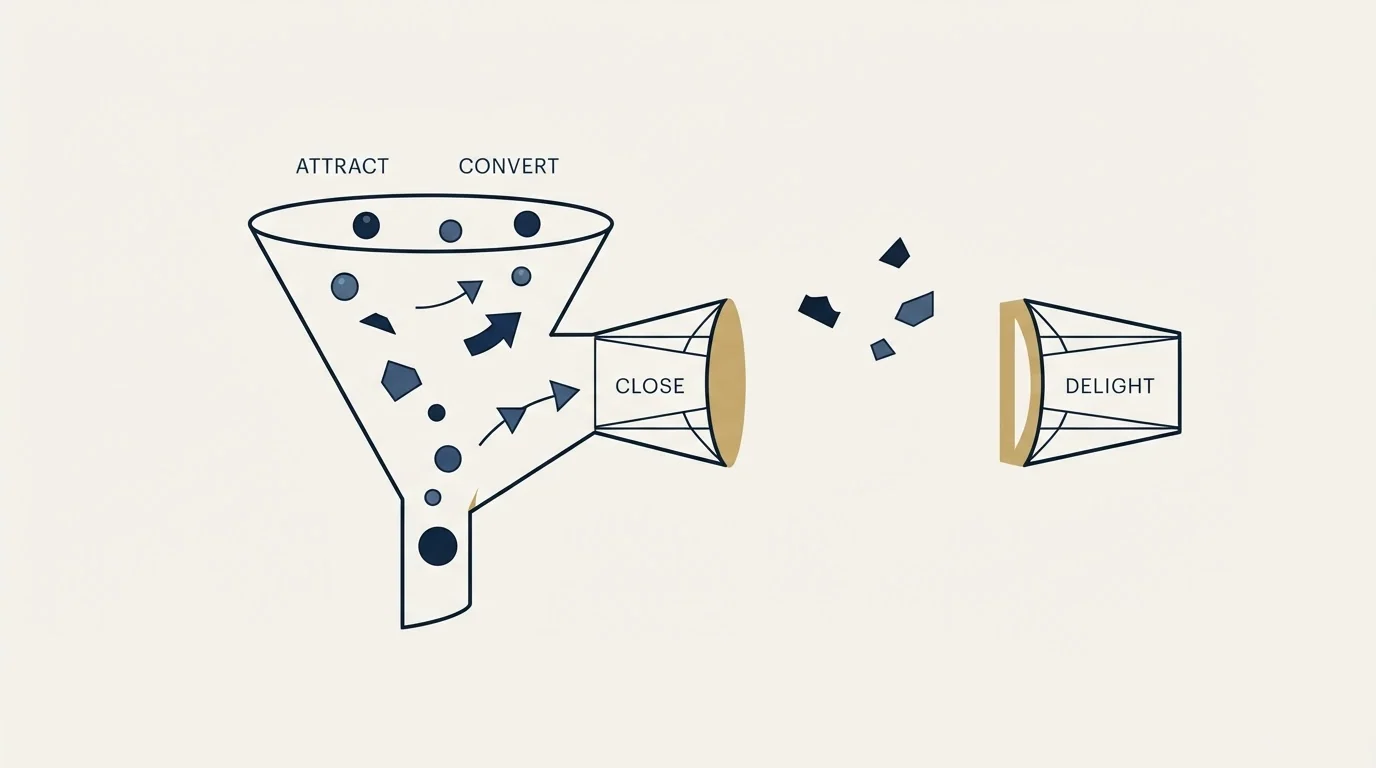
Draw the inbound funnel on a whiteboard and it comes out the same way every time. Attract at the top, convert below it, close below that, delight at the bottom. Everyone in the room agrees with it, because it is a fair description of what a company would like to happen.
Then somebody asks what actually moves a person from the second stage to the third, and the room goes quiet for a moment before someone offers a word that means keep emailing them. That pause is the interesting part of the model. Three of the four stages name a mechanism you could point at. The second-to-third transition names a hope.
Top of funnel means the Attract stage and the population inside it: everybody who has encountered you and has not yet identified themselves, which is the only stage measured in sessions rather than in people.
What the model is genuinely for
The same model is sold as a lead generation funnel when the stages are drawn from the first form fill rather than the first visit, and the seams are in exactly the same places.
A lead funnel is the same object again under a shorter name, usually drawn as top, middle and bottom of funnel rather than as the four stages here, and the transition with no mechanism behind it sits in exactly the same place.
The funnel is a shared vocabulary for a handoff. Its value is that two teams with different incentives can point at the same object and agree which one of them owns it right now. That is not a small thing, and it is worth keeping.
What it is not is a description of how buyers behave. Buyers loop. They research, go quiet for five months, come back with a different job title, involve four colleagues who have done none of the reading, and arrive at a shortlist assembled from a conversation you were not part of. The people who popularised the funnel largely replaced it with a flywheel for exactly this reason, which is an unusually honest thing for a vendor to do about its own diagram.
So use it as a filing system for handoffs, and stop expecting it to predict anything.
Real, and measurable in sessions
Real, and set by what you offer
Real, and owned by sales
Real, and owned by nobody in marketing
The three seams where funnels leak
Every stage boundary is a handoff between owners, and a handoff is where things fall.
Attract to convert leaks on the offer. The traffic is fine and the thing being asked for is not worth an email address, or it is worth one to a population who will never buy. This is a content-and-offer problem and it is the most commonly diagnosed one, largely because it is the easiest to see.
Convert to close leaks on time and on evidence. Somebody identified themselves, and by the time a human engages them the moment has passed, or the human has nothing to go on beyond a name and a downloaded file. The mechanics of closing this seam are in inbound lead generation.
Close to delight leaks on expectation. What was sold and what gets delivered differ slightly, and the gap shows up two quarters later as churn that marketing never hears about and therefore never corrects for.
The stage labels themselves cause a fourth problem, which is that two teams use the same word for different objects. An MQL that marketing counts and an MQL that sales accepts are separate numbers, and the argument about which is real is really an argument about evidence. The version of the definitions that survives that argument is in MQL vs SQL.
The middle of the funnel, where the standard answer is a schedule
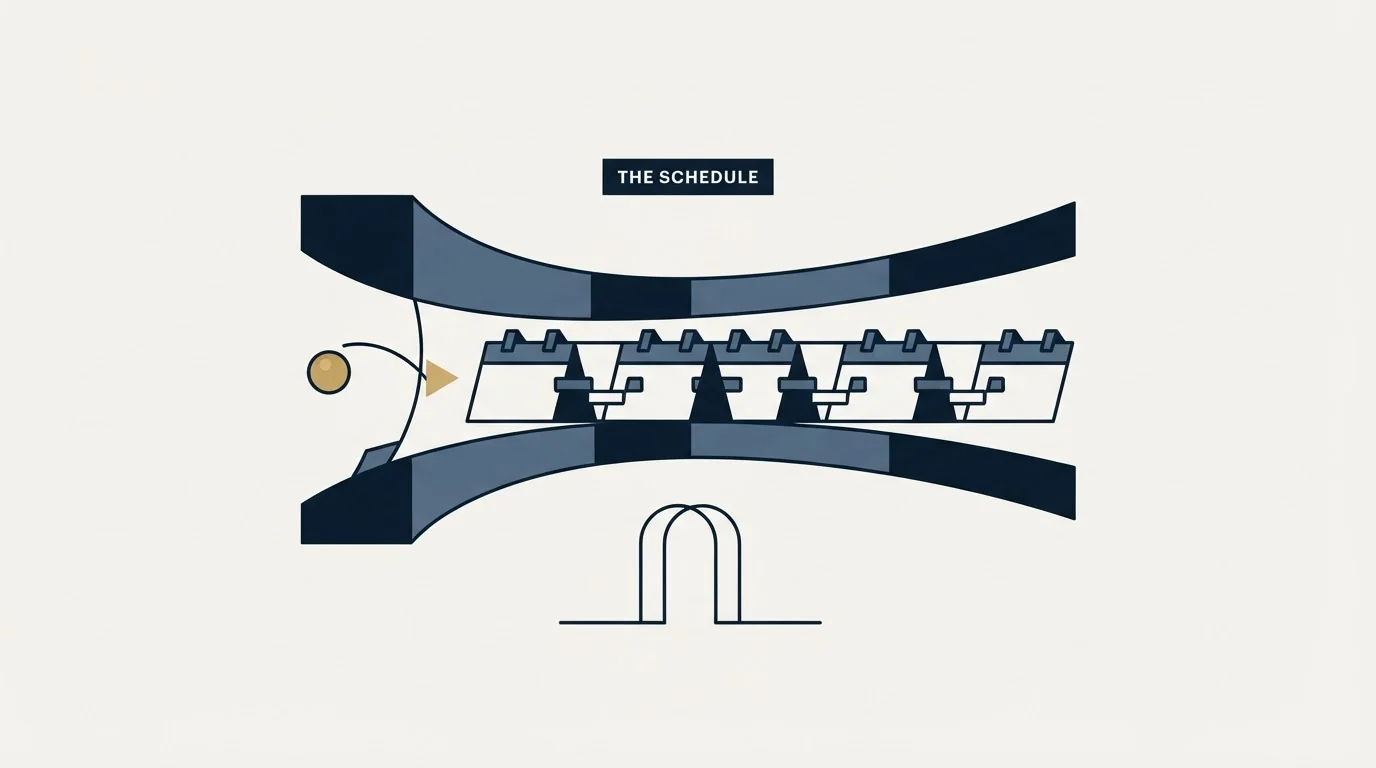
Here is the stage with no mechanism, stated plainly. A person converted. They are not ready to talk. Something is supposed to happen over the following weeks that makes them ready.
The conventional answer is a scheduled run of educational emails, spaced out over some number of weeks, that keeps arriving until the person books something or stops opening. Almost every treatment of this funnel recommends it, and the recommendation usually arrives with a diagram of numbered emails and day counts.
Where we differ from standard practice
We never run those, on our own outbound or on our clients'. One message per campaign, built on one premise, sent once, with no scheduled reminder afterwards.
Squeamishness about volume is not the reason. The reason is that a schedule substitutes for having something to say. When a person is silent, the honest interpretation is that the thing you offered was not what they needed that day. A timer does not change that fact and cannot discover what would change it. What it does is put your name repeatedly beside a feeling of low-grade obligation, which is a strange thing to spend brand equity on. What happened to our meeting rate when we stopped is in we stopped using follow-up emails.
What replaces it
The middle of the funnel does have real mechanisms. They are just harder than a schedule, which is why the schedule is popular.
Give them a reason to return rather than a reason to be reminded. A benchmark that updates, a tool they will need again, a number that changes quarterly. The person comes back because the thing is useful, and their return is a genuine signal rather than a manufactured one.
Let the product be the middle of the funnel. A sandbox, a limited free tier, a sample of the actual work. A person who tried the thing has moved themselves through the stage, and you learn more from ten minutes of their usage than from six months of opens.
Watch for a new premise, then write once. If something changes at their company that makes your case newly relevant, that is a reason to write, and it is a different message from the one you sent before. We treat that as a new campaign rather than as the next item on a schedule, because it is a genuinely different argument rather than a repetition of the last one.
Campaign messaging like this depends on the right delivery tooling, and the options built for agency workflows are compared in best sales engagement platforms for agencies.
Accept that some people leave the funnel. Most converted people are not going to buy this year, and pretending otherwise is what generates the schedule in the first place. A programme that lets them go, and stays findable when they come back, outperforms one that keeps talking.
- A timer decides when you speak
- Content is generic, written before you knew who they were
- Silence is treated as a reason to send more
- Measured in opens and clicks
- Requires no new information to keep running
- A new fact about their business decides when you speak
- Content is written after you know why you are writing
- Silence is treated as an answer
- Measured in conversations
- Requires a genuine reason, which is the point
The last stage is the only one that compounds, and marketing leaves the room
Delight sits at the bottom of the diagram, usually gets the least attention in the plan, and is the only stage whose output feeds back into the top of the funnel.
A customer who succeeds tells colleagues, answers questions in the communities where your buyers already are, agrees to be referenced, and shows up in the searches that matter most because they are searching for you by name. None of that appears in a campaign report, and all of it does more for attraction than another content pillar would.
What usually happens instead is that marketing hands off at close and the stage becomes customer success's problem, measured on retention. Retention and advocacy are different outcomes. A quietly renewing customer is retained and generates nothing at the top of the funnel. A customer who will publicly say why they chose you is doing attraction work that no amount of budget replicates.
The practical version is small: know which of your customers would speak on the record, ask them before you need them, and treat that list as a demand generation asset rather than as a sales collateral request. It is the cheapest attraction available and it is the one that requires somebody to have kept a relationship warm, which is why it usually does not exist.
Measuring it without fooling yourself
Three numbers, and one habit.
Stage-to-stage conversion rate, tracked separately. A single top-to-bottom rate hides which seam is leaking. Two adjacent rates tell you where to spend the quarter.
Time in stage. A stage where people sit for months is either mislabelled or has no mechanism, and both are worth knowing. This is usually the number that exposes the middle-of-funnel problem long before anyone admits to it.
Where the eventual customers first arrived, recorded separately from where they converted. These are almost always different pages, and standard attribution hands all the credit to the second one. A page doing the hardest work in the funnel can look like a failure for years.
Attribution has a harder limit than page order, since buyer conversations that carry no identifier never reach a system that could join them to anything.
The habit: count people who left. A funnel that only reports the survivors of each stage will always look reasonable, because a rate computed over the people who made it through is a rate over survivors. Knowing that four hundred people entered the middle stage and eleven emerged is a more useful sentence than any conversion percentage.
Where this funnel does not reach
Every stage of this model assumes the person arrived. An account that has never searched for anything in your category never enters at the top, and no amount of work on the four stages will find them. Deciding which accounts need a different play entirely is the subject of demand creation, capture and conversion, and the honest comparison of the two instruments is in inbound marketing vs outbound.
The short version
The funnel is a good filing system for handoffs and a poor model of buyer behaviour. Three of its four stages name a real mechanism. The one that does not is the middle, and the conventional filler for it is a schedule that runs whether or not you have anything to say.
Replace the timer with reasons: something worth coming back to, a product surface they can try, and a single message written when a real change gives you something specific to write about. Then measure the seams separately, count the people who left, and let the ones who are not buying this year go quietly.
If you want to see what one researched message to twenty named accounts looks like, aimed at people who will never enter this funnel on their own, we will build it: free campaign.
Frequently asked questions.
Frequently asked questions- What are the stages of the inbound marketing funnel?
- Attract, convert, close and delight, in the version most teams draw. Attract brings anonymous readers, convert turns them into named people, close is the sales conversation, and delight covers what happens after purchase. The labels are useful for agreeing who owns a person right now, and unreliable as a description of how buyers actually move.
- Is the funnel or the flywheel the better model?
- The flywheel handles one real problem the funnel does not, which is that buyers loop rather than descend. Its authors replaced their own diagram for that reason. In practice both are filing systems, and the useful test is whether the model helps two teams agree who owns a person and what evidence moved them.
- What should happen in the middle of the funnel?
- Give people a reason to come back rather than a reason to be reminded. A benchmark that updates, a tool they need again, a product surface they can try. Each of those produces a genuine signal when the person returns, which a scheduled email cannot, because the schedule fires whether or not anything changed.
- Why not run a nurture track for leads who are not ready?
- Because a schedule substitutes for having something to say, and most converted people are not buying this year. We send one message per campaign, once. When a real change at their company makes our case newly relevant, that is a new campaign with a new premise rather than the next item on a timer.
About the author.

B2B cold email experts helping companies generate qualified leads through done-for-you outreach campaigns.
RevenueFlow Team
Explore more.
Ready to scale your outreach?
We build GTM engines that book real meetings. See the receipts.
Related articles.
B2B Lead Lists for Aviation Companies: Build or Buy
Aviation is one of the few industries whose accounts are published by its regulator, which changes what is worth buying and what is worth downloading yourself.
Cold Calling for Food and Beverage Companies: Three Doors
Cold calling for a food or beverage company: who picks up at a chain, a distributor and an independent grocer, where each publishes its door, and when the phone is wrong.
Win Rate Benchmarks: Which Figures State a Population
A catalogue of the published average sales win rates, sorted by whether the page names the population behind its own number. Most do not.
LinkedIn Outreach for Banks: A Regulated Message
How a bank's relationship managers use LinkedIn to reach business owners: what the FFIEC guidance, FINRA's notices and LinkedIn's own rules require, and where to stop.
Cold Calling for PPC Agencies: What You Can See First
A paid media prospect is partly readable before the call and has already been told by the platform what to do when a stranger rings about its ads.
Cold Calling for Consulting Firms: The Partner's Hour
Cold calling for a consulting firm: who it dials and who picks up, why partner-led economics argue against the phone, the client's fiscal year, and when to skip it.