Why B2B Companies Should Focus on Reply Volume Over Rates
Reply rate is a ratio and pipeline is a count, so optimising the ratio while the denominator shrinks makes a team worse while the dashboard improves.
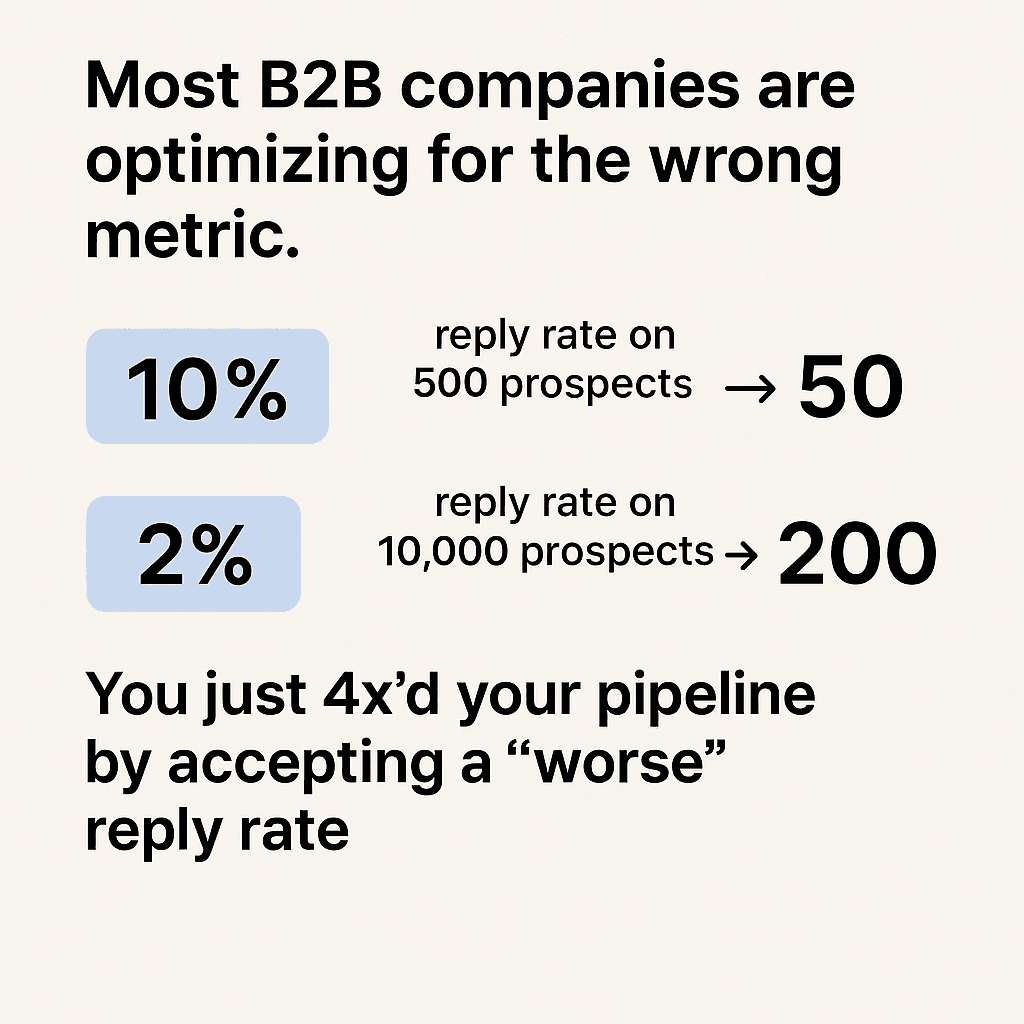
Reply volume matters more than reply rate because reply rate is a ratio and pipeline is a count. A lower rate across a much larger list produces more conversations, provided sending capacity supports the volume, the list stays inside a defensible ICP, and positive replies rather than raw replies are what gets counted.
Key takeaways
- Reply rate is a ratio and pipeline is a count, so optimising the rate while the list shrinks makes a programme worse while the dashboard improves.
- Signal-based targeting has a hard ceiling: the size of the population carrying the signal, which no amount of extra effort raises.
- Volume is capped by sending capacity, by how large a list can be at an ICP you would defend, and by not adding touches to the same people.
- Count positive replies rather than raw replies, because out-of-office and automated responses scale with volume and reward sending rather than performance.
Reviewed and updated September 1, 2026
Why B2B Companies Should Focus on Reply Volume Over Reply Rates
A team with a 12 percent reply rate on a 400-person list runs out of list in three weeks and books four meetings. A team with a 2 percent reply rate on a 12,000-person list is still sending in month three and has booked thirty. The second team is doing worse work by every metric the first team is proud of.
The Arithmetic, Which Is Illustrative and Not Ours
Take two hypothetical programmes. These figures are invented for the sake of the arithmetic rather than measured from any campaign, and the point is the shape rather than the numbers.
- An illustrative 10 percent reply rate across 500 prospects produces 50 replies.
- An illustrative 2 percent reply rate across 10,000 prospects produces 200 replies.
The second programme has a reply rate five times worse and four times the conversations. Every quarterly review that judges the two on reply rate concludes the first team is better at cold email.
That is the whole argument, and it is worth being careful about what it does and does not say. It does not say reply rate is meaningless. It says reply rate is a ratio, pipeline is a count, and optimising the ratio while the denominator shrinks is a way of getting worse at the job while the dashboard improves.
Why Reply Rate Feels Like the Right Metric
Reply rate is seductive because it is the metric that rewards craft. It moves when the copy improves, when the targeting gets sharper, when the personalisation gets better. It feels like the score for skill, and it is the number that gets quoted in case studies and on conference stages.
Volume feels like the opposite. Sending more looks like brute force, and there is a persistent sense that a real operator should be able to get the same result from a smaller list.
There is also an incentive problem. A rate is comparable across companies and a count is not, so rate is what gets benchmarked, compared and bragged about. Nobody publishes their reply volume, because it only means something next to their list size, their inbox capacity and their offer.
The result is a whole discipline optimising the metric that compares well rather than the metric that pays.
The Hidden Cost of High Reply Rates

Chasing a high reply rate has a specific and predictable failure mode.
You spend weeks connecting Clay to Apollo to ZoomInfo to find prospects carrying hyper-specific signals. You build a go-to-market motion that only works for the 500 people who carry them. Three weeks later you have exhausted those 500, and you are back at the start, hunting new signals, wiring new tools, rebuilding the workflow.
Meanwhile the team on the illustrative 2 percent reply rate has sent its fiftieth batch and has a pipeline full of conversations.
The deeper cost is that signal-based targeting has a hard ceiling nobody mentions: the size of the population carrying the signal. A brilliant play that works on 500 people is a play that cannot be scaled by working harder. It can only be scaled by finding another signal, which is another few weeks of building.
The effort in that loop goes into engineering around the thing nobody wants to do, which is making an offer good enough that a cold prospect stops for it.
Where Volume Actually Comes From
Volume is not a decision. It is the output of three constraints, and only one of them is about the list.
Sending capacity. Inboxes multiplied by a safe daily send rate. That number is set by infrastructure rather than ambition, and pushing past it costs deliverability, which costs the whole programme rather than one campaign.
List size at the ICP definition you are willing to defend. Widening a list by loosening the ICP is not volume, it is noise wearing volume's clothes. The honest version is a genuinely large addressable market, described broadly enough to be big and tightly enough that the offer still makes sense to everyone in it.
Campaign structure. Volume does not come from sending the same person more messages. RevenueFlow runs one message per campaign and no bump sequences or thread replies, because a second message under the one somebody ignored reads as a bump whatever the campaign calls it. So volume has to come from more people, not more touches per person, and that constraint is a feature: it forces the work back onto the list and the offer.
If none of those three can move, the reply rate is the only lever left, and optimising it is the right thing to do. That is a much narrower situation than the discourse suggests.
What Really Matters
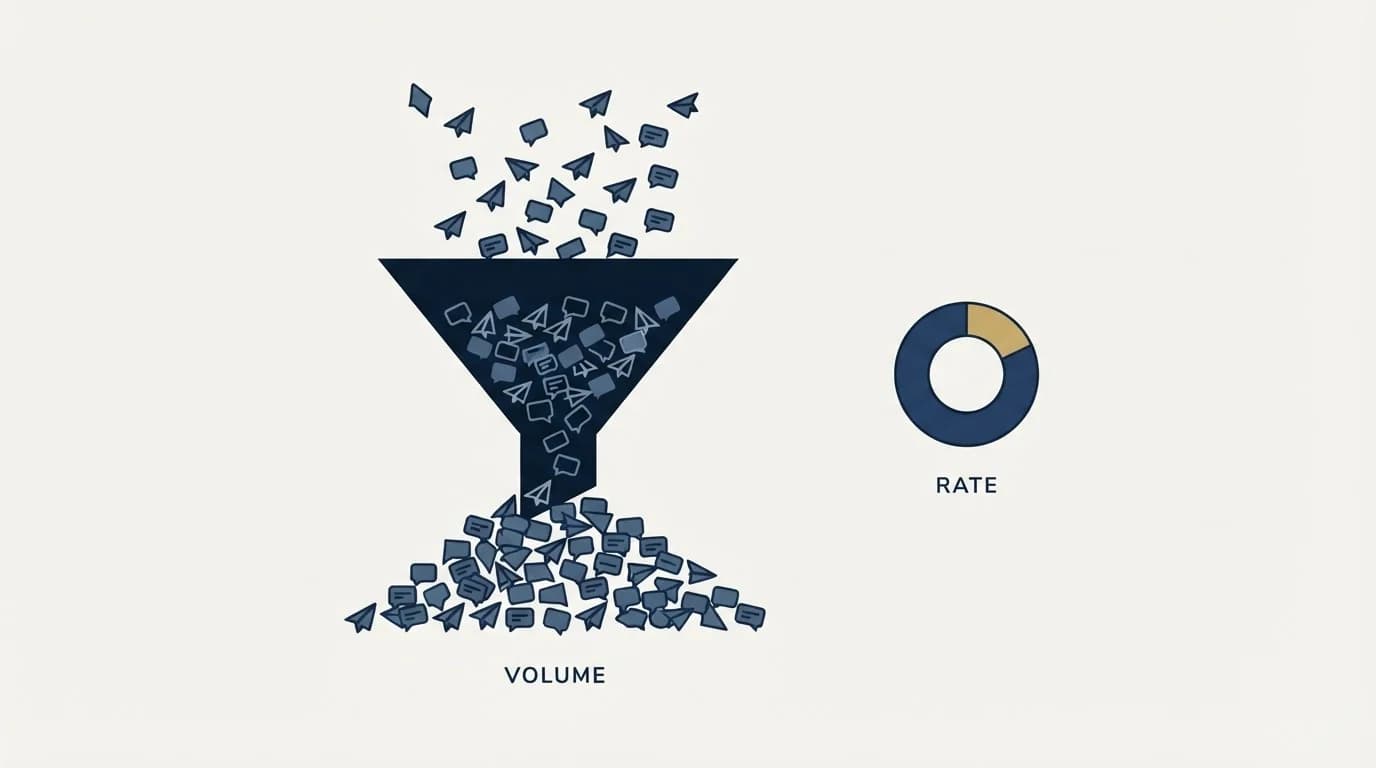
The real constraint is not reply rate optimisation.
It is offer quality and list size.
Most companies would rather spend forty hours building a signal-based targeting system than four hours crafting an offer good enough that a cold prospect stops and reads. The targeting system is engineering, which is comfortable and has a visible output. The offer is a judgement call about what the market wants, which is uncomfortable and has no output until it is tested.
Engineering around the hard problem is the most reliable pattern in outbound.
The Priority Order
- Step 1Infrastructure
Can you deliver at scale?
- Step 2List size
Do you have enough prospects?
- Step 3Offer quality
Is your offer compelling?
- Step 4Reply rate optimization
Fine-tune only after the above are solid
(The hierarchy is worth reading in full: The Hierarchy of Effective Cold Emailing.)
The infrastructure and the list matter more than the copy. The offer matters more than the targeting. Volume with a decent reply rate beats perfect targeting with a great reply rate, every single time.
Where the Volume Argument Breaks
This position is easy to over-apply, and it fails in three specific ways.
Volume without deliverability capacity is self-harm. Pushing more sending through the same inboxes than they can carry does not produce more replies. It produces spam placement, and it damages domains that then need weeks of remediation. Volume is capped by infrastructure, and the cap is not negotiable.
Scaling volume without the reply rate falling is the version of this question most teams actually ask, and the honest answer is that a fall is expected and a collapse is not. Added names are drawn from further down the same list, so the population changes even when the copy does not, and a modest decline is that population showing up in the number. A sharp drop points somewhere else, usually at mailbox capacity raised per inbox rather than spread across new ones. Read the two apart before deciding whether the extra volume was worth it.
Volume outside a defensible ICP produces junk replies. Two hundred replies from people who cannot buy is worse than fifty from people who can, because somebody has to work through all two hundred. Reply volume is only the right metric while the list is still a list of plausible buyers.
A very small market makes the whole argument moot. If the entire addressable market is 800 companies, there is no volume play available, and the only way to more pipeline is a better offer and better targeting. That is a real situation and it is the one every high-reply-rate case study is quietly describing.
The honest version of this argument is narrower than the slogan: when the market is large enough to support it and the infrastructure can carry it, choose the bigger denominator.
Count Positive Replies, Not All Replies
There is a version of the volume argument that is simply wrong, and it comes from counting the wrong replies.
A raw reply counter in a sending platform counts everything that arrives back: out-of-office bounces, automated acknowledgements, unsubscribe requests, and people telling you firmly to stop. In a holiday month the automated share alone can be most of it. A programme that scales volume and watches a raw reply counter climb has measured its own sending, not its own performance.
So the metric that survives scaling is positive replies: a human answering with interest, a question, or a request to talk. Reading the inbound and classifying it is the only reliable way to get that number, and it is worth the time precisely because it is the number that changes decisions.
This also disciplines the volume argument in a useful direction. Doubling the list doubles the automated replies too, so a raw counter rewards scale automatically and a positive-reply counter does not. If positive replies do not move when volume moves, the extra names were not buyers and the ICP conversation is overdue.
The same care applies to bounces. SMB and small-company lists carry higher turnover, so a growing list quietly raises bounce rate, and bounce rate damages deliverability for every campaign on that infrastructure rather than the one that caused it.
Reply Volume Is Not the Final Metric Either
Having argued for reply volume over reply rate, it is worth naming the metric that beats both.
A reply is not pipeline. It is an event that might become a meeting, and the number that actually pays is held meetings with people who fit the criteria agreed in writing before launch. RevenueFlow qualifies a meeting against a written standard covering audience fit, the participant's responsibility for the relevant area, a real business conversation and attendance, and budget, timing and decision authority are deliberately not part of it.
That matters here because it is the check on the volume argument. A programme that doubles reply volume and holds the same number of qualified meetings has not improved. Reply volume is the right metric to optimise against reply rate, and qualified meetings is the right metric to check reply volume against.
Track both, and let the second one veto the first.
- Depends: Sending capacity supports the target volume without raising per-inbox limits
- Depends: The addressable market is genuinely large at the ICP you would defend
- Depends: The offer has produced positive replies at current volume
- Depends: Replies are converting into held, qualified meetings
- No: The plan is to widen the ICP to find more names
- No: The plan is to add follow-up touches to the same people
The Question You Should Be Asking

What is keeping you from sending to 10,000 people instead of 500?
Usually it is one of three things, and each has a different answer. Not enough sending capacity is an infrastructure project. Not enough people who fit is an ICP conversation, and sometimes an honest admission that the market is small. Not enough confidence in the offer is the real one, and it is the one the targeting project exists to avoid.
If you can hold even a 2 to 3 percent positive reply rate at scale, you will out-produce a competitor obsessing over perfect targeting and a 10 percent reply rate on a tiny list. Those percentages are illustrative rather than measured, and the shape of the comparison is what matters.
Stop over-engineering. Start scaling, once the infrastructure can carry it.
Related Reading
- Why Short Cold Emails Get More Replies Than Perfectly Personalized Ones
- The Hierarchy of Effective Cold Emailing
- Cold Email Infrastructure: What a Sending Setup Actually Needs
If you would rather have this run for you, RevenueFlow books qualified meetings on a pay-per-meeting basis and publishes client results.
Frequently asked questions.
Frequently asked questions- Is a low reply rate actually fine?
- It is fine when the list is large enough that the reply count is high and the people on it are plausible buyers. It is not fine when the rate is low because the list has drifted outside the ICP, since those replies do not become meetings. Judge the rate against the reply count and the meeting count together.
- How do I know if I should scale volume or fix reply rate?
- Check three things first. Whether sending capacity supports more volume without raising per-inbox limits, whether the addressable market is genuinely large at an ICP you would defend, and whether current replies are converting into held meetings. If any of those is a no, fix that rather than adding names.
- Does sending more emails hurt deliverability?
- Pushing more volume through the same inboxes than they can safely carry does. Volume is capped by infrastructure, so scaling means more sending capacity rather than a higher per-inbox rate. Growing the list also raises bounce risk, and bounces damage deliverability for every campaign on that infrastructure rather than just the one.
- What should I track instead of reply rate?
- Positive replies and held meetings that meet criteria agreed in writing before launch. A raw reply counter includes out-of-office messages and unsubscribes, both of which scale with volume automatically. Held qualified meetings is the number that checks reply volume, because more replies with the same meeting count is not an improvement.
About the author.

Tim Carden is CMO / CTO at RevenueFlow, which builds and operates outbound revenue engines for B2B companies. Studied at McGill University.
Tim Carden · CMO / CTO
Connect on LinkedIn →Explore more.
Ready to scale your outreach?
We build GTM engines that book real meetings. See the receipts.
Related articles.
Cold Email Frameworks: Which One Fits Your Offer
AIDA, PAS and Before-After-Bridge arrange the same four elements in different orders. What each one assumes about the reader, and what none of them fix.
CAN-SPAM Act Compliance for B2B Cold Email: The Rules
The CAN-SPAM Act makes no exception for business-to-business email. Here are the seven requirements, the opt-out clocks, and where liability lands when an agency sends.
How to Write a New Year Outreach Email, Line by Line
A new year outreach email works only where January is a fact about the account. Who that is, the structure line by line, and two worked examples.
How to Write a Third Follow Up Email, Line by Line
A third follow up email belongs only in a thread where the person replied or agreed to something. When to send one, and how to write it line by line.
CMO Email List: What You Are Actually Buying
Seven of the ten results for this phrase sell a file filtered on a title that describes forty percent of the market. What to build instead, and why.
SMTP Reply Codes: What Each Class Instructs
The digits are a verdict and the text is the reason. Separating an address failure from a policy refusal before reacting is what decides whether the fix works.