Revenue Marketing: The Number Marketing Agrees to Own
Revenue marketing is marketing measured on pipeline created and revenue closed instead of leads and traffic. It is an accountability claim, not a tactic: the same channels and team, read one sales cycle later. It is real only where a written opportunity definition, separate sourced and influenced lines, a fixed attribution model and a leading indicator exist.
Key takeaways
- Revenue marketing changes which number sits at the top of the marketing report, from leads and traffic to pipeline created and revenue closed, without changing the channels or the team.
- The cost of the change is a feedback loop one sales cycle long, which is why a leading indicator such as opportunities created has to sit beside the revenue figure.
- Sourced credit partitions the pipeline while influenced credit overlaps, so the two are reported as separate lines and never blended into one number.
- Adopt it in order: the written opportunity definition, a frozen attribution model, split reporting and protected long-payback budget come before the headline number moves.
Revenue marketing is marketing run and measured against pipeline and closed revenue rather than against leads, downloads and traffic. It is a claim about accountability rather than a set of tactics: the same channels, the same content and the same team, judged on a number that only resolves after a sales cycle has run.
Nothing in the toolkit changes when a team adopts it. What changes is which number appears at the top of the marketing report, and therefore which arguments the team is able to win and which ones it is now obliged to lose.
What is revenue marketing?
Revenue marketing is a marketing function that reports pipeline created and revenue closed as its headline numbers, in place of leads and traffic. The channels, the content and the team stay the same. What moves is the point in the sales process where marketing's result is read, and that point sits one full sales cycle later than the one a lead-based team is judged at.
What the term is actually asserting
Three moves separate the term from the arrangement it replaced.
The unit of measurement moves downstream. A lead-based function reports contacts collected and qualified leads passed. A revenue-based one reports opportunities created and revenue closed. The gap between those two reports is a sales cycle long, which is the first thing the change costs.
The handoff stops being a handoff. Under the older arrangement marketing owned everything up to a qualified lead and sales owned everything after it, so a lead that went nowhere was either badly generated or badly worked depending on who was asked. A revenue remit removes the seam by making both teams accountable to the same figure, which is the whole argument for it.
The definition of a qualified opportunity becomes a shared, written artefact. This is the part that is easy to skip and the part that decides whether the rename is real. Two teams cannot be measured on one number until they agree what counts, in writing, before the period starts.
| Lead-based marketing | Revenue marketing | |
|---|---|---|
| Reports | Contacts, qualified leads and cost per lead | Opportunities created and revenue closed |
| Feedback arrives | Within the month | One sales cycle later |
| Optimises for | Volume at the top of the funnel | The accounts that eventually buy |
| Shared with sales | Nothing in writing | A written definition of a qualified opportunity |
| Argues about | Lead quality | Attribution |
The last row of that table is the honest trade. The argument does not disappear. It moves from a subjective dispute about lead quality to a technical dispute about credit, and the technical one is at least resolvable with a stated rule.
Why it matters: the failure it was invented against
The specific failure is familiar enough to be invisible. Marketing reports a strong quarter in leads. Sales reports a weak quarter in pipeline. Both reports are accurate, both are drawn from the same system, and there is no arithmetic that reconciles them, because they count different objects at different points in a process nobody agreed the boundaries of.
Two costs follow, and neither is attributed to measurement.
The first is that the top of the funnel gets optimised toward whatever is cheapest to produce. A cost-per-lead target is satisfied most easily by an audience that converts to a contact and never to a customer, and that audience is always available. Nothing in the lead-based report can distinguish it from a good one until the cycle finishes, by which point the budget for the next period is already set on the old number.
The second is that marketing loses the argument for the work with the longest payback. Anything whose effect appears two quarters later is indefensible in a system that reviews monthly, so the work that builds a category position gets cut first. That is the demand generation half of the job, and a revenue remit is supposed to protect it by lengthening the measurement window. Adopted badly it does the opposite, because a team newly accountable for closed revenue reaches for the shortest path to a closed deal.
How it is measured, and the number it rests on
A revenue-marketing report is only as sound as its attribution, and attribution is the weakest instrument in the stack.
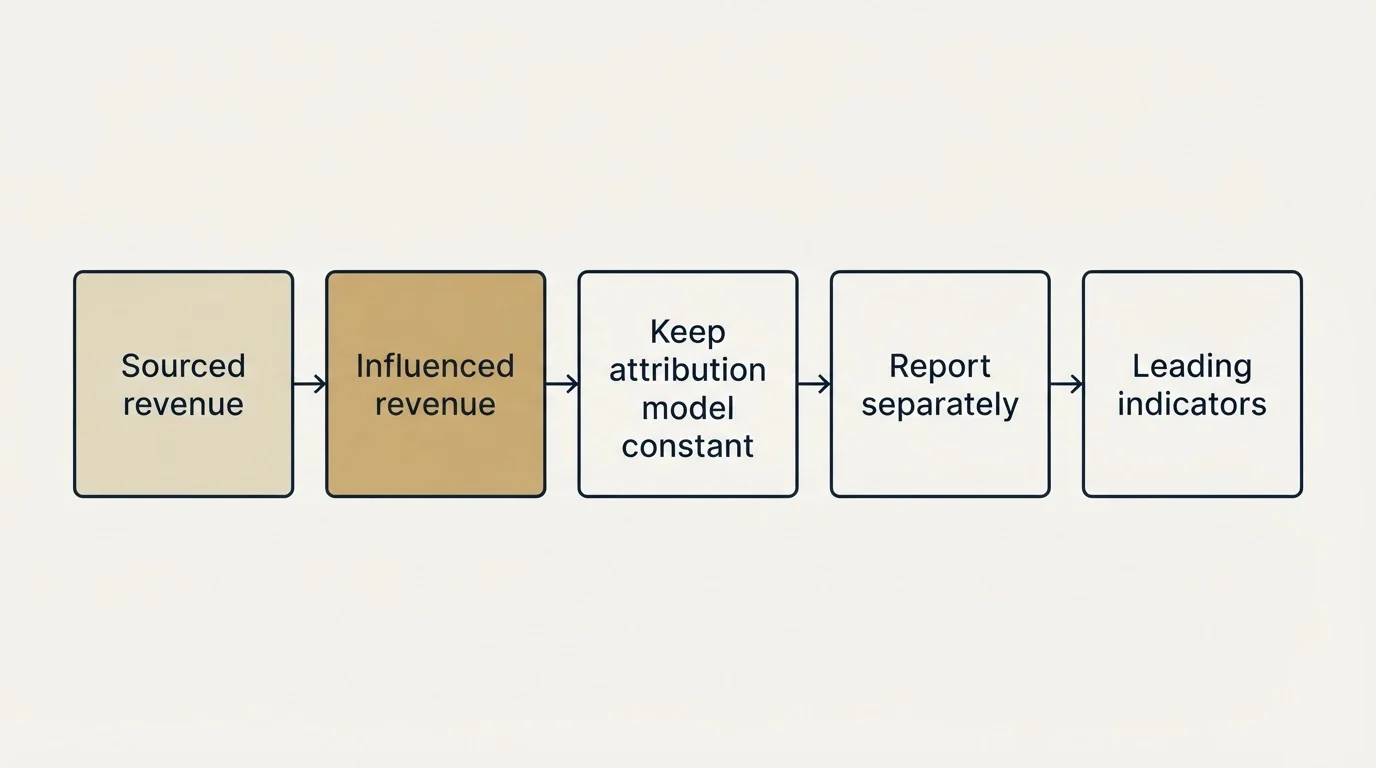
The load-bearing distinction is between sourced and influenced. Sourced names the origin of an opportunity: one thing produced the first contact, each opportunity has exactly one source, and the sources partition the pipeline cleanly. Influenced names presence: a qualifying marketing interaction appeared somewhere in the account's history. The second number is larger, softer, and grows quietly until it stops carrying information. Which qualifying touch counts is the entire metric, and the argument is set out in full in marketing influenced pipeline.
Three practices keep the report readable.
State the model and do not change it inside a comparison period. Moving from last touch to a multi-touch split changes every historical number without anything happening in the market. The models and what each one credits are compared in multi-touch attribution.
Report sourced and influenced as two lines, never as one. A single blended figure is silently one of them, and the reader assumes the other.
Hold the revenue number next to a leading one. Closed revenue this quarter was decided a cycle ago. Opportunities created this month is the number the team can still act on, and reporting only the lagging figure removes the ability to correct anything in period.
Exists as an artefact
- A written definition of a qualified opportunity, agreed by marketing and sales before the period
- Sourced and influenced reported as two separate lines
- An attribution model stated in writing and unchanged inside the comparison window
- A leading indicator reported beside the lagging revenue figure
- Budget for work whose payback falls outside the reporting period
Signs of a rename
- A single blended influenced number carried to the board
- The same team, the same targets, and a new title on the report
How to move a team to revenue marketing
The order matters more than the speed. Every artefact above has to exist before the headline number changes, because a team measured on revenue before the definitions are written will spend its first two quarters arguing about what the number means.
Run the old report and the new one side by side for at least one full sales cycle. The revenue figure for the first cycle was decided by work done before the change, so it says nothing about the new arrangement, and a team that reads it as a verdict will reverse a decision it has not yet tested.
Expect the lead numbers to fall. A function that stops optimising for the cheapest contact produces fewer contacts, and that drop arrives a full cycle before any revenue evidence that it was the right call. Agreeing in advance that this will happen, and what would count as a real warning, is the difference between a transition and a panic. Deciding which constraint to fund first is a separate question, worked through in demand gen strategy.
Where the term misleads
It is read as a promotion rather than a constraint. Being accountable for revenue means being accountable for a number four other functions also move. A good quarter has several owners and a bad one has none, which is the same problem the enablement version of this argument runs into, set out in revenue enablement.
It is confused with revenue operations. Operations owns the systems, the data model and the process definitions that make the measurement possible at all. Revenue marketing is a marketing function measured through those systems. The two are adjacent and a company that merges them usually ends up with an operations team, because systems work has deadlines. What the operations function actually owns is set out in revenue operations.
It quietly assumes attribution is solved. The whole apparatus rests on being able to say which activity produced which opportunity, in a buying process where research routinely happens without a trackable touch. The number is directionally useful and it is not an accounting record, and treating it as one produces confident decisions built on a measurement nobody can audit.
It shortens the horizon it was meant to lengthen. The intent is to stop marketing being judged on vanity volume. The observed effect, where the reporting cadence stays monthly, is that anything with a payback longer than the cadence gets defunded, which is the opposite of the intent and stays invisible for several reporting periods.
How it is used in outbound
An outbound programme is the cleanest test of a revenue-marketing remit, because the feedback loop is short enough to read and the artefacts are all inspectable.
Three things the remit owes an outbound lane.
One written definition of an acceptable meeting, agreed before anything sends. This is the artefact the whole accountability claim depends on, and it has to be written before the results exist. Ours excludes budget, timing and authority deliberately, because those change every quarter and turn a qualification standard into a negotiation held after the fact. The stable version is a meeting that was attended and met criteria agreed in writing before launch, which is what a qualified appointment means here.
The reason each account is on the list, attached to the record. A revenue-accountable function cannot review its own targeting without knowing why an account was selected. When the trigger stops at the list builder, every downstream analysis is left comparing outcomes across accounts that were chosen for reasons nobody wrote down.
Protection for the work that fills the list later. Outbound harvests interest and demand generation creates it, and a team under revenue pressure will cut the second to fund the first. That decision looks efficient for two quarters and then shows up as an audience that has never heard of you.
Our own practice narrows this further. We send one message per campaign, with no bumps and no thread replies. For a revenue-marketing report that has one useful consequence: with a single message per campaign there is no sequence to smear credit across, so the attribution question at the front of the funnel becomes unusually clean. What the campaign is measured on and how the plan line becomes a weekly number is covered in go-to-market execution.
The short version
Revenue marketing is the marketing function measured on pipeline and closed revenue rather than on leads and traffic. It is an accountability claim rather than a method, and it exists because a lead-based report and a pipeline-based report can both be accurate and irreconcilable.
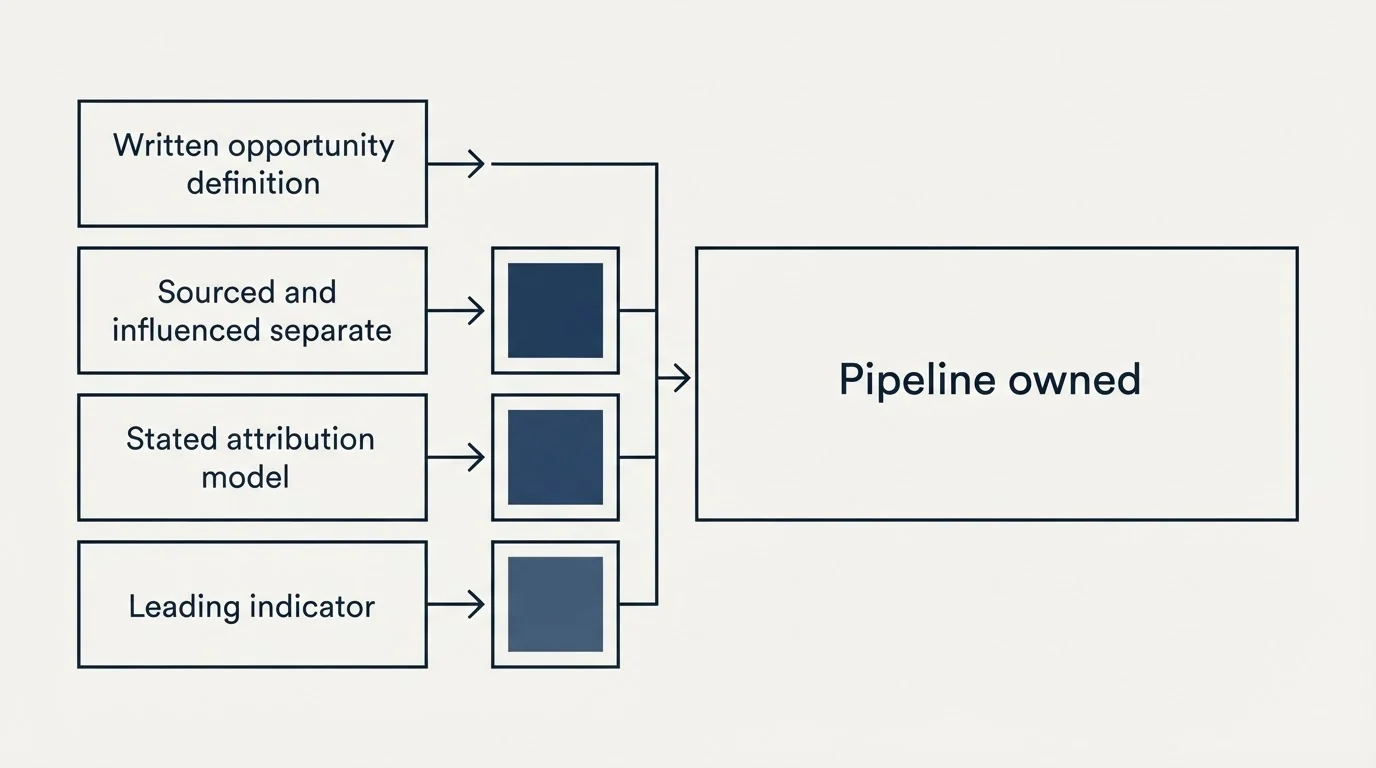
It is real only where a written definition of a qualified opportunity exists before the period, sourced and influenced are reported separately, the attribution model is stated and stable, and a leading indicator sits beside the lagging one. Without those it is a rename, and the first thing it defunds is the long-payback work it was supposed to protect.
The neighbouring definitions are demand generation, which creates the interest this function is now accountable for converting, outbound marketing, which is the company-initiated half of the channel mix, and pipeline in business, which is the object the report is denominated in. How win and loss reasons feed back into the targeting decision is in win/loss analysis.
RevenueFlow supplies the front of that pipeline: attended meetings against criteria agreed in writing before launch, one message per campaign. See what a first campaign produces.
Frequently asked questions.
Frequently asked questions- What is revenue marketing?
- Revenue marketing is a marketing function measured on pipeline created and revenue closed rather than on leads, downloads and traffic. It is an accountability claim rather than a set of tactics. The channels, content and team stay the same, and the result is read later in the sales process, on a number that only resolves after a sales cycle has run.
- What is the difference between revenue marketing and lead generation?
- A lead-based function reports contacts, qualified leads and cost per lead, gets feedback within the month, and argues with sales about lead quality. A revenue marketing function reports opportunities and closed revenue, waits a sales cycle for feedback, shares a written definition of a qualified opportunity with sales, and argues about attribution instead.
- How is revenue marketing measured?
- Through attribution, which is the weakest instrument in the stack. Report sourced pipeline, where each opportunity has exactly one origin, separately from influenced pipeline, where a marketing touch appeared somewhere. State the attribution model and keep it fixed inside a comparison period, and hold a leading indicator such as opportunities created beside the closed revenue figure.
- How do you implement revenue marketing?
- In order. Write a definition of a qualified opportunity with sales, choose and freeze one attribution model, split sourced from influenced, add a leading indicator, and ring-fence budget for long-payback work. Only then move pipeline and revenue to the top of the report. Run the old and new reports side by side for one full sales cycle.