Pipeline in Business: One Word for Four Different Objects
A pipeline in business is a named sequence of stages that items move through toward an outcome, carrying a count and a value at each stage. Companies run several at once: hiring, product, data and deals. The staged shape is shared, and the assumption that movement comes from your own effort fails on the sales pipeline alone.
Key takeaways
- The staged shape is genuinely shared across hiring, product, data and deal pipelines, and only the sales case holds items that decide for themselves.
- A stage that advances on seller activity advances whether or not anybody is buying, which turns a forecast into a measure of effort.
- A pipeline is a standing balance, so it can hide a collapse in new business for most of a sales cycle before the total visibly moves.
- Managing throughput and managing a deal pipeline are different jobs, and applying the first to the second produces effort aimed at items that are not waiting on you.
A pipeline in business is a named sequence of stages that things move through on their way to a finished outcome, with a count and a value attached at every stage. The word is borrowed from plumbing and it keeps the borrowed property that matters: things enter at one end, they move in one direction, and what is in the middle tells you what will come out later.
Four objects in an ordinary company carry the name. A hiring pipeline holds candidates between application and offer. A product pipeline holds features between idea and release. A data pipeline holds records between a source system and a destination. A sales pipeline holds open deals between a first qualified conversation and a closed outcome. All four share the staged shape, and only one of them is what a revenue team means by the word.
The common shape
Whatever it holds, a pipeline is doing three jobs, and a thing called a pipeline that does none of them is a list with an ambitious name.
It tells you what happens next to any single item. Stage membership implies an action. If the stage name does not imply one, the person working the item is navigating from memory.
It makes a forecast arithmetically possible. Multiply what is in each stage by the historical rate at which that stage produces an outcome, and you get an expectation. That arithmetic is valid only when stage membership is an observable fact rather than an opinion, which is a condition that is easy to state and quietly hard to satisfy.
It shows you where things die. This is the job most teams never get from theirs, because it needs time in stage rather than count in stage, and the default report everywhere shows count.
- A candidate, a feature, a record
- Movement is caused by work your team does
- An item that stalls is a resourcing or a dependency problem
- Throughput is mostly a function of capacity
- An open deal, owned by a person, with a value and a date
- Movement requires somebody outside the company to act
- An item that stalls may have decided and not said so
- Throughput is mostly a function of who was chosen at the top
That difference is the whole reason the sales case needs its own vocabulary. In every other pipeline the items are inert and the constraint is your capacity to work them. In a sales pipeline the items have their own priorities, their own budgets and their own reasons to go quiet, and a manager who applies task-queue thinking to it will spend the quarter adding activity to deals that were never moving.
Why the general reading misleads
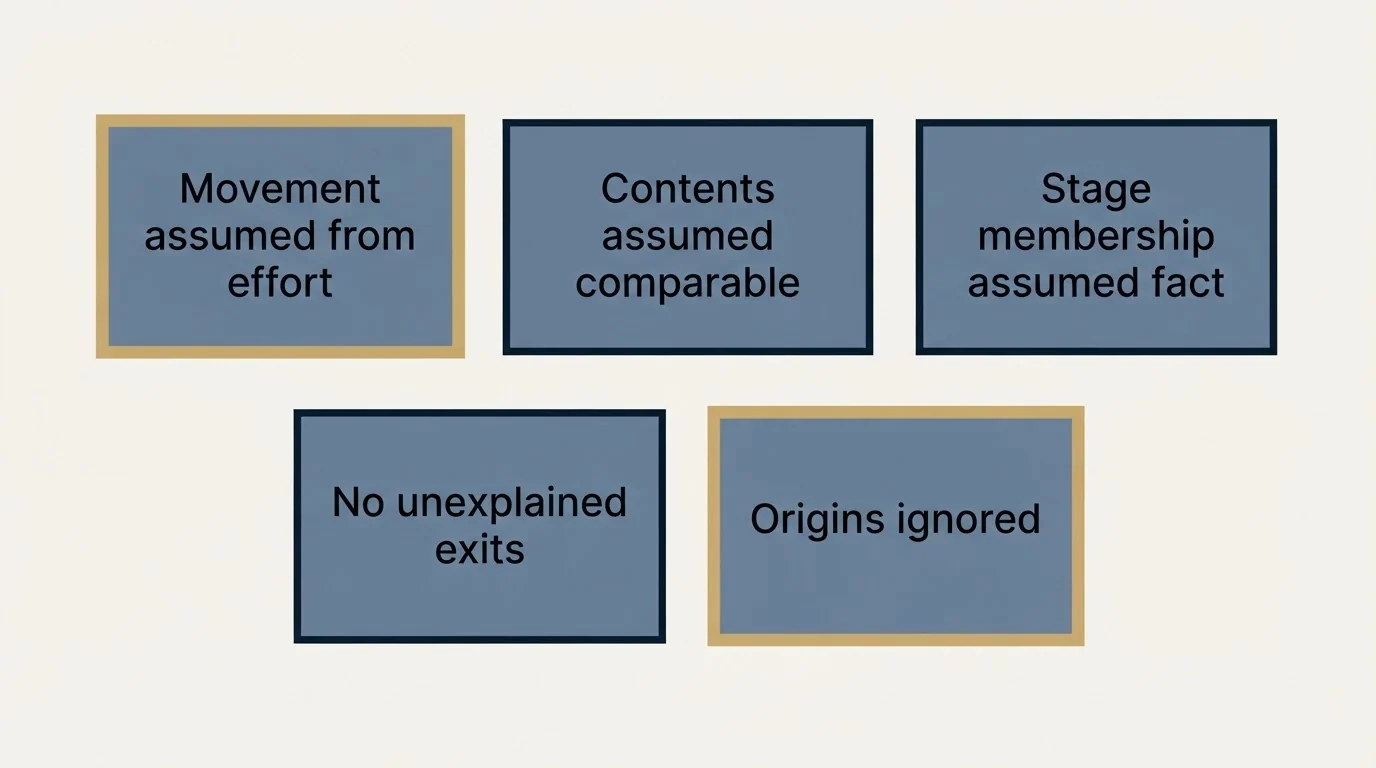
The generic definition, a staged sequence with items in it, is accurate and it imports one assumption that does not survive contact with revenue.
It assumes movement is caused by effort. In a hiring or a data pipeline that is broadly true, and more work at a stage produces more throughput. In a sales pipeline a deal advances when a buyer does something, so a stage that advances on seller activity advances whether or not anybody is buying. The forecast built on it then measures effort and reports it as revenue. The exit criteria that fix this, phrased as things the buyer did rather than things the seller did, are set out in sales pipeline stages.
It assumes the contents are comparable. A pipeline of records is a pile of the same kind of object. A pipeline of deals is not: one seven-figure opportunity and forty small ones can sum to a healthy total while carrying completely different risk. Any total computed over a sales pipeline needs the underlying items read at least once before it means anything.
It assumes stage membership is a fact. In a data pipeline a record is where the system says it is. In a sales pipeline a deal is where a person typed that it is, and that person's performance is described by the number. The two are not the same kind of claim.
It has no notion of an item leaving without a reason. A record that fails validation is logged. A candidate who withdraws is recorded. A deal that quietly stops moving usually stays exactly where it was, at its original value, with a close date that has been pushed several times, because nothing in the general model requires an item to be closed out with a reason.
It says nothing about where the items came from. Every pipeline inherits its contents, and a sales pipeline inherits them from a targeting decision taken roughly one sales cycle earlier. That is why a gap discovered in a forecast review is almost never fixable in the period it appears in.
- Yes: Every stage implies an obvious next action for whoever owns the item
- Yes: Each stage has an exit criterion two people would agree on
- Yes: Items sometimes move backwards when the evidence says they should
- Yes: Time in stage is reported, not only count in stage
- Yes: An item that leaves is closed out with a reason from a fixed list
- No: A stage exists so an item can stay on the list without advancing
- No: Stage entry is recorded when the owner performed an activity
Pipeline management means two different jobs
The phrase travels with the word and it names one thing in the general case and something else once deals are involved, which is why advice about it so often fails to transfer.
In the general case, managing a pipeline means managing throughput. The items are yours, the constraint is capacity, and the work is removing bottlenecks: adding people at the stage where things queue, automating a handoff, cutting a step that adds no decision. Everything that improves it is an operational change inside your own building.
Managing a deal pipeline is mostly hygiene and selection rather than throughput. The work is keeping the record honest, which means closing out what has stopped, refusing to advance anything on seller activity alone, and letting deals move backwards when the evidence says they should. A pipeline nobody cleans grows steadily and forecasts worse every quarter, because the additions are real and the departures are never recorded.
The tell that the two have been confused is a plan to fix a revenue gap by working the existing deals harder. That is throughput thinking applied to items that are not waiting on you, and the honest version of the same effort goes into what enters next month instead.
What it means for outbound

Outbound is the mechanism that fills the sales pipeline, and holding the general definition in mind makes one thing obvious that is otherwise argued about every quarter.
A pipeline is a standing balance, and a standing balance hides a collapse for a full cycle. Open value falls as deals close and rises as deals are created, so in a period where both happen at similar rates the total barely moves. A team that stopped generating new conversations six weeks ago and is still closing what it had shows a stable pipeline while the balance drains, and the first visible symptom is a quarter with nothing left to close. The figure that moves in the week the problem starts is new value entering per period, and it is the one most often missing from the report.
The top of a sales pipeline is not the top of the outbound motion. Prospecting has its own sequence, running from targeted to contacted to replied to meeting booked to meeting held, and it belongs in its own reporting rather than bolted on as three extra stages. The two join at exactly one point, which is the moment somebody accepts a held meeting against written criteria and creates an opportunity record. Being precise about that join settles the reporting arguments that otherwise recur every quarter, and the counting difference either side of it is the subject of pipeline and funnel as two models with two denominators.
A deal described as stuck was frequently never moving. They entered a late stage on the strength of a conversation that went well rather than on anything the buyer did, and no amount of pressure afterwards supplies the thing that was missing on entry. Reading time in stage by stage, rather than one average across the whole pipeline, is what separates a genuine slow stage from a stage where items arrive and never leave, and pipeline acceleration is the version of that diagnosis written out.
Our own contribution to the first of those is deliberately constrained. We send one message per campaign, built on one premise, once, and a later approach is a separate campaign with its own reason to exist. That puts the weight on who was chosen rather than on how many times they were contacted, which is the same argument the general definition makes at a distance: what comes out of a pipeline was decided by what went into it.
Related terms
Pipeline coverage is the ratio between what a sales pipeline holds and the target it is measured against. Sales velocity is the compact expression of how fast its contents move. Sales cycle sets how far ahead of a number it has to be filled. And conversion rate is what each stage-to-stage transition is measured with, once both of its ends are named. The six metrics worth reporting on one, and the companion each of them needs, are in pipeline metrics.
The short version
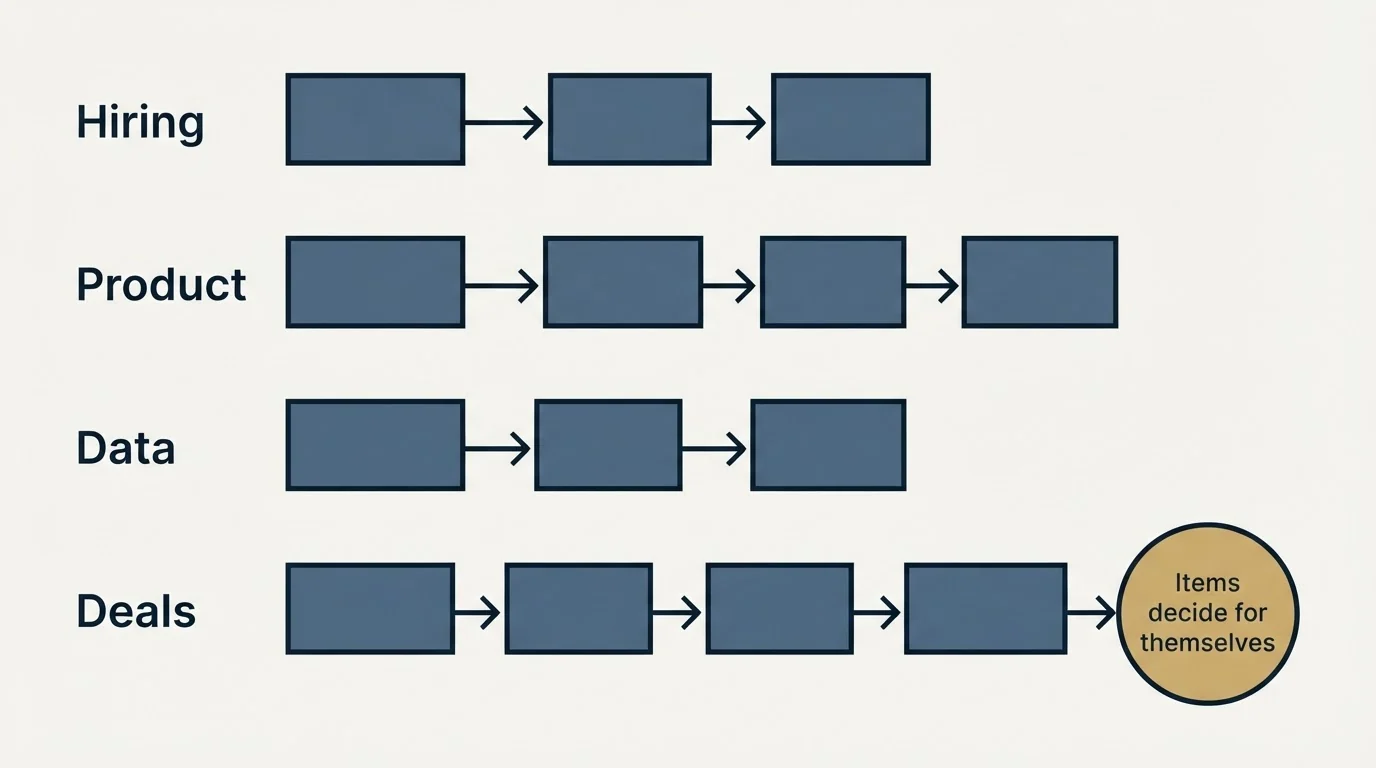
A pipeline in business is a staged sequence with a count and a value at every stage, and companies run several of them at once: hiring, product, data, and deals. The staged shape is genuinely shared. The assumption that movement is caused by your own effort is not, and it is the assumption that breaks when the word is applied to revenue.
A sales pipeline holds items that decide for themselves, get entered by the person whose performance the number describes, and arrive from a targeting decision taken a cycle earlier. Give every stage an exit criterion naming something the buyer did, report time in stage rather than count, close items out with a reason, and read new value entering rather than the standing total.
If the constraint is what enters rather than what is already in there, that is the part we run: see what one campaign puts into it.
Frequently asked questions.
Frequently asked questions- What does pipeline mean in business?
- A named sequence of stages that things move through toward a finished outcome, with a count and a value attached at each stage. The same word covers hiring pipelines, product pipelines, data pipelines and sales pipelines. All four share the staged shape, and which one somebody means is usually decided by the department they work in rather than by the sentence.
- How is a sales pipeline different from other business pipelines?
- The items decide for themselves. A candidate, a feature or a record moves when your team does work; an open deal moves when somebody outside the company acts. That single difference means capacity is not the constraint, stage membership is a claim rather than a system fact, and an item can stop moving without anybody recording that it has.
- What is the difference between a pipeline and a funnel?
- A funnel counts people through stages of their own buying behaviour and reports rates over a population, so it can tell you whether the intake is any good. A pipeline counts open deals, each with an owner, a value and a date, and reports money. Something leaving a funnel is unexplained attrition; something leaving a pipeline is closed with a reason.
- Why does a healthy-looking pipeline still miss the number?
- Because open value is a standing balance. It falls as deals close and rises as deals are created, so a period where both happen at similar rates barely moves the total, even if new business stopped weeks ago. The figure that moves immediately is new value entering per period, and it is the one most reports leave out.