Pipeline Acceleration: Most Stuck Deals Were Never Moving
Split cycle time by stage before deciding anything. A long tail in one stage is a pile of dead deals, not a slow stage, and the fix is a rule rather than effort.
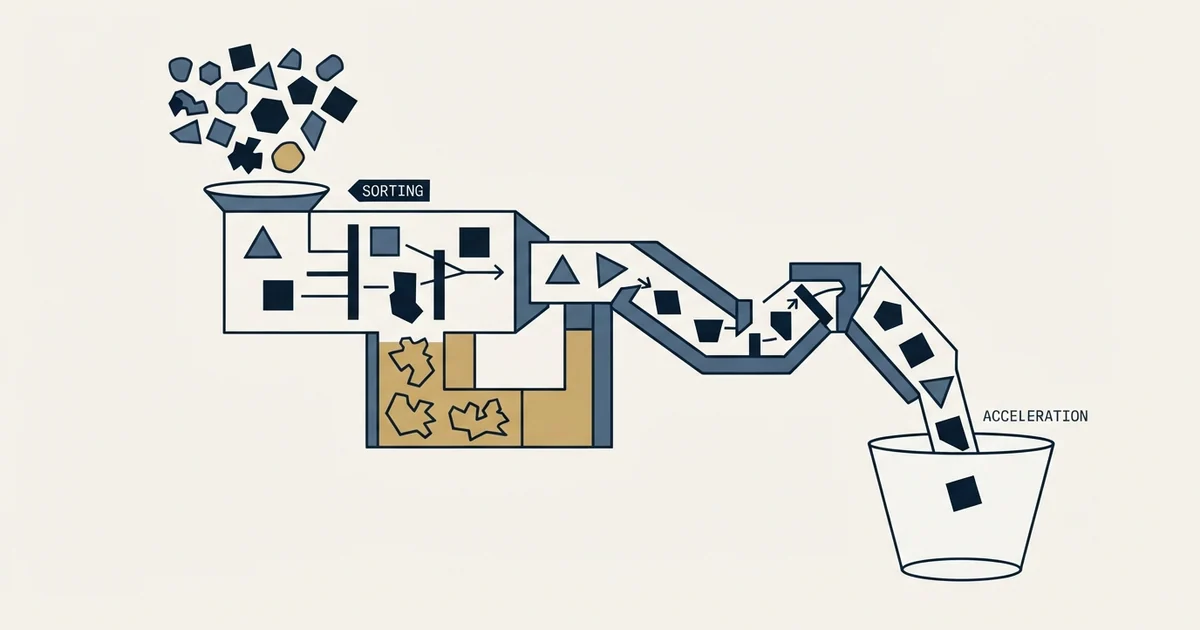
Pipeline acceleration is the practice of reducing the time between a deal entering the pipeline and closing, without lowering the standard for what enters. Diagnose it by splitting cycle time per stage and reading the distribution, never the mean. The levers that move deals are stricter entry criteria, early multithreading, and naming the specific blockage.
Key takeaways
- An average sales cycle averages over stages that behave nothing alike, so split cycle time by stage before choosing any intervention.
- A stage with a short median and a long tail is a fast stage holding dead deals, which calls for a cleanup rule and no acceleration effort.
- Deals that entered a late stage without a verified buyer action behind them were never moving, and no amount of contact afterwards supplies what was missing at entry.
- Replace the review question about the next step with what has to be true for this to be signed, answered with a person and a date.
Reviewed and updated September 18, 2026
A deal has sat in Proposal for six weeks. The rep has sent four checking-in messages and had two of them answered with a variation of "still working through it internally". The forecast still carries the deal at the original close date. Every review, someone asks how we accelerate it, and pipeline acceleration goes onto the agenda for another quarter.
The uncomfortable answer is that most deals described as stuck were never moving in the first place. They entered a late stage on the strength of a conversation that went well, not on the strength of anything the buyer did, and no amount of pressure applied afterwards can supply the thing that was missing on entry.
What is pipeline acceleration, and the two things it gets confused with
Pipeline acceleration is the practice of reducing the time between a deal entering the pipeline and it closing, without lowering the standard for what enters. The last clause is what makes it hard. Accepting fewer, better deals shortens average cycle time immediately, and so does disqualifying the slow ones, and neither of those is acceleration in any useful sense. They are just a different denominator.
The wider label for the same ambition is revenue acceleration, which adds the time lost in the seams on either side of the pipeline, where a handover has two owners and no clock.
It also gets confused with generation. A team short of pipeline sometimes calls its prospecting push an acceleration programme because the goal is faster revenue. Those are different problems with different fixes: generation is about how many qualified opportunities exist, acceleration is about how long the existing ones take. Diagnosing one and treating the other is common, and the tell is that the acceleration work is being asked to fix a coverage shortfall it cannot reach in the period.
Anyone using the phrase to mean "accelerate the pipeline" as a general call to move faster is describing an intent rather than a mechanism, and the mechanisms below are what the intent has to resolve into.
Coverage problem
Not enough pipeline
- Shows up as pipeline value against target
- Fixed by generation, upstream
- Cannot be fixed inside the period
- Acceleration work here just moves deals earlier once
Velocity problem
Pipeline moves too slowly
- Shows up as time in stage, by stage
- Fixed by removing a specific blockage
- Genuinely addressable this quarter
- This is what acceleration means
Entry problem
Pipeline that was never real
- Shows up as deals ageing in one stage
- Fixed by the entry criterion, and never by activity
- Looks identical to a velocity problem in a total
- The most common of the three
Teams describing themselves as building pipeline more slowly than the plan needs are usually naming the first column rather than the second, and the distinction decides which work helps: nothing done to the deals already in the pipeline changes how many new ones arrive next month.
Generation answers to different arithmetic, and the four ratios behind an outbound programme name the population and the rates a target depends on.
Time in stage is the diagnostic, and the total is not
When prospects go dark with no explanation the instinct is to read it as a communication failure, and the third column is usually the better explanation: a deal that was entered on a seller's optimism rather than on a buyer's action has nothing to go quiet about, because it was never moving in the first place.
An average sales cycle is an unhelpful number because it averages over stages that behave nothing alike. Early stages are slow for reasons about you: nobody replied, the meeting slipped, the follow-up went to the wrong person. Late stages are slow for reasons about them: legal is backed up, the budget belongs to a committee, the sponsor has a bigger project this quarter.
Splitting cycle time by stage separates those, and it separates the third case as well: a stage where deals arrive and never leave, which is an entry problem wearing a velocity problem's clothes. The stage definitions that make this readable at all are the subject of sales pipeline stages, and a pipeline whose stages fail that test cannot be diagnosed for speed because the timings are not measuring the same thing across deals. Every pipeline metric is ambiguous alone and settles when held next to a companion, and time in stage is the companion the cycle-length number needs. Sales velocity is the compact version of the same warning: three of its four inputs are averages, and an average needs a population that holds together. Pipeline coverage has the same problem one level up.
The distribution matters more than the mean, and this is where most reviews stop too early. A stage with a median of nine days and a long tail of deals at ninety is not a slow stage. It is a fast stage with a pile of dead deals in it, and the fix is a cleanup rule rather than an intervention.
One pipeline read stage by stage, with invented numbers
The example below is illustrative. The pipeline, its stages and every number in it are invented to show the reading.
A team's average cycle has lengthened and the review wants an acceleration programme. Splitting the time by stage, and holding the deals that closed against the deals open now, gives four different findings where the average gave one.
| Stage | Days, deals that closed | Days, open deals now | Reading |
|---|---|---|---|
| Discovery | 9 | 11 | Healthy. Leave it alone |
| Evaluation | 21 | 24 | Healthy |
| Proposal | 12 | 41 | entry Deals arrive and never leave. Fix the entry criterion |
| Contract | 15 | 19, with two deals past 60 | velocity A fast stage with two blockages to name |
Only the last row is an acceleration problem in the sense this page uses, and it is two deals wide. The Proposal row is the larger finding and no amount of activity touches it: those deals were moved forward on a good conversation, so the fix is a Proposal stage that needs something a third party could check before a deal may enter. The front half needs nothing, which is worth saying out loud in the review, because a programme aimed at the average would have spent most of its effort there.
The lever that does not work, and why it stays popular

The standard advice for a stalled deal is more contact: a follow-up cadence, a bump, a break-up message, a sequence that runs until someone answers. It stays popular because it is the only lever a single rep can pull alone, and because it occasionally coincides with a deal that was going to move anyway.
It does not work as a mechanism, and it is worth being precise about why. A deal is slow because a decision has not been made by a group. Additional messages to the one person you know do not change the group's position; they change that person's willingness to keep answering you. The observable outcome of an aggressive follow-up campaign on a stalled deal is usually that the contact stops replying, which converts an unknown into a loss.
We do not run bump sequences or thread replies in any campaign, on the same reasoning applied one layer earlier: repeated contact under an unanswered message reads as pressure regardless of how the copy is written. When there is a reason to re-approach, it is a new campaign built on a new angle, triggered by something that actually changed. On a stalled deal the equivalent is a genuine event: a new person joined the buying group, a competitor announcement landed, their quarter turned over, a stated blocker resolved. That is a reason to make contact. The absence of a reply is not.
The three levers that do move deals
A quarter-end deadline concentrates all three of these at once, and it is worth being honest about which one it can move: the blockage in a specific deal is addressable in days, the entry criterion is not addressable this quarter at all, and no amount of urgency creates coverage that was never generated.
Fix the entry criterion, which is the highest-leverage and the slowest to pay off. The general form of this rule, defining every stage exit as an action the buyer took rather than a feeling the seller had, is set out in the SaaS sales funnel. If deals enter a late stage without a verified buyer action behind them, the stage will always contain deals that cannot move. Requiring something a third party could check, a scheduled meeting with a named second stakeholder, a returned security questionnaire, a written confirmation of the budget cycle, removes the phantom deals from the stage. The pipeline gets smaller and the forecast gets more accurate, which is a trade some teams find harder to accept than the slow deals were.
The go-to-market playbook framework describes how each play pairs an entry criterion with a single owner and an exit date.
Multithread early, before you need to. A single-threaded deal moves at the speed of one person's calendar and dies with their reorganisation. Adding a second contact after a deal stalls is difficult because the request itself signals distrust. Adding one in the first meeting is ordinary. The article on high-ticket appointment setting covers this in the context of large deals, where the buying group is a committee by default and the cost of losing your one contact is a permanent loss of the account.
A related but distinct problem is the whitespace inside accounts you already have, where mapping unworked whitespace shows which buying centres were never approached at all.
Remove the specific blockage rather than the general one. The reason a deal is slow is usually nameable if anyone asks the buyer directly. Procurement needs a form nobody has. Security review has a queue. The sponsor needs a number they cannot get from their own finance team. Each of those has a concrete action attached, and none of them is a messaging problem. The question that surfaces them is what has to be true for this to be signed, asked of the buyer rather than answered internally.
Where outbound sits in an acceleration programme

Outbound is a generation instrument, not an acceleration one, and treating it as the latter produces the worst version of both. The one genuine overlap is entry quality: a programme that contacts companies chosen against written criteria produces opportunities that are less likely to stall for fit reasons, because the fit half was settled before the first message. Timing is still unknown, which is why some proportion of any outbound-sourced pipeline will always be slower than the average.
The other overlap is re-entry. Accounts that went quiet six months ago are not dead, they are untimed, and when something changes at that account it becomes a new opportunity to open rather than an old one to chase. That motion is a fresh campaign on a fresh signal, which is a different thing from following up.
The review question that does most of the work
One change to the pipeline review is worth more than any tactic listed above, and it costs nothing. Replace the question of what the next step is with the question of what has to be true for this to be signed, and require the answer to name a person and a date.
The difference is that the first question can always be answered. There is always a next step: send the case study, book a follow-up, check in next week. The second question cannot be answered on a deal that is not real, and the inability to answer it is the diagnosis. A rep who can name the remaining gate, who controls it, and when it is expected to clear, has a deal. A rep who lists activities has a hope.
Deal review note, Proposal stage
Next step: send the case study, book a follow-up, check in next week. 1
What has to be true for this to be signed: their security questionnaire is returned. It sits with their IT lead, who expects to finish it by the 14th. 2
- 1A list of activities. There is always a next step, so this answer tells the review nothing about whether the deal exists.
- 2The remaining gate, the person who controls it, and a date. A rep who can write this line has a deal.
Applied consistently, this changes the composition of the pipeline within a quarter, mostly by removing things from it. That is the correct outcome and it will look like a bad quarter in the pipeline-value number while making the forecast substantially more accurate.
What acceleration cannot do
Saying pipeline generation has stalled describes the first column rather than the second, and the distinction is worth holding onto under pressure: there is nothing inside the existing deals to accelerate, and the work that fixes it sits upstream where nothing will show a result inside the quarter.
It cannot compress a buying process that has a fixed external gate in it. A deal waiting on a budget cycle that opens in January closes after January, and every touch before then is a cost with no corresponding effect. It cannot rescue a deal with no internal champion, because the work of moving a purchase through an organisation is done by someone inside it. And it cannot make a forecast honest: a shorter average cycle achieved by disqualifying slow deals is a real improvement in resource allocation and no improvement at all in revenue, and reporting the two as the same thing is how acceleration programmes get declared successful in a quarter where nothing closed sooner.
Building the generation half against criteria agreed before launch is the part we can help with, and a test campaign is the cheapest way to see what that produces.
The short version
Split cycle time by stage before deciding anything, because a total hides the difference between a slow stage and a stage full of dead deals. Most pipeline acceleration problems are entry problems: deals that arrived in a late stage without a verified buyer action behind them were never moving. The levers that work are a stricter entry criterion, multithreading from the first meeting, and naming the specific blockage. More follow-up is the lever that stays popular because one person can pull it alone, and it converts an unknown into a loss.
Frequently asked questions.
Frequently asked questions- What is pipeline acceleration?
- It is reducing the time between an opportunity entering the pipeline and closing, without lowering the standard for what enters. That last condition matters, because accepting fewer and better deals shortens average cycle time immediately and is not acceleration in any useful sense. It is a different denominator, and reporting it as a speed improvement flatters a quarter where nothing closed sooner.
- How do you accelerate a sales pipeline?
- Split cycle time by stage first, and compare deals that closed with the deals open now. Then use the three levers that move deals: a stricter entry criterion built on a verified buyer action, a second contact added in the first meeting, and the specific blockage named by asking the buyer what has to be true for this to be signed.
- Do follow-up sequences speed up stalled deals?
- No, and they carry a specific cost. A deal is slow because a group has not decided, and more messages to your single contact do not change the group's position. What they change is that contact's willingness to keep replying, which converts an unknown into a loss. We run one message per campaign and re-approach only on a genuine new event.
- What is the difference between a coverage problem and a velocity problem?
- Coverage shows up as total pipeline value against target and is fixed upstream by generation, which cannot help inside the current period. Velocity shows up as time in stage and is addressable this quarter by removing a specific blockage. Treating a coverage shortfall with an acceleration programme is common, and the tell is work being asked to close a gap it cannot reach in time.
About the author.

B2B cold email experts helping companies generate qualified leads through done-for-you outreach campaigns.
RevenueFlow Team
Explore more.
Ready to scale your outreach?
We build GTM engines that book real meetings. See the receipts.
Related articles.
Win Rate Benchmarks: Which Figures State a Population
A catalogue of the published average sales win rates, sorted by whether the page names the population behind its own number. Most do not.
Sales Kickoff Agendas: Five Published, Session by Session
Five publishers print a sales kickoff agenda. They agree on four blocks and disagree on session length, rehearsal and where the agenda comes from.
SDR Outsourcing for Logistics Companies: The Brokerage Line
What an outside sales development team may do in a freight company's name, the calling and email rules it inherits, and which arrangement survives a bid-shaped market.
SDR Outsourcing for Business Brokers: The Fee Timing
Whether a success-fee brokerage should rent sales development at all: the fee timing, the texts that limit what an outside person may say about value, and who signs.
Sales Cycle Length Benchmarks: What Each Figure Counts
The published B2B sales cycle benchmarks, sorted by what each page says it counted. The same number means two different things in two of them.
Sales Enablement Charters: What the Published Ones Ask For
Six publishers set out what a sales enablement charter should contain. Five describe a document nobody can check, and one writes a definition with inspection in it.