Whitespace Mapping: Building the Grid
Sixty-two empty cells shaded green, and ninety days later the same sixty-two cells. How to build a whitespace grid on buying centres, and how to read one honestly.
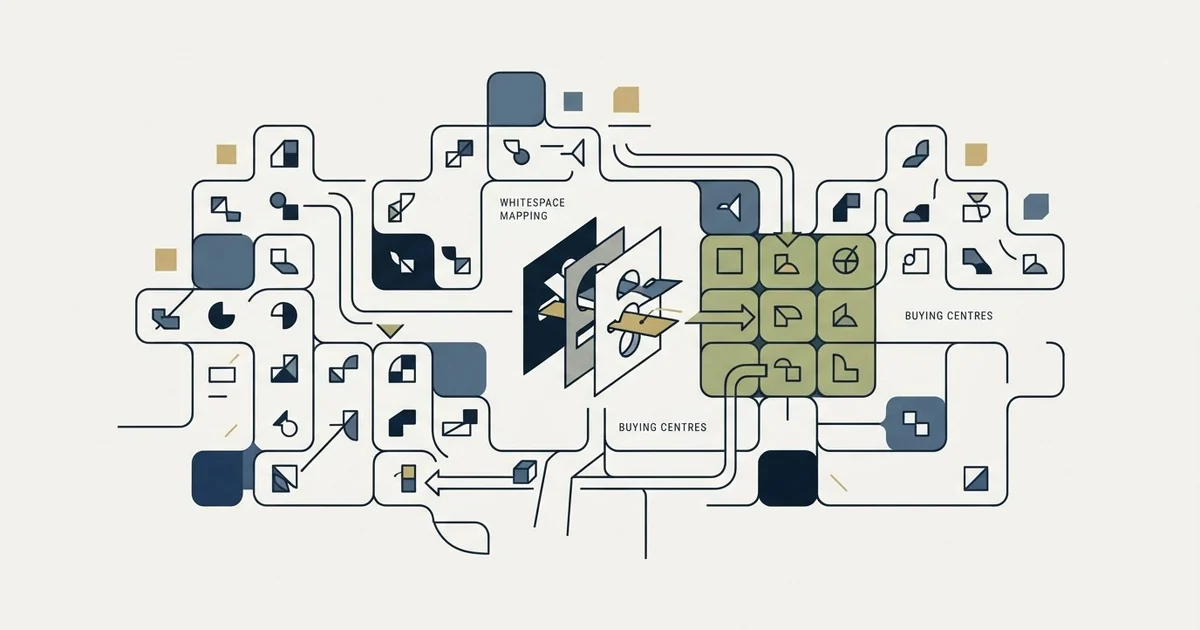
Whitespace mapping compares what an existing customer already buys against what they could buy, drawn as a grid of their buying centres against your portfolio. The empty cells are the whitespace. Its value depends entirely on building it at the level of units that can purchase independently, and on giving every empty cell a stated reason it is empty.
Key takeaways
- Build the grid on buying centres rather than the parent company. Prolifiq's guide states that revenue lives at the buying centre level rather than the corporate logo level, and estimates that a large enterprise can easily have 15 to 40 units able to make independent purchase decisions.
- An empty cell is not an opportunity. It can mean the product does not apply, an incumbent contract has years left, a group policy forbids it, or nobody has ever raised it, and the grid renders all four identically. Only the last is worth acting on.
- Rank surviving cells by relationship rather than by value. Prolifiq's guide notes that a gap you can technically fill with no relationship in that buying centre is far harder than one where an executive champion already exists, so two cells of equal size are not comparable.
- Apparent corroboration in this category is sometimes a corporate structure. Upland Software's whitespace article and Altify's glossary entry carry the same defining sentence word for word, because Upland owns Altify, and most published material on the term comes from vendors selling account-planning software.
Reviewed and updated October 1, 2026
A quarterly review opens on a slide showing one customer as a grid. Products down one side, the customer's divisions across the top, and sixty-two empty cells shaded green to mark the opportunity. Everyone agrees it is a big number. At the next quarterly review the same slide appears with the same sixty-two cells, because in the intervening ninety days nobody contacted anybody in a division they were not already selling to.
That is the ordinary outcome of whitespace mapping, and the mapping is not the part that failed.
Whitespace sales is the same exercise named after the motion rather than the artefact, and the naming matters because it puts the emphasis on the contact that has to follow the grid rather than on the grid itself.
Three different things share this name
Before anything else, because a reader can arrive here from three unrelated jobs. The phrase means one thing to a patent analyst, who uses it for gaps in an intellectual-property landscape where little filing activity exists. It means a second thing in innovation and market strategy, where it describes unmet demand between what a market offers and what customers want. This page is about the third, which is the sales sense: the gap between what one existing customer already buys from you and what they could buy.
If you came for the first two, the vocabulary overlaps and almost nothing else does.
The grid, and where the term comes from
Prolifiq's guide describes the construction more clearly than most, and the construction is the definition. White space analysis is "a structured method for identifying revenue opportunities within an existing customer account by comparing current product penetration against total addressable potential", and the name comes from visualising an account as a grid: "On one axis you list the customer's business units, divisions, geographies, or buying centers. On the other axis you list your product or service portfolio." Each cell is either filled or empty, and the empty ones are the whitespace.
Upland Software's article on the subject defines the underlying idea as "the existing opportunity within customer accounts to cross-sell and up-sell", and adds a caveat in the same sentence worth keeping: it is "surprisingly tricky to measure".
One thing worth knowing before treating the published guidance as a consensus. That Upland sentence appears word for word on Altify's glossary page as well, and Altify's page carries a supporting quotation attributed to "Nigel Cullington VP of Marketing, Upland Sales Effectiveness". A reader scanning the results for this term sees two sources agreeing and is looking at one organisation on two hosts. Most of the category's published material comes from vendors selling account-planning software, which is not a reason to discount it, and is a reason to notice when apparent corroboration is a corporate structure.
Build it on buying centres, not on the logo

The single decision that determines whether the exercise is useful is what goes on the horizontal axis.
Prolifiq's guide is direct about it: "revenue lives at the buying center level, not the corporate logo level", and its first build step is to "list every distinct unit within the account that can make an independent buying decision". Its own estimate is that "a large enterprise can easily have 15 to 40 buying centers."
The reason this matters is that an account-level view of penetration is almost always flattering and always vague. A customer who buys three of your seven products looks like a three-sevenths account. If those three products sit in one division of eleven, the true penetration is a small fraction of that, and the grid built at the logo level cannot show the difference. Building at the division level is more work, produces a worse-looking number, and is the only version that names a place somebody could actually go.
- Step 1List the buying centres
Every unit inside the account that can make an independent purchase decision, not the parent company
- Step 2List the portfolio
Your products or service lines, at the granularity somebody could actually buy one
- Step 3Fill what is true today
Mark the cells you can evidence from contracts and usage, not from what a seller believes is in place
- Step 4Qualify the empty cells
Separate the gaps the customer could plausibly fill from the gaps that exist because the product does not apply there
An empty cell is not an opportunity
This is where most grids stop being useful, and the distinction is easy to state and unpopular to apply.
A cell is empty for one of several reasons and only some of them are commercial. The division may have no use for that product. It may already run a competitor on a contract with three years left. It may be prohibited from buying it by a group policy. Or the product may genuinely fit and nobody has ever raised it. Only the last is whitespace in any sense worth acting on, and the grid renders all four in the same shade.
Prolifiq's guide adds the constraint that separates a workable gap from a theoretical one, and it is a relationship constraint rather than a product one: "A gap you can technically fill but where you have no relationship in the relevant buying center is far harder than a gap where you already have an executive champion." That is the sentence to read the grid against. Two empty cells of identical size, one in a division where you have a champion and one in a division where you know nobody, are not comparable opportunities and should not appear on the same list.
- Yes: Filled cells are evidenced from contracts or usage rather than from recollection
- Yes: Each empty cell has a stated reason it is empty
- Yes: Cells blocked by an incumbent contract carry the renewal date
- Yes: Cells where the product genuinely does not apply have been removed, not shaded
- Depends: Every surviving cell names a person, or names that nobody is known there
- Depends: The account is worked by a seller with capacity for it this quarter
- No: Cell value is estimated from list price across the whole division
The last unchecked line is where the sixty-two-cell slide comes from. Multiplying every empty cell by a list-price estimate produces a number large enough to survive any scrutiny in the room and small enough in reality that nobody ever reconciles it afterwards.
The failure is the same one account plans have

Our page on account planning in Salesforce makes an observation about plans that transfers directly to grids: the most common outcome of an account-planning programme is a set of complete, thoughtful plans for accounts that receive no contact. A whitespace grid is that failure with a better visual.
The mechanism is arithmetic rather than laziness. A seller can hold a bounded number of live conversations, and a whitespace exercise generates opportunities from strategic reasoning rather than from that capacity. The grid produced intent. Contact is a separate act, and it competes with a pipeline that already exists and is closer to closing.
The measurement that exposes this is the one that page already names and it works unchanged here: count the surviving cells that received real contact in the period, and compare it to the number of surviving cells. In most programmes the gap is larger than anyone expects, and it is the gap rather than the grid that decides whether the exercise produced revenue.
What the grid is worth measuring against
Expansion inside the existing base is what net revenue retention reports after the fact, and the connection is worth making explicit because it changes what a grid is for.
NRR has four inputs, and two of them cap what any amount of mapping can achieve. Product breadth decides how many columns the grid can have at all, and a single-product company with a fixed footprint per customer has a structural ceiling that no amount of division-level analysis moves. Pricing structure decides whether growth in a customer's own usage is captured automatically or has to be sold each time. A whitespace programme launched into a business with one product and flat pricing is being asked to fix something upstream of it.
Where the grid genuinely helps is in the two places a retention metric cannot see: which specific division to approach next, and which of them you have no route into.
The cells where nobody knows you
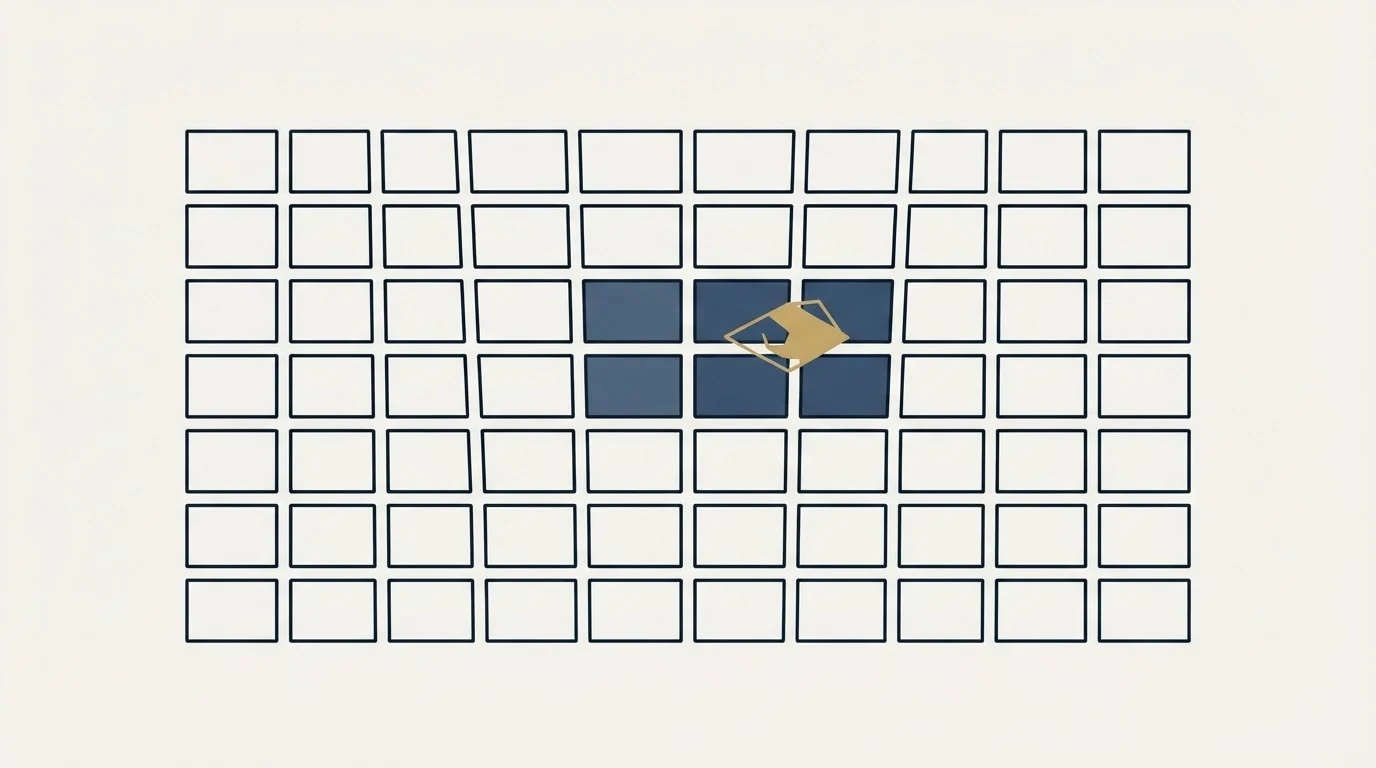
The most valuable output of an honest grid is usually the least comfortable one. After the blocked cells and the inapplicable ones are removed, a portion of what remains sits in divisions where the account team knows nobody at all. That is a real finding and it is frequently treated as a data-quality problem instead.
Those cells do not belong to the account manager's relationship map, because there is no relationship in them. They are a first-touch problem inside a company that is already a customer, which is an unusually strong premise: something checkable about their own organisation is already true, and the buying centre next door is a reference you are allowed to use.
Two boundaries from our own practice apply if that motion gets automated. We run one message per campaign, with no bumps and no thread replies. And the criteria that make a meeting qualified are agreed in writing before anything sends, which in this motion means deciding in advance whether a divisional user counts or whether the divisional budget holder is required. The template-shaped versions of the warm half of this work are in cross-sell email templates and upsell email templates; the cold half, into a division that has never heard of you, is a different message and a different list, and it is worth planning capacity for separately using the arithmetic in sales capacity planning.
The short version
Whitespace mapping compares what an existing customer buys against what they could buy, drawn as a grid of buying centres against your portfolio. Build it at the level of units that can make their own purchase decisions, because a logo-level view flatters the number and names nowhere to go.
An empty cell is not an opportunity. Give every one a reason it is empty, remove the ones where the product does not apply, date the ones blocked by an incumbent contract, and rank what survives by whether you know anybody in that buying centre rather than by estimated value. Expect the exercise to produce more intent than contact, and measure the cells that were actually worked rather than the cells that were identified.
The cells where the account team knows nobody are the ones the grid is uniquely good at finding and worst at acting on. We will build one campaign into those divisions and you can read the replies.
Definitions, the grid construction and the buying-centre figures are verified against Prolifiq's white space analysis guide, Upland Software's whitespace analysis article and Altify's whitespace glossary entry, all fetched 23 August 2026. Publishers revise these pages; confirm the current text before relying on them.
Frequently asked questions.
Frequently asked questions- What is whitespace mapping in sales?
- A structured comparison of what one existing customer currently buys against what they could buy across their whole organisation, drawn as a grid. Prolifiq's guide describes putting the customer's business units, divisions, geographies or buying centres on one axis and your product portfolio on the other, with each cell either filled or empty.
- Is whitespace analysis the same as white space in patents?
- No. The phrase is used in at least three unrelated jobs. Patent analysts use it for gaps in an intellectual-property landscape, innovation and market strategy use it for unmet demand in a market, and sales uses it for the unsold gap inside an existing customer. The vocabulary overlaps and almost nothing else does.
- Why do whitespace maps not produce revenue?
- Because building the map and working it are separate acts and only the first has a deadline. A seller can hold a bounded number of live conversations, and those go to pipeline that is closer to closing than a division nobody has contacted. Count the cells that received real contact against the cells identified, and the gap is usually larger than expected.
- How do you prioritise whitespace opportunities?
- Remove the cells where the product genuinely does not apply, date the ones blocked by an incumbent contract, then rank what survives by whether anybody is known in that buying centre. Estimating cell value from list price across a whole division produces a number large enough to survive the meeting and too soft to plan against.
About the author.

B2B cold email experts helping companies generate qualified leads through done-for-you outreach campaigns.
RevenueFlow Team
Explore more.
Ready to scale your outreach?
We build GTM engines that book real meetings. See the receipts.
Related articles.
Land and Expand: The Motion, Its Metrics and Where It Fails
Land and expand as three public companies describe it in their own filings and as the sales publishers teach it: the motion, its retention metrics, and where it fails.
Sales Enablement Charters: What the Published Ones Ask For
Six publishers set out what a sales enablement charter should contain. Five describe a document nobody can check, and one writes a definition with inspection in it.
Win Rate Benchmarks: Which Figures State a Population
A catalogue of the published average sales win rates, sorted by whether the page names the population behind its own number. Most do not.
Sales Kickoff Agendas: Five Published, Session by Session
Five publishers print a sales kickoff agenda. They agree on four blocks and disagree on session length, rehearsal and where the agenda comes from.
Sales Cycle Length Benchmarks: What Each Figure Counts
The published B2B sales cycle benchmarks, sorted by what each page says it counted. The same number means two different things in two of them.
Sales Comp Plan Design: What the Publishers Prescribe
Four publishers set out how to design a sales compensation plan. Here are their procedures, their components, and which of their ratios carry a population.