Land and Expand: The Motion, Its Metrics and Where It Fails
Land and expand as three public companies describe it in their own filings and as the sales publishers teach it: the motion, its retention metrics, and where it fails.
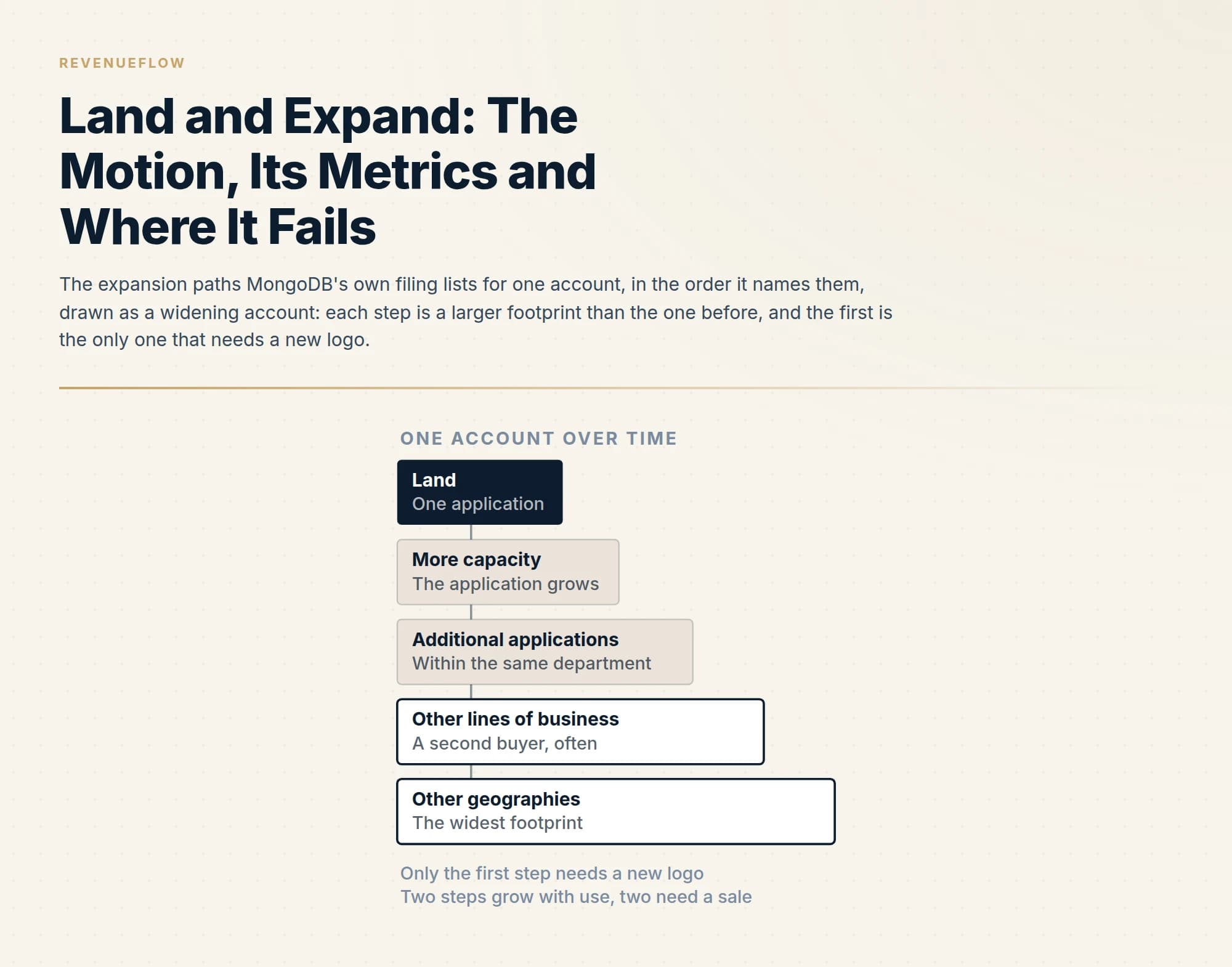
Land and expand is a small first deal followed by growth inside the account. MongoDB's filing names the model and defines its expansion metric, Datadog's says the product must be easy to adopt and self-service to expand, and Snowflake watches existing-customer consumption. It is a plan where a seat, meter or module grows without renegotiation, and a second sale otherwise.
Key takeaways
- DealHub, HubSpot and DemandFarm define the motion as a small landing deal followed by upsell and cross-sell, and DemandFarm calls it a business strategy that masquerades as a sales model because product, onboarding and support do the growing.
- MongoDB's, Datadog's and Snowflake's own annual reports describe expansion as a property of the product and the contract: capacity that grows with an application, a footprint extended on a self-service basis, consumption that rises with use.
- Each filing publishes its own retention rate with its own name, period and cohort rule; all net departures against growth, none is comparable with the others, and none tells consumption growth from a second product sold.
- The expand half is a plan only where a seat count, usage meter or module grows without a renegotiation; where growth needs a second buyer it is another land, with different people, measures and clocks.
Reviewed and updated September 21, 2026
The land and expand explainers this page draws on are written by companies that sell software to the teams running it, which is why the motion tends to be described as a philosophy about trust. It is more useful to read it as three public companies describe it in their own annual reports, where the phrase carries legal weight and the metric behind it has a published definition. This page takes the motion from those filings and from the sales publishers who teach it, sets out what has to be true of the product and the contract before the expansion half is a plan rather than a hope, and says where the motion fails. Nothing here is a customer story of ours; every named company is quoted from its own filing, dated. The metric the motion is judged by has its own entry at net revenue retention, and the precondition that decides whether the motion is one sale or two is on SaaS GTM strategy.
The motion, as the publishers define it
DealHub's glossary entry (published 8 August 2024, modified 9 April 2026, fetched 21 September 2026) gives the two halves their plain names: "The landing phase involves securing an initial, smaller deal with a new customer." and, once value is shown, the expanding phase, which it describes as upselling and cross-selling into the account. Its summary: "The core idea of the land and expand strategy is to start small, prove value, and gradually broaden the scope of the relationship."
HubSpot's sales blog (updated 2 May 2025) tells the same story as a rep's progression: "A 'Land and Expand' strategy starts when a sales rep lands a small deal with an organization." Its worked example is a construction-software seller whose first deal is five franchise builds and whose eventual deal is a national roll-out, and its closing claim is that "The most important aspect of the tactic is trust."
DemandFarm, a key-account-planning vendor (published 30 June 2020, modified 12 March 2025), states the motion as three rules, the second of which is the one sellers most often break: "Selling too much too soon can undermine deals." It also makes a distinction the other publishers skip. Land and expand, it argues, "It is a business strategy that masquerades as a sales model.": the sales team plants the seed, but product, onboarding, support and account management do the growing.
Those three pages agree on the shape and differ on the emphasis. What none of them supplies is a definition with consequences attached, and for that the better sources are companies that have to describe the motion to their shareholders.
The motion, as three public companies describe it
MongoDB's annual report for the fiscal year ended 31 January 2026, signed 11 March 2026 and fetched from EDGAR on 21 September 2026, names the model in one sentence: "The economic attractiveness of our subscription-based model is demonstrated by customer renewals and increasing existing customer subscriptions over time, referred to as land-and-expand." The mechanics follow in the same passage: "If an application grows and requires additional capacity, our customers increase their usage of our platform." Elsewhere the filing lists the expansion paths in order: more capacity for a growing application, then additional applications, within the same department or in other lines of business or geographies.
Datadog's report for the year ended 31 December 2025, signed 18 February 2026, is the most explicit about what the product has to be: "We employ a land-and-expand business model centered around offering products that are easy to adopt and have a very short time to value." And about who does the expanding: "Our customers can expand their footprint with us on a self-service basis." The filing's own reason for the model is efficiency: "We believe that our land-and-expand business model allows us to efficiently increase revenue from our existing customer base."
Snowflake's report for the fiscal year ended 31 January 2026, signed 20 March 2026, does not use the phrase and describes the same two halves: "Our go-to-market strategy is focused on acquiring new customers and driving increased use of our platform for existing customers." Its statement of why the second half is watched: "We believe the growth in use of our platform by our existing customers is an important measure of the health of our business and our future growth prospects."
Read together, the three filings say something the blog definitions leave implicit. In every case the expansion is described as a property of the product and the contract: capacity that grows with an application, a footprint a customer extends without a salesperson, consumption that rises with use. The relationship and the trust the publishers emphasise are present in all three companies, and none of the three filings puts them in the sentence that defines the model.
The metrics, as the filings define them
The number the motion is judged by is a retention rate that includes expansion, and the three filings publish three versions of it, each with its own name and cohort rule.
MongoDB: "We also examine the rate at which our customers increase their spend with us, which we call net ARR expansion rate." The filing defines it as the annualised recurring revenue at the end of a period from customers who were also customers a year earlier, divided by the ARR from all customers at the earlier date, including those who churned or reduced their subscriptions: the surviving cohort's later ARR is the numerator, and every customer's ARR at the base date is the denominator. Its published figure: "As of January 31, 2026, our net ARR expansion rate was approximately 121%."
Datadog calls its version the dollar-based net retention rate, compares ARR from the same set of customers against the year-ago period, and reports: "As of December 31, 2025, our trailing 12-month dollar-based net retention rate was about 120%."
Snowflake's is a dollar-based net revenue retention rate built on a two-year measurement period and a cohort of customers under capacity contracts who used the platform in the first month of that period; its filing attributes the year's product revenue growth "primarily due to increased consumption of our platform by existing customers, as evidenced by our net revenue retention rate of 125% as of January 31, 2026."
Three things about those definitions matter to anyone reading a land and expand claim. The cohort always includes the customers who left, so the rate nets departures against growth; a rate above one hundred means the base grew without a single new logo. The period and the cohort rule differ by company, so the three figures are not comparable with each other, whatever a benchmark deck says. And every one of them is a consumption or capacity number: the metric rises when customers use more, which is the mechanical expansion the filings describe, and it does not distinguish a customer who bought a second product from one whose existing workload grew. The general reading rules for the number, and the ways a cohort definition can flatter it, are on the net revenue retention entry.
What has to be true before the expand half is a plan
DealHub's page names the precondition in passing, and it is the sentence that separates the motion from a slogan: "Some of your customers will expand without any need for additional support from you." It also states the product requirement: "Next, you need a scalable business model (and product) that allows for incremental expansion." Datadog's filing says the same about itself, with products that are easy to adopt, a short time to value, and a footprint the customer extends on a self-service basis.
The live SaaS GTM strategy guide draws the line this implies: the plan is real only where a seat count, a usage meter or a module grows without a renegotiation, and where expansion needs a second sale to a second buyer it is two acquisition motions wearing one name, of which only the first is funded. MongoDB's own list of expansion paths shows both sides of that line inside one company: a growing application takes more capacity without anyone being sold to, while a new line of business or a new geography is, in most organisations, a new buyer with a new budget.
So the questions to ask before writing land and expand into a plan are about the product and the contract rather than the relationship. Does usage grow with the customer's own work, or is the footprint fixed per company? Is there a second product the same buyer needs? Does the contract meter what grows, or does every increase reopen the negotiation? Who at the customer can approve the next increment, and is it the person who approved the first? A company that answers those four honestly usually finds that part of its expansion is mechanical and part of it is a second sale, and that the two need different people, different measures and different clocks.
Where it fails
The publishers who sell to account teams are candid about the failure, because it is the problem their products exist for. Kapta, an account-management-software vendor (undated page, fetched 21 September 2026), names the most common one: "One of the primary reasons is that account teams often fall into the trap of using the same tools and techniques designed for new business acquisition." Its argument is that "New business sales and account management are fundamentally different disciplines.": one prospects, pitches and closes strangers, the other works inside a relationship that already exists.
The second failure is the one DemandFarm's second rule names, selling too much too soon. Its post also flags a measurement trap that the filings' metric definitions make concrete: the need for "Distinguishing between organic growth and growth due to upselling/cross-selling while tracking or incentivizing sales." A retention rate that nets consumption growth and cross-sales into one number cannot say which of the two a team produced, so a plan that pays account managers on the number pays them for the customer's own growth.
The third failure is structural and belongs to the product. A tool with a fixed footprint per company has nothing to expand into, and the net revenue retention entry's point that a rate above one hundred needs a product whose usage grows with the customer's own work applies here in full: the motion cannot be executed into a product that does not grow.
The fourth is the clock. Expansion revenue lands inside a quarter, from a known buyer, and new-logo revenue lands after a cycle usually longer than the quarter it is worked in; a seat asked to produce both will choose the certain one whenever it is behind. That is why hunter and farmer roles are split at all, and why a land and expand plan that does not say who owns the land is a plan to stop landing.
| Failure | Who names it | The check |
|---|---|---|
| Existing customers worked like new prospects | Kapta | Does the account team run new-business playbooks? |
| Selling too much too soon | DemandFarm | Is the first deal one value proposition, kept small? |
| Consumption growth paid as if it were selling | DemandFarm; the filings' cohort rules | Can the retention rate say which growth a person produced? |
| A product with nothing to expand into | The net revenue retention entry | Does usage grow with the customer's own work? |
Where our own practice sits
Our work is the land only. A campaign we run for a client sends one message per person, on one premise, to companies chosen in advance, and its job is the first conversation with a new account; a later approach to the same person is a separate campaign with a separate premise, never a reminder, and the reasoning is on the Agoge sequence. Expansion into an existing customer is one of the five situations where account-based work fits, set out on account-based marketing use cases, and when a client runs it through us the list is the customer base and the buyer is the second department, which makes it, in the terms above, another land.
A meeting we book is qualified against criteria agreed in writing before launch, and budget, timing and authority are never conditions of it having counted. For a land and expand client that criterion is usually deliberately small, because the first deal is meant to be small: the person has responsibility for one team's problem, and the expansion is the customer's to grow. The whole shape of a recurring-revenue business, with the expand half drawn to the right of the sale, is on the bow tie model.
The short version
Land and expand is a small first deal followed by growth inside the account, and the useful definitions are the ones with consequences: MongoDB's filing names the model and defines its expansion metric, Datadog's says the product must be easy to adopt and expandable on a self-service basis, and Snowflake's watches existing-customer consumption as the measure of its health. The retention rates those filings publish net departures against growth, differ in period and cohort, and cannot tell consumption growth from a second product sold. The motion is a plan where a seat, a meter or a module grows without a renegotiation, and a second acquisition motion where it needs a new buyer; the failures are running new-business playbooks on existing customers, selling too much too soon, paying for the customer's own growth, and expecting a fixed-footprint product to expand.
If the constraint is the first half, too few accounts landed for the second half to matter, that is a supply question: a first campaign shows what a market returns before the expansion plan is written.
Every quotation above is from the named page as fetched on 21 September 2026: DealHub's glossary entry (published 8 August 2024, modified 9 April 2026); HubSpot's sales blog (updated 2 May 2025); DemandFarm (published 30 June 2020, modified 12 March 2025); Kapta (undated); MongoDB's Form 10-K for the fiscal year ended 31 January 2026 (signed 11 March 2026), Datadog's Form 10-K for the year ended 31 December 2025 (signed 18 February 2026) and Snowflake's Form 10-K for the fiscal year ended 31 January 2026 (signed 20 March 2026), all on the SEC's EDGAR host. Companies and publishers revise these documents; confirm the current text before relying on it.
Frequently asked questions.
Frequently asked questions- What is a land and expand sales strategy?
- A motion that wins a small first deal with a new account, proves value, and grows the account afterwards through more usage, more seats, more products or more teams. DealHub's glossary describes the landing phase as securing an initial, smaller deal and the expanding phase as upselling and cross-selling; MongoDB's own annual report defines land-and-expand as customer renewals and increasing existing customer subscriptions over time.
- Which metric measures land and expand?
- A retention rate that includes expansion. MongoDB calls its version net ARR expansion rate, Datadog dollar-based net retention rate and Snowflake net revenue retention rate; each follows the customers who existed at a base date forward, keeps departures and reductions in the denominator, and divides the later total by the earlier one. The period and cohort rules differ by company, so the published figures are not comparable with each other.
- When does land and expand fail?
- Four ways the publishers and the filings make concrete: account teams running new-business playbooks on existing customers, which Kapta names; selling too much too soon, DemandFarm's second rule; paying people for consumption growth the customer produced, which a netted retention rate cannot separate from selling; and a product with a fixed footprint per company, which has nothing to expand into whatever the account team does.
- Is land and expand one sales motion or two?
- It depends on what grows. Where a seat count, a usage meter or a module grows without a renegotiation, expansion is mechanical and belongs in the plan as the expand half. Where the next increment needs a new line of business, a new geography or a new budget holder, it is a second acquisition motion with its own buyer, its own cycle and its own owner, and a plan that funds only the first will stop landing.
About the author.

B2B cold email experts helping companies generate qualified leads through done-for-you outreach campaigns.
RevenueFlow Team
Explore more.
Ready to scale your outreach?
We build GTM engines that book real meetings. See the receipts.
Related articles.
Sales Prospecting for Consulting Firms: Find the Event
Prospecting for a consulting firm: where triggers are published by practice, who inside the firm reads them, why alumni and referrals come first, when to skip it.
Physician Email Lists: The Row, Its Sources and Its Gaps
The anatomy of a physician email list: the six field groups, which CMS, AMA and state board records hold each, what vendors claim, the rules, and the order to verify.
Telemarketing Laws by State: 13 Statutes, Read
Thirteen states' own telemarketing statutes and agency pages, read first-hand: what each one keys on, and which of them reach a business to business call.
B2B Lead Lists for Utilities: Three Registries, One Gap
The anatomy of a utilities lead list: the EIA-861 census, PHMSA annual reports and SDWIS enumerate electric, gas and water utilities; vendors sell the field they lack.
Sales Prospecting for Utilities: Read the Filings First
Prospecting utilities from the proceedings that announce their spend: rate cases, resource plans and procurement decisions, who owns each, and the supplier gate.
Cold Calling for PPC Agencies: What You Can See First
A paid media prospect is partly readable before the call and has already been told by the platform what to do when a stranger rings about its ads.