Account-Based Marketing Use Cases: Five Situations
A qualifying test for account-based work: five situations where it earns its cost, three that look like it and are not, and the minimum kit each one needs.

Account-based marketing fits when the target companies can be named today, landing a few would change the year, more than one person decides, and you already know something specific about each account. The clearest situations are customer expansion, committee-decided enterprise deals, enumerable markets, displacement and beachhead entry.
Key takeaways
- Knowing a company's name is not knowing something about it, and the specific thing you know is what the message is built from.
- Expansion into existing customers is the highest-yield situation, because the account is known, a relationship exists and the work is reaching untouched parts of it.
- A pipeline gap with no named accounts behind it is a symptom rather than a use case, and a list assembled to justify the programme proves nothing.
- Four of the five things an account-based programme needs are list and research work, and none of them is a platform.
Reviewed and updated September 2, 2026
Snowflake's published account-based programme is described by the vendor running it in one revealing line: "The strategy is to only pursue accounts they know something about" (AdRoll). That sentence is doing more work than the percentages printed above it. The programme started from a position of knowing which companies mattered and something specific about each of them.
That is the actual precondition for account-based marketing, and it is the one most often missing when ABM gets proposed. The proposal usually arrives as a response to a pipeline shortfall, at which point the question being asked is "what should we do about the number" rather than "which named companies do we need and what do we know about them". Those produce very different programmes.
Choosing the right response to a pipeline shortfall depends on which growth discipline is actually stuck, a question diagnosing the growth bottleneck walks through before any agency shortlist.
This piece is the qualifying test: five situations where account-based work genuinely beats broad outbound, three that look like it and are not, and what each of the five needs to be run properly.
The qualifying test
- Yes: The companies you want can be listed by name, today
- Yes: Landing a handful of them would change the year
- Yes: More than one person has to agree before anything is bought
- Yes: You already know something specific about each company
- Yes: Someone senior will spend real attention per account
- No: The trigger for asking was a pipeline number rather than a list
The fourth condition is the one that separates a working programme from an expensive one. Knowing a company's name is not knowing something about it. Knowing that they run the incumbent product, that they opened an office in a market you serve, that they are hiring for the function you replace, or that their last three job postings describe the problem you solve, is knowing something. That knowledge is what a message is built out of, and without it account-based work degenerates into ordinary outbound with a shorter list.
Five situations where it earns its cost
Expansion into accounts you already have. The highest-yield use of account-based work is not new logos. It is selling more into companies where you are already present, where you know the org chart, and where a positive internal reference exists. Snowflake's ABM lead states it directly in her own words: "We're achieving a 50 percent new opportunity rate with existing customers we target with ABM." That figure is her claim rather than an audited one, and the mechanism is unremarkable: the account is known, the relationship exists, and the work is reaching the parts of the organisation the current relationship does not touch.
Enterprise deals decided by a committee. Where five to ten people across three functions have to converge, reaching one champion accomplishes very little, and the whole discipline of buying-group coverage exists for this case. The test is whether a single enthusiastic contact has ever failed to get a deal through at your company. If that has happened more than once, the group is the problem and the group is what account-based work addresses.
A total addressable market small enough to enumerate. Some categories have three hundred realistic buyers worldwide. Broad marketing against a market that size wastes almost all of its spend on people who cannot buy, and the entire market fits on a list you could review in an afternoon. Here account-based work is not a strategy choice, it is arithmetic.
Competitive displacement. You know which companies run the incumbent, when their contracts renew, and what specifically frustrates them, because your last four wins told you. That is the richest possible starting position: a named list, a shared problem, and a timing signal. The message writes itself, and the only real work is coverage and timing.
A defined beachhead in a new market. Entering a region or a vertical with a list of thirty companies that would make credible first references is a genuine account-based situation, and it is often mistaken for a brand-building one. Thirty named companies do not require awareness. They require contact.
Beachhead entry often runs on dinners and roadshows, and what a field programme costs per meeting divides that spend the way any other channel is divided.
- Expansion into existing customers
- Committee-decided enterprise purchases
- A market small enough to enumerate
- Displacing a known incumbent
- A thirty-account beachhead in a new region
- A pipeline gap with no named accounts behind it
- Single-decision-maker purchases
- High-volume SMB with short cycles
- A market you can only describe, not list
- Broad outbound with company names merged in
Three things that look like a use case and are not
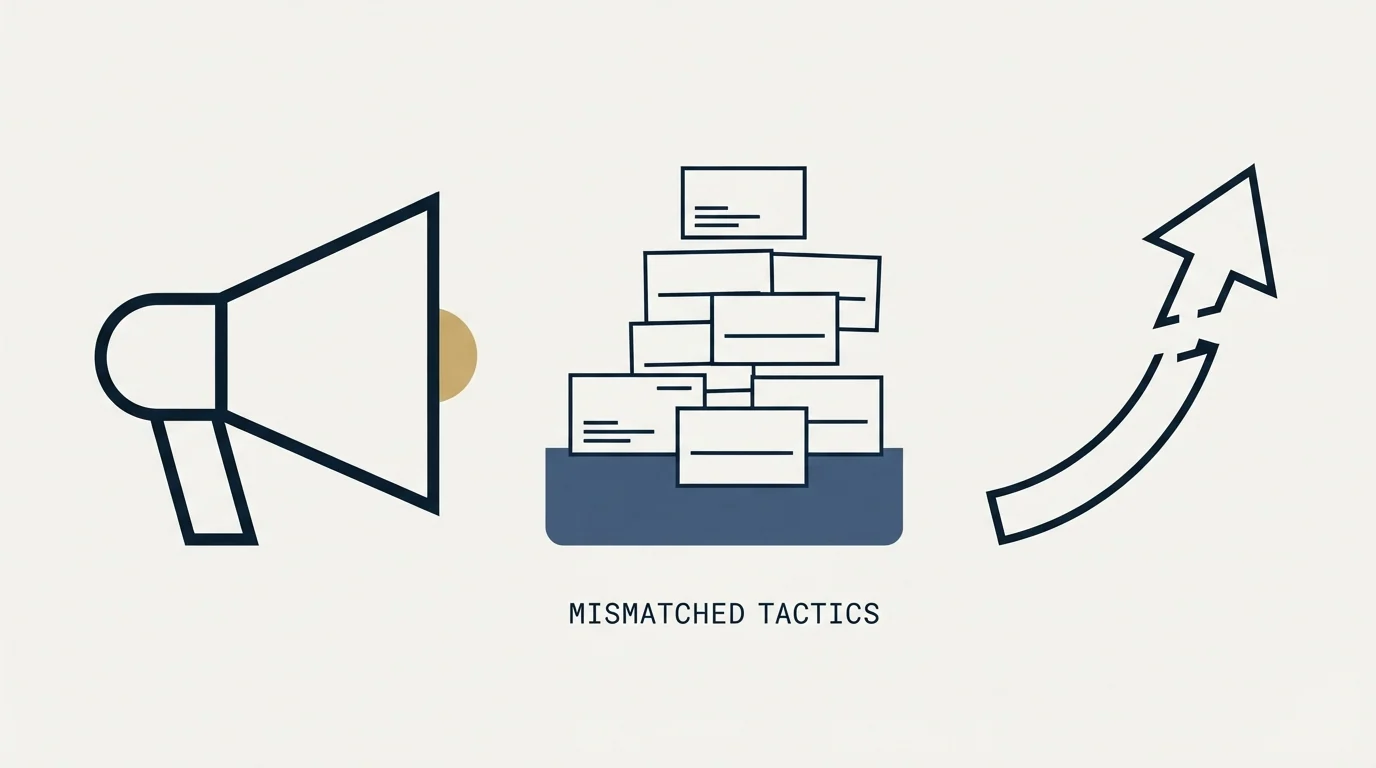
"We need more pipeline." This is a symptom and it is compatible with almost any diagnosis. Account-based work is the answer only if the accounts you want are identifiable and not responding. If the honest position is that you do not know who should buy, the first job is finding out, and running an account-based programme against a list assembled hurriedly to justify the programme is the most reliable way to spend a quarter proving nothing. ABM versus inbound marketing sets out the diagnostic when the answer is genuinely unclear.
A single person can decide and sign. Account-based work exists to coordinate contact across a group. Where one operations manager evaluates, decides and pays, the coordination has nothing to coordinate, and everything account-based adds is cost. Targeted outbound to the right individual is the same motion without the overhead.
Broad outbound with company names inserted. Merging a company name into a template is personalisation of the message and not account-based marketing, because nothing about the targeting, the coverage or the reporting has changed. The tell is that the account list has no upper bound. A programme with four thousand accounts on it is broad outbound, whatever it is called internally, and it will be measured in volume within two quarters because nothing else in it is countable.
What each situation actually needs
- Step 1The list, as rows
Named companies with an owner each. If it cannot be produced today, this is the whole job.
- Step 2The specific thing you know
Per account or per cluster: the trigger, the incumbent, the hiring signal. This is what the message is made of.
- Step 3The buying group
Named people and verified contact details across the roles that decide.
- Step 4One argument per role
Four short arguments beat one long one, because the roles are answering different questions.
- Step 5A coverage number
How much of each buying group has actually been reached. Read it at six weeks, not at quarter end.
Notice that four of the five are list and research work, and none of them is a platform. That ratio holds across every situation above, and it is why so many ABM evaluations conclude with a target list rather than a licence. Where the account volume genuinely is too high to manage by hand, tooling helps; below that it mostly formalises work you still have to do yourself. Account-based marketing strategy covers building the list, and B2B account-based marketing covers the plays worth running against it first.
Sizing the list to the situation

The five situations do not all want the same list size, and getting this wrong is the most common way a qualifying programme still fails.
Expansion and displacement usually produce short lists, often under fifty accounts, because the qualifying knowledge is specific and you either have it about a company or you do not. Short lists tolerate genuine per-account work and they demand it, since fifty accounts contacted generically is a wasted quarter with nothing to learn from.
Enumerable markets and beachheads land in the middle, at roughly fifty to two hundred, which is where clustering starts to pay. Group the accounts by the problem they share, build one argument per cluster, and vary only the specifics. Committee-decided enterprise programmes can run wider still, because the per-account work concentrates on identifying people rather than on writing bespoke arguments.
The general rule is that the list should be as long as your qualifying knowledge stretches and no longer. When somebody proposes adding another two hundred accounts, the question to ask is what you know about those two hundred, and whether anyone will do anything differently for them.
Reading other people's use cases
Every vendor publishes customer stories organised by situation, and they are worth reading for the mechanism rather than the numbers. What transfers is which accounts the team picked and why, how they defined coverage, and what they did when an account went quiet. What does not transfer is the percentage, because almost none of these stories discloses a baseline, a measurement period or what the programme cost. The method for reading them is in ABM success stories, and the vocabulary they use is decoded in ABM meaning in marketing.
Where we fit
Four of the five situations above are ones we run directly: expansion into existing customers, committee-decided enterprise deals, competitive displacement, and beachhead entry. The work is the list, the buying group, and one message per person written from the specific thing you know about that company. Nothing chases it, which keeps the reply rate readable as a verdict on the list rather than on persistence.
Meetings count against criteria agreed in writing before launch, and budget, timing and authority are never conditions. The case studies carry those definitions next to the numbers, and a free campaign runs the qualifying test against your own list in practice, which answers it faster than another planning cycle will.
The short version
Account-based marketing fits when the companies can be named, when landing a few of them would change the year, when more than one person decides, and when you already know something specific about each account. The five clearest situations are expansion into existing customers, committee-decided enterprise deals, an enumerable market, competitive displacement, and a defined beachhead. It does not fit a pipeline gap with no list behind it, single-decision-maker purchases, or broad outbound with company names merged in.
Vendor claims and figures verified against the vendor's own pages as of mid-2026, from stored snapshots of the served bytes. The Snowflake figures are AdRoll's published claims about its customer, with the 50 percent figure quoted from a named customer employee. Verify current terms with the vendor before relying on them.
Sources: AdRoll Snowflake case study.
Frequently asked questions.
Frequently asked questions- What is a good use case for account-based marketing?
- Selling further into companies you already serve is the strongest one, because you know the organisation and a reference already exists. After that: enterprise purchases decided by a committee, markets small enough to list in full, displacing a known incumbent whose customers you can name, and entering a new region with a defined set of first-reference accounts.
- When should you not use ABM?
- When a single person evaluates, decides and signs, because there is no group to coordinate and the overhead buys nothing. Also when the market is high-volume SMB with short cycles, and when you can describe your ideal customer but cannot list the companies. In those cases targeted outbound or inbound does the same job without the per-account cost.
- How many accounts should be on the list?
- As many as your qualifying knowledge stretches to. Expansion and displacement programmes often run under fifty accounts, which tolerates and demands real per-account work. Enumerable markets and beachheads sit around fifty to two hundred, where clustering by shared problem starts to pay. A list of several thousand is broad outbound under another name.
- Do you need an ABM platform to run these use cases?
- Not for most of them. Four of the five things a programme needs are list building, qualifying research, buying-group identification and role-specific arguments, all of which are work rather than software. Tooling helps when account volume is genuinely too high to manage by hand, and below that it mostly formalises work you still have to do.
About the author.

Ben Carden is CRO at RevenueFlow, which builds and operates outbound revenue engines for B2B companies. Previously at Gartner Enterprise. Studied at London School of Economics.
Ben Carden · CRO
Connect on LinkedIn →Explore more.
Ready to scale your outreach?
We build GTM engines that book real meetings. See the receipts.
Related articles.
5 ABM Campaign Examples and How Each One Is Built
Five worked account-based campaign examples, each built on the same five fields: account set, tier, plays in order, owner and handoff, and the exit condition.
ABM Metrics: Coverage Decides Every Other Number
Every published ABM metric is a ratio whose denominator somebody chose. Six numbers, the denominator each one needs, and the comparison that settles it.
Two Agencies, One Target List: Who Owns Which Accounts
Two outbound suppliers on one market will contact the same companies unless the buyer splits it first. How to cut the list, run the exclusion feed and check the overlap.
Last Outbound Agency Did Not Deliver: Locating the Failure
The leads were bad names a symptom and no stage. Four places an outbound engagement fails, the counts that separate them, and what to change in the next purchase.
IT Lead Generation: The Buyer Runs Your Playbook
Technology buyers evaluate outbound for a living, and their purchases carry a security review nobody in your meeting owns. Which triggers are real.
HR Lead Generation: The Renewal Clock and Who Signs
An HR buyer who agrees with every word still cannot act outside their own renewal window. Which triggers are observable, and who signs.