Outbound Marketing: The Definition, and the Split Inside It
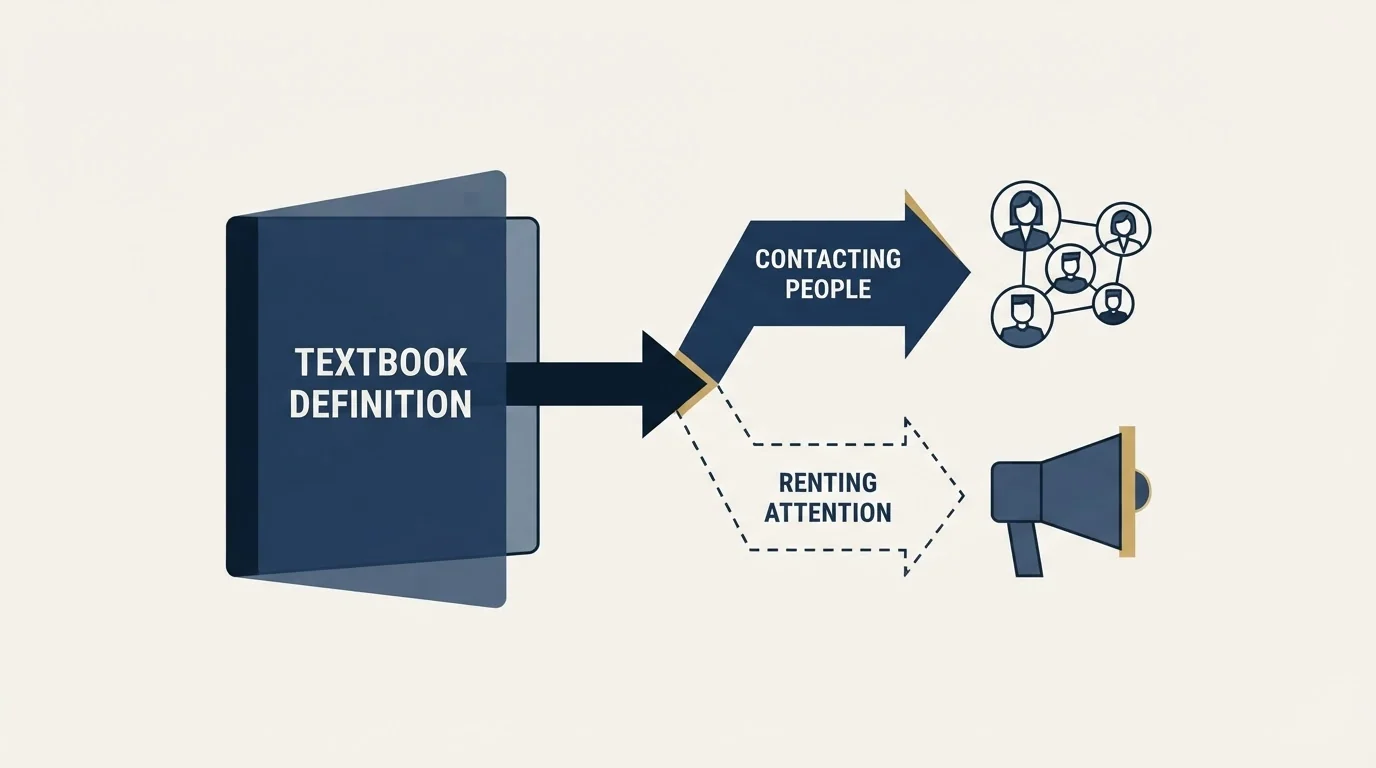
Outbound marketing is any marketing where the company starts the conversation rather than waiting to be found. The category holds two instruments that behave differently: paid interruption rents attention from an audience chosen by attributes, and addressed outreach contacts specific people chosen by name. Only the second can say who answered.
Key takeaways
- The standard definition groups paid interruption and addressed outreach together, and they differ on whether a response can be attributed to a named company.
- Broadcast tactics need sustained spend across many exposures, because most of the audience cannot buy in any given quarter.
- In B2B the addressed half is usually the one worth funding, because the market is small enough that reaching many people is not the problem.
- Spray and pray describes the broadcast half accurately and describes a badly run addressed programme, not the category.
Outbound marketing is any marketing in which the company initiates contact and pushes a message toward an audience that did not ask for it, rather than publishing something and waiting to be found. The standard list of examples runs television, radio, print, billboards, trade show booths, display advertising, cold calls and cold email.
That definition is correct and it groups together instruments that have almost nothing in common operationally. A billboard and a cold email are both outbound, and every decision worth making about them is different.
The distinction the standard definition hides
The received framing splits marketing into two columns, inbound on the left and outbound on the right, and treats the right-hand column as one thing. It contains two.
Paid interruption buys placement in front of an audience defined by attributes rather than by intent. Display, paid social, sponsored newsletters, radio, print, out of home. You choose the attributes and rent the attention for as long as you pay. The cost is purely marginal, the audience is broad and mostly not in market at any given moment, and you cannot say who saw it.
Addressed outreach contacts a specific person you chose deliberately, through a channel that reaches them directly. Cold email, cold calls, LinkedIn messages. You know exactly who you contacted because you picked them, and you can attribute a response to a named company.
Outreach marketing is the phrase the same activity travels under in agency and content vocabulary, and read in a B2B context it names this addressed half rather than a separate discipline.
Both are outbound under the standard definition. They differ on the property that decides most planning arguments, which is whether the tactic can tell you who answered.
- You publish, they arrive on their own schedule
- Your topic selects the audience
- High fixed cost, near-zero marginal cost
- Keeps producing after you stop paying
- You choose attributes, not people
- Broad audience, mostly not in market this quarter
- Cost scales with impressions
- Stops the day the spend stops
- Every recipient picked by name
- Audience is exactly your target list
- Cost scales with people contacted
- A response is attributable to a company
The practical consequence is blunt. Broadcast in B2B needs sustained spend across many exposures before anything happens, because the buying window for a business purchase is narrow and rare, and the audience seeing your message this quarter is largely unable to buy this quarter however good it is. That is a reasonable thing to fund over two years. It is a waste when funded for one quarter and measured on pipeline.
Running a broadcast tactic on an addressable budget and then trying to attribute it is the most common expensive mistake in this category, and it is invisible while it happens, because impressions always go up.
Why the definition matters
Three things follow from taking the split seriously, and each one changes a decision.
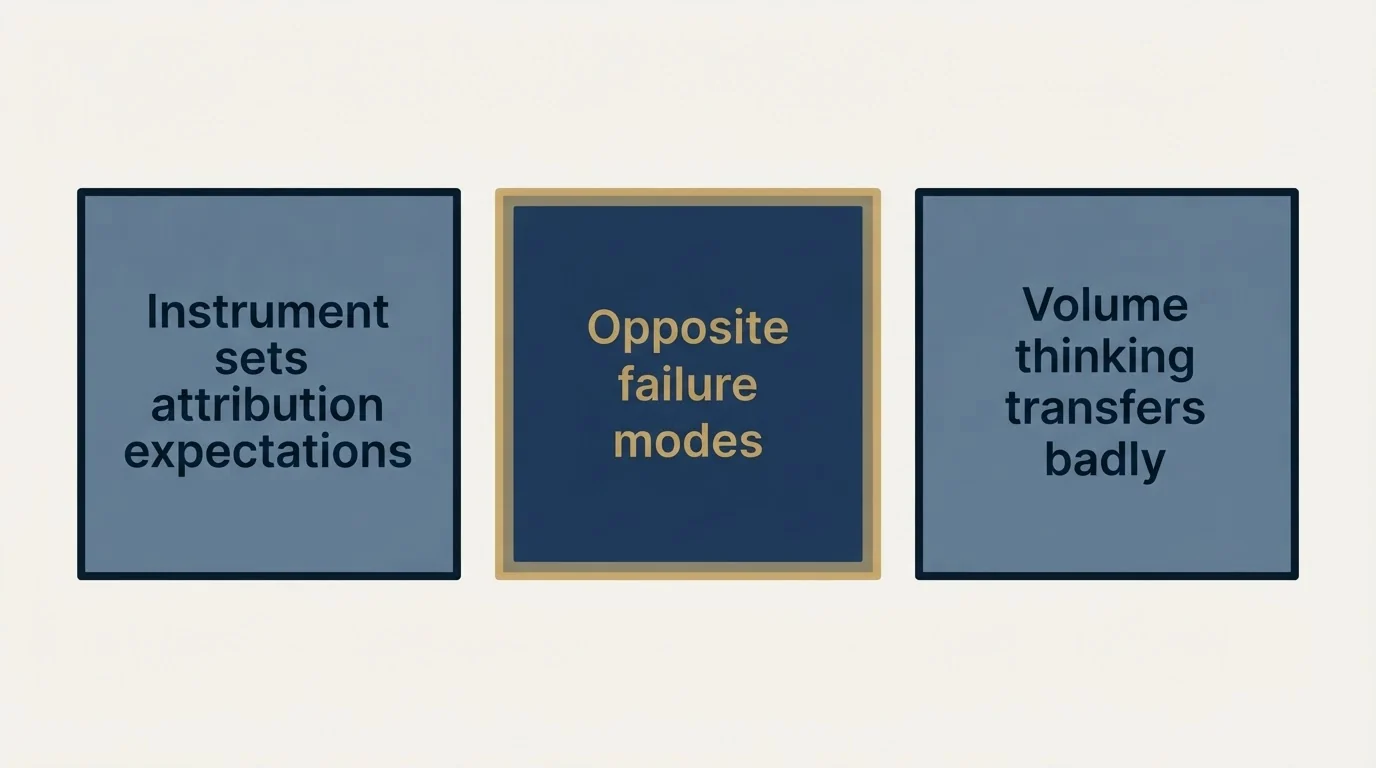
Attribution expectations should be set by the instrument, not by the reporting tool. Addressed outreach produces a response you can trace to a company. Paid interruption produces a lift in direct traffic and branded search that you can count and cannot trace. Demanding per-lead attribution from a broadcast channel produces a model that assigns credit somewhere, confidently and arbitrarily.
The failure modes are opposite. Addressed outreach fails when you cannot name the accounts: if the buyer is defined by something invisible from outside, a list is guesswork and no copy fixes a guessed list. Paid interruption fails on arithmetic, because it is the only one of the three where a large budget can be spent quickly with no signal that anything is wrong.
Volume thinking transfers badly between them. More impressions is a coherent goal for broadcast. More recipients is usually not, for addressed outreach: a larger send to a worse list does not produce more meetings, it produces more people who now associate your name with something irrelevant. The asymmetry is worth holding onto, because the two instruments respond to a budget increase in opposite directions, and a plan that raises both proportionally is quietly funding one of them to do harm.
The tactic-by-tactic version of this argument, including which items on the standard list quietly do not work in B2B, is in outbound marketing tactics.
How it is used in outbound
For a B2B team, the useful reading of the term is that almost everything worth funding under it is the addressed half, and the reason is market size rather than taste.
B2B markets are small in the way that matters. A company selling to a few thousand organisations does not need to reach many people, it needs to reach a handful of specific people at each of a few hundred companies. Broadcast is excellent at reaching many people cheaply, which is a capability that market does not need and pays for anyway.
Two operational differences follow once you are working the addressed half.
The list is the ceiling. Because you chose every recipient, the quality of thinking about who to contact bounds everything downstream. Copy improves a good list and cannot rescue a wrong one. The discipline that sets it is an ideal customer profile written as filters somebody else could re-run.
Events are two tactics wearing one name, and the split runs straight through them. A trade show is usually one budget line and it is two activities. The booth is broadcast: it buys presence, it is measured in conversations you did not plan, and its value is mostly brand. The meetings arranged before you arrive are addressed, they are the actual pipeline, and they are produced by outreach in the weeks beforehand rather than by the event. Teams that treat the show as the tactic get badge scans; teams that treat it as a reason to write get a calendar, and the second requires an addressed channel to exist anyway.
The infrastructure is shared and fragile. Addressed email runs on sending domains and inboxes with reputations attached, so volume has to be earned rather than assumed, and a badly targeted campaign costs more than its own poor results. That is a constraint broadcast does not have and it is the main reason volume is the wrong lever here.
Our own position is narrow and follows from both. We run one message per campaign, built on one premise and sent once, with no bumps and no thread replies, and reaching the same audience again is a separate campaign with a new reason to exist. That removes repetition as a way of compensating for a weak premise, which pushes the work upstream into the choosing. On LinkedIn the argument is stronger still, because a second message lands directly under the one the reader already chose not to answer, so it reads as a bump whatever the campaign structure calls it.
- Step 1Count the market
How many organisations could genuinely buy this, as a number rather than a revenue figure
- Step 2Check reachability
Whether the people who decide can be identified and contacted by name
- Step 3Fund the addressable half first
Small market to calls, larger market to email, hard-to-reach roles to LinkedIn
- Step 4Add broadcast only if funded for years
Sustained presence across many exposures, or not at all
Where the textbook definition misleads
Outbound is not the opposite of inbound in any useful sense. They are frequently presented as rivals, and they answer different constraints: inbound lands late in the buying cycle when the buyer has already decided to buy something, outbound lands early, before a shortlist exists. Early contact converts worse and it is the only way to be in the conversation before the shortlist. The four axes that settle the argument are in inbound marketing versus outbound.
Spray and pray is a description of one half, presented as a definition of both. The phrase travels with this term and it describes broadcast accurately. Applied to addressed outreach it describes a badly run programme rather than the category, and accepting it as the definition is how a team concludes that the addressable half cannot be done well.
The examples list is stuck in the wrong decade. Television, radio and print lead most definitions of outbound marketing because the term predates the channels B2B teams actually use. They are not wrong so much as mismatched: excellent at reaching many people cheaply, which is not the problem a B2B company has.
Outbound is not a synonym for cold email. Cold email is one addressed channel among several, and which one leads is set by deal size and by how reachable the buyers are. Phone produces the highest quality of information per attempt and the lowest quantity, which makes it the right primary channel into a genuinely small market. Email is the only addressed channel that scales past a few hundred accounts without adding people. LinkedIn sits between them on cost and carries limits the platform enforces itself. Direct mail to a named recipient is expensive per attempt and unusually good at reaching senior people, and its economics work only where one customer is worth a great deal.
- Depends: You can say who was reached, by name or by company
- Depends: A response can be attributed to a specific organisation
- Depends: The audience is inside the market you actually sell to
- Depends: The budget covers enough exposures for a broadcast tactic to work at all
- Depends: Success is defined as conversations rather than as impressions
- Depends: The measurement asked of it matches what the instrument can produce
Related terms
Inbound lead is what the other half of the split produces. Lead qualification is the judgment applied to whatever either half generates. Serviceable addressable market is the count that decides which half to fund. Positioning statement fixes the audience the whole exercise is aimed at. And qualified appointment is the unit an addressed programme should be measured on.
The short version
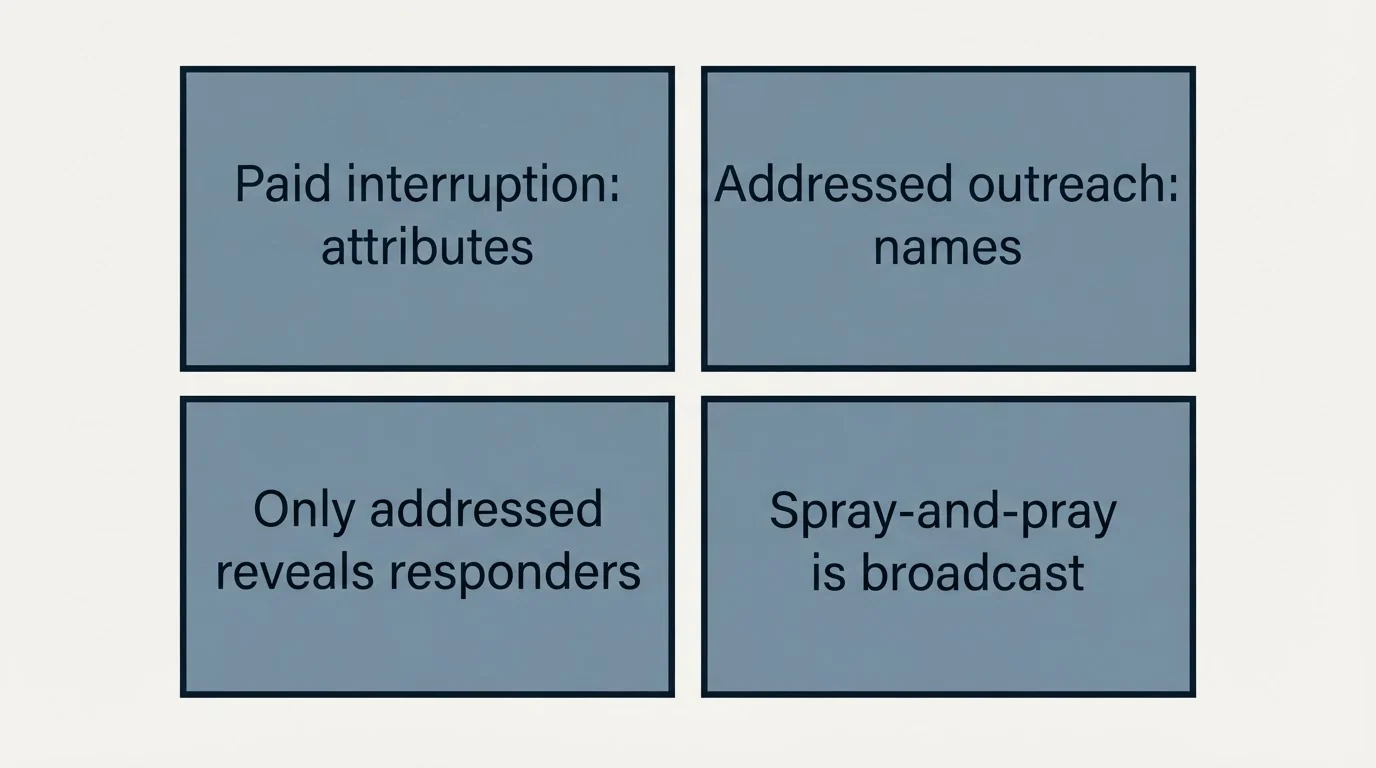
Outbound marketing is marketing where the company starts the conversation. The standard definition is accurate and it hides the split that matters: paid interruption rents attention from an audience chosen by attributes, and addressed outreach contacts people chosen by name.
Only the second can tell you who answered, and in B2B it is usually the half worth funding, because the market is small enough that reaching many people is not the problem. Broadcast can work and needs sustained spend across years rather than a quarter and pipeline expectations attached.
Read the spray-and-pray characterisation as a description of the broadcast half. Applied to addressed outreach it describes a programme run badly, and the fix sits in the list rather than in the volume.
Addressed outreach on email and LinkedIn is the half we run, one message per campaign, against criteria agreed in writing before launch. See what one campaign produces.
Frequently asked questions.
Frequently asked questions- What is the difference between outbound marketing and inbound marketing?
- Inbound publishes something a buyer is already looking for, so they arrive on their own schedule and usually late in the buying cycle. Outbound starts the conversation, so it lands early, before a shortlist exists. Inbound has high fixed cost and keeps working after you stop paying. Outbound is largely marginal cost and stops within one sales cycle of you stopping.
- Is cold email outbound marketing?
- Yes, and it is one channel within the addressed half rather than the whole category. Addressed outreach also covers cold calls, LinkedIn messages and direct mail to a named recipient. Which one leads is set by deal size and by how reachable the buyers are: phone suits a genuinely small market, email is the only one that scales past a few hundred accounts without adding people.
- Why does outbound marketing have a poor reputation?
- Because the phrase that travels with it, spray and pray, describes the broadcast half accurately. Interrupting a broad audience that mostly cannot buy is wasteful by construction. The same phrase applied to addressed outreach describes a programme run on a bad list rather than the category, and the fix sits in who gets contacted rather than in sending less.
- How should outbound marketing be measured?
- By what the instrument can actually produce. Addressed outreach yields responses traceable to a named company, so measure conversations and meetings held. Paid interruption yields a lift in direct traffic and branded search that can be counted and not traced, so demanding per-lead attribution from it produces a model that assigns credit confidently and arbitrarily.