Metadata vs 6sense: Paid Media Execution vs Intent
Metadata runs paid B2B campaigns through seven AI agents; 6sense ranks accounts on intent and sells contact data by credit. Neither publishes a rate. Read 18 Sep 2026.
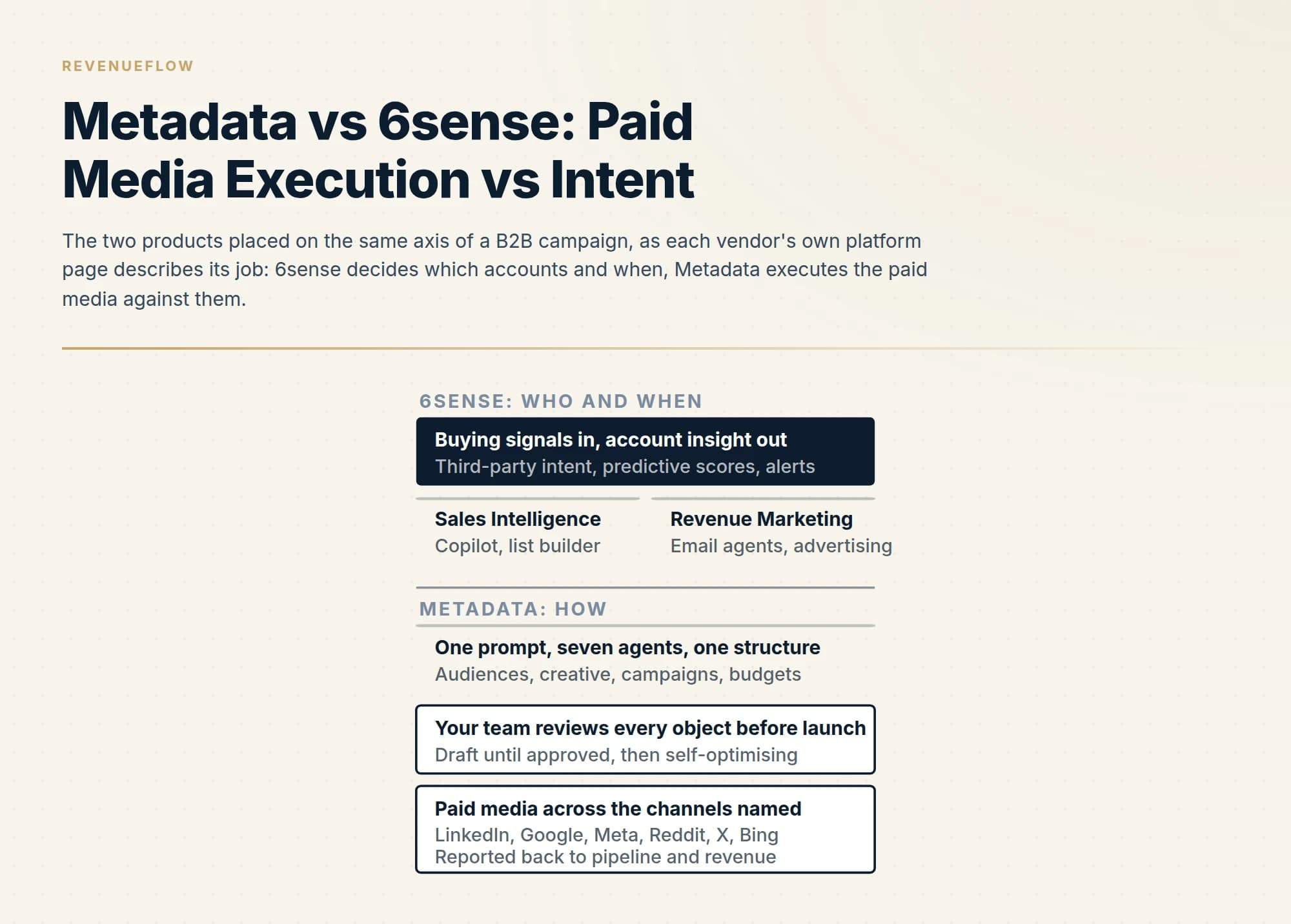
Metadata, as its own pages describe it on 18 September 2026, is a paid-media execution layer: seven AI agents build audiences, creative, campaigns and experiments across LinkedIn, Google, Meta, Reddit, X and Bing, priced to channels and spend. 6sense is an intent platform sold in three packages with a data-credit meter and no figure. They do different jobs.
Key takeaways
- Metadata's pricing page states there is no public price grid and that the number depends on the channels under management, the ad spend the agents operate and how much of the workflow the team delegates; its platform page names seven agents and the channels they build for.
- 6sense's sales intelligence pricing page lists three combinations of Sales Intelligence, Data Credits and Predictive AI with no currency figure, and defines data credits as what unlocks and exports emails, phone numbers and enriched records.
- Metadata's own comparison page concedes the split: choose Metadata for executing and scaling paid campaigns, choose 6sense for identifying in-market accounts, and many teams use both.
- 6sense's apex refused plain and headless fetches on 18 September 2026 but its www pricing and platform pages rendered in a headless browser; Metadata's pages served plain.
Reviewed and updated September 18, 2026
Metadata's pricing page, read on 18 September 2026, says in its own heading that the product is priced to your GTM, not a one-size grid, and then explains why there is no public price: the number depends on the channels you run, the ad spend the agents manage, and how much of the execution work you hand over. 6sense's sales intelligence pricing page, rendered the same day, lists three package combinations and, as on every earlier read of that page, not one currency figure.
So neither vendor publishes a rate, and that is where the resemblance ends. Metadata's platform page describes one execution layer for enterprise B2B paid media, with seven AI agents that prepare audiences, creative, campaigns, budgets, experiments and reporting for a team that keeps launch control. 6sense's platform page describes turning the noise of buying signals into insights so your team and agents know who to engage, why, and when, with a product line split into Revenue Marketing and Sales Intelligence. One runs paid campaigns; the other tells you which accounts are in market.
That makes this a cross-category comparison, and the honest page says so up front, the way the Gong against ZoomInfo comparison does for a different pair. Metadata publishes its own comparison with 6sense; where that page describes 6sense, the description is a rival's and is not adopted here. The live 6sense pricing and 6sense alternatives guides read that vendor in depth.
What each vendor says it is
Metadata's platform page is unusually concrete about its own mechanism. Seven named agents, Mei, Max, Zoe, Eva, Ann, Tom and Raj, plan, build audiences, create, shape offers, assemble campaigns, read performance and run operations, each working in the customer's account as a reviewable teammate, and the page states that your team reviews every object before a dollar moves. One campaign structure spans LinkedIn, Google, Meta, Reddit, X, Bing and more, with the agents building the native ad structure for each channel. Audiences draw on what the page calls a 500 million plus profile targeting graph, with firmographic, technographic, Bombora and G2 intent, CRM lifecycle, retargeting and suppression layers, and the page describes the platform having run 263,554 experiments across audience, creative, offer, bid and budget permutations.
6sense's sales intelligence pricing page sells one product in three combinations: Sales Intelligence with Data Credits and Predictive AI, Sales Intelligence with Data Credits, and Sales Intelligence with Predictive AI. The base product, present in all three, carries a Sales Copilot with a Chrome extension and an AI writer marked beta, company and contact insights including a persona map, technographics, psychographics, web visitor identification, job postings and third-party intent, alerts, intelligent workflows, corporate hierarchy, and integration with a CRM, a sales engagement platform and a web app. Predictive AI adds the predictive model, scores and dashboards, AI recommended actions and account summaries. Data credits add company and contact data acquisition, buyer discovery and a list builder, and the page defines them: data credits within Sales Intelligence are used to unlock and export emails, phone numbers and enriched contact and company records.
6sense's platform page adds the marketing half the pricing page does not cover: Revenue Marketing lists email agents, advertising, intelligent workflows, an audience builder, smart form fill, reporting and an MCP server, and the page names account-based marketing, inbound marketing automation, outbound sales automation, deal acceleration and customer expansion as its use cases.
Pricing, as published on 18 September 2026
Metadata's pricing page shows no grid and explains its inputs. The page states that pricing depends on the channels under management, naming LinkedIn, Meta, Google, Microsoft and Reddit, the ad spend the agents operate, and which parts of the workflow, audiences, creative, experiments and reporting, the customer keeps versus delegates. It states what every plan includes, the full agent team and platform, with the customer holding budgets, approvals and brand control, and it describes the sales call as a working demo on a real campaign plan, an honest fit assessment for your spend level, and a written proposal. Its own comparison page adds a fourteen-day free trial and usage-based pricing that scales with ad spend, which is the vendor's description of its own model.
6sense publishes packages and no figure. The three combinations above are the whole structure on the sales intelligence page, and the vendor's platform page routes every product to a demo. The live 6sense pricing guide records the same absence on a fetch made on 2 September 2026, and this page confirms it sixteen days later on a fresh render.
Neither absence is a fetch failure. Metadata's page served plain and says in words that there is no public grid; 6sense's page rendered in full under a headless browser and carries package contents in detail. Both vendors have decided that the number arrives in a conversation.
Metadata's quote moves with
- Which channels the agents manage
- The ad spend the agents operate
- How much of the workflow the team delegates
- A written proposal after a demo on a live campaign
6sense's quote moves with
- Which of three package combinations is bought
- Whether Predictive AI is included
- How many data credits the contract carries
- Marketing products on the other side of the platform
What Metadata says about 6sense, and what to do with it
Metadata's comparison page carries a feature matrix and a verdict. The verdict is the useful part, because it is a rival conceding the split: choose Metadata if the primary need is executing, optimising and scaling paid campaigns with built-in experimentation and attribution, choose 6sense for a predictive intelligence platform that identifies in-market accounts, and many B2B teams use both, 6sense for the who and Metadata for the how. The page also states plainly that 6sense's proprietary company graph de-anonymises website traffic in a way Metadata does not natively replicate.
The matrix cells that describe Metadata are the vendor's own claims: native LinkedIn, Facebook and Google execution, an audience builder combining firmographic, technographic and intent data, seven autonomous agents, attribution tied to campaigns and experiments, AI-generated creative, and a usage-based model with a trial. The cells that describe 6sense, including a typical contract figure and a setup timeline, are a rival's characterisation, and 6sense's own pages carry neither number, so they are not repeated here.
The one claim that both vendors' own pages support is the division of labour. 6sense's platform page describes intent data, predictive modelling and audience building; Metadata's platform page describes its intent as coming from Bombora and G2 and its audiences as built from a targeting graph plus CRM context. Neither describes itself as doing the other's core job.
The four jobs, and which one each product fills
The account-based platforms comparison sorts this category into four separable jobs: account and contact data, third-party intent, advertising activation, and orchestration and reporting. Placing the two products on that list is the clearest way to read them.
6sense's pages describe the first two jobs as its centre and the third and fourth as products beside them. Its data credits are contact and company data acquisition; its third-party intent and predictive model are the signal; its Revenue Marketing line includes advertising and workflows; its reporting is a listed platform feature.
Metadata's pages describe the third job as its centre and reach the other three through connections. Its audiences pull intent from Bombora and G2 and lifecycle context from the CRM; its execution is native to the ad platforms it names; its reporting ties spend to pipeline. It does not describe a contact database of its own and it does not describe a predictive account model.
A team that already holds an intent and scoring platform is asking whether Metadata replaces its advertising execution. A team that runs paid media by hand is asking whether 6sense would tell it where to point that media. Those are the two questions the pair actually answers, and the ABM tools catalogue lists the published-price alternatives for the jobs neither product is built for.
| Row | Metadata | 6sense |
|---|---|---|
| Account and contact data of its own | No | Yes |
| Third-party intent | Partial | Yes |
| Predictive account scoring | No | Yes |
| Paid media execution on LinkedIn, Meta, Google | Yes | Partial |
| Experimentation across audience, creative, offer and bid | Yes | No |
| Attribution from spend to pipeline | Yes | Partial |
| A published rate | No | No |
The partials follow the vendors' wording: Metadata's intent is described as Bombora and G2 signals in its audience builder; 6sense's advertising sits in its Revenue Marketing line rather than on the sales intelligence page, and its reporting is listed without the experiment attribution Metadata describes.
Who each one fits
Read from the pages alone, Metadata fits a marketing team whose constraint is running paid B2B media across several channels at a spend large enough for an agent layer to matter, that wants to keep approval of every object, and that can supply its account list and intent from elsewhere. Its pricing page's honesty about spend level as an input, and its own line that it will say so if it is not the right tool for your stage, tells a small team where it stands.
6sense fits a revenue team whose constraint is knowing which accounts to work and when, that wants contact data metered by credit inside the same platform, and that is buying the predictive layer as a module. Its three combinations let a team with its own contact database buy intelligence without credits, which the live pricing guide flags as the configuration to ask for by name.
A team with neither constraint has a different question. The intent test in the platforms comparison applies to both: if a signal would change which account a rep works this week, it earns its line; if it produces a weekly list nobody treats differently, it is a report.
Where either one sits in an outbound stack
Neither product writes to a stranger. Metadata places ads; 6sense ranks accounts and, through its marketing line, runs email agents and advertising. The one message per campaign that we send, with no bumps and no thread replies, sits downstream of both: an account either vendor flags is a candidate for one campaign on one premise, and a quiet account is a reason for a new premise later, never a retargeted second touch under the first.
We run cold email and LinkedIn against a named account list rather than paid media, so this is a documentation-grounded comparison of two products we do not operate. Where the shortage is conversations with the accounts you already know rather than signals about them, RevenueFlow books qualified meetings on a pay-per-meeting basis, against criteria agreed in writing before launch.
The short version
Metadata, as its own pages describe it on 18 September 2026, is a paid-media execution layer: seven AI agents that build audiences, creative, campaigns and experiments across LinkedIn, Google, Meta, Reddit, X and Bing for a team that approves every object, priced to channels, spend and delegated work with no public grid. 6sense is an intent and account-intelligence platform sold in three sales intelligence combinations with a metered data-credit line and a separate marketing line, with no published figure.
They do different jobs and Metadata's own comparison page says so. Buy 6sense for the who and when, Metadata for the how, and treat every number one vendor quotes about the other as positioning.
Metadata's product description, agent names, channel list, audience sources and experiment count are per metadata.io's platform page; its pricing inputs per its pricing page; its verdict and self-claims per its own comparison page. 6sense's package combinations and data credit definition are per its sales intelligence pricing page and its product lines per its platform page, both rendered in a headless browser after the apex refused plain fetches. All fetched 18 September 2026. Metadata's statements about 6sense are reported as a rival's claims. Verify current terms with both vendors before relying on them.
Sources: Metadata pricing, Metadata platform, Metadata vs 6sense, metadata.io, 6sense sales intelligence pricing, 6sense platform
Frequently asked questions.
Frequently asked questions- Are Metadata and 6sense competitors?
- Not by their own descriptions on 18 September 2026. Metadata's platform page describes one execution layer for enterprise B2B paid media, with agents that build audiences, creative and campaigns across named ad channels. 6sense's platform page describes turning buying signals into insight about which accounts to engage and when, with a sales intelligence line and a revenue marketing line. Metadata's own comparison page says many B2B teams use both, 6sense for the who and Metadata for the how.
- How much do Metadata and 6sense cost?
- Neither publishes a rate. Metadata's pricing page says in its own words that there is no public price grid, and that the number depends on channels under management, ad spend operated and how much execution is delegated, with a written proposal after a demo. 6sense's sales intelligence pricing page publishes three package combinations and no currency figure on any of them, as it did on an earlier read on 2 September 2026.
- Does Metadata have intent data like 6sense?
- Metadata's platform page describes buyer intent in its audience builder as category, competitor and topic signals from Bombora and G2, layered with firmographic, technographic, CRM and retargeting context. 6sense's pricing page lists third-party intent inside its base Sales Intelligence product and sells a predictive model, scores and dashboards as a separate module. Metadata's comparison page states that 6sense's company graph de-anonymises website traffic in a way Metadata does not natively replicate.
- Which one should a small B2B team consider?
- Metadata's pricing page names ad spend level as an input and says it will tell a team if the tool is not right for its stage, its own signal that a small budget is the wrong fit. 6sense's three combinations let a team with its own contact data buy intelligence without data credits. A team with a list under a few hundred accounts is usually asking neither vendor's question, and direct contact against that list is a different purchase.
About the author.

Tim Carden is CMO / CTO at RevenueFlow, which builds and operates outbound revenue engines for B2B companies. Studied at McGill University.
Tim Carden · CMO / CTO
Connect on LinkedIn →Explore more.
Ready to scale your outreach?
We build GTM engines that book real meetings. See the receipts.
Related articles.
Chili Piper vs LeanData: Form-First Against CRM-First
Chili Piper publishes a seat floor and bundles scheduling and chat; LeanData prices by Salesforce object and sells scheduling separately. Both read 18 September 2026.
Zoom Revenue Accelerator vs Gong: An Add-On vs a Platform
Zoom's support centre documents Revenue Accelerator as a licence on a Zoom account in two classes; Gong sells a platform per user plus a platform fee. Neither has a rate.
Cognism vs Upcell: A Data Provider Against a Data Layer
Cognism sells compliance-first contact data by quote and credit; Upcell sells a layer that runs your providers, Cognism included, through one record. Read 18 Sep 2026.
Mailshake vs Pipedrive: A Sender and a CRM, Side by Side
Mailshake sells per-user sending with a two-way Pipedrive sync from its middle tier; Pipedrive is a per-seat CRM with sequences from Growth. Both read 18 September 2026.
PromptLoop vs ZoomInfo: Web Research Against a Database
PromptLoop builds a dataset from the live web in credits it publishes; ZoomInfo sells access to a maintained database by quote. Both pages read 18 September 2026.
Apollo.io vs Proofy: Data Enrichment Tool Comparison
Compare Apollo.io and Proofy side by side. See pricing, features, and integrations to choose the right data enrichment tool for your needs.