Zoom Revenue Accelerator vs Gong: An Add-On vs a Platform
Zoom's support centre documents Revenue Accelerator as a licence on a Zoom account in two classes; Gong sells a platform per user plus a platform fee. Neither has a rate.
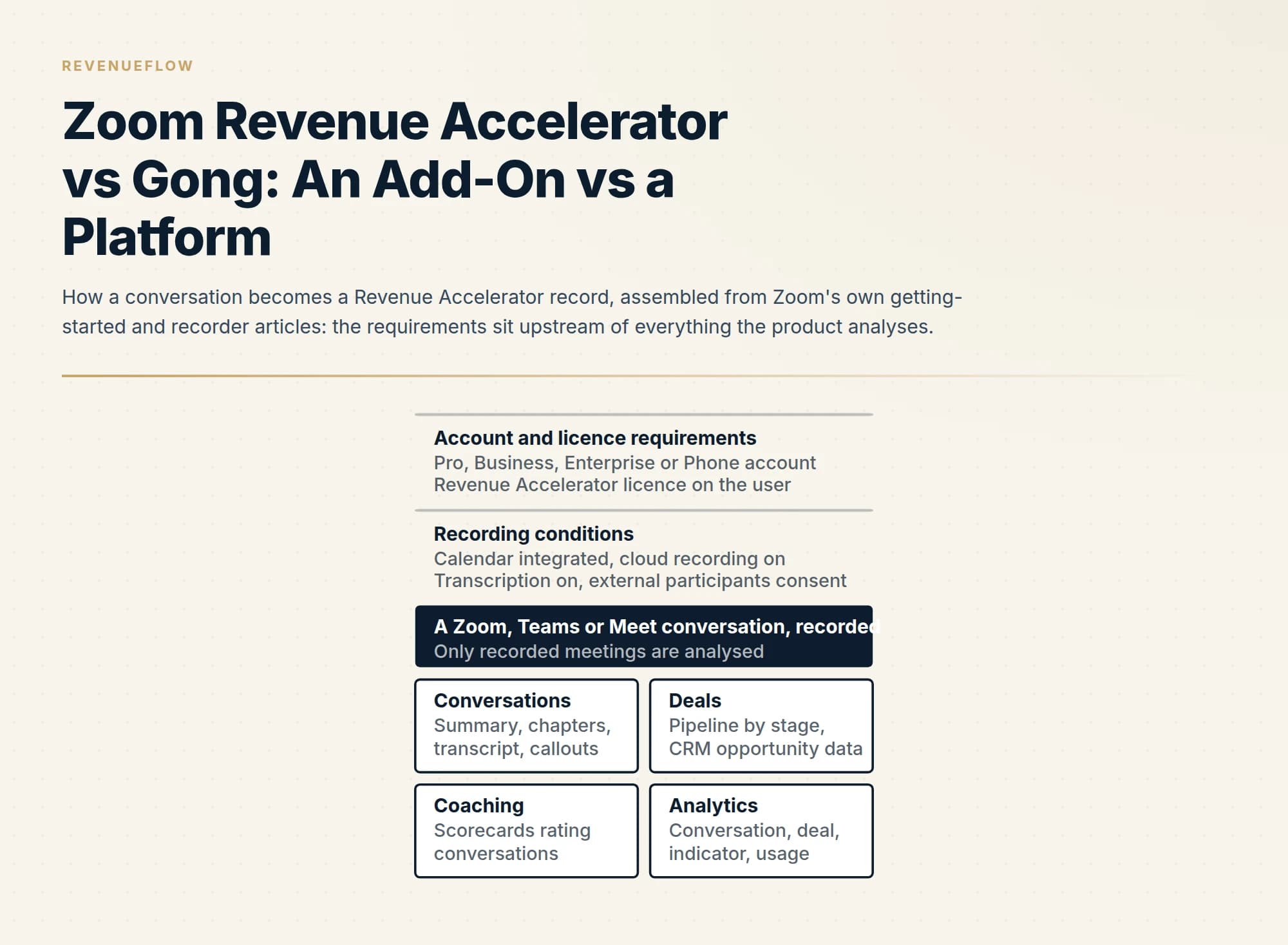
Zoom Revenue Accelerator, per Zoom's support centre on 18 September 2026, is a conversational-intelligence add-on licence on a Zoom account, sold in Essentials and Premium classes that share a feature set and differ in an AI assist cap. Gong is a standalone revenue platform priced per user plus a platform fee. Neither publishes a rate.
Key takeaways
- Zoom's getting-started article lists the requirements: a Pro, Business, Enterprise or Zoom Phone standalone account, a Revenue Accelerator licence, calendar integration, cloud recording and audio transcription enabled, and only recorded meetings are analysed.
- Zoom's licence comparison, updated 17 August 2026, states that Essentials and Premium share every feature and differ in metering: AI sales assist is capped at 60 minutes per user per month on Essentials and unlimited on Premium, with role-play and Ask ZRA metered in AI credits on both.
- Gong's pricing page publishes no figure and three model sentences: licences priced per user, a platform fee based on users supported, and free integration of the existing stack, with a quote after a team-size band.
- Zoom's marketing and pricing pages answered 403 on every fetch route from this network, so every Zoom fact here is a support-article fact; its CRM article documents a Salesforce sync every four hours.
Reviewed and updated September 18, 2026
Zoom's own support article on getting started with Revenue Accelerator, updated 22 July 2026 and read on 18 September 2026, states the product's boundary in its requirements list: a Pro, Business, Enterprise or Zoom Phone standalone account, a licensed user with a Zoom Revenue Accelerator licence, a calendar integrated with Zoom, cloud recording enabled and audio transcription enabled. Gong's pricing page, read the same day, states its boundary as a pricing model: licences are priced per user, there is a platform fee based on the number of users supported, and you can integrate your existing tech stack for free.
Neither vendor publishes a price. That is the first thing to know, and it is not the interesting thing. The interesting thing is that Zoom's product is an add-on licence inside a meetings and phone platform, documented in a support centre, while Gong's is a standalone platform sold on a quote with a team-size band. A buyer comparing the two is usually already paying one of the vendors for something else, and that is what decides the comparison more than any feature list.
One access note before the comparison. Zoom's marketing pages for Revenue Accelerator, including its pricing page and a blog post positioning the product as an alternative to Gong, answered 403 on every fetch route from this network, plain, headless and forced. Zoom's support centre renders, and fifteen of its Revenue Accelerator articles were read for this page. So every Zoom fact below is a support-article fact, and nothing from the marketing site is claimed. The Gong side comes from gong.io's pricing and home pages, and the Gong revenue intelligence guide reads that vendor in depth.
What Zoom says the product is
The getting-started article describes Zoom Revenue Accelerator as conversational intelligence within Zoom products, available as an add-on, using machine-learning algorithms to transform customer interactions into insights for identifying opportunities, assessing risks and improving sales team performance. It is available for Zoom Meetings and Zoom Phone, on the web portal, the desktop client and the mobile apps, and it supports CRM integration.
The same article names the components. A Dashboard shows performance over time and metrics across all meetings, and lets a user ask questions in natural language across conversations, deals, accounts and pipeline. Conversations are the recorded and analysed meetings, each with playback, a summary and smart chapters, a speaking breakdown by participant, conversational metrics, a full transcript, callouts such as good questions or next steps, comments and clips. Deals is a pipeline view that tracks deals by stage and, with a CRM connected, brings in opportunity information such as deal size and activity. Coaching is scorecards a supervisor creates to rate conversations. Analytics covers conversation, deal, indicator and usage analytics. Teams organises users for reporting.
Two limitations are stated in the vendor's own words. Revenue Accelerator can only analyse recorded meetings, because recording consent must be provided by external participants, and admins can customise the consent disclaimer. And select features have different limitations depending on whether the user holds an Essentials or a Premium licence. Recordings follow the account's data retention policy, so a deletion rule set for Zoom recordings removes them from Revenue Accelerator too.
A separate article, updated 21 January 2025, describes an external recorder that joins Microsoft Teams and Google Meet meetings as well as Zoom ones, invited by email address or through calendar integration, so the product is not confined to conversations hosted on Zoom.
What Gong says the product is
Gong's home page titles the product Gong Revenue AI OS and describes it as capturing every interaction, analysing what is working, and automating what happens next. Its product navigation, on the same page and on the pricing page, names the pieces: a platform overview, Gong Engage, Gong Forecast, Gong Enable, Gong Revenue Graph and Gong AI. The home page describes Engage as prioritising and personalising every sales engagement and Forecast as forecast accuracy with unbiased insights and centralised analytics.
That is a wider surface than Zoom's articles describe, and the width is the point of the comparison. Zoom's components are a dashboard, conversations, deals, coaching, analytics and teams, all hanging off recorded meetings. Gong's named products add a sales engagement layer and a forecasting layer to the capture-and-analyse core, and its pricing page sells the whole thing per user plus a platform fee. The Gong as a sales tool guide works through what each of those product lines is for and why a quote is larger than a rep expects.
Gong's pricing page carries no figure. Its form asks for a team size in four bands, 1 to 50, 51 to 1,000, 1,001 to 9,999 and 10,000 or more, and promises a customised proposal. The three sentences it does publish, per-user licences, a platform fee scaled to users supported, and free integration of the existing stack, are the whole disclosure, and they were the same on a snapshot taken two weeks earlier.
The two licence shapes, side by side
Zoom sells two licence classes for the add-on, and its comparison article, updated 17 August 2026, is specific about the difference. ZRA Essentials and ZRA Premium both enable AI role-play, AI sales assist, Ask ZRA and the other Revenue Accelerator features. The difference is in metering. AI sales assist on Essentials is limited to 60 minutes per month per user, with no pooling and usage rounded up in six-second increments; on Premium it is unlimited. AI role-play on both licences is a time-based metered action using Zoom AI credits, rounded up in six-second increments, and Ask ZRA on both is a metered feature using the same credits. The article states that Essentials and Premium users have the same level of access to every other Revenue Accelerator feature, and it points to Zoom's pricing page, which this network could not open, for how credits are bought.
So the Zoom side of the comparison is a licence attached to an existing Zoom account, with an AI meter on top, and the two classes differ in how much of one feature is included rather than in which features exist.
Gong's side is per-user licences plus a platform fee that scales with users supported, which the Gong revenue intelligence guide notes makes cost per rep non-linear at the bottom of the range. No licence classes are published on Gong's pricing page; the products are named, and which ones a proposal includes is a quote question.
Zoom Revenue Accelerator
- An add-on licence on a Pro, Business, Enterprise or Phone account
- Two classes, Essentials and Premium, same feature set
- Premium removes the monthly cap on AI sales assist
- AI role-play and Ask ZRA metered in Zoom AI credits on both
- Rate on a Zoom pricing page this network could not open
Gong
- Licences priced per user
- A platform fee based on the number of users supported
- Existing tech stack integrations free
- Products named: Engage, Forecast, Enable, Revenue Graph, AI
- A quote after a team-size band is chosen
The CRM connection, which both vendors treat as the point
Zoom's article on configuring Revenue Accelerator with a CRM, updated 3 November 2025, states why the connection exists: so that Zoom can sync deal progress with Revenue Accelerator and provide additional analytics, matching conversations to opportunities, accounts and, where none is open, leads. It names four CRMs with their own sections, Salesforce, Microsoft Dynamics 365, Monday and HubSpot, and states the mechanics for Salesforce: an initial sync on connection, then a sync every four hours, configured through OAuth, which the article recommends, or a JWT token, with a toggle to sync team data from the CRM. The requirements repeat the account and licence conditions and add an approved associated domain and admin privileges.
The deals article, updated 29 January 2025, describes what the connection feeds: a pipeline view with visual summaries of engagement activity, comparison of deals on one timescale, filters on activity count, close date, deal size and stage, and conversation-to-deal matching scored on factors such as meeting start time and whether the opportunity name appears in the meeting name.
Gong's pricing page says integrations with the existing stack are free and its home page lists integrations as a product area; the specific CRMs and cadence are documented on Gong's help centre, which serves, rather than on the pages read for this comparison. What the two vendors agree on is the shape: a conversation-intelligence product is only as useful as the deal record it can attach a conversation to, and both sell the attachment as core.
The analytics, and the caveat Zoom prints on them
Zoom's analytics article, updated 22 January 2026, lists what the product measures. Speaker analytics cover talking speed, talk-listen ratio, filler words, longest spiel and patience. Conversation analytics cover the number of conversations, duration, good questions, next steps, a sentiment score and an engagement score. Deal analytics cover conversations and duration per deal. Indicators are configurable words, phrases or sentences the product flags. Usage covers conversation views, commenting, scorecards and shared moments.
The article carries a caveat that deserves to be quoted in full: metrics and analytics are provided for informational purposes and may contain inaccuracies, results are not intended to be used for employment decisions or other comparable decisions, and all recommended ranges for metrics are based on publicly available research. That is a vendor telling its buyers not to manage reps against its own numbers, and it is the same warning the Gong guides on this site draw from first principles: talk-listen ratio is a real measurement, and the moment it becomes a target reps optimise it directly.
| Row | Zoom Revenue Accelerator | Gong |
|---|---|---|
| Recording, transcript and summary of a conversation | Yes | Yes |
| Deal pipeline view fed by a CRM | Yes | Yes |
| Coaching scorecards | Yes | Partial |
| Speaker and conversation analytics | Yes | Partial |
| A sales engagement product line | No | Yes |
| A forecasting product line | No | Yes |
| Recorder for Teams and Meet meetings | Yes | Partial |
| A licence class comparison published | Yes | No |
| A published rate | No | No |
The partials on Gong's side mark capabilities its home page describes in general terms, coaching and analysis across reps and deals, without the component-level naming Zoom's support centre gives; the recorder partial marks that Gong's home page describes capturing every interaction without the pages read naming which conferencing hosts.
Who each one fits
Read from the vendors' own pages, the fit is about what you already pay for.
Zoom Revenue Accelerator fits a team whose meetings already run on Zoom Meetings or Zoom Phone, whose account is Pro, Business or Enterprise, and whose admins are prepared to enable cloud recording, transcription and a consent disclaimer for external participants. The two licence classes let a team buy the same feature set with a capped or uncapped AI assist meter, and the external recorder extends coverage to Teams and Meet meetings a rep is invited to.
Gong fits a team that wants conversation capture, engagement and forecasting from one vendor, is willing to be quoted per user plus a platform fee, and has enough conversations for cross-rep patterns to mean anything. Its pricing page's team-size bands start at 1 to 50, and the platform fee is the line a small team should ask about first.
What neither fits is a team whose problem is upstream of the call. Both products analyse conversations that are already happening. A team with too few of them has nothing to record, and the instrument that reads conversations cannot see the companies that never replied.
Where this sits for us
We run email and LinkedIn rather than phone, so the calling half of what either product records is not something we operate, and this is a documentation-grounded comparison rather than an account of running either. The meetings our campaigns produce are qualified against criteria agreed in writing before launch, and the number we would put a conversation-intelligence tool on is the one both vendors' pages point at: what happened in the meetings that were held, not how many were held. If the second number is the constraint, RevenueFlow books qualified meetings on a pay-per-meeting basis, and the Gong against ZoomInfo comparison covers the data-first version of the same ordering question.
The short version
Zoom Revenue Accelerator, as Zoom's support centre documents it on 18 September 2026, is a conversational-intelligence add-on licence on a Zoom Meetings or Phone account, sold in Essentials and Premium classes that share a feature set and differ in an AI assist cap, with a CRM sync every four hours and analytics the vendor itself says are not for employment decisions. Gong, as its own pages describe it, is a standalone revenue platform with engagement and forecasting lines, priced per user plus a platform fee, quoted after a team-size band.
Neither publishes a rate, and Zoom's marketing pages could not be opened from this network at all. Choose by what you already pay for and by whether you want the wider platform; test either on recorded conversations you can judge; and do not buy either to create conversations, because that is not what they do.
Zoom facts are per Zoom's support articles on getting started, comparing ZRA Essentials and Premium licences, configuring with a CRM, the external recorder, deals and analytics, each carrying the update date quoted; Zoom's marketing and pricing pages answered 403 on every route. Gong facts are per gong.io's pricing and home pages. All fetched 18 September 2026. Verify current terms with both vendors before relying on them.
Sources: Getting started with Zoom Revenue Accelerator, Comparing ZRA Essentials and ZRA Premium licenses, Configuring Zoom Revenue Accelerator with a CRM, Using Revenue Accelerator recorder for meetings, Managing Zoom Revenue Accelerator Deals details, Managing Revenue Accelerator analytics, Gong pricing, Gong
Frequently asked questions.
Frequently asked questions- Is Zoom Revenue Accelerator a replacement for Gong?
- They overlap on conversation capture and differ in scope. Zoom's support centre describes Revenue Accelerator as an add-on to Zoom Meetings and Zoom Phone with a dashboard, conversations, deals, coaching, analytics and teams, plus an external recorder for Teams and Meet. Gong's home page names a wider platform: Engage, Forecast, Enable, a revenue graph and an AI layer. A team already on Zoom may find the add-on covers the capture job.
- How much do Zoom Revenue Accelerator and Gong cost?
- Neither publishes a rate as read on 18 September 2026. Zoom's licence comparison article points to the Zoom pricing page for how AI credits are bought, and that page answered 403 on every route from this network. Gong's pricing page states that licences are priced per user with a platform fee based on the number of users supported and integrations included free, then asks for a team-size band before a proposal.
- What is the difference between ZRA Essentials and ZRA Premium?
- Per Zoom's comparison article updated 17 August 2026, both licences enable AI role-play, AI sales assist, Ask ZRA and the other Revenue Accelerator features. AI sales assist on Essentials is limited to 60 minutes per month per user with no pooling, rounded up in six-second increments, and is unlimited on Premium. AI role-play and Ask ZRA are metered in Zoom AI credits on both licences, and the article says the two classes have the same access to everything else.
- What do you need before Zoom Revenue Accelerator will analyse a meeting?
- Zoom's getting-started article lists a Pro, Business, Enterprise or Zoom Phone standalone account, a user holding a Revenue Accelerator licence, calendar integration with Zoom, cloud recording enabled, audio transcription enabled, and a desktop or mobile app at or above the stated version. It states that the product can only analyse recorded meetings because external participants must consent to recording, and that recordings follow the account's data retention policy.
About the author.

Tim Carden is CMO / CTO at RevenueFlow, which builds and operates outbound revenue engines for B2B companies. Studied at McGill University.
Tim Carden · CMO / CTO
Connect on LinkedIn →Explore more.
Ready to scale your outreach?
We build GTM engines that book real meetings. See the receipts.
Related articles.
Cognism vs Upcell: A Data Provider Against a Data Layer
Cognism sells compliance-first contact data by quote and credit; Upcell sells a layer that runs your providers, Cognism included, through one record. Read 18 Sep 2026.
PromptLoop vs ZoomInfo: Web Research Against a Database
PromptLoop builds a dataset from the live web in credits it publishes; ZoomInfo sells access to a maintained database by quote. Both pages read 18 September 2026.
Gong vs NeverBounce: Sales Engagement Platform vs Data Enrichment Tool Comparison
Compare Gong (sales engagement platform) and NeverBounce (data enrichment tool) side by side. See pricing, features, and integrations to decide which one, or both, your stack needs.
Chili Piper vs LeanData: Form-First Against CRM-First
Chili Piper publishes a seat floor and bundles scheduling and chat; LeanData prices by Salesforce object and sells scheduling separately. Both read 18 September 2026.
Metadata vs 6sense: Paid Media Execution vs Intent
Metadata runs paid B2B campaigns through seven AI agents; 6sense ranks accounts on intent and sells contact data by credit. Neither publishes a rate. Read 18 Sep 2026.
Mailshake vs Pipedrive: A Sender and a CRM, Side by Side
Mailshake sells per-user sending with a two-way Pipedrive sync from its middle tier; Pipedrive is a per-seat CRM with sequences from Growth. Both read 18 September 2026.