Gong as a Sales Tool: What the Quote Will Contain
Gong publishes no price, but its pricing page publishes the model: per-user licences plus a platform fee, integrations free. How to turn that into a comparable number.
Gong is sales software that records, transcribes and analyses a team's calls and meetings, then builds forecasting, outreach and coaching on that conversation data. Its pricing page publishes a model, per-user licences plus a platform fee based on users supported with integrations free, and no number.
Key takeaways
- Gong's homepage calls the product a Revenue AI OS that captures every interaction, with Gong Engage, Forecast, Enable and Agents built on top.
- The pricing page publishes a two-part model and no figures: licences priced per user plus a platform fee based on the number of users supported.
- The same page states that integrating the existing tech stack is free, so a separately priced CRM connector on a quote is worth querying.
- Conversation intelligence needs enough calls to find patterns and a named person to act on them, and it cannot create conversations that are not happening.
Reviewed and updated September 19, 2026
Gong is the tool that shows up in a sales stack review with no price beside it. Everybody in the room has an opinion about what it costs, the opinions differ by a factor of three, and the vendor's pricing page does not settle it. That page is still worth reading, because it publishes the pricing model in plain sentences even though it publishes no figures, and the model is what determines your number.
Here is what Gong does, what its own pricing page commits to, and how to run the quote conversation so the number you get back is comparable to anything else.
What is Gong, as a sales tool?
Gong is sales software that records a team's calls and meetings, transcribes them, and analyses them for patterns across reps and deals, then builds forecasting, outreach and coaching on top of that conversation data. Sales teams buy it to see inside conversations they cannot all listen to. Its pricing page publishes a pricing model, per-user licences plus a platform fee, and no number.
Gong sells itself as a revenue platform rather than a call recorder. Its homepage titles the product "Gong - Revenue AI OS" and describes it as capturing every interaction, analysing what is working, and automating what happens next (gong.io).
Underneath that positioning, the site's own product navigation names the pieces: Gong Engage, Gong Forecast, Gong Enable, Gong Revenue Graph and Gong AI, alongside a product overview and an integrations surface. The homepage body adds Gong Agents, which it says automate follow-ups, pipeline edits, enablement triggers and forecast corrections.
That product suite sits downstream of lead sourcing, and a cross-category look at Apollo.io and Gong explains how the two tools cover separate stages of the same workflow.
The shape that matters for a buying decision is that these are separable jobs sold as one platform.
The first column is the one with the reputation. Conversation intelligence, meaning the recording, transcription and analysis of sales calls, is what built the brand and what a rep pictures when the name comes up. The other columns are the reason the quote is larger than the rep expected, and they are also where the overlap with your existing stack lives.
What the pricing page actually publishes
Gong's pricing page carries no dollar figures. It carries something more useful, which is the structure, stated in three sentences that a raw fetch of the page confirms verbatim.
The page states that "Gong's pricing model depends on a few factors specific to your team", that "Licenses are priced per user", that "There is a platform fee based on the number of users supported", and that "You can integrate your existing tech stack for free" (gong.io/pricing). It then asks for a team-size band and a form, with the bands listed as 1 to 50, 51 to 1,000, 1,001 to 9,999, and 10,000 or more.
That is a two-part pricing model, and knowing it is two parts is most of the negotiating advantage available to a buyer.
Read again for this update, the page still carries each of those statements word for word and still publishes no figure of any kind, so the model above is current rather than a reading of an older version.
The practical consequence is that a per-seat price quoted in isolation tells you very little. Two vendors quoting the same per-seat number are not quoting the same product if one of them adds a platform fee scaled to headcount and the other does not. Ask for the annual total, both components named, and compare that.
The second consequence is the integrations line. Since the pricing page states integrations with your existing stack are included, a quote that prices a CRM connector separately is a quote worth going back on, with the vendor's own page as the reference.
Why no number is published
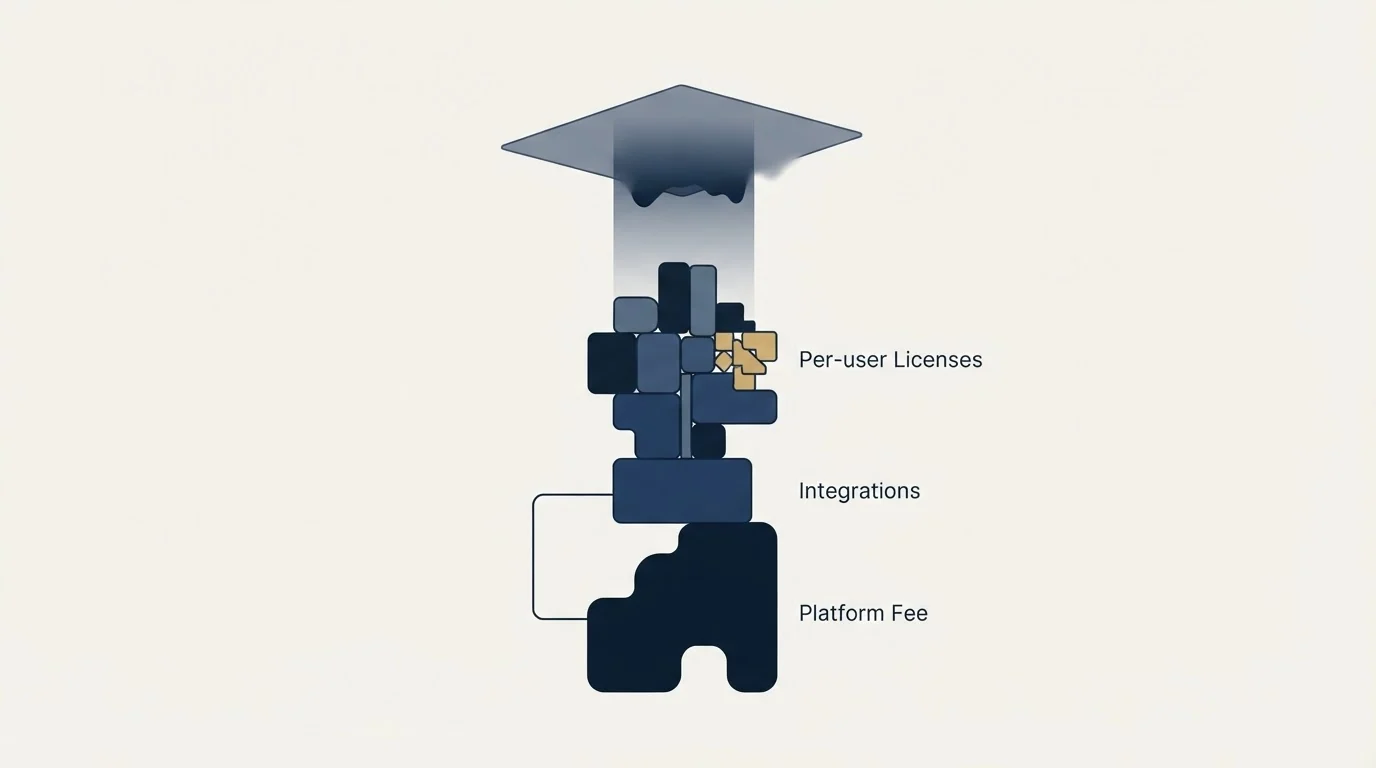
Enterprise software with a platform fee and a wide seat range is priced per deal, and publishing a figure would anchor every negotiation to the lowest band. This is normal enterprise practice, and it is also the reason third-party pages confidently quoting a Gong price should be treated as rumour. A price that only exists on someone else's blog is not a price.
What you can do instead is force the quote into a comparable shape, which the two-part model makes straightforward once you know to ask.
To: Gong account executive · Subject: quote in two parts, please
Please send the annual total with the licence component and the platform fee stated separately. 1
What is the minimum seat count, and what happens to the platform fee if headcount changes mid-term? 2
Please confirm in writing that our CRM and dialer integrations carry no charge. 3
Which product lines are included at that price, and which are separate SKUs? 4
- 1A per-seat figure alone is not comparable when one vendor also charges a platform fee.
- 2A platform fee scaled to users supported usually implies a floor.
- 3The pricing page states existing tech stack integrations are free.
- 4Engage, Forecast and Enable are separately named products.
Who it fits, and who it does not
The tool earns its price where there are enough calls to make patterns real. Conversation intelligence works by comparing many conversations, so a team of three reps taking a handful of calls a week generates a dataset too small for the analysis to say anything the manager could not have learned by listening. The same platform in front of thirty reps is reading something no manager has time to hear.
The second fit condition is that someone owns acting on it. Recorded calls that nobody reviews are an archive, not a coaching programme, and the platform is frequently blamed for a gap that is really an unassigned responsibility. Before the quote conversation, it is worth naming the person whose job changes when the tool arrives.
Where it does not fit is a team whose problem is upstream of the call. If the constraint is that not enough qualified conversations are happening at all, a platform that analyses conversations has nothing to work with. Call analytics measure the meetings you booked; they do not produce more of them. That is a different problem with a different budget line, and buying the analysis first is a common and expensive sequencing error.
What the analysis reads, and where it misleads

The output of a conversation intelligence platform looks like fact and is closer to correlation, so it is worth knowing what the machine is doing before a coaching programme is built on it.
The base layer is transcription, and transcription quality is not uniform. Accented speech, two people talking over each other, a bad connection and industry vocabulary all degrade it, and the degradation is invisible in the summary that lands in the manager's inbox. Every number computed downstream inherits that error. This is a reason to spot-check transcripts against the audio during the pilot rather than after rollout, on the calls that matter most, which are usually the ones with the most crosstalk.
The layer above it detects things: which topics came up, who spoke for how long, whether a competitor was named, whether next steps were agreed. That detection is genuinely useful and it is also the layer where a metric turns into a target. Talk-to-listen ratio is the standard example. It is a real measurement, it correlates with outcomes across large samples, and the moment it becomes a number reps are scored on, they optimise it directly and the correlation stops carrying information.
The top layer is the pattern claim: winning deals sound like this. Those findings are drawn from the vendor's aggregate data or from your own history, and both have the same limitation, which is that they describe what happened alongside wins rather than what caused them. Successful deals have engaged buyers, and engaged buyers ask more questions, so a pattern that says "winning calls contain more buyer questions" may be reading the buyer's intent rather than the rep's skill. Coaching a rep to ask for more questions does not import the intent.
None of this makes the platform less worth buying. It makes the difference between a team that uses it to find calls worth listening to, which it is excellent at, and a team that uses it to replace listening, which is where the disappointment comes from.
One operational decision to make before rollout
Recording is a configuration, not a default anyone should accept unexamined. Whether participants are notified, whether external attendees are recorded, which calls are retained and for how long, and who inside the company can search the archive are all settings, and they interact with obligations that vary by jurisdiction and by the contracts you have with your own customers.
Settle those with whoever owns legal and privacy in your business before the first call is captured rather than after, and write the answer down. The setting is easy to change on day one and awkward to change once a year of recordings exists under the old policy.
Where it sits against the alternatives
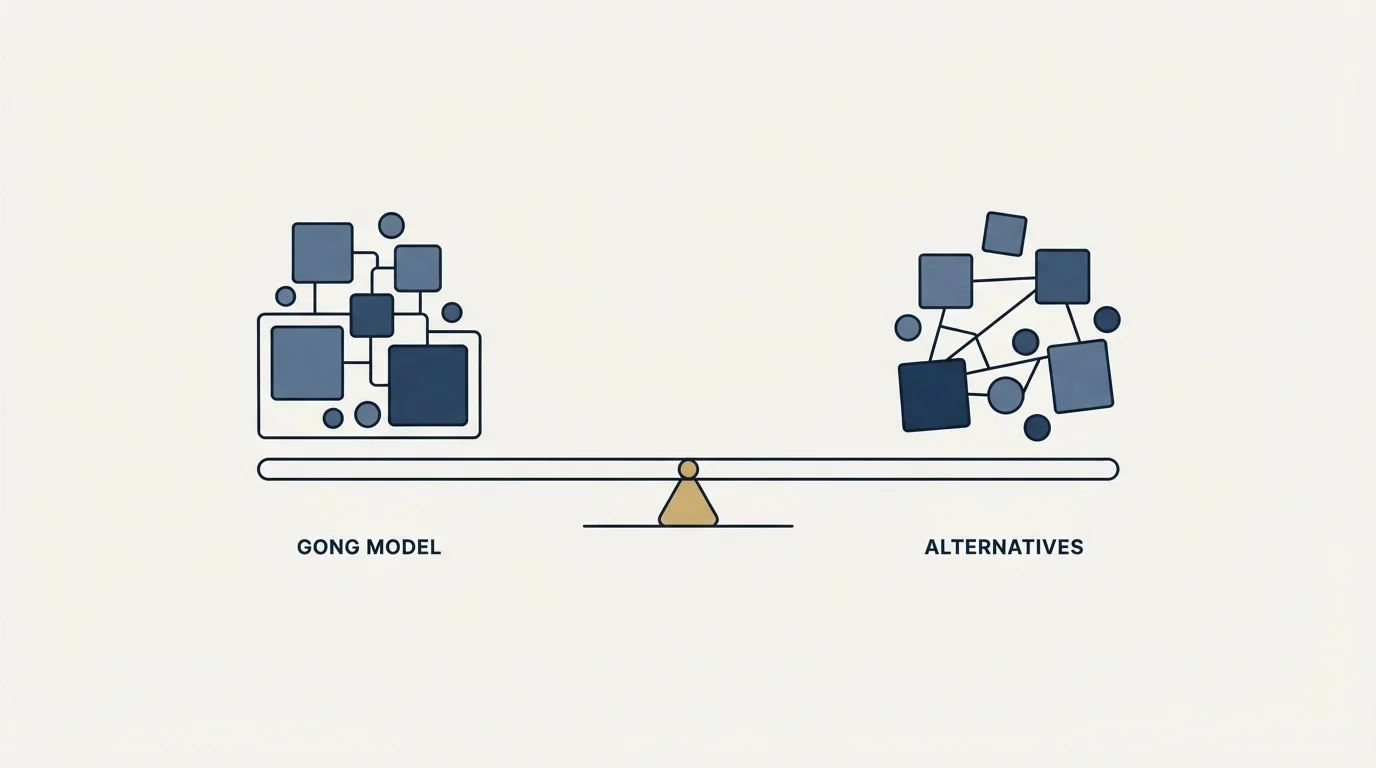
The category has widened considerably, and the useful split is between tools that only do the first column and platforms that bundle all three. A team that wants call recording and transcription can buy exactly that, often at a fraction of a platform price, and several tools in that space now sit inside the meeting rather than beside it.
Call recording platforms like Gong sit at a different workflow stage than outreach tools, a distinction explored in a comparison of Gong and Reply.io.
If you are shopping that comparison directly, the alternatives round-up sorts the field, and the head-to-head against Salesloft is the specific comparison that comes up most, because it is really a question about whether conversation intelligence or sequencing is the centre of the stack. If your answer is sequencing, the sales engagement platform category is the one to price first. And if the reason Gong is on the list is that somebody wants AI to do more of the selling, it is worth being clear-eyed first about which sales jobs an AI agent handles and which it fails.
The decision, in one line
Buy Gong when you have more sales conversations than any human can review and a named person whose job is to act on what the review finds. Do not buy it to create conversations, because that is not what it does, and the cheapest way to find out whether conversation volume is really your constraint is to fix the top of the funnel first and see what changes. If that is the honest diagnosis, we will run the campaign and you can revisit the analytics budget once there is something to analyse.
Gong vs Klenty: Cross-Category Comparison explains why these tools solve different problems, pairing outreach execution with conversation analysis rather than competing head to head.
Pricing and features are taken from the vendors' own pages. Gong publishes no figures on its pricing page, so treat any specific price from a third party as unverified. Verify current terms with the vendor before relying on them.
Frequently asked questions.
Frequently asked questions- What is Gong in sales?
- Gong is a sales tool that records a team's calls and meetings, transcribes them and analyses them for patterns across reps and deals. Its homepage calls it a Revenue AI OS and lists products built on that data: Gong Engage for outreach, Gong Forecast, Gong Enable for revenue enablement, and Gong Agents for follow-ups and pipeline edits.
- How much does Gong cost?
- Gong publishes no price. Its pricing page publishes the model instead: licences are priced per user, there is a platform fee based on the number of users supported, and integrating your existing tech stack is free. It then asks for a team-size band and routes to a customised proposal, so any specific figure from a third party is unverified.
- Is Gong worth it for a small sales team?
- Conversation intelligence works by comparing many conversations, so a team of three reps taking a handful of calls a week gives the analysis too little to say anything a manager could not learn by listening. It earns its price with enough calls to make patterns real and a named person whose job is to act on what the review finds.
- What should I ask for in a Gong quote?
- Ask for the annual total with the licence component and the platform fee stated separately, the minimum seat count, what happens to the platform fee if headcount changes mid-term, written confirmation that CRM and dialer integrations carry no charge, and which product lines are included at that price and which are separate SKUs.
About the author.

B2B cold email experts helping companies generate qualified leads through done-for-you outreach campaigns.
RevenueFlow Team
Explore more.
Ready to scale your outreach?
We build GTM engines that book real meetings. See the receipts.
Related articles.
Sybill: The Credit Meter Is the Number to Model
Sybill meters by credits per week rather than by seat, and its pricing page carries three different figures for the same two plans. Both facts change the model.
Circleback: The Automations Are the Product, Not the Notes
Circleback publishes real prices and an unusually wide automation surface. What the notes contain matters less than where they land and who maintains the rules.
Fathom AI Note Taker: What It Records and Where Notes Land
Fathom records, transcribes and summarises calls, and hides a conversation intelligence product on its upper tier. What it publishes, and the decisions to make first.
Avoma Pricing: Recorder Seats, Free Viewers, and the Add-Ons
Avoma charges only for people whose meetings get recorded and makes viewers free, so the seat count to price is smaller than the team and the add-ons are larger.
Conversation Intelligence: What the Recording Layer Misses
Talk ratio is arithmetic. Sentiment is a guess about words. And the biggest blind spot is the calls that never happened, which no recorder can see.
Sales Automation Software for Small Business: Four Buys
One search returns four unrelated products, and on at least one vendor's published plan list the automation is gated above the tier a small team buys.