Gong vs Reply.io: Cross-Category Comparison
Compare Gong (sales engagement platform) and Reply.io (cold email platform) side by side. Understand how these tools fit different stages of your sales workflow.
Reply.io comes first, from $59 per user a month or $49 billed annually, carrying 1,000 active contacts and unlimited mailboxes per seat. Gong publishes no figure, only per-user licences and a platform fee. This is the one pairing where both vendors bill per seat, so size both against headcount rather than send volume.
Key takeaways
- Reply.io's Multichannel card lists 5 mailboxes in its monthly state and 10 in its annual state, so the mailbox allowance is worth confirming with the vendor before sizing a multi-domain setup on it.
- Gong's pricing page publishes a model rather than a price: seats, plus a platform fee sized on the number of users supported, with no figure on the page.
- The two tools are metered differently, which is what makes a headline comparison misleading: Gong bills seats, plus a platform fee sized on the number of users supported, and Reply.io bills active contacts, per seat, with a first-step email counted once per contact.
- A feature appearing on one vendor's page and not the other's records what each vendor chose to publish. It supports saying that Reply.io lists a capability and Gong does not, and never that only one of them can do the job.
Reviewed and updated August 29, 2026
Gong vs Reply.io: Cross-Category Comparison
Reply.io's Email Volume tier starts from $59 per user a month, or from $49 billed annually, and puts 1,000 active contacts and unlimited mailboxes behind it, with live data drawn from 1 billion B2B contacts. Gong's pricing page publishes a model instead of a price: per-user licences, a platform fee based on the number of users supported, and a team size form.
Both pages price on seats, which makes this the one pairing in this family where the two meters actually agree. What they disagree about is what a seat buys: a rep sending sequences, or a rep whose calls are being recorded and analysed.
Why Compare These Two Tools?
Email sending platforms focus specifically on cold email campaigns, while sales engagement platforms offer multi-channel outreach including email, phone and social. The comparison comes down to specialization against breadth of channels.
Gong is a revenue AI platform that captures and analyzes customer interactions across calls, emails, and meetings to deliver deal intelligence, forecasting, and sales coaching insights. It is filed here as a sales engagement platform. To be precise about what that means, its own pricing page is titled Gong Revenue AI Pricing and leads on deal intelligence, forecasting and coaching rather than on sending.
Reply.io is an AI-powered sales engagement platform with live data drawn from 1 billion B2B contacts, multichannel sequences, and AI SDR capabilities. It is filed here as a cold email platform, and its own pricing page rations active contacts, per seat, with a first-step email counted once per contact. It is worth noting that its own description calls it a sales engagement platform too, so the cross-category framing is looser here than the labels suggest.
The category labels are the least interesting thing on this page. What decides the purchase is which meter each vendor bills on, which of the two gaps is currently costing more, and whether the second purchase can wait a quarter.
Where Each Tool Fits in Your Workflow
- Step 1Campaign execution
Reply.io covers cold email outreach, from $59/mo.
- Step 2Outreach orchestration
Gong covers multi-channel sales outreach, on a quote rather than a published price.
| Aspect | Gong | Reply.io |
|---|---|---|
| Category | Sales Engagement Platform | Cold Email Platform |
| Workflow Stage | Outreach orchestration | Campaign execution |
| Primary Focus | Multi-channel sales outreach | Cold email outreach |
| Starting Price | Quote on request | $59/mo |
| Capabilities Listed | 10 | 9 |
| Integrations Listed | 12 | 9 |
Gong's capability list is built around capture and analysis: call recording and transcription, deal intelligence and risk alerts, forecasting, coaching insights, smart trackers. Sequences appear once, as Gong Engage. Nothing its pricing page publishes speaks to mailbox warmup, domain rotation or a monthly send allowance.
Reply.io lists email warmup as included with every mailbox and carries an anti-spam and deliverability suite on its paid tiers. The Email Volume card lists unlimited mailboxes, and the Multichannel card's mailbox figure differs between its monthly and annual states.
Pricing Comparison

Gong Pricing
| What the page publishes | Detail |
|---|---|
| Licence model | Priced per user |
| Platform fee | Based on the number of users supported |
| Integrations | Integrate your existing tech stack for free |
| Figures | None published; the page collects a team size band and returns a proposal |
Gong publishes a pricing model rather than a price. Its pricing page states that licences are priced per user, that there is a platform fee based on the number of users supported, and that you can integrate your existing tech stack for free, then asks which of four team size bands you fall into so it can prepare a proposal. Two things follow for a budget. The bill has two parts rather than one, so a per-seat figure quoted by anyone outside Gong is incomplete by construction. And the price moves with headcount rather than with how much outbound you run, so the bill grows when the team grows and not when the programme does.
Source: Gong Pricing
Reply.io Pricing
| Plan | Paying monthly | Billed annually | What the card covers |
|---|---|---|---|
| Email Volume | From $59 per user/month | From $49 per user/month | 1,000 active contacts, unlimited mailboxes |
| Multichannel | From $99 per user/month | From $89 per user/month | Unlimited active contacts, email plus LinkedIn, SMS and calls |
| Agency Core | From $210/month | Contact sales | Multiple client workspaces, unlimited clients and users |
| AI SDR | From $500/month | Contact sales | Jason AI SDR, live data, intent signals |
Two things on that page repay a second read. The Multichannel card lists 5 mailboxes in its monthly state and 10 in its annual state, so the mailbox allowance is worth confirming with Reply.io before sizing a multi-domain setup on it. And the paid rows are sliders rather than fixed prices: the AI SDR row's lowest rendered figure is $500 a month, and the higher numbers on that row are other positions of the same control. LinkedIn automation is $69 /mo/acct and calls and SMS $29 /mo/acct on top.
Source: Reply.io Pricing
Pricing Context
One of these pages publishes a price and the other publishes a process, which makes a headline comparison between them impossible rather than merely unhelpful. The published side can be modelled today; the unpublished side is a quote, and a quote arrives with a seat count, a term and whatever sits outside the licence attached to it. Budget the gap rather than the sticker.
What A Two-Tool Stack Costs
Here is illustrative arithmetic, invented as a worked example rather than taken from any client, for a two person team running one wave of about 2,000 prospects a month.
The Gong page fetched for this comparison publishes no figure to put in this column, so the honest entry is a quote. Leave a placeholder in the model and replace it before anyone signs anything.
On the other side the model is arithmetic rather than a negotiation, because each seat carries 1,000 active contacts, so two seats cover a 2,000 prospect wave and unlimited mailboxes come with the tier. Reply.io on its Email Volume tier is $49 per user a month billed annually, so two seats across twelve months comes to $1,176.
So the modelled year is $1,176 of published price plus one quote. A stack whose second line is a quote cannot be budgeted from a comparison page, and the quote is usually the larger number by some distance.
Three things make that quote arrive faster and closer to what you will actually pay: a seat count, because every unpriced vendor in this category starts there; the volume the other tool already carries, so the conversation is about what the platform adds; and a direct question about what sits outside the licence, since a platform fee, an implementation charge and a minimum term never appear on a pricing page.
Feature Highlights
Gong Key Capabilities (Sales Engagement Platform)
- AI-powered call recording and transcription
- Deal intelligence and risk alerts
- Revenue forecasting with pipeline analytics
- Sales engagement sequences (Gong Engage)
- Coaching insights and talk-track analysis
- Email and web conferencing capture
- Smart trackers for competitive mentions
- Team and rep performance dashboards
- Data Cloud for revenue data warehouse
- Ask Anything AI-generated insights
Reply.io Key Capabilities (Cold Email Platform)
- Unlimited email warmup
- 1 billion B2B contacts database
- Anti-spam & deliverability suite
- LinkedIn automation (add-on)
- SMS and calls (add-on)
- AI personalization
- AI SDR capabilities
- Multi-workspace for agencies
- 14-day free trial
Where The Two Actually Overlap
Reply.io publishes unlimited email warmup, a database of 1 billion B2B contacts, an anti-spam and deliverability suite, LinkedIn automation and calls as add-ons, AI personalization, AI SDR capabilities and multi-workspace agency support. Gong publishes recording, transcription, deal intelligence, forecasting, coaching, trackers and dashboards. Three areas touch. Both list AI assistance, both reach the phone, and both put analytics in front of a manager.
The scope differs in each case. Reply.io's AI writes and sends; Gong's reads and grades. Reply.io's analytics report on a sequence; Gong's report on a pipeline. Both pages are publishing decisions rather than capability boundaries, so nothing here says only one of them can do a given job.
Do You Need Both, And In Which Order
Reply.io first, with a caveat this pairing earns. Both vendors bill per seat, so the growth curves look similar and the usual argument that the cold tool is cheap does not hold as cleanly: Reply.io's Multichannel tier from $99 per user a month is a real per-head cost.
The order still favours Reply.io, because it produces the conversations. What changes is the size of the decision. On this page a two-rep team is choosing between two per-seat commitments rather than between a small volume subscription and a large licence, so the honest advice is to size both against headcount over the next year rather than against this quarter's send volume.
Integration Ecosystem
Gong Integrations
Gong connects with: Salesforce, HubSpot, Microsoft Dynamics 365, Zoom, Microsoft Teams, Google Meet, Webex, Gmail, Microsoft Outlook, Slack, Outreach, Salesloft.
Reply.io Integrations
Reply.io connects with: HubSpot, Salesforce, Pipedrive, Copper CRM, Zendesk Sell, Close, Zapier, Make, n8n.
Shared Integrations
Both tools integrate with: Salesforce, HubSpot. This shared ecosystem means they can work together in your tech stack.
When to Choose Gong

- Your biggest gap is in outreach orchestration
- You already have a solid cold email platform and need specialized multi-channel sales outreach capabilities
- You need enterprise-grade multi-channel sales outreach features
- Your team's primary bottleneck is multi-channel sales outreach
When to Choose Reply.io
- Your biggest gap is in outreach orchestration
- You already have a solid cold email platform and need specialized multi-channel sales outreach capabilities
- You need enterprise-grade multi-channel sales outreach features
- Your team's primary bottleneck is multi-channel sales outreach
- Your biggest gap is in campaign execution
- You already have a sales engagement platform and need better cold email outreach
- You need enterprise-grade cold email outreach features
- Your team's primary bottleneck is cold email outreach
- Your biggest gap is in campaign execution
- You already have a sales engagement platform and need better cold email outreach
- You need enterprise-grade cold email outreach features
- Your team's primary bottleneck is cold email outreach
Using Both Together
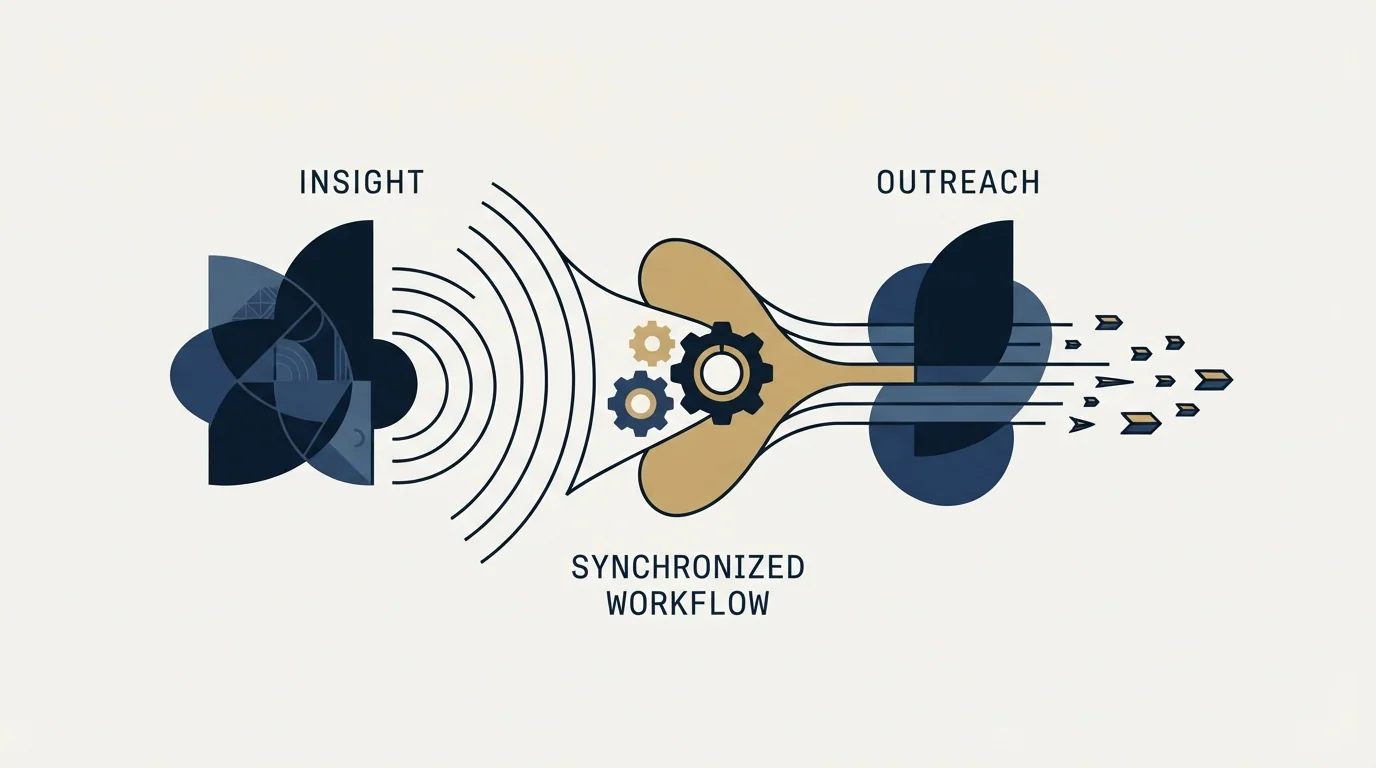
Both together is what a funded team ends up with, and the two systems never compete for the same job: Reply.io runs the wave and Gong reads the calls it produces. The handoff between them is the meeting itself, and nothing in either tool automates that link.
House practice makes that manageable rather than theoretical. RevenueFlow runs one message per campaign, with no thread replies and no bump sequences behind it, so a prospect who appears in both systems receives at most one message from each rather than two escalating threads. The suppression list sits above the tools and is loaded into each of them before anything sends.
Salesforce, HubSpot appear on both integration lists above, and those shared connectors are where a duplicate is easiest to catch, because both systems can write to the same CRM record.
Rollout Notes
- Yes: Name the system that owns the contacted-already list
- Yes: Load suppression into both tools before either sends
- Yes: Send one message per campaign, with no bump step behind it
- Yes: Check the sending mailboxes are warmed and authenticated
- Yes: Agree in writing what counts as a qualified meeting
- Depends: Point replies at one inbox a person actually reads
Reply.io bills per seat, so a migration is priced on people rather than on volume and the mailbox allowance differs between the page's monthly and annual states. Confirm the allowance in writing before committing, export the contacted list, and re-authenticate every mailbox rather than assuming a connection carries across.
Meetings are qualified against criteria agreed in writing before launch, and that definition should survive a tooling change unchanged. A tool migration that quietly moves the qualification bar is how a reporting line stops being comparable to last quarter's.
Decision Shortcut
- Name the binding constraint. List quality, sending capacity, or what happens after a reply. One of the three is costing more than the other two right now.
- Read both meters before both feature lists. Gong is priced on seats, plus a platform fee sized on the number of users supported; Reply.io is priced on active contacts, per seat, with a first-step email counted once per contact. Adding a rep and adding a domain cost different things on the two sides.
- Price a realistic year, not a headline. Include the add-ons each tool needs to reach parity with the other, and leave the unpriced side as a placeholder until a quote arrives.
- Decide who owns suppression. One system holds the contacted-already list, and both read from it before anything sends.
- Re-check in a quarter. Whichever tool was bought second should have a measurable job by then, or it is a renewal to cancel.
Related Reading
- Best Gong Alternatives in 2026
- Best Reply.io Alternatives in 2026
- Gong vs Outreach: Sales Engagement Platform Comparison
- Gong vs Salesloft: Sales Engagement Platform Comparison
- Instantly vs Reply.io: Which Cold Email Platform Fits Your Outreach Strategy?
If you would rather have this run for you, RevenueFlow books qualified meetings on a pay-per-meeting basis and publishes client results.
Pricing and features are taken from the vendors' own pages. Verify current terms with the vendor before relying on them.
Frequently asked questions.
Frequently asked questions- How many mailboxes does Reply.io Multichannel include?
- The page gives two answers. Its monthly card lists 5 mailboxes and its annual card lists 10, so the allowance depends on which billing state the page is rendering. Confirm it with Reply.io in writing before sizing a multi-domain setup, because the difference doubles how many sending domains a seat can carry.
- How does Gong pricing actually work?
- Gong does not publish one. Its pricing page states that licences are priced per user, that there is a platform fee based on the number of users supported, and that you can integrate an existing tech stack for free, then asks which of four team size bands you fall into. Budget for a two-part bill rather than a per-seat figure.
- How does Reply.io pricing actually work?
- Per seat, on active contacts. Email Volume starts from $59 per user a month, or $49 billed annually, with 1,000 active contacts and unlimited mailboxes. Multichannel starts from $99 or $89. The paid rows are sliders, so the AI SDR row's lowest rendered figure is $500 a month and higher numbers are other positions of the same control.
- Does a team need both Gong and Reply.io?
- A funded team usually ends up with both, and the order matters more than the choice. The sending side produces the conversations, and the orchestration side reads and organises them. Load one suppression list into both before either sends, run one message per campaign with no bump behind it, and agree in writing what counts as a qualified meeting.
About the author.

Tim Carden is CMO / CTO at RevenueFlow, which builds and operates outbound revenue engines for B2B companies. Studied at McGill University.
Tim Carden · CMO / CTO
Connect on LinkedIn →Explore more.
Ready to scale your outreach?
We build GTM engines that book real meetings. See the receipts.
Related articles.
GetSales.io vs Yet Another Mail Merge: Sales Engagement Platform vs Cold Email Platform Comparison
Compare GetSales.io (sales engagement platform) and Yet Another Mail Merge (cold email platform) side by side. See pricing, features, and integrations to decide which one, or both, your stack needs.
Enginy vs Success.ai: Sales Engagement Platform vs Cold Email Platform Comparison
Compare Enginy (sales engagement platform) and Success.ai (cold email platform) side by side. See pricing, features, and integrations to decide which one, or both, your stack needs.
Artisan vs Yet Another Mail Merge: Sales Engagement Platform vs Cold Email Platform Comparison
Compare Artisan (sales engagement platform) and Yet Another Mail Merge (cold email platform) side by side. See pricing, features, and integrations to decide which one, or both, your stack needs.
Hexospark vs JustCall: Cold Email Platform vs Sales Engagement Platform Comparison
Compare Hexospark (cold email platform) and JustCall (sales engagement platform). See pricing, features, and integrations to decide which one, or both, your stack needs.
EmailBison vs Luru: Cold Email Platform vs Sales Engagement Platform Comparison
Compare EmailBison (cold email platform) and Luru (sales engagement platform) side by side. See pricing, features, and integrations to decide which one, or both, your stack needs.
Gong vs NeverBounce: Sales Engagement Platform vs Data Enrichment Tool Comparison
Gong vs NeverBounce: what Gong's own pages say about enrichment, what NeverBounce's API returns about an address, and how each vendor prices.