PromptLoop vs ZoomInfo: Web Research Against a Database
PromptLoop builds a dataset from the live web in credits it publishes; ZoomInfo sells access to a maintained database by quote. Both pages read 18 September 2026.
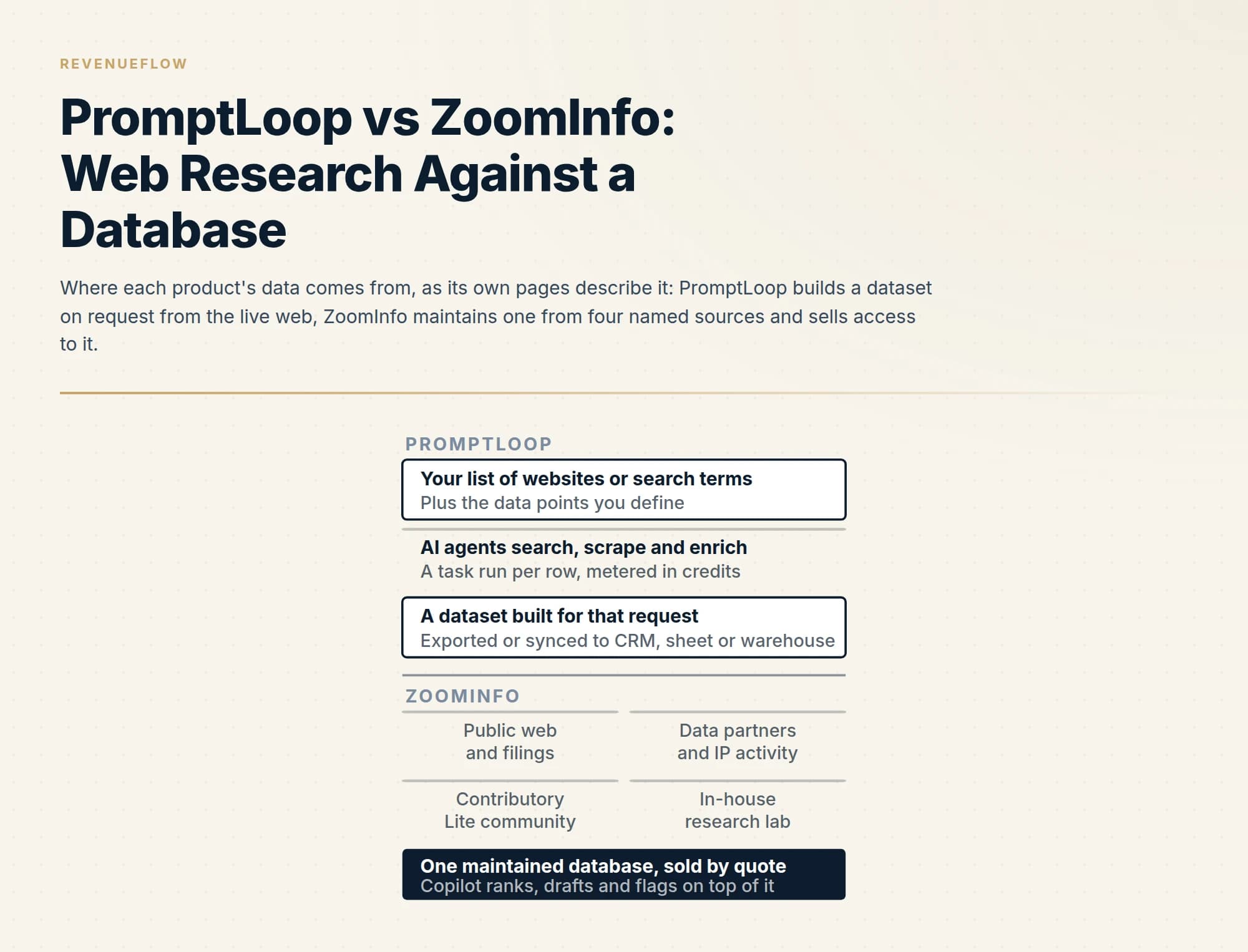
PromptLoop, as published on 18 September 2026, is a web-research and enrichment platform sold in credits, with a free plan, an Individual plan at 18 dollars a month and a Team plan from 400 dollars a month. ZoomInfo Copilot is an AI layer on a maintained database assembled from four named sources, sold by quote with no figure.
Key takeaways
- PromptLoop's pricing page lists Free with 500 credits, Individual at 18 dollars a month with 1,000 credits and 0.035 dollars a credit beyond, and Team from 400 dollars a month with volume rates as low as 0.015 dollars a credit, unlimited seats and an API, as read on 18 September 2026.
- ZoomInfo's Copilot page publishes no price, only a free-trial form and a contact-sales route, and its pricing page answered 403 on every fetch route from this network.
- ZoomInfo's data-sources page names four inputs behind its database: public information from over 28 million sites a day, data partners, a contributory community of more than 200,000 Lite users and an in-house research lab; PromptLoop's pages describe tasks run by AI agents over websites you supply.
- PromptLoop's own comparison post of 21 August 2025 states a starting price that its pricing page no longer carries; the pricing page is the more recent surface and the one quoted.
Reviewed and updated September 18, 2026
PromptLoop's pricing page, read on 18 September 2026, sells credits: a Free plan with 500 of them, an Individual plan at 18 dollars a month with 1,000 credits and extra usage at 3.5 cents a credit, and a Team plan starting at 400 dollars a month with volume pricing the page puts as low as 1.5 cents a credit. ZoomInfo's Copilot product page, read the same day, sells nothing you can compute from: a free-trial form, a contact-sales route, and no figure of any kind, which is how the rest of the ZoomInfo platform is sold too.
That gap in disclosure is the easy part of this comparison. The harder part is that the two products are not the same kind of thing. PromptLoop's home page describes AI agents that search, scrape and enrich data from the live web to build a dataset. ZoomInfo's data-sources page describes a database assembled from four named sources and refreshed by machine learning across 28 million sites and domains a day. One builds a table from scratch on request; the other maintains one and sells access to it. A reader typing this pair is usually asking whether an AI research layer can replace a database subscription, and the honest answer depends on which fields they need.
Everything below comes from the two vendors' own pages. PromptLoop publishes its own comparison with ZoomInfo, and where that post makes claims about ZoomInfo they are a rival's claims and are not repeated here as fact; the same rule applies to anything ZoomInfo's content site says about PromptLoop. The ZoomInfo Copilot guide covers the ZoomInfo product in depth; this page puts the two shapes side by side.
What each vendor says it is
PromptLoop's home page leads with building high-quality GTM datasets in minutes, not weeks, and describes three capabilities: search, scrape and enrich data in one flow; data agents that run an AI task on thousands of websites to find exactly what you need, naming website deep research, emails and mobile numbers; and integrations that export or sync to Salesforce, HubSpot, Excel and a warehouse. Its pricing page's FAQ says the platform automatically extracts company data, buying signals and custom insights from websites, that it runs custom AI models alongside access to dozens of leading providers, and that it integrates with major CRMs like HubSpot and offers a REST API. Its developer docs describe a task and batch API with endpoints to run a task, create and cancel a batch, retry failed jobs, read team usage and limits, and create a company list export.
ZoomInfo's Copilot page titles the product an AI sales agent and organises it around four promises: surfacing verified decision makers so sellers do not waste dials, prioritising accounts dynamically as new signals come in, centralising research and outreach in one workspace, and generating tailored talking points from company updates, intent data and org shifts. Its data-sources page names the four inputs behind every record: unstructured public information from over 28 million sites and domains a day, data partners for job postings, intent-related web activity and location data, a contributory community of more than 200,000 ZoomInfo Lite users, and an in-house data training lab that benchmarks email bounce rates, employer relationships and firmographic accuracy.
The two descriptions do not overlap much, and that is the finding. PromptLoop's unit of work is a task run over a list of websites. ZoomInfo's unit of work is a record retrieved from a maintained database.
Pricing, as published on 18 September 2026
PromptLoop publishes a ladder and a unit. Its pricing page lists Free with 500 credits included, Individual at 18 dollars a month with 1,000 credits a month, which the page glosses as roughly 200 to 300 companies, and extra usage at 0.035 dollars a credit, and Team starting at 400 dollars a month with volume pricing as low as 0.015 dollars a credit, described as ideal for 5,000 to 50,000 plus monthly credits. The feature columns move seats from one on Free and Individual to unlimited on Team, batch size from 25 rows at a time on Free to 1,000 on Individual and 50,000 plus on Team, and add phone and email enrichments, CRM integrations, the web API and dedicated Slack support at the Team tier. The FAQ describes free daily use within limits without a credit card.
One thing on PromptLoop's own surfaces is worth flagging rather than resolving. Its comparison post, dated 21 August 2025, states that paid plans start at 9 dollars a month, while its pricing page on 18 September 2026 lists the first paid plan at 18 dollars a month. Both pages are the vendor's; the pricing page is the more recent and is the one quoted here, and the conflict is reported because a buyer will meet both numbers.
ZoomInfo shows no price for Copilot on the product page, and its pricing page answered 403 to every fetch route from this network, a behaviour recorded on earlier reads of the same host. The Copilot page's routes are a free-trial form and a contact-sales link, and the platform is sold by quote. The ZoomInfo data enrichment guide records that the vendor's own surfaces describe its credit model two different ways, and that the documentation page that would let a buyer model credit burn returns a 404; nothing on the pages read for this comparison changes that.
PromptLoop publishes
- Three plans, two of them with a monthly figure
- A credit unit and an overage rate per credit
- Seats, batch size and integrations per tier
- A free plan and free daily use within limits
- An older blog figure that disagrees with the current page
ZoomInfo publishes
- No figure on the Copilot product page
- A free-trial form and a contact-sales route
- A pricing page this network cannot open
- A credit model its own pages describe two ways
- Four named data sources and what each contributes
The fields each one is built to return
The decision underneath the comparison is about fields, and the two vendors' pages describe different ones.
ZoomInfo's data-sources page describes what its inputs produce: leadership changes from corporate websites, executive promotions and product launches from news, revenue and headcount from public filings, technographics from website source code, technologies and upcoming projects from job postings, intent from anonymised web activity at the company-IP level, and business contact information contributed through the Lite community. The Copilot page describes what the AI layer does with those: verified decision makers, priorities that update as signals arrive, drafted messages and talking points, and flags when a prospect re-engages or goes quiet.
PromptLoop's pages describe fields you define. The home page's phrasing is find the exact datapoints and enrichment that you need, with templates for company, people and geographic search. The pricing page's feature list names website data extraction, custom and advanced data formats, AI company search results, geographic search results, and phone and email enrichments on the Team tier. The docs describe a task as something created from a description and run over a batch of inputs, with results read back per job. The vendor's home page frames the strength as fields no database sells: whether a company runs a particular platform, what its pages say, what a niche local business looks like.
That is the split a buyer should carry into any trial. A standard firmographic or contact field on a mid-sized software company is what a maintained database is for, and how ZoomInfo gets its data explains where that coverage is strong and where it thins. A custom field on a long list of small or unusual companies is what a web-research agent is for, and AI lead generation tools explains why the output of that kind of product has to be judged by reading it against the page it came from rather than by how fluent it is.
| Row | PromptLoop | ZoomInfo |
|---|---|---|
| A custom data point you define from a company's own website | Yes | No |
| Verified contact records from a maintained database | Partial | Yes |
| Third-party intent at the company level | No | Yes |
| Technographics | Partial | Yes |
| Drafted messages and talking points | No | Yes |
| A published rate | Yes | No |
| An API for programmatic runs | Yes | Yes |
The partial cells follow the vendors' own wording. PromptLoop's Team tier lists phone and email enrichments and its FAQ names access to dozens of providers, so contact data arrives through the platform rather than from a database it maintains; a technographic field is a question a PromptLoop task can be told to answer from a website rather than a maintained attribute.
What each vendor claims about the other, and what to do with it
PromptLoop's comparison post is a vendor's argument for itself. Its claims about PromptLoop, that it routes each task across a dozen models from named providers, that it pre-plans agent steps, that large jobs typically complete within ninety minutes, are the vendor's own and can be tested on a trial. Its claims about ZoomInfo, including specific annual figures and satisfaction scores drawn from third parties, are a rival's characterisation and are not adopted here. No page about PromptLoop appeared on the ZoomInfo surfaces read for this comparison, though its content site ranks for the pair.
The one claim worth pulling out because it is checkable on the vendor's own surfaces is the pricing one: the post's starting figure and the pricing page's do not match, as noted above. A vendor's comparison post is a snapshot of an unknown date; the pricing page carries the fetch date.
Where each one sits in an outbound stack
Neither product sends anything. PromptLoop's pages end at export or sync to a CRM, sheet or warehouse; ZoomInfo's Copilot page ends at drafted messages and sequences inside its own workspace, and the sequencing half is a feature the vendor sells that we do not run. Our own practice is one message per campaign, with no bumps and no thread replies, so a signal that a prospect has gone quiet is not a prompt for a second message under the first; it is, at most, a reason for a new campaign on a new premise.
Where the two products would sit for a team like ours is at the list stage, and in a specific order. A web-research task is the right tool for the question that decides whether a company belongs on the list at all, because that question is usually about what the company does rather than who works there. A database is the right tool for the contact record once the company has qualified. Running the research first means the database is asked about fewer companies, which matters when the database bills per record returned, as the ZoomInfo API guide sets out. Whatever resolved the address, we verify it immediately before it enters a campaign.
The short version
PromptLoop, as published on 18 September 2026, is a web-research and enrichment platform sold in credits: a free plan, an Individual plan at 18 dollars a month with 1,000 credits and 3.5 cents a credit beyond, and a Team plan from 400 dollars a month with volume rates as low as 1.5 cents a credit, unlimited seats and an API. ZoomInfo Copilot is an AI layer on a maintained database assembled from four named sources, sold by quote, with no figure on the product page and a pricing page this network cannot open.
They answer different questions. Use a research agent for the field no database carries and for the qualification question that decides whether a company belongs on the list; use a database for the contact record once it does. Treat each vendor's page about the other as positioning, and note that PromptLoop's own blog and pricing page disagree on its starting price.
If the list is the part you would rather have built, qualified and verified than metered, RevenueFlow builds and sends the first campaign against your market on a pay-per-meeting basis, with the qualification criteria agreed in writing before launch.
PromptLoop plans, credit rates, tier features and FAQ statements are per promptloop.com's pricing and home pages and its developer documentation; the older starting figure is per PromptLoop's blog post of 21 August 2025. ZoomInfo's product claims are per the Copilot product page and its sourcing description per the data-sources page; its pricing page answered 403 on every route. All fetched 18 September 2026. Verify current terms with both vendors before relying on them.
Sources: PromptLoop pricing, PromptLoop, PromptLoop API docs, PromptLoop vs ZoomInfo, promptloop.com blog, ZoomInfo Copilot, ZoomInfo data sources
Frequently asked questions.
Frequently asked questions- What is the difference between PromptLoop and ZoomInfo?
- By their own pages on 18 September 2026, PromptLoop is a platform whose AI agents search, scrape and enrich data from websites you supply, building a dataset on request and exporting it to a CRM, sheet or warehouse. ZoomInfo maintains a database assembled from four named sources and sells access to it, with Copilot as an AI layer that ranks accounts, surfaces decision makers and drafts messages. One builds a table; the other sells one.
- How much does PromptLoop cost compared with ZoomInfo?
- PromptLoop's pricing page on 18 September 2026 lists a free plan with 500 credits, Individual at 18 dollars a month with 1,000 credits and 0.035 dollars per extra credit, and Team starting at 400 dollars a month with volume pricing as low as 0.015 dollars a credit. ZoomInfo publishes no price for Copilot on its product page and its pricing page could not be opened from this network; the platform is sold by quote.
- Can PromptLoop replace ZoomInfo?
- Only for some fields. PromptLoop's pages describe custom data points extracted from a company's own website, with phone and email enrichments on its Team tier and access to providers through the platform. ZoomInfo's pages describe verified contact records, company-level intent from partner data and technographics from a maintained database. A research agent fits the qualification question and the field no database carries; a database fits the contact record once a company qualifies.
- Does PromptLoop have an API?
- Yes. PromptLoop's developer documentation, read on 18 September 2026, describes a task and batch API with endpoints to run a task, create and validate a batch, read results, cancel a batch, retry failed jobs, read team usage and limits, and create a company list export, authenticated with an API key header. The pricing page lists the web API and CRM integrations on the Team tier.
About the author.

Tim Carden is CMO / CTO at RevenueFlow, which builds and operates outbound revenue engines for B2B companies. Studied at McGill University.
Tim Carden · CMO / CTO
Connect on LinkedIn →Explore more.
Ready to scale your outreach?
We build GTM engines that book real meetings. See the receipts.
Related articles.
Cognism vs Upcell: A Data Provider Against a Data Layer
Cognism sells compliance-first contact data by quote and credit; Upcell sells a layer that runs your providers, Cognism included, through one record. Read 18 Sep 2026.
Zoom Revenue Accelerator vs Gong: An Add-On vs a Platform
Zoom's support centre documents Revenue Accelerator as a licence on a Zoom account in two classes; Gong sells a platform per user plus a platform fee. Neither has a rate.
Chili Piper vs LeanData: Form-First Against CRM-First
Chili Piper publishes a seat floor and bundles scheduling and chat; LeanData prices by Salesforce object and sells scheduling separately. Both read 18 September 2026.
Metadata vs 6sense: Paid Media Execution vs Intent
Metadata runs paid B2B campaigns through seven AI agents; 6sense ranks accounts on intent and sells contact data by credit. Neither publishes a rate. Read 18 Sep 2026.
Mailshake vs Pipedrive: A Sender and a CRM, Side by Side
Mailshake sells per-user sending with a two-way Pipedrive sync from its middle tier; Pipedrive is a per-seat CRM with sequences from Growth. Both read 18 September 2026.
Apollo.io vs Proofy: Data Enrichment Tool Comparison
Compare Apollo.io and Proofy side by side. See pricing, features, and integrations to choose the right data enrichment tool for your needs.