AI Lead Generation Tools: Four Products, One Label
Six AI lead generation tools open in six tabs are usually not competitors. They do four different jobs, and sorting them by job cuts the shortlist in half.

Products marketed as AI lead generation tools sit in one of four categories: finding and resolving contacts, watching and scoring signals, researching and writing, or sending and handling replies. Each has a different failure cost. Buy delivery first, then data, then signals, then generation, and design the trial so it can actually fail.
Key takeaways
- Four distinct jobs share the label, and the failure cost rises sharply across them, from a wasted bounce to a burned sending domain.
- Fluent output is the easiest capability to demo and the hardest to evaluate, because reading well says nothing about whether the content is true.
- Credit pricing is the least predictable model: ask what a miss costs, whether credits expire, and how a partial record is billed.
- Generation is the cheapest layer to add and the one most teams buy first, which amplifies whatever the delivery and data layers got wrong.
Reviewed and updated September 1, 2026
AI Lead Generation Tools: Four Different Products Sharing One Label
A revenue leader opens six tabs to compare AI lead generation tools. All six homepages promise more qualified pipeline with less manual work. All six show a screenshot of a clean interface with a list of companies in it. By the fourth tab the differences have stopped being legible, and the decision drifts toward whichever demo was most impressive or whichever sales rep followed through.
The comparison failed before it started, because those six products are not competitors. They do four different jobs, and the label they share describes an outcome rather than a function. Sorting them by what they actually do makes the shortlist obvious and usually cuts it in half.
Buyers say there are too many lead generation tools to trial them all, and sorting by job is what makes the shortlist finite: six products that look like competitors are usually doing four different jobs, and only the ones sharing your actual constraint are worth an afternoon.
The four jobs hiding under one phrase
Almost every product marketed as an AI lead generation tool sits primarily in one of these, and the good ones are explicit about which.
| Job | The question it answers | What it actually contains | What it should be bought on |
|---|---|---|---|
| Find and resolve | Who exists, and how do I reach them | Company and contact databases, email finding, verification, person resolution | Coverage, accuracy and refresh rate |
| Watch and score | Which of them is worth contacting now | Signal and intent monitoring, visitor identification, fit and priority scoring | Whether the signal genuinely predicts anything |
| Research and write | What do I say to this specific account | Enrichment from unstructured sources, bulk extraction, grounded generation | Grounding and traceability, never prose quality |
| Send and handle | How does it reach them, and what happens next | Sending infrastructure, inbox and domain management, reply classification | Reliability, control and visibility |
The reason this matters commercially is that the four types have different failure modes and very different renewal risks. A data product that is wrong about a person costs you a bounce. A signal product that is wrong costs you an entire campaign pointed at the wrong accounts. A generation product that is wrong costs you the account and sometimes the reputation. A sending product that is wrong costs you the domain, and that one takes weeks to undo.
The signal product's accuracy matters less than what happens after it flags an account, a limitation examined in how Salesloft Rhythm ranks seller actions.
AI-powered outbound sales messages sit in the third job, research and write, which means the tools advertising them are bought on grounding and traceability rather than on how the drafts read, and a product that cannot show which page a claim came from is failing the only test that matters in that row.
That ordering should govern how much diligence each purchase gets. Teams routinely spend a month choosing a writing tool and an afternoon choosing the sending setup underneath it, which inverts the risk.
Buying all four from one vendor is possible and sometimes correct. Buying all four from one vendor without knowing that you did is how teams end up with a suite that is strong at one job and quietly weak at the other three.
What the AI part is actually doing
The label is applied fairly loosely, and it is worth being able to tell three different things apart in a demo.
The first is machine learning that has been in these products for years: scoring, deduplication, matching, ranking. This is real, useful and unglamorous, and it predates the current wave entirely.
The second is language-model reading. Handing a model a messy web page and getting back a structured answer is genuinely new capability, and it is the most reliable of the three because the output can be checked against the page it came from. Where a language model beats a conventional data provider, and where it does not, is worked through in Clay agents.
The third is language-model writing, which is where the marketing concentrates and where the buyer needs to be most careful. Fluent output is the easiest thing in the category to demonstrate and the hardest to evaluate, because a message that reads well tells you nothing about whether its factual content is true.
- Ranking, matching and deduplication
- Fit and priority models
- Reliable and unglamorous
- Judge it on whether the score correlates with anything you care about
- Messy page in, structured field out
- Bulk extraction across thousands of sources
- Checkable against the page it came from
- Judge it by spot-reading outputs against sources
- Drafting and personalisation at volume
- Always produces something, including when evidence is thin
- Impossible to evaluate from fluency
- Judge it only on grounded, traceable claims
- Yes: Which of the four jobs is this product primarily for
- Yes: For any factual sentence in a generated message, can you see the source page
- Yes: What does it do when research finds nothing about an account
- Yes: Can you inspect rendered output for real records before anything sends
- Yes: Does it log rejected or skipped records with a reason
- No: Is the headline capability messages or contacts per day
- No: Is the demo running only on large companies with rich public footprints
The last line catches more bad purchases than the rest combined. Every product in this category demonstrates on well-known companies, because well-known companies have abundant public information and the output looks excellent. Most lists are not made of well-known companies. The gap between a demo account and a median account on your own list is where the real evaluation lives, and the only way to see it is to run the tool against your own records.
The pricing models are where the surprises are

Three billing shapes dominate, and each hides its cost in a different place.
Per-seat pricing is predictable and penalises exactly the usage pattern these tools are supposed to enable, because the value comes from processing volume rather than from having more people logged in.
Credit-based pricing is the most common and the least predictable. A credit rarely maps to one useful outcome: a single enriched record can consume several, a failed lookup often consumes one anyway, and re-running a job after a configuration mistake consumes the lot. Ask specifically what happens to credits on a miss, whether they expire, and whether an enrichment that returns a partial record is charged as a hit.
Usage or outcome pricing sounds fairest and needs the definition read closely, because the definition of the billable unit is doing all the work. A charge per verified email and a charge per email returned are very different products at the same headline rate.
The general point is that the sticker price is close to meaningless in this category until you know the unit, and the unit is where vendors differentiate quietly. Some of that arithmetic in the enrichment layer specifically is in waterfall enrichment, which is also the argument for why chaining cheap providers usually beats paying one expensive one.
What to buy first, if you are starting from nothing
The order matters, because a later layer amplifies whatever an earlier one got wrong.
Sending infrastructure and deliverability come first, because every other investment is wasted if the mail does not arrive. This is unexciting and it is the step teams skip.
Data comes second, because a good message to the wrong person fails completely and a mediocre message to the right person sometimes works.
Signals come third, and only when you have enough volume for prioritisation to matter. A team contacting two hundred accounts a month does not need a scoring layer; it needs a person to think for an hour. The available options for connecting signal sources when you do need them are catalogued in intent signal APIs for outbound.
Generation comes last, and it is the one most teams buy first. It is the cheapest capability to add, the easiest to demo, and the one that does the least good on its own, because it amplifies whatever the previous three layers handed it.
- Step 1Delivery
Domains, warmup and monitoring, so mail arrives at all
- Step 2Data
Accurate accounts and contacts, verified before use
- Step 3Signals
Prioritisation, once volume makes prioritising worthwhile
- Step 4Generation
Grounded writing, applied to a list that is already right
For a wider view of what exists in the market and how the pieces fit together, GTM tools worth watching in 2026 is the map, and eight GTM agent workflows covers concrete applications that hold up in practice. For the autonomy question, meaning how much a product should be allowed to do without a person in the path, AI sales agents is the piece to read alongside this one.
Design the trial so it can fail

Most evaluations in this category are structured in a way that guarantees a positive result, which is why so many purchases disappoint within a quarter.
The common shape is a pilot judged on meetings booked over eight to twelve weeks. That sounds rigorous and it answers almost nothing, because it confounds the tool with the list, the proposition, the market and the season all at once. If the pilot produces meetings you do not know which of those was responsible, and if it produces none you know even less.
A better trial is smaller, faster and narrower. Take fifty accounts drawn from the middle of your list rather than from the top. Run them through the product. Read every rendered output line by line, with somebody who knows the market, and write down what was wrong and how it was wrong. That takes an afternoon and answers a question the twelve-week pilot cannot: how often is this thing confidently incorrect about a company we know something about.
Three specific things to record while doing it. How many accounts produced no usable output at all, because that is your real coverage rather than the coverage on the pricing page. How many produced output that was fluent and false, because that is the risk number. And how much manual work was needed to make an acceptable output acceptable, because that is the labour the purchase is supposed to remove.
Build, buy, or assemble
The last decision is how much to own, and the answer has shifted as the underlying components have become available directly.
Buying a suite makes sense when the team is small, the volume is modest, and nobody wants to maintain plumbing. The cost is that you inherit the vendor's opinion about every one of the four jobs, including the ones they are weakest at, and switching later means switching all of them at once.
Assembling from components makes sense when one of the four jobs is genuinely central to how you compete. A team whose advantage is a proprietary view of which accounts are in-market should own that layer and buy the rest. A team whose advantage is deliverability at scale should own the sending side. The mistake is assembling everything, which produces a stack that needs a maintainer nobody budgeted for.
Building from scratch is rarely correct for the data and sending layers, where the incumbents have real scale advantages, and is sometimes correct for the research layer, where the underlying models are available to everybody and the differentiator is the retrieval and verification logic around them rather than the model itself.
The constraint no tool removes
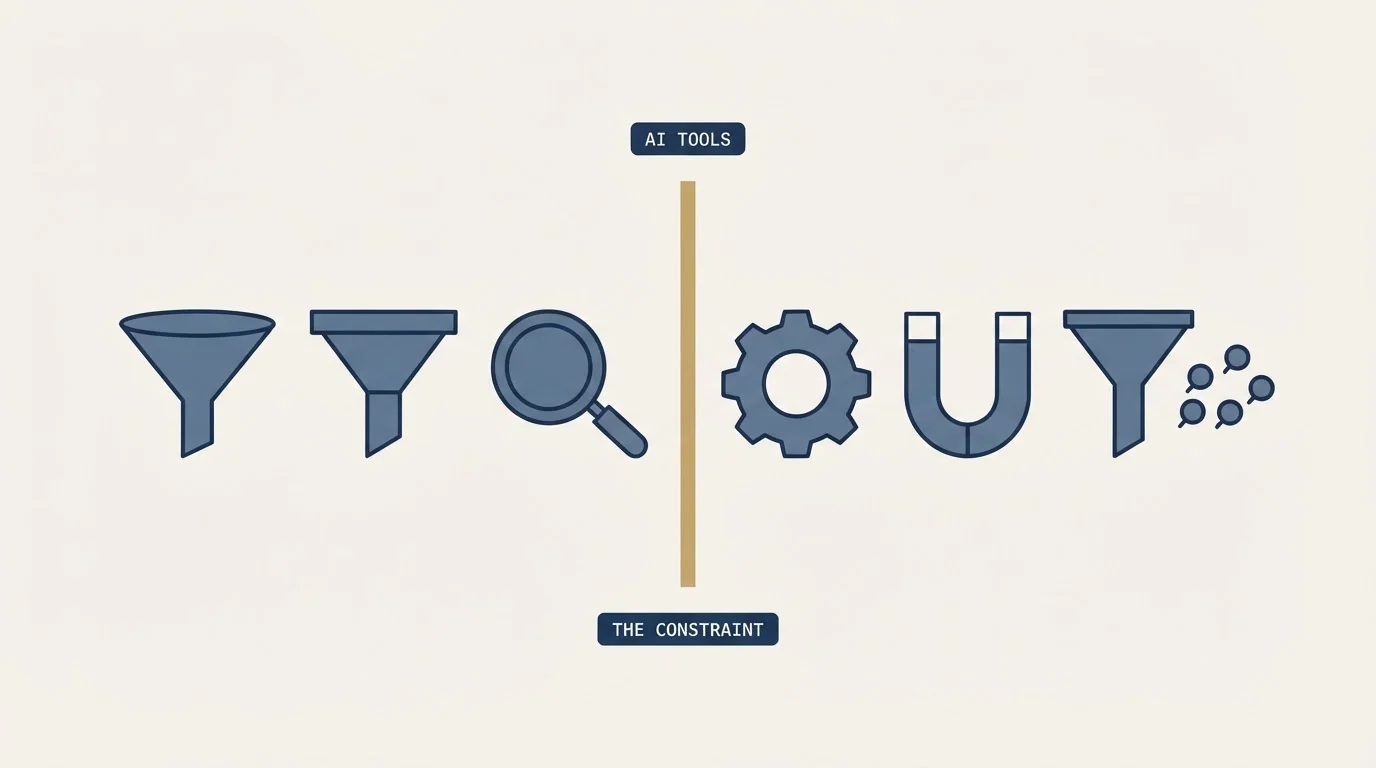
One thing is worth saying plainly at the end of a page about buying software. The output of this entire category is messages to people who did not ask for them, and the supply of those people is finite.
Our own practice is one message per campaign, built on one premise, sent once. If a different premise is worth putting to the same account later, that is a separate campaign with its own reason to exist. Every tool decision above should be read through that constraint, because it changes which capability is worth paying for. Under it, throughput is close to worthless and grounding is the whole game, which means the products worth buying are the ones that make the message true rather than the ones that make it frequent.
If you would rather see a grounded list and a single message built against your own market before committing to a stack, see what a first campaign looks like.
Frequently asked questions.
Frequently asked questions- How do I compare AI lead generation tools that all sound the same?
- Sort them by job before comparing anything else. Finding and resolving contacts, watching and scoring signals, researching and writing, and sending and handling replies are four different products. Most vendors lead in one and are ordinary in the rest, and the engagement they propose tells you which one faster than their homepage does.
- What should I ask in a demo?
- Which of the four jobs the product is primarily for, whether you can see the source page behind any factual sentence it generates, what it does when research finds nothing, whether you can inspect rendered output before anything sends, and whether it logs skipped records with a reason. Insist the demo runs on your own accounts.
- Which layer should we buy first?
- Sending infrastructure and deliverability, because every other investment is wasted if the mail does not arrive. Then data, because a good message to the wrong person fails completely. Then signals, once volume makes prioritising worthwhile. Generation last, because it amplifies whatever the layers beneath it handed over.
- How should we run a trial?
- Small and fast rather than long. Take fifty accounts from the middle of your list, run them through the product, and read every rendered output line by line with somebody who knows the market. Record how many produced nothing usable, how many were fluent and false, and how much manual work each acceptable output needed.
About the author.

B2B cold email experts helping companies generate qualified leads through done-for-you outreach campaigns.
RevenueFlow Team
Explore more.
Ready to scale your outreach?
We build GTM engines that book real meetings. See the receipts.
Related articles.
Video Prospecting Tools by Job: What Each One Is For
Ten video prospecting tools sorted by the job each vendor's own page describes: record and share, personalise at volume, avatars, hosting and interactive demos.
The Real Cost per 1,000 Emails, Verifications and Data Credits in 2026
Unit prices computed from verified vendor plans: $1.00 per 1,000 emails sent, $2.00 per 1,000 verifications and $19.60 per 1,000 enrichment credits.
Which CRMs and Tools the Outbound Stack Connects To: Integration Data From 342 Sales Tools
HubSpot is named as an integration by 52.3% of 342 verified sales tools, Zapier by 50.3% and Salesforce by 43.3%. Here is the full map by category.
Sales Engagement Platform Pricing in 2026: What 61 Tools Charge and Which Hide It
Sales engagement platforms start at a median of $75 a month, 70.5% carry a quote-only tier, and AI SDR platforms start at $204.50. Data from 61 verified tools.
Free Tiers and Trials in Sales Tools: What $0 Gets You Across 386 Vendors
37.0% of 386 verified sales tools have a permanent free plan. The median free data tier gives 50 credits and the median free sending plan 2,500 emails a month.
RevOps Tools: Nine Products and the Job Each Does
Nine revenue operations products sorted by the six jobs the category covers, with every product fact and price read off the vendor's own pages and dated.