Salesloft Rhythm: What the Prioritised Workflow Assumes
Rhythm ranks what a seller does next. It assumes attention is the constraint, which holds for a full pipeline and fails quietly for a thin one.
Salesloft Rhythm ranks seller actions using an engine the company calls Conductor AI, drawing on buyer signals such as website activity, content views and connected data sources. It assumes seller attention is the binding constraint. Where few accounts are engaged, the ranking reorders a short list rather than improving it.
Key takeaways
- Rhythm's components are the Prioritizer agent, the Priority Accounts agent, Signals, Plays and Focus Zones, with the ranking driven by an engine Salesloft calls Conductor AI.
- The outcome figures on the product page trace to a Salesloft newsroom release dated 25 October 2023, four months after Rhythm launched in June 2023, and are vendor-reported customer results with no methodology published.
- That release also stated that trending data on win rates and cycle times across the customer base was expected in the first half of 2024, which is a fair question to put to a salesperson.
- A prioritisation layer cannot manufacture demand, so a ranked list of eleven actions is the same eleven actions in a different order.
Reviewed and updated September 1, 2026
Every seller already has a prioritised list. It is usually in their head, it is rebuilt each morning from whatever they remember, and it is wrong in a predictable direction: the accounts that got attention yesterday get attention again today, and the ones that went quiet stay quiet.
Rhythm is Salesloft's answer to that, and it is the module a platform demo tends to lead with. Understanding what it assumes about your motion is the difference between a layer that changes the working day and a layer that reorders the same list.
The signal side of this has its own name in the product: Hot Leads, where engagement events accrue points against a threshold an admin sets, and the person crosses into the prioritised view once the total clears it, which means the ordering you get is only as good as the point weights somebody chose months ago. Third-party engagement signals feed the same queue, and Vidyard is the clearest example because the vendor names it its preferred video partner and documents the integration against Rhythm specifically: a video view becomes another signal competing for the same position in the list, which is fine as long as somebody has decided what a view is worth relative to a reply.
What Rhythm is
Salesloft describes Rhythm as an AI layer that prioritises seller actions, built on a proprietary engine the company named Conductor AI. Four named components do the work.
The Prioritizer agent takes buyer signals and turns them into one ranked workflow per seller. The Priority Accounts agent does the same job one level up, ranking whole accounts by engagement and buying intent so a team can work an account-based motion rather than a contact list. Signals are the inputs: the vendor's page names website activity, content views, upsell and cross-sell triggers from business intelligence tools, a customer's own proprietary data, and custom integrated sources. Plays are automations that fire on a signal and prompt a seller to act, with the page listing buyer intent scores, website engagement, an upcoming meeting or a meeting follow-up, product usage moving up or down, and customer health score changes as example triggers.
Focus Zones are the interface wrapper. A seller works a filtered slice of the ranked list at a time, running cadence steps in one zone and late-stage deal work in another, rather than context-switching down a single mixed queue.
- Step 1A signal exists
Someone visits the site, opens content, changes product usage, or a connected system reports a score change
- Step 2The signal reaches the platform
Through a native integration, the open API, or data the customer pushes in themselves
- Step 3The engine ranks it
Conductor AI scores the action against everything else competing for that seller's day
- Step 4A seller sees it in a zone
The action appears in the relevant Focus Zone rather than in a general task list
- Step 5An action is taken, or is not
The measurable output is whether behaviour changed, which is the only part a trial can settle
The chain is worth drawing because the first link is the one most often missing. A prioritisation engine can only rank the signals it receives. A company with no meaningful website traffic from its target accounts, no product telemetry, and no intent data feed is asking the engine to rank activity data it generated itself, which reduces the ranking to a recency and stage heuristic.
The published numbers, and where they come from

Salesloft's Rhythm page carries a set of outcome figures: a 20 percent reduction in average cycle time, a 25 percent increase in close rates, and a 39 percent decrease in the activities needed to schedule a buyer meeting.
Those numbers have a traceable origin, which is more than most vendor statistics can claim. They appear in a Salesloft newsroom release dated 25 October 2023, published four months after Rhythm launched in June 2023. The same release adds that account executives were completing 39 percent more tasks per day after adoption, that sales and business development reps saw a 57 percent lift in productivity, that active users scheduled 23 percent more meetings for the same activity, and that customers saw a doubling of average contract value.
Vendor-reported, 2023
Vendor-reported, 2023
Vendor-reported, 2023
Vendor-reported, 2023
Two details in that release are worth carrying into a demo. The first is that it describes the figures as trending data from early adopters, four months into a launch, which is the point in a product's life when the users are the most motivated ones. The second is a sentence the release includes and the product page does not: trending data on win rates and cycle times across the global customer base was "expected to become available in the first half of 2024". Asking what that data eventually showed is a fair question to put to a salesperson, and the answer tells you something either way.
None of this makes the figures false. It makes them a description of what happened to self-selected customers at a specific moment, which is a different thing from a forecast for your team.
What the model assumes about your motion
The heaviest assumption is that seller attention is the binding constraint. Rhythm is built for a world in which there is more worthwhile work than time, and the job is choosing correctly among it.
That is genuinely the situation for a full-cycle seller running fifty live accounts with a real digital footprint. It is not the situation for a team whose problem is that only nine accounts are engaged at all. Prioritisation cannot manufacture demand, and a ranked list of eleven actions is the same eleven actions in a different order.
- Sellers own many live accounts at once
- Real inbound traffic from target accounts
- Product usage or intent data flowing in
- A mix of new business, expansion and renewal
- Managers who will act on the ranking
- Few accounts engaged at any one time
- Target accounts leave no digital trail you can see
- No intent or telemetry feed connected
- Pure new-logo cold outbound
- The bottleneck is meetings booked, not tasks chosen
The second column is not a criticism of the product. It is a description of a company that should fix its top of funnel before buying a layer that assumes the top of funnel is full. If that is the situation, the ordering question comes after the ideal customer profile question and after the pipeline stage definitions that make any ranking meaningful in the first place.
Accounts or contacts, and why the choice shows up here
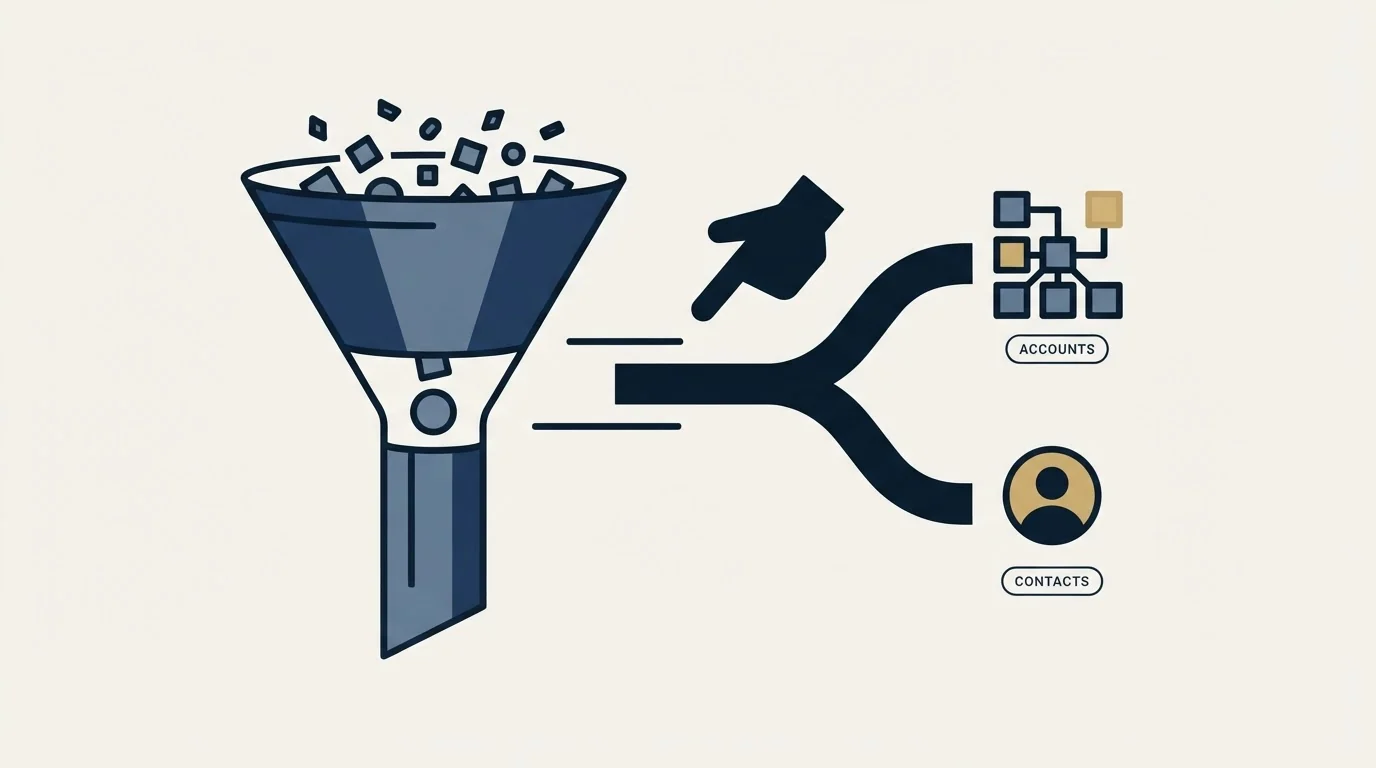
The Priority Accounts agent is a separate decision from the Prioritizer, and teams tend to buy both without noticing they are choosing between two models of selling.
Reply.io compared against Salesloft explains why the two tools sit at different workflow stages, cold email execution versus coordinated multi-channel orchestration, and why teams often run both.
A different angle entirely is data sourcing rather than workflow stage, which is what Adapt.io's comparison against Salesloft examines, contrasting contact enrichment with multi-channel orchestration.
Contact-level prioritisation ranks people. It suits a motion where the deal is one person's decision and the job is reaching them at the moment they are receptive. Account-level prioritisation ranks companies, then asks a seller to work several stakeholders inside the highest-ranked ones. It suits a motion where a purchase requires four people to agree and a single champion cannot sign.
The reason this matters at evaluation time is that the two models produce different daily behaviour and different reporting. A team told to work ranked accounts and then measured on contact-level activity will optimise for the metric, which means many shallow touches across many companies, which is the opposite of what the account ranking was bought to produce. Deciding which unit the team is actually managed on, before the platform is configured, prevents a year of that.
It also changes what "AI" is doing here, which is worth being precise about. Nothing in this module writes your emails or decides your strategy. It scores and orders work that already exists, using signals that already exist, and surfaces the top of that ordering to a person who remains free to ignore it. That is a narrower claim than the marketing language suggests, and it is also the version most likely to survive contact with a real sales team.
Deciding whether that scoring layer even belongs in your stack often comes down to how Salesloft's broader orchestration compares against a lighter execution tool, a question addressed directly in Outplay compared with Salesloft.
Plays, cadences, and one point of disagreement
Plays prompt actions. The vendor's page describes them as automations that "prompt user actions like prepping for a meeting, sharing an agenda, and sending a follow-up email", each triggered by an event or a signal. That is a sensible design for the motion most sales organisations run, which is a multi-step cadence per prospect with follow-ups scheduled against non-response.
We run outbound differently, and the difference is worth stating because it changes which parts of a platform earn their cost. Our documented practice is one message per campaign: no bumps, no thread replies, and no follow-up sequences against silence. Re-approaching a prospect who did not reply means a new campaign with a new angle rather than another touch inside the old one. Under that model, the prompts that fire on non-response have nothing to do, and the ones that fire on a real buyer action, a site visit, a meeting booked, a usage change, keep all of their value.
That is the useful split for evaluating any prioritisation layer. Signals that come from the buyer doing something are worth ranking. Signals that come from your own sequence timing out are a scheduler wearing a prediction costume.
What a trial has to prove
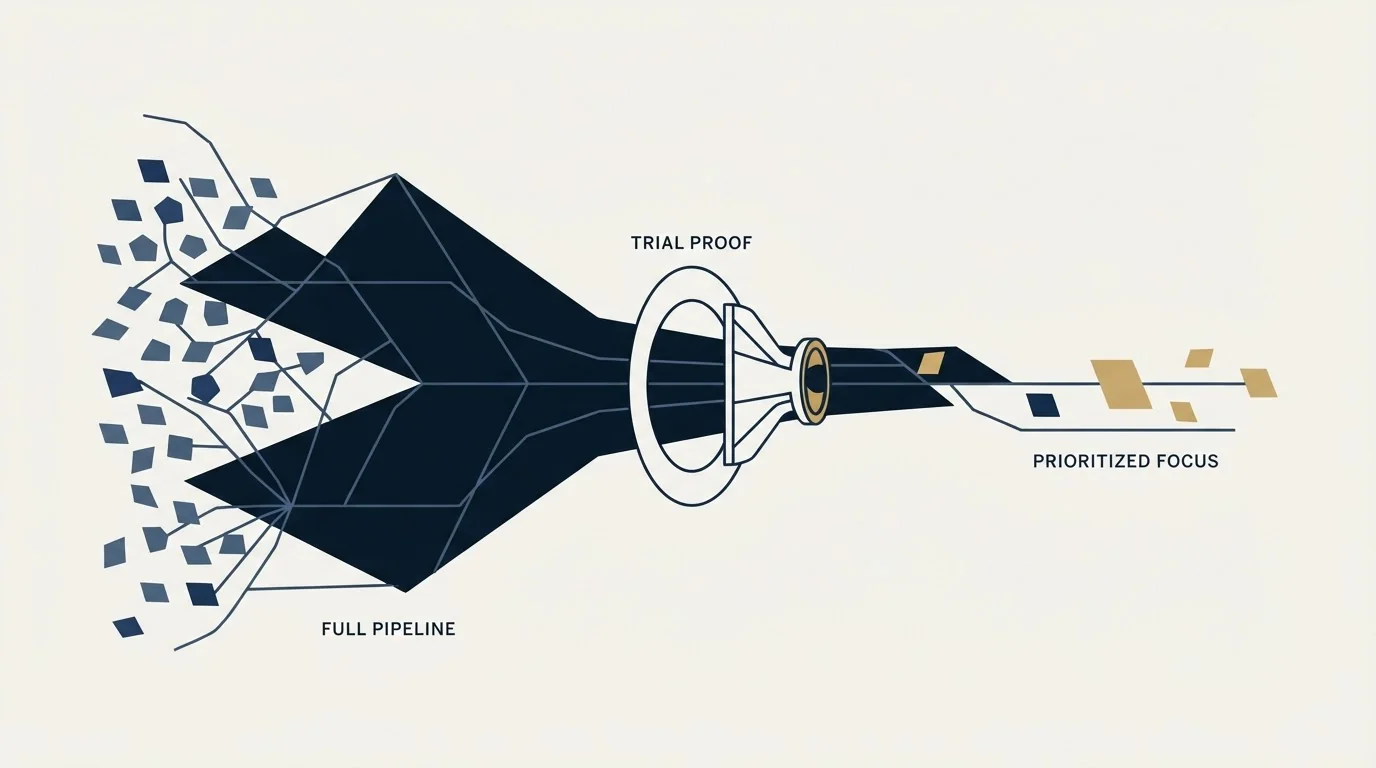
The trial question is narrow and it is not about accuracy. It is whether the ranking changes behaviour.
Run it on one team for two weeks. Before the platform is switched on, have each seller write down their top five actions for the day. Afterwards, compare that list against what Rhythm puts at the top. Two outcomes matter. If the lists broadly agree, the value on offer is time saved building the list, which the vendor's own customer quote frames as roughly half an hour a day of admin, and that is a real but modest benefit to price accordingly. If the lists disagree, the interesting question is who was right, which you can only answer by following the disputed accounts to an outcome.
Then check adoption honestly at the end of the period. A prioritisation tool that reps close in favour of their own list has failed silently, and the reporting will still show a healthy licence count. The wider category comparison sits in sales engagement platforms, and the lighter tools that skip this layer altogether are covered in Salesloft alternatives.
If the honest answer is that the list is short because not enough qualified conversations are starting, no ranking engine fixes that. Seeing a campaign built for your market tests the other end of the problem.
Product features and published claims verified as of mid-2026. Verify current terms with the vendor before relying on them.
Frequently asked questions.
Frequently asked questions- What is Salesloft Rhythm?
- Rhythm is Salesloft's prioritisation layer. It takes buyer signals such as website activity, content views, product usage changes and connected intent data, ranks the resulting actions per seller through an engine the company calls Conductor AI, and presents them in filtered Focus Zones so a rep works one type of action at a time.
- Are the Rhythm performance figures reliable?
- They are vendor-reported customer results from a specific moment. The figures displayed on the product page appear in a Salesloft release dated 25 October 2023, four months after launch, describing trending data from early adopters. No sample size, methodology or comparison group is published, so treat them as best-case claims rather than as a forecast.
- Does Rhythm work without intent data?
- It degrades. The ranking is only as good as the signals reaching it, and the vendor's own list of signal sources is dominated by buyer behaviour: site visits, content views, product usage and connected business intelligence. A company whose target accounts leave no visible digital trail is asking the engine to rank its own activity data.
- What is the difference between the Prioritizer and Priority Accounts agents?
- The Prioritizer ranks individual actions for a seller. The Priority Accounts agent ranks whole companies by engagement and buying intent, which suits a motion where several stakeholders have to agree. Choosing which unit your team is managed on matters, because reps measured on contact activity will optimise for touches rather than for account coverage.
About the author.

B2B cold email experts helping companies generate qualified leads through done-for-you outreach campaigns.
RevenueFlow Team
Explore more.
Ready to scale your outreach?
We build GTM engines that book real meetings. See the receipts.
Related articles.
Which CRMs and Tools the Outbound Stack Connects To: Integration Data From 342 Sales Tools
HubSpot is named as an integration by 52.3% of 342 verified sales tools, Zapier by 50.3% and Salesforce by 43.3%. Here is the full map by category.
Sales Engagement Platform Pricing in 2026: What 61 Tools Charge and Which Hide It
Sales engagement platforms start at a median of $75 a month, 70.5% carry a quote-only tier, and AI SDR platforms start at $204.50. Data from 61 verified tools.
What Cold Email and Sales Tools Actually Cost in 2026: Pricing Data From 386 Vendors
RevenueFlow's verified dataset of 386 sales tools puts the median starting price at $39.98 a month. Here is the spread by category, tier and billing model.
Gong Engage vs Salesloft Cadence: How They Differ
Gong Engage and Salesloft Cadence compared from each vendor's own pages: where each starts, six jobs side by side, and what the pricing pages disclose.
Annual vs Monthly Billing: How Much Sales Tools Discount for Paying Yearly
Across 112 verified sales tools with both rates on record, the median discount for annual billing is 20.0%, and it only pays off after month 9.6.
RevOps Tools: Nine Products and the Job Each Does
Nine revenue operations products sorted by the six jobs the category covers, with every product fact and price read off the vendor's own pages and dated.