ZoomInfo vs Clearbit: Sales Intelligence vs Data Enrichment
ZoomInfo provides comprehensive sales intelligence for enterprise teams, while Clearbit focuses on marketing enrichment and visitor identification. Here's how to choose.
ZoomInfo vs Clearbit is now a choice between a sales intelligence platform sold by quote and Clearbit's data inside HubSpot. ZoomInfo suits outbound prospecting with direct dials and topic intent. Clearbit's data, bought as HubSpot's data enrichment on Starter plans and above, suits completing records and shortening forms.
Key takeaways
- Clearbit's pricing address redirects to a homepage that reads "Clearbit has joined HubSpot!", and its data now ships as HubSpot's data enrichment.
- HubSpot's knowledge base says data enrichment does not consume HubSpot Credits and is available with Starter, Professional and Enterprise hub subscriptions.
- ZoomInfo's own pages disagree on coverage: 500M+ profiles and 135M+ direct dials on its data page, 420M+ contacts and 120M+ direct dials on its sales page.
- ZoomInfo's pricing page refused every fetch for this comparison, and its about page routes buyers to Contact sales or a Free trial, so its price is a quote.
Reviewed and updated September 19, 2026
Clearbit's pricing address now forwards to its homepage, and the homepage has one headline: "Clearbit has joined HubSpot!" So ZoomInfo vs Clearbit is no longer a comparison of two subscriptions. ZoomInfo is still sold as its own sales intelligence platform. Clearbit's data reaches new buyers as HubSpot's data enrichment, inside a HubSpot subscription, and the useful question is which of those two purchases fits the job in front of you.
ZoomInfo vs Clearbit: the quick answer
Pick ZoomInfo when the job is outbound prospecting: its sales page describes a contact database with direct dials, buyer intent, and a dialer and email tool. Pick Clearbit's data, now bought as HubSpot's data enrichment, when the job is completing the records and forms that already live in HubSpot. ZoomInfo's pricing page could not be read for this comparison, so no ZoomInfo price appears here.
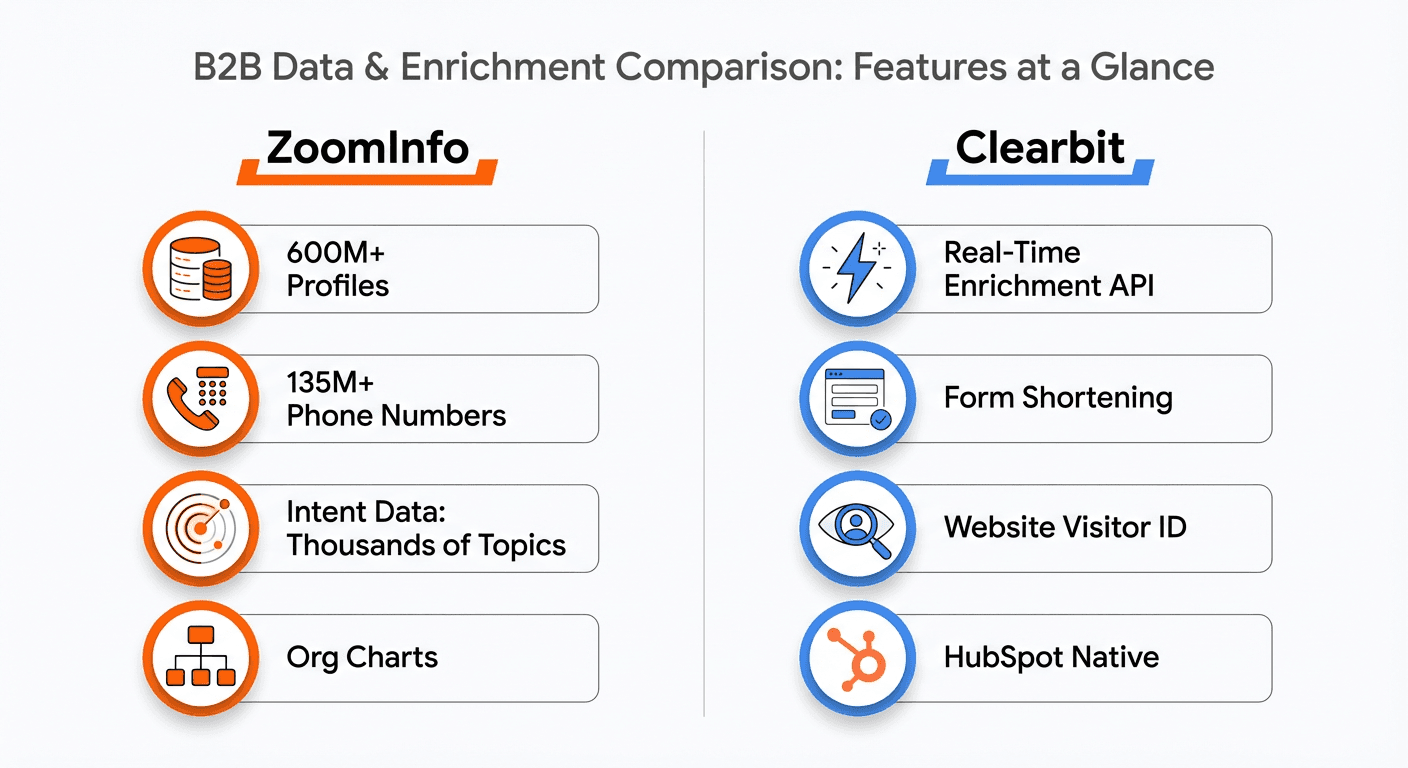
Both have grown toward each other. ZoomInfo's own navigation lists website visitor tracking and web form optimization, which used to be Clearbit's territory, and the Clearbit data inside HubSpot still reveals which companies visit your site. The split that survives is scale of contact data against depth inside one CRM.
Understanding the Core Difference
ZoomInfo calls itself a go to market intelligence platform that helps businesses find, engage, and win customers more efficiently. Its product list runs from a company and contact database through buyer intent, website visitor tracking, conversation intelligence and a sales automation tool, and its about page says 30,000+ customers use it. Sales teams use it for prospecting, account research and buying signals.
Clearbit was marketing data infrastructure: enrichment, form shortening and visitor identification. HubSpot's Clearbit page now describes adding 100+ B2B data points to every contact or company record, dynamically shortening forms, and seeing which companies visit your website. HubSpot's knowledge base describes the same capability as data enrichment, powered by HubSpot's commercial dataset, third-party providers and publicly available information.
Database and Data Coverage
ZoomInfo publishes its coverage on more than one page, and the pages do not agree. Its data page says 500M+ professional profiles, 135M+ direct dial numbers and 122M+ companies. Its sales product page says 420M+ global contacts, 120M+ direct dials and 145M+ companies, and further down the same page, over 70M phone numbers and 174M-plus verified email addresses. Quote the page you are reading, and ask the rep which count the contract covers.
| Figure | Data page | Sales page |
|---|---|---|
| People | 500M+ profiles | 420M+ contacts |
| Direct dials | 135M+ | 120M+ |
| Companies | 122M+ | 145M+ |
| Intent topics | 4,500+ | not listed |
| Verified emails | 300M+ | 174M-plus |
| Phone numbers | not listed | over 70M |
Clearbit does not sell a database to search. Its homepage describes enriching records you bring: global coverage across every country, industry codes down to 6 digit NAICS, GICS and SIC, corporate hierarchies, and normalised role and seniority. Neither clearbit.com nor HubSpot's Clearbit page mentions phone numbers.
So ZoomInfo offers the larger raw database, particularly for direct dials, and Clearbit's value sits in completing records as they arrive. That makes Clearbit most useful where data needs to flow automatically through HubSpot rather than be exported in bulk.
Deciding whether Clearbit fits your stack often means understanding what it does not do, and how it differs from revenue intelligence tools clarifies why teams pair rather than choose between them.
Pricing Comparison
ZoomInfo Pricing
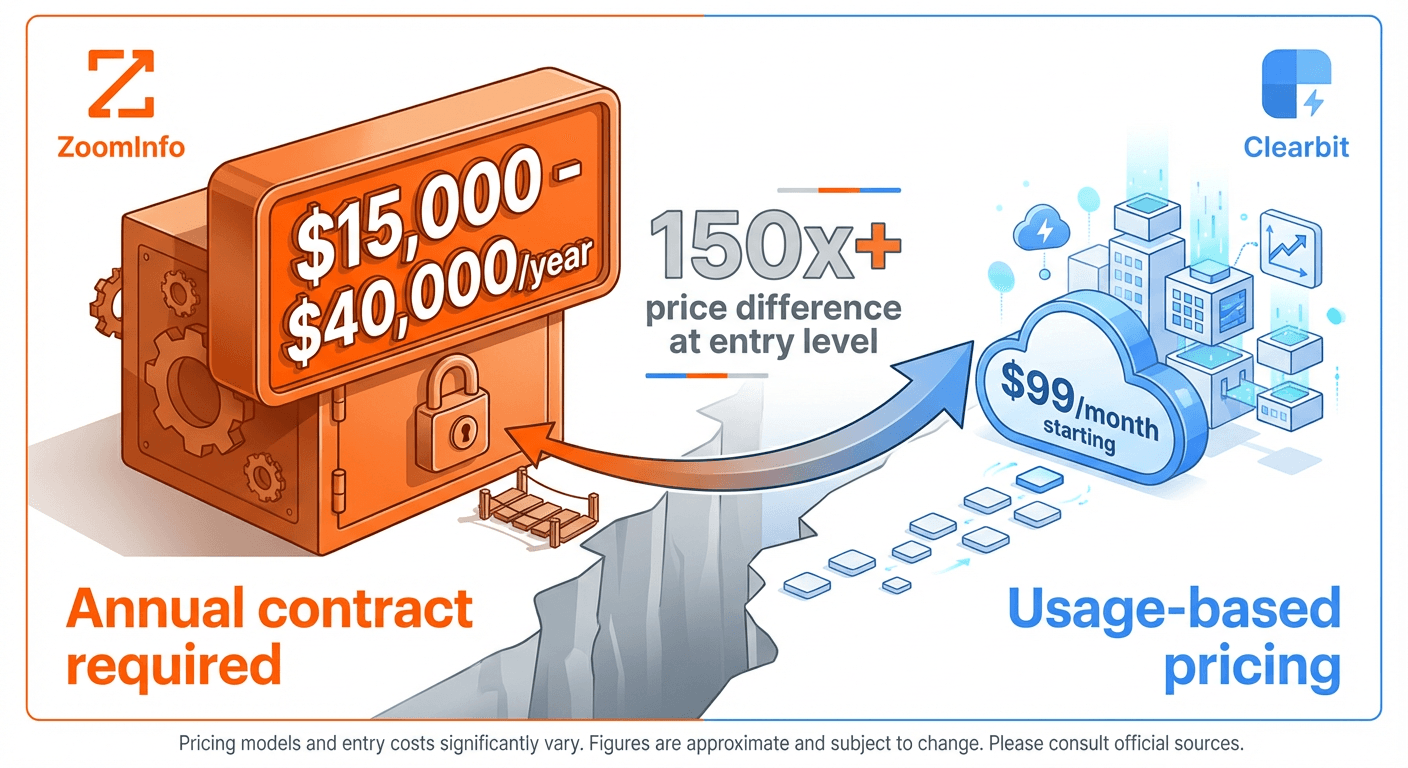
ZoomInfo's pricing page returned HTTP 403 to a plain fetch and was refused to a headless browser on every attempt for this refresh, and so was its homepage. Its about page, which did load, carries Pricing, Contact sales and Free trial links. No ZoomInfo figure is stated here: the ranges quoted around the web are estimates rather than ZoomInfo's own numbers. Ask for the quote in writing, with the credit allowance and seat count it assumes.
Clearbit Pricing
Clearbit no longer sells a plan of its own. Its pricing address redirects to the homepage, which reads "Clearbit has joined HubSpot!" and offers a customer login. The data now arrives as HubSpot's data enrichment, which HubSpot's knowledge base lists as available with Starter, Professional and Enterprise subscriptions of its Marketing, Sales, Service, Data and Content hubs.
Clearbit's absorption into HubSpot raises a related question about pairing enrichment data with a dedicated pipeline tool, a topic covered in Clearbit's fit alongside pipeline software.
The credit side is narrower than it sounds. HubSpot's knowledge base says data enrichment does not consume HubSpot Credits, while smart properties do, and that credits are required for certain features. So the cost of Clearbit's data is mostly the HubSpot subscription it sits in.
Pricing Analysis
ZoomInfo is a sales conversation before it is a price, and a team without a data budget line will find that slow. Organisations running large outbound programmes are the ones that justify it.
Teams with smaller budgets facing similar tradeoffs might instead weigh enrichment tools built for lighter budgets, where free entry tiers make prospecting more accessible.
Clearbit is no longer a separate purchase. A team already paying for a HubSpot Starter subscription or above has the enrichment within reach; a team on another CRM would be buying HubSpot to get it.
Feature Comparison by Use Case
Outbound Sales Prospecting
ZoomInfo: Built for this use case. Its sales page describes building lists from 300+ attributes such as technology stack and funding data, direct dials, and a sales automation tool with a direct phone dialer and email. Sales teams can identify targets, reach contact information and export to their CRM in one click.
Clearbit: Limited prospecting functionality. It enriches leads you already have rather than discovering new prospects, although HubSpot's Clearbit page does describe building target market lists of B2B companies.
Winner for prospecting: ZoomInfo
Lead Enrichment
ZoomInfo: Its navigation lists CRM enrichment and an API that delivers data across business systems and workflows. The enrichment requires a ZoomInfo subscription.
Clearbit: Purpose-built for enrichment, and now native to HubSpot. HubSpot's knowledge base describes four ways to enrich: automatically for new records, one record at a time, in bulk from an index page or an import, and from the Intelligence tab. Form shortening remains the standout: when a visitor fills in a form, HubSpot checks the enrichment dataset and only displays the fields it cannot fill.
Winner for enrichment: Clearbit, for teams on HubSpot
Intent Data
ZoomInfo: Its data page lists real-time intent signals from 4,500+ topics, and its sales page describes surfacing companies with high intent scores based on content consumption, technology signals and behavioural patterns.
Clearbit: Website-visit intent. Clearbit uses IP intelligence to identify the companies that visit your website, a form of first-party intent, and neither Clearbit page fetched for this comparison describes third-party topic intent.
Winner for intent: ZoomInfo
Website Visitor Identification
ZoomInfo: Lists website visitor tracking, sold as WebSights on its sales page, to discover decision-makers from companies exploring your website.
Clearbit: Reveal was built for this. HubSpot's Clearbit page describes seeing which companies visited in the past hours, days, weeks or months, who visited the pricing page and how many times, and whether they are already in HubSpot.
Winner for visitor identification: Clearbit for HubSpot users, though both list it
CRM and Marketing Automation Integration
ZoomInfo: Its sales page promises one-click export to your CRM, automatic record sync and connections to existing sales engagement tools, and its about page announces ZoomInfo data inside Microsoft Dynamics 365 and ZoomInfo MCP on Salesforce's AgentExchange.
Clearbit: It is part of HubSpot now, so the integration is the CRM itself.
Winner for HubSpot users: Clearbit Winner for other CRMs: ZoomInfo
Feature Comparison Summary
| Feature | ZoomInfo | Clearbit, inside HubSpot |
|---|---|---|
| Contact database | 500M+ profiles on its data page, 420M+ contacts on its sales page | Enriches records you already hold |
| Direct dials | 135M+ on its data page, 120M+ on its sales page | Not mentioned on either Clearbit page |
| Intent | Signals from 4,500+ topics | Companies visiting your site, by IP |
| Website visitor ID | Listed | Listed |
| Form shortening | Web form optimization listed | Listed, inside HubSpot forms |
| CRM enrichment | Listed | HubSpot data enrichment, no HubSpot Credits used |
| How you buy | Contact sales or free trial; pricing page unreadable here | A HubSpot Starter, Professional or Enterprise subscription |
Use Case Recommendations

Pick ZoomInfo when
- Outbound prospecting is the job
- Calls need direct dials
- Topic intent decides which accounts come first
- Lists are built and exported in bulk
- The CRM is not HubSpot
Pick Clearbit in HubSpot when
- The CRM is HubSpot, Starter or above
- Forms should ask for less
- Inbound records need completing as they arrive
- The companies visiting your site matter
When to Use Both
Some organizations use ZoomInfo and Clearbit together. Sales teams use ZoomInfo for prospecting and account research, while marketing teams use Clearbit's data inside HubSpot for enrichment and visitor identification. This approach maximizes functionality but increases total data spend.
Teams weighing lighter-weight, budget-friendly alternatives might also compare Adapt.io against Lead411 for verified contacts and intent-based prospecting.
Data Quality Considerations
Both platforms invest in data accuracy, though their approaches differ.
ZoomInfo says its data is backed by proprietary AI and human validation, and its data page states a 96% email deliverability rate and 87% mobile number accuracy. Those are ZoomInfo's own figures. The scale of the database means some decay is inevitable.
Clearbit describes starting with the most precise data sources and then incorporating all other available sources to balance accuracy and coverage. The trade-off is that it completes records rather than supplying new ones.
Practical recommendation: Regardless of platform, implement verification in your workflow. Email validation, phone number verification, and regular list hygiene remain important even with premium data sources.
Getting Started and Switching
ZoomInfo is a procurement cycle: a demo or a free trial, then a quote. Clearbit's data inside HubSpot is a setting: a Super Admin configures enrichment, and automatic enrichment stays off for both contacts and companies until someone turns it on.
Moving from Clearbit to ZoomInfo makes sense when the sales team is scaling, needs bulk prospect data and phone numbers, or wants topic intent to shape the pipeline. Moving from ZoomInfo to Clearbit's data is rarer, and makes sense when the organisation is consolidating on HubSpot and enrichment of inbound records has become the main job.
Final Thoughts
ZoomInfo and Clearbit serve different primary purposes despite both being B2B data companies.
Choose ZoomInfo for: Enterprise sales intelligence, comprehensive database access, intent signals, phone coverage, and large-scale outbound prospecting
Choose Clearbit for: Marketing data enrichment inside HubSpot, form shortening, website visitor identification, and records that complete themselves as they arrive
The right choice depends on your primary use case, and now on your CRM. Sales-driven organizations running outbound programs typically get more value from ZoomInfo. HubSpot teams focused on enrichment and automation typically get more value from Clearbit's data.
Related Reading
- Apollo vs Clearbit: Comparing B2B Data Platforms for Sales and Marketing
- Lusha vs Clearbit: Sales Prospecting Tool vs Marketing Enrichment Platform
- ZoomInfo vs Clay: Enterprise Data Platform vs Data Orchestration Tool
If you would rather have this run for you, RevenueFlow books qualified meetings on a pay-per-meeting basis and publishes client results.
Pricing and features are taken from the vendors' own pages. Verify current terms with the vendor before relying on them.
Frequently asked questions.
Frequently asked questions- Is ZoomInfo or Clearbit better?
- For outbound prospecting, ZoomInfo: its sales page describes a contact database with direct dials, topic intent and a dialer and email tool. For enriching records and shortening forms inside HubSpot, Clearbit's data, which HubSpot now provides as data enrichment. The deciding question is usually the CRM, since Clearbit's data is only sold inside a HubSpot subscription today.
- Is Clearbit still available as a standalone product?
- No. Clearbit's pricing address redirects to its homepage, which says Clearbit has joined HubSpot and offers only a customer login. Its capabilities reach new buyers as HubSpot's data enrichment, which HubSpot's knowledge base lists with Starter, Professional and Enterprise subscriptions of its Marketing, Sales, Service, Data and Content hubs.
- Does HubSpot's data enrichment use HubSpot Credits?
- HubSpot's knowledge base says data enrichment does not consume HubSpot Credits. Smart properties do consume them, and the article notes that credits are required for certain features. So the main cost of Clearbit's data inside HubSpot is the subscription tier, not a per-record meter, which is a change from how Clearbit billed on its own.
- How much does ZoomInfo cost?
- ZoomInfo does not publish a price that could be read for this comparison: its pricing page returned HTTP 403 to a plain fetch and was refused to a headless browser. Its about page offers Contact sales and a Free trial. Ask for the quote in writing, with the credit allowance and number of seats it assumes, before comparing it with anything.
About the author.

Tim Carden is CMO / CTO at RevenueFlow, which builds and operates outbound revenue engines for B2B companies. Studied at McGill University.
Tim Carden · CMO / CTO
Connect on LinkedIn →Explore more.
Ready to scale your outreach?
We build GTM engines that book real meetings. See the receipts.
Related articles.
Cognism vs Upcell: A Data Provider Against a Data Layer
Cognism sells compliance-first contact data by quote and credit; Upcell sells a layer that runs your providers, Cognism included, through one record. Read 18 Sep 2026.
PromptLoop vs ZoomInfo: Web Research Against a Database
PromptLoop builds a dataset from the live web in credits it publishes; ZoomInfo sells access to a maintained database by quote. Both pages read 18 September 2026.
Metadata vs 6sense: Paid Media Execution vs Intent
Metadata runs paid B2B campaigns through seven AI agents; 6sense ranks accounts on intent and sells contact data by credit. Neither publishes a rate. Read 18 Sep 2026.
Chili Piper vs LeanData: Form-First Against CRM-First
Chili Piper publishes a seat floor and bundles scheduling and chat; LeanData prices by Salesforce object and sells scheduling separately. Both read 18 September 2026.
Zoom Revenue Accelerator vs Gong: An Add-On vs a Platform
Zoom's support centre documents Revenue Accelerator as a licence on a Zoom account in two classes; Gong sells a platform per user plus a platform fee. Neither has a rate.
Mailshake vs Pipedrive: A Sender and a CRM, Side by Side
Mailshake sells per-user sending with a two-way Pipedrive sync from its middle tier; Pipedrive is a per-seat CRM with sequences from Growth. Both read 18 September 2026.