Apollo vs Clearbit: B2B Data Platforms Compared
Apollo offers an all-in-one sales platform with contact database, while Clearbit specialized in real-time data enrichment for marketing teams. An objective comparison.
Clearbit vs Apollo compares two data models. Apollo is a searchable prospecting database its site sizes at 240M contacts and 30M companies, from $49 per seat per month billed annually. Clearbit enriched records a team already had, and its homepage now says it has joined HubSpot, whose own data enrichment documents that job.
Key takeaways
- Apollo searches for people you do not have yet, while enrichment fills in records you already hold: HubSpot's help article matches contacts on name and work email and companies on domain.
- Apollo's credits reach the same yearly total on either billing mode, 30,000 on Basic and 48,000 on Professional, so monthly billing changes the price and the timing, not the allowance.
- Worked out from Apollo's list prices, one Basic seat costs $588 a year billed annually against $780 billed monthly, and one Professional seat $948 against $1,188.
- Clearbit publishes no standalone price, and HubSpot's data enrichment help article says data enrichment does not consume HubSpot Credits.
Reviewed and updated September 21, 2026
Apollo.io and Clearbit represent two different approaches to B2B data. Apollo built its platform around sales prospecting, with a searchable contact database and outreach tools on top. Clearbit built an enrichment layer that filled in records a team already had, and its homepage now says Clearbit has joined HubSpot. So Clearbit vs Apollo comes down to a data model question: search for people you do not have yet, or fill in the ones you do.
Teams still weighing Apollo's fit against another enrichment tool can see how it stacks up in a separate comparison of lead sourcing platforms.
This guide compares them on what each needs as input, what each returns, what each costs, and where Clearbit's capability is documented now.
Clearbit vs Apollo: Which Is the Better Tool?
Apollo is the better tool for finding new prospects, because it is a searchable database its site sizes at 240M contacts and 30M companies, with sequences and a dialer built in. Clearbit was built for enriching records a team already had, and it can no longer be bought on its own. Its homepage says it has joined HubSpot, whose help centre now documents a data enrichment feature for that job.
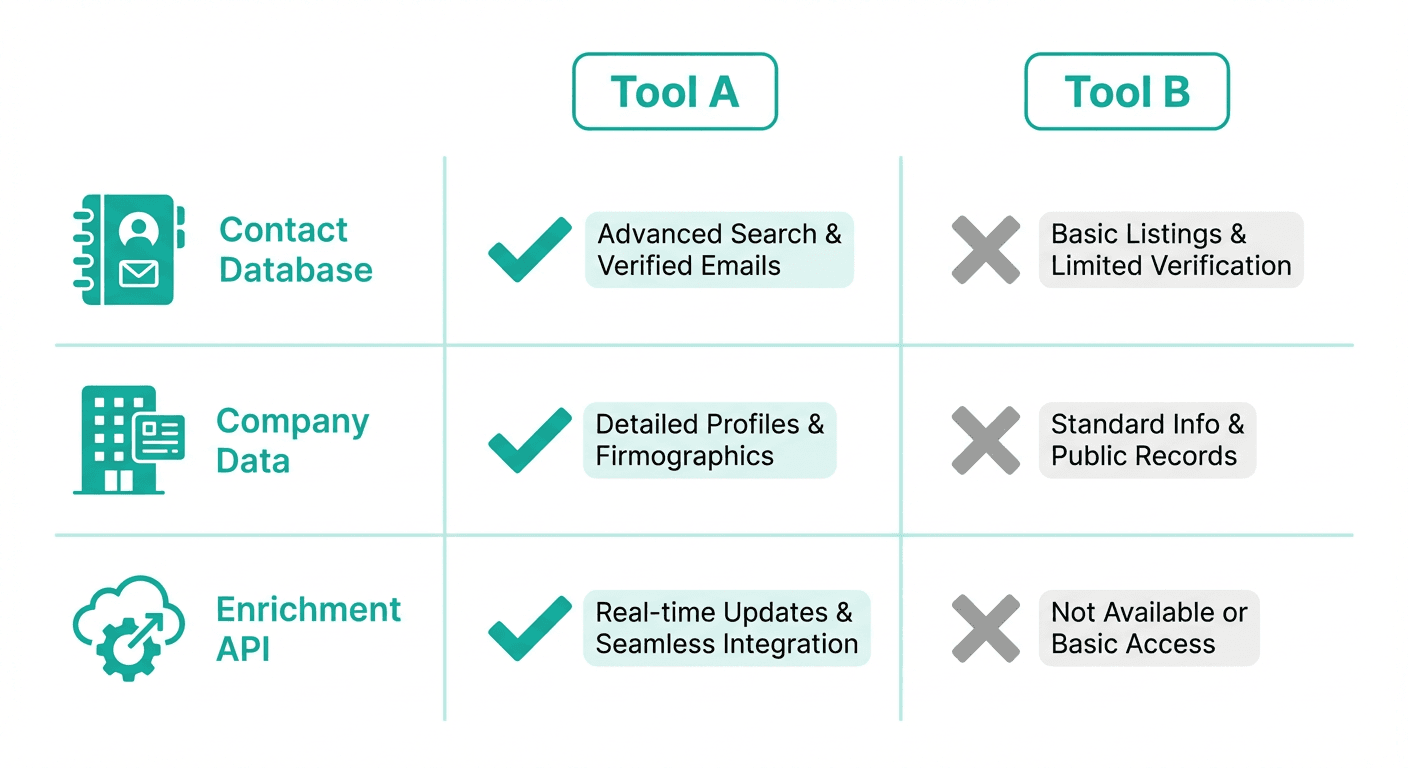
If you need a contact database with built-in outreach for sales prospecting, Apollo sells it on a free plan and on paid plans from $49 per seat per month billed annually.
If you need enrichment that completes CRM records, shortens forms and shows which companies visit your site, the first question is whether you run HubSpot. Its data enrichment help article lists the feature on Starter, Professional and Enterprise subscriptions. Outside HubSpot, Apollo's own enrichment lines are the nearest thing to buy.
Understanding the Core Difference
These platforms solve related but distinct problems.
Apollo.io functions as an all-in-one sales platform. Sales teams use Apollo to find prospects, export contact data, run email sequences, make calls, and track engagement. The database serves as the foundation, but outreach tools drive much of the platform's value.
Clearbit was a data enrichment layer. Marketing and operations teams used it to enrich existing records, shorten forms, identify anonymous website visitors and score and route leads. It did not provide prospecting lists or outreach tools, and its homepage now says it has joined HubSpot.
This distinction matters more now than it did. Apollo competes with platforms like ZoomInfo and Lusha. Clearbit sat nearer 6sense and Demandbase in the enrichment and intent category, and its capability now has to be looked for inside HubSpot or rebuilt.
Deciding whether these tools even belong in the same bucket gets easier after a cross-category breakdown of both platforms showing how outreach and enrichment roles actually complement each other.
Database and Data Coverage
Apollo.io Database
Apollo's site describes its database as 240M contacts and 30M companies, and its pricing page says credits give you access to emails, phone numbers and enriched data. Searches start from basic filters on the free plan and advanced filters and signals on paid plans, which add buying intent topics, job change enrichment and waterfall enrichment. The workflow it is built for is search first: find the people who match the criteria, then work them from a list.
Source: apollo.io
Clearbit Data
Clearbit did not provide a prospecting database; it enriched records a team already had. Its homepage describes the data as gathered from public data on the web, its proprietary data and LLMs that convert unstructured information into standardized data sets, for leads, contacts and accounts, with global coverage across every country.
HubSpot's data enrichment help article describes the enrichment it runs now in the same record-first shape. It fills in the record you already hold: contact enrichment uses first name, last name and work email address, and company enrichment uses the company domain, matched against HubSpot's commercial dataset, third-party providers and publicly available information.
Source: clearbit.com and HubSpot's data enrichment help article
Data Coverage Comparison
For finding new prospects: Apollo provides the database. Enrichment needs a name and a work email, or a company domain, before it can do anything.
For enriching existing records: Apollo's paid plans list CSV, CRM and API data enrichment and automated CRM enrichment. HubSpot enriches records automatically, continuously, one at a time or in bulk, and its help article says existing data is kept unless you choose to overwrite it.
For website visitor identification: Clearbit's homepage still describes turning anonymous traffic into buying intent signals with IP intelligence. HubSpot's Intelligence tab shows website visitor activity, and Apollo's paid cards identify 100 companies a month from website visitors.
Teams weighing Clearbit-style enrichment against a raw data provider rather than a prospecting tool can read the separate clearbit vs people data labs comparison.
Pricing Comparison
Apollo.io Pricing
| Plan | Per seat, annual | Per seat, monthly | Credits, annual billing | Credits, monthly billing |
|---|---|---|---|---|
| Free | $0 | $0 | 900 a year, granted monthly | 900 a year, granted monthly |
| Basic | $49 | $65 | 30,000 a year, upfront | 2,500 a month |
| Professional | $79 | $99 | 48,000 a year, upfront | 4,000 a month |
| Organization | $119, 3 seat minimum | Annual only | 72,000 a year, upfront | Annual only |
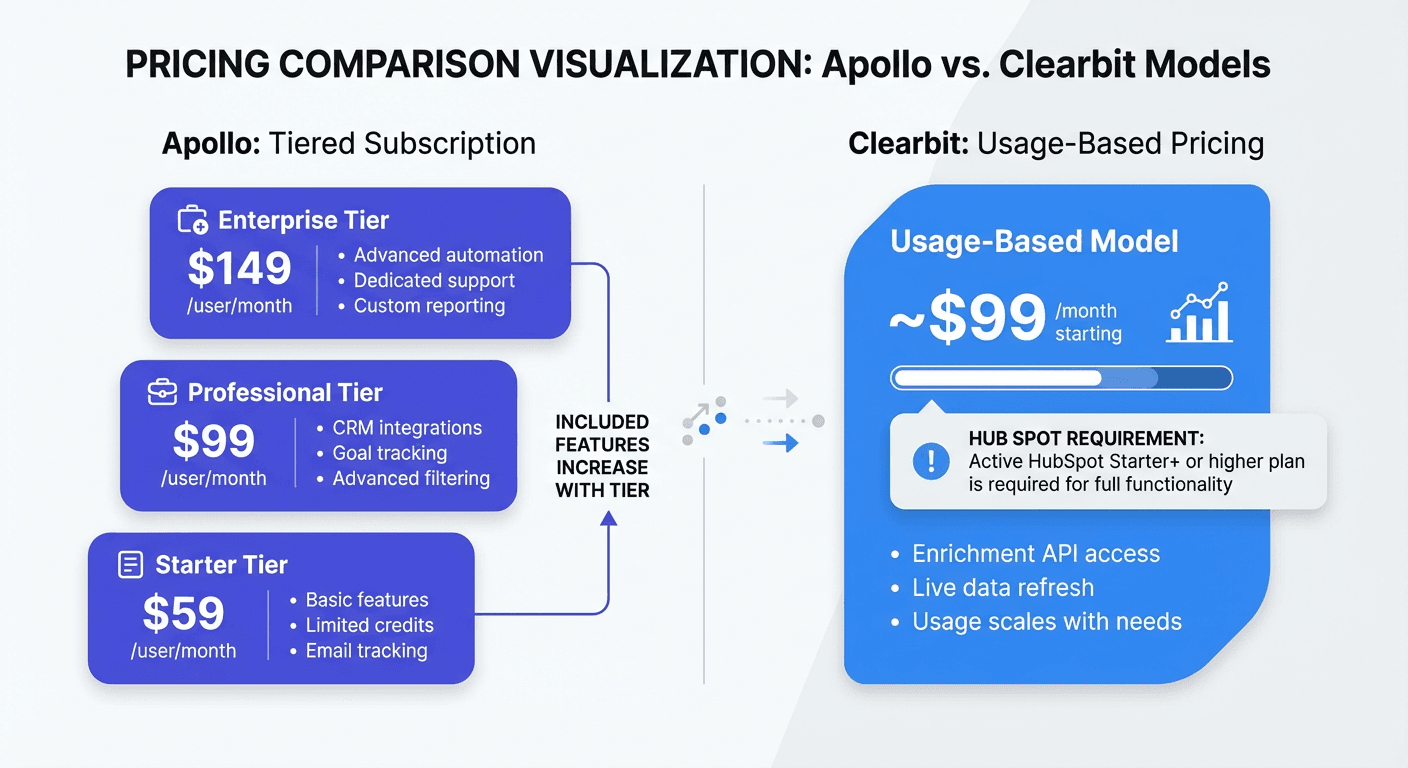
Twelve monthly grants come to the same yearly total as the annual grant: 2,500 a month is 30,000 a year and 4,000 a month is 48,000. So the billing choice changes the price and when the credits arrive, not how many there are. Worked out from the list prices, one Basic seat costs $588 for a year billed annually against $780 billed monthly, which matches the 24% saving the page advertises. On Professional it is $948 against $1,188, closer to 20%.
Source: Apollo.io Pricing
Clearbit Pricing (standalone product retired)
Clearbit no longer publishes a standalone price list, and its pricing address redirects to the homepage, which states that Clearbit has joined HubSpot. HubSpot's old Breeze Intelligence pricing address now resolves to a knowledge base article about HubSpot Credits. The data enrichment help article is the one that settles the cost question: it states that data enrichment does not consume HubSpot Credits, while smart properties do, and lists the feature on Starter, Professional and Enterprise subscriptions.
Source: Clearbit and HubSpot's data enrichment help article
Pricing Analysis
Direct price comparison is difficult because the platforms serve different functions:
For sales prospecting: Apollo's $49 to $119 per seat per month billed annually includes database access plus outreach tools. Clearbit did not offer prospecting functionality at any price.
For enrichment only: Clearbit's enrichment is not sold on its own any more. Inside HubSpot it comes with the subscription, while Apollo meters enrichment from the same credits that reveal emails and phone numbers.
For HubSpot users: enrichment is already part of a Starter or higher subscription, so Apollo earns its place on the outbound side rather than as an enrichment purchase.
Feature Deep Dive
Apollo.io Key Features
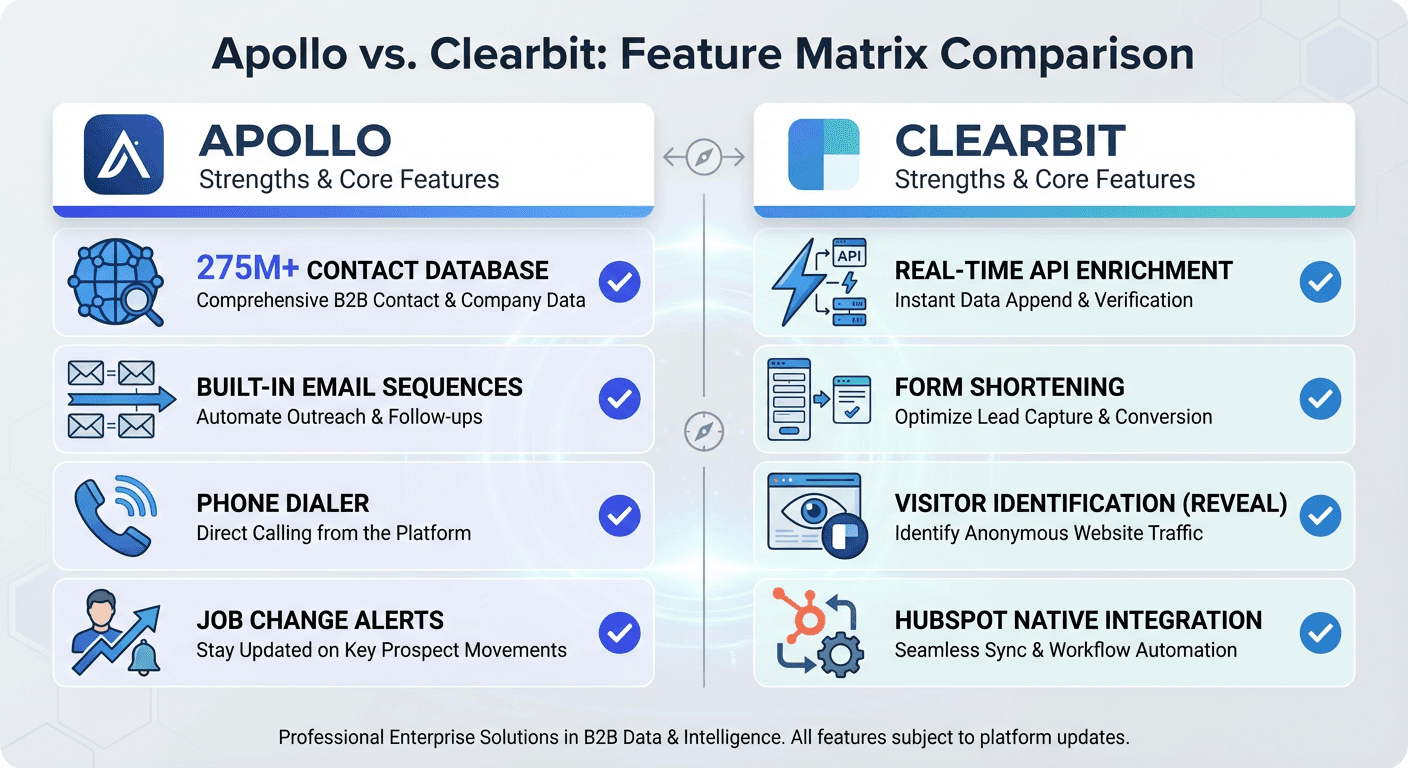
Contact Database and Search
- Basic filters on the free plan, advanced filters and signals on paid plans
- Buying intent topics and job change enrichment
- A Chrome extension for prospecting in the browser
Email Sequences
- Unlimited sequences on paid plans, with A/Z testing from Professional
- A deliverability suite and email warmup on paid plans
Deliverability guardrails matter across the outbound stack, and teams weighing campaign execution against inbox warmup can compare cold email and warmup tools that address these complementary needs.
Dialer
- A US dialer on paid plans, with credits applying
- An Advanced Dialer add-on with power dialing, voicemail drop and call logging
CRM Integration
- CRM integrations with Salesforce, HubSpot and Pipedrive
- Automated CRM enrichment on paid plans
What Clearbit's Capability Looks Like Now
Clearbit's homepage lists what the product did: enrich every record, score and route leads in real time, reveal buying intent from anonymous traffic with IP intelligence, and shorten forms dynamically so a field that can be enriched is not asked. It also lists 6 digit NAICS, GICS and SIC codes, corporate hierarchies and a normalized role and seniority set.
Inside HubSpot, the help article documents form shortening that only displays the fields that cannot be enriched, enriched fields that improve lead scoring and trigger workflow enrollment, and personalization tokens populated from enriched data.
Use Case Comparison
When Apollo.io Excels
Outbound Sales Prospecting Sales teams building prospect lists and running cold outreach campaigns benefit from Apollo's combination of database access and sequence tools. The workflow of search, export, and email happens within a single platform.
Whoever starts the conversation decides most of what follows, which is the distinction the outbound sales definition draws before any tooling question arises.
SDR/BDR Team Operations Teams running high-volume outbound programs use Apollo's unlimited email sending (Professional tier) and integrated dialer to reach prospects across multiple channels.
Beyond database and dialer tools, deliverability itself matters, and teams weighing warmup versus outreach execution can compare that split in email warmup and cold outreach tools.
Sales Intelligence Intent data, job change alerts, and company tracking help sales teams prioritize accounts showing buying signals.
Budget-Conscious Teams Apollo's $49/month starting price (with a functional free tier) makes B2B data accessible to startups and small teams.
When Clearbit-Style Enrichment Is the Need
The jobs Clearbit was bought for have not gone away: shorter inbound forms, CRM records kept complete, target accounts spotted on the website, and personalization fed by firmographic data. For a team on HubSpot, the data enrichment help article lists the same uses: form shortening, lead scoring, segmentation on enriched fields such as job title, industry and company size, personalization tokens and workflow triggers. For a team elsewhere, those jobs need a deliberate replacement, and Apollo's enrichment lines are the place to start measuring the gap.
Integration Ecosystems
Apollo.io Integrations
- CRMs: Salesforce, HubSpot, Pipedrive
- Engagement: Outreach, SalesLoft
- Email delivery: SendGrid, Mailgun
- Also named in its FAQ: Marketo and LinkedIn
- Mailboxes: Gmail on non-paying plans, Microsoft and other providers after paying
- API: API enrichment on paid plans
Clearbit Integrations
Clearbit's homepage no longer lists integrations. The enrichment HubSpot documents writes to HubSpot records, so another tool sees it wherever that tool already syncs with HubSpot.
Integration Comparison
Apollo's integrations focus on the sales workflow, connecting CRMs and engagement platforms that sales teams use daily. On the enrichment side, the integration question has become which systems read HubSpot's enriched fields.
Data Quality and Accuracy
Apollo.io Data Quality
Apollo's pricing page says it enriches every record with Apollo data, trusted partners and AI research, and lists waterfall enrichment and an enrichment report and history on its plans. Like every B2B database, its records decay as professionals change roles and companies, which is what the job change enrichment line exists to catch.
Clearbit Data Quality
Clearbit's homepage says it starts with the most precise data sources and then incorporates all other available sources, to balance accuracy and coverage. For the enrichment HubSpot runs now, its help article says enriched data is dynamically weighed and scored against its data sources, checked for accuracy and freshness, and reviewed by a human quality assurance team.
Quality Recommendations
Regardless of platform choice:
- Verify email addresses before high-volume sending
- Build workflows to handle enrichment failures gracefully
- Monitor bounce rates and data accuracy over time
- Supplement any single source with verification tools
Choosing Between Apollo and Clearbit
Choose Apollo.io When
- You need a prospecting database to find new contacts
- Sales reps require built-in outreach tools
- Budget constraints make enterprise platforms inaccessible
- You want an all-in-one platform to reduce tool count
- Outbound sales drives your growth model
Choose HubSpot's Data Enrichment When
- Inbound marketing generates most of your pipeline
- Your tech stack already centers on HubSpot
- Website visitor activity on the Intelligence tab supports your ABM work
- Marketing owns the data enrichment budget
Consider Both When
Some organizations run both, split by function:
- Apollo for sales prospecting and outbound
- HubSpot's enrichment for inbound records and form shortening
This combination addresses both prospecting and enrichment needs, though it increases total tool spend.
Feature Comparison Summary
Apollo's paid cards list real-time form enrichment with a 10 limit, beside the unlimited sequences and US dialer covered above. The table puts the two side by side as they can be bought today.
| Capability | Apollo | Clearbit today |
|---|---|---|
| Contact database | 240M contacts and 30M companies | None; it enriched records you had |
| Email sequences | Unlimited on paid plans | None |
| Dialer | US dialer, credits apply | None |
| Record enrichment | CSV, CRM and API data enrichment | HubSpot data enrichment |
| Website visitors | 100 companies a month on paid plans | HubSpot's Intelligence tab |
| Form shortening | Real-time form enrichment, 10 limit | HubSpot form shortening |
| Starting price | Free, then $49 per seat billed annually | No standalone price |
Getting Started Recommendations
On HubSpot, the help article sets the order. Super Admin permissions are required to configure enrichment settings, automatic enrichment is off by default and has to be set up for contact and company records separately, and HubSpot recommends testing record eligibility before enriching. The last decision is whether enrichment may overwrite values it judges incorrect.
On Apollo, the order is the one any database rollout needs: connect the Chrome extension and the CRM, turn the ideal customer profile into search filters, verify data quality on a small sample before large exports, then configure deliverability settings and run a small test campaign.
On HubSpot
On Apollo
Final Thoughts
Apollo.io and Clearbit were built for different primary functions despite both operating in the B2B data space.
Choose Apollo.io for: Sales prospecting, contact database access, built-in outreach tools, and a free plan below paid tiers from $49 per seat per month billed annually.
Look to HubSpot's data enrichment for: Filling in records, shortening forms and seeing visitor activity, now that Clearbit's homepage says it has joined HubSpot.
A team can run both, with sales prospecting in Apollo while marketing enriches inbound leads in HubSpot. Settle the primary use case first, and treat any standalone Clearbit price you find as a historical figure.
Related Reading
- ZoomInfo vs Clearbit: Enterprise Sales Intelligence vs Marketing Data Enrichment
- Lusha vs Clearbit: Sales Prospecting Tool vs Marketing Enrichment Platform
If you would rather have this run for you, RevenueFlow books qualified meetings on a pay-per-meeting basis and publishes client results.
Pricing and features are taken from the vendors' own pages. Verify current terms with the vendor before relying on them.
Frequently asked questions.
Frequently asked questions- Which is better, Clearbit or Apollo?
- It depends on the data model you need. Apollo is better for finding new prospects, since it is a searchable database with sequences and a dialer. Clearbit was built to enrich records a team already had, and its homepage now says it has joined HubSpot, whose data enrichment feature covers that job for HubSpot customers.
- Can Clearbit be used to find new sales prospects?
- No. Clearbit did not provide a prospecting database; it filled in records a team already held. The enrichment HubSpot documents now works the same way, matching contacts on first name, last name and work email address and companies on the domain. Finding people you do not have yet is the job Apollo's database is built for.
- Is Apollo cheaper on annual or monthly billing?
- Annual billing is cheaper. Apollo lists Basic at $49 per seat per month billed annually against $65 billed monthly, and Professional at $79 against $99. Over a year that is $588 against $780 for one Basic seat. The credits come to the same yearly total either way; monthly billing grants them each month instead of upfront.
- Is Clearbit still sold as a standalone product?
- No standalone price list is published. Clearbit's pricing address redirects to its homepage, which says Clearbit has joined HubSpot. HubSpot's data enrichment help article lists the feature on Starter, Professional and Enterprise subscriptions and states that data enrichment does not consume HubSpot Credits, while its smart properties do.
About the author.

Tim Carden is CMO / CTO at RevenueFlow, which builds and operates outbound revenue engines for B2B companies. Studied at McGill University.
Tim Carden · CMO / CTO
Connect on LinkedIn →Explore more.
Ready to scale your outreach?
We build GTM engines that book real meetings. See the receipts.
Related articles.
Cognism vs Upcell: A Data Provider Against a Data Layer
Cognism sells compliance-first contact data by quote and credit; Upcell sells a layer that runs your providers, Cognism included, through one record. Read 18 Sep 2026.
PromptLoop vs ZoomInfo: Web Research Against a Database
PromptLoop builds a dataset from the live web in credits it publishes; ZoomInfo sells access to a maintained database by quote. Both pages read 18 September 2026.
Metadata vs 6sense: Paid Media Execution vs Intent
Metadata runs paid B2B campaigns through seven AI agents; 6sense ranks accounts on intent and sells contact data by credit. Neither publishes a rate. Read 18 Sep 2026.
Chili Piper vs LeanData: Form-First Against CRM-First
Chili Piper publishes a seat floor and bundles scheduling and chat; LeanData prices by Salesforce object and sells scheduling separately. Both read 18 September 2026.
Zoom Revenue Accelerator vs Gong: An Add-On vs a Platform
Zoom's support centre documents Revenue Accelerator as a licence on a Zoom account in two classes; Gong sells a platform per user plus a platform fee. Neither has a rate.
Mailshake vs Pipedrive: A Sender and a CRM, Side by Side
Mailshake sells per-user sending with a two-way Pipedrive sync from its middle tier; Pipedrive is a per-seat CRM with sequences from Growth. Both read 18 September 2026.