Clearbit vs Gong: Cross-Category Comparison
Clearbit covers sourcing and verified contacts while Gong covers sending and follow-through. Which gap to close first, what a year costs, and whether a team needs both.
Clearbit vs Gong compares two products at opposite ends of a deal. Clearbit enriches records before a conversation exists and is now bought through HubSpot, whose enrichment needs a Starter hub or above. Gong captures and analyses conversations, and prices by per-user licence plus a platform fee without publishing a figure.
Key takeaways
- clearbit.com/pricing redirects to a homepage reading "Clearbit has joined HubSpot!", with a customer login and no plans or prices.
- Gong's pricing page says licenses are priced per user, a platform fee depends on the number of users supported, and existing tools integrate for free.
- Gong's form sorts teams into bands of 1 - 50, 51 - 1,000, 1,001 - 9,999 and 10,000+, and no price appears anywhere on the page.
- A 2022 Gong press release announced a partnership with Apollo, Clearbit and Cognism on contact enrichment, before Clearbit joined HubSpot.
Reviewed and updated September 19, 2026
Gong's pricing page answers the pricing question in three lines and no numbers: licenses are priced per user, a platform fee depends on the number of users supported, and the existing tech stack integrates for free. Clearbit's pricing address answers it with no lines at all, because it now redirects to a homepage that says "Clearbit has joined HubSpot!". So Clearbit vs Gong compares two price shapes, one of which now belongs to another company, and two products that work at opposite ends of a deal.
Clearbit vs Gong: the Short Answer
Buy Gong when the gap is understanding conversations that are already happening: its homepage describes capturing every interaction, analysing what works and automating what happens next. Clearbit's enrichment works before any conversation exists, and it is bought through HubSpot now, whose knowledge base lists data enrichment on Starter hubs and above. Most teams need the enrichment side first.
If you came here comparing Clearbit vs Salesloft, Clearbit vs Salesloft covers that pair, and a team replacing Salesloft rather than adding Gong can start with the Salesloft alternatives. The wider Clearbit field is in the best Clearbit alternatives.
What Each Product Is Today
Clearbit describes a data foundation on its homepage: enrichment of every record, real-time scoring and routing, industry codes, corporate hierarchies and IP intelligence for identifying website visitors. The page carries a customer login and no plans or prices. HubSpot's knowledge base describes the enrichment HubSpot sells now: it fills contact properties from a first name, a last name and a work email address, and company properties from a domain, and it does not consume HubSpot Credits.
Gong calls itself a Revenue AI OS and says it is trusted by 5,000+ customers. Its homepage names Gong Engage, which it says prioritizes and personalizes every sales engagement, Gong Forecast and Gong Enable, all built on captured customer interactions. It is a conversation and deal platform, and its own pages say nothing about building prospect lists.
The two companies have met before. A 2022 Gong press release announced partnerships with Apollo, Clearbit and Cognism, saying Gong would integrate with the partners' contact enrichment, with the features expected later that year. That announcement predates Clearbit joining HubSpot, and Gong's partner directory refused automated requests for this comparison, so whether a Clearbit integration still runs is a question to put to Gong.
Where Each Sits in a Cold Outbound Run
A cold outbound run has a fixed shape, and this pair sits at its two ends. Targeting comes first, and that is a decision about who is worth writing to rather than a piece of software. Then every row on the list gets filled in, which is the enrichment side's job. Gong's part starts when people talk: it captures the interaction, analyses it, and feeds engagement, coaching and the forecast.
RevenueFlow runs one message per campaign, so nothing in the run is a bump step or a thread reply waiting to fire. A prospect who stays quiet gets re-approached later through a new campaign with a different angle, never with a second message stacked under the one they ignored, and on LinkedIn that second message does not get sent at all.
The last stage belongs to neither product. Somebody reads the reply and somebody books the meeting, and the meeting counts only against qualification criteria written down before launch. A tool can route a reply into a queue. It cannot decide what a qualified meeting is.
Pricing Comparison
Clearbit Pricing
Clearbit sells no standalone plan: clearbit.com/pricing redirects to the homepage, which shows no prices. Pricing the capability now means pricing a HubSpot hub. HubSpot's knowledge base lists data enrichment on Marketing, Sales, Service, Data and Content Hub at Starter, Professional and Enterprise, and HubSpot's Sales Hub pricing page, served in pounds to this fetch, lists Starter as starting at £7 per seat per month.
The retired standalone Clearbit prices that used to sit in a table here are gone, because no Clearbit page carries them today.
Source: Clearbit and HubSpot: Get started with data enrichment
Gong Pricing
| What the pricing page says | Detail |
|---|---|
| Licenses | Priced per user |
| Platform fee | Based on the number of users supported |
| Integrations | Your existing tech stack integrates for free |
| Team size question | Bands of 1 - 50, 51 - 1,000, 1,001 - 9,999 and 10,000+ |
Gong publishes a pricing model instead of a rate, and offers to prepare a customized proposal once the form is filled in.
Source: Gong Pricing
gong.io/pricing · Get the scoop on Gong pricing
Licenses are priced per user 1
There is a platform fee based on the number of users supported 2
You can integrate your existing tech stack for free. 3
How big is your team? 1 - 50 · 51 - 1,000 · 1,001 - 9,999 · 10,000+ 4
- 1The per-seat part: it scales with headcount, like any seat licence.
- 2The fixed part: a fee tied to the users supported, which a small team carries over fewer seats.
- 3No connector fee is stated for existing tools, so the budget is licences plus the platform fee.
- 4The smallest band starts at 1 and runs to 50, the only size signal the page gives before the proposal.
Reading the Two Price Shapes Together
Clearbit no longer has a price shape to read, so this half of the budget is a HubSpot question: a line inside a contract the company may already hold, or a new hub.
Gong names no price and does set out its model, which is the more useful part. A platform fee on top of per-seat licensing is what catches small teams out: cost per rep is not linear at the bottom of the range, so a five person team cannot halve a ten person quote. The shape below is illustrative and carries no Gong figure.
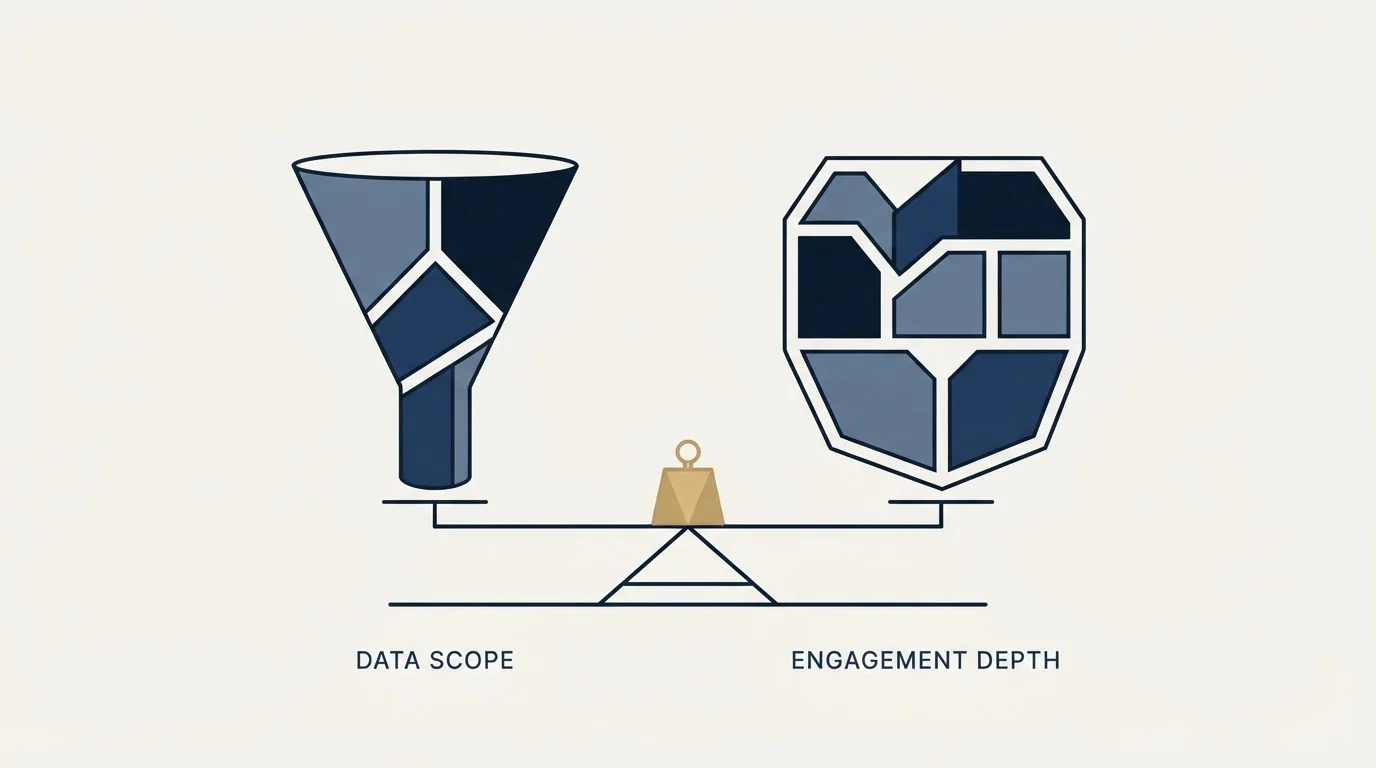
So neither half of this pair can be costed from a public page, for two different reasons: Gong withholds its figures and will produce them in a proposal, while Clearbit has none left to withhold.
What One Year of This Stack Actually Costs
The arithmetic cannot be completed honestly, and saying so is more useful than inventing a figure. For the enrichment half, the question for a team already on HubSpot is only whether its hub sits at Starter or above; for a team not on HubSpot it is whether a new CRM subscription is really on the table.
For the Gong half, get the licence price per user and the platform fee as two separate lines in the proposal, at the user count the team will actually run, because the fee is what makes a small team's cost per user higher.
Where the Two Actually Overlap
Barely. The enrichment side's listed capabilities are all upstream of a conversation: filled-in records, scores, routing and visitor identification. Gong's are all downstream of one: captured interactions, engagement priorities, coaching and the forecast. The 2022 partnership was an attempt to join the two, by putting contact data into Gong's deal view.
A capability named on a vendor's page is a claim about scope rather than a measure of quality, and neither page supports a claim that only one of them can do something. The practical overlap is the CRM record both would write to, which is where a trial should look.
When to Choose Which
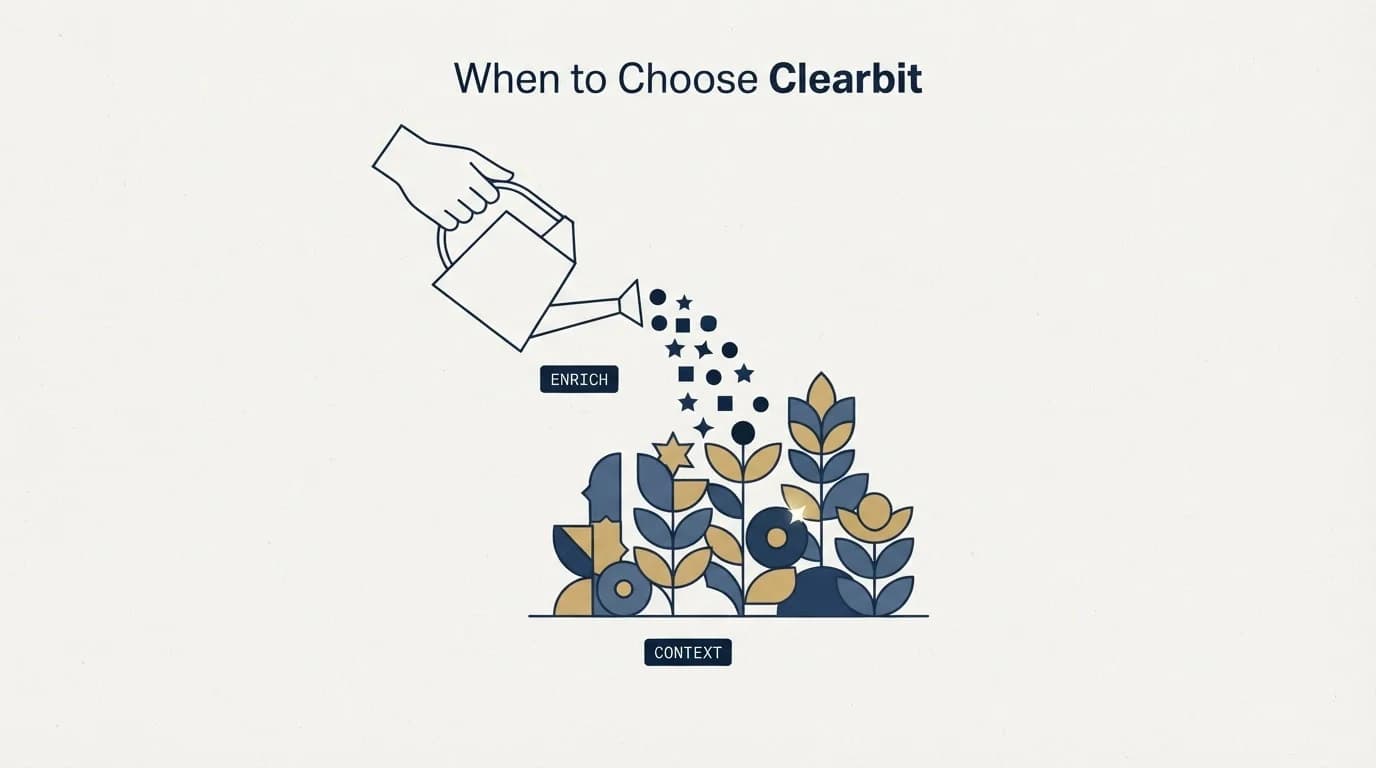
Choose the enrichment side, through HubSpot or another source, when the list is the part that is failing: rows with no usable contact, employers out of date, or a campaign that cannot start. Choose Gong when meetings are happening and being lost afterwards, because it is bought to understand conversations that already exist and cannot manufacture the conversations themselves.
A team that names the wrong gap buys a capable tool that changes nothing.
Do You Need Both, and in Which Order?
Ordering this pair is unusual, because one side is no longer a purchase. A team already on a HubSpot hub at Starter or above has the enrichment available and needs only to switch it on. A team not on HubSpot is choosing a different enrichment vendor whatever this page concludes.
The order that works is data first, conversation intelligence later, for reasons of measurement rather than preference. Gong's value comes from calls and meetings, and a team without enough of them has little for it to capture.
One case honestly reverses it. A team already booking meetings and losing them to disorganised follow-through has a workflow gap rather than a data gap, and that is the gap Gong's own homepage describes closing.
Using Both Together

Teams that run both use them at opposite ends of the deal. The enrichment side fills the rows before a campaign; Gong captures and analyses the conversations that come back.
Where the two meet is the CRM record, so ask Gong which enrichment integrations it runs today and how they write to that record before counting on the 2022 partnership.
Rolling It Out Without Breaking the Run
There is no Clearbit-first order left to run. The practical first step is to establish what the existing HubSpot contract already covers, because that answer decides whether this half of the stack is a new purchase or a setting somebody has not turned on. Gong lands second, and often much later, because its per user licensing plus platform fee is priced for a team that already has conversations happening. Buying it to create those conversations is the wrong way round.
Whichever order the two arrive in, keep the sending inventory out of it. Sender domains, mailbox warmup and daily caps are their own project, and a stack change made in the same week as a sending change leaves nothing to attribute a bounce rate to. Change one layer, let a full wave run, then change the next.
Two habits save real money. Trial on accounts already worked rather than on a fresh list, because the only coverage question that matters is coverage on the segment being sold to. And export what the incumbent already found before a subscription lapses: records bought once are cheap to keep and expensive to buy twice.
The Short Version
- Check the HubSpot contract before pricing Clearbit as a purchase; the enrichment may already be paid for on a Starter hub or above.
- Gong names no price on its own pricing page: per user licences, a platform fee by users supported, and free integration of the existing stack.
- The two barely overlap. Enrichment works before a conversation exists and Gong works on the conversation, so the choice is which gap gets closed first.
- Buy the data side first when the list runs out, and Gong first when meetings are being booked and then lost after the reply.
- Measure the change in meetings booked against criteria fixed before launch, because that is the only number both products are trying to move.
Related Reading
- Best Clearbit Alternatives in 2026
- Best Gong Alternatives in 2026
- Apollo vs Clearbit: Comparing B2B Data Platforms for Sales and Marketing
- Clearbit vs ZoomInfo: Data Enrichment Tool Comparison
- Gong vs Outreach: Sales Engagement Platform Comparison
If you would rather have this run for you, RevenueFlow books qualified meetings on a pay-per-meeting basis and publishes client results.
Pricing and features are taken from the vendors' own pages. Verify current terms with the vendor before relying on them.
Frequently asked questions.
Frequently asked questions- Does Gong integrate with Clearbit?
- Gong announced a partnership with Apollo, Clearbit and Cognism in 2022, saying it would integrate with their contact enrichment, with features expected later that year. That predates Clearbit joining HubSpot, and Gong's partner directory refused the automated requests made for this comparison, so ask Gong whether a Clearbit integration still runs before counting on it.
- How much does Gong cost?
- Gong's pricing page publishes a model rather than a price: licenses are priced per user, there is a platform fee based on the number of users supported, and existing tools integrate for free. It asks for team size in bands starting at 1 to 50 and then prepares a customized proposal, so the only number available is a quote.
- Is Clearbit still sold separately from HubSpot?
- Not on Clearbit's own site. Its pricing address redirects to the homepage, which reads that Clearbit has joined HubSpot and offers a customer login instead of plans. HubSpot's knowledge base describes the data enrichment it sells now, available on hubs at Starter, Professional and Enterprise, and says that enrichment does not consume HubSpot Credits.
- Clearbit vs Salesloft or Clearbit vs Gong: which comparison fits?
- It depends on the second tool's job. Gong's own pages describe capturing and analysing customer interactions and forecasting, so it answers a conversation gap. Salesloft is a separate pairing covered in its own comparison on this site. On the Clearbit side the starting point is the same in both: its homepage says it has joined HubSpot.
About the author.

Tim Carden is CMO / CTO at RevenueFlow, which builds and operates outbound revenue engines for B2B companies. Studied at McGill University.
Tim Carden · CMO / CTO
Connect on LinkedIn →Explore more.
Ready to scale your outreach?
We build GTM engines that book real meetings. See the receipts.
Related articles.
Gong vs NeverBounce: Sales Engagement Platform vs Data Enrichment Tool Comparison
Gong vs NeverBounce: what Gong's own pages say about enrichment, what NeverBounce's API returns about an address, and how each vendor prices.
AroundDeal vs Leadspicker: Data Enrichment Tool vs Sales Engagement Platform Comparison
Compare AroundDeal (data enrichment tool) and Leadspicker (sales engagement platform) side by side. See pricing, features, and integrations to decide which one, or both, your stack needs.
ContactOut vs Luru: Data Enrichment Tool vs Sales Engagement Platform Comparison
Compare ContactOut (data enrichment tool) and Luru (sales engagement platform) side by side. See pricing, features, and integrations to decide which one, or both, your stack needs.
Enrich Layer vs La Growth Machine: Data Enrichment Tool vs Sales Engagement Platform Comparison
Compare Enrich Layer (data enrichment tool) and La Growth Machine (sales engagement platform) side by side. See pricing, features, and integrations to decide which one, or both, your stack needs.
Leadspicker vs NeverBounce: Sales Engagement Platform vs Data Enrichment Tool Comparison
Compare Leadspicker (sales engagement platform) and NeverBounce (data enrichment tool) side by side. See pricing, features, and integrations to decide which one, or both, your stack needs.
11x vs Adapt.io: Sales Engagement Platform vs Data Enrichment Tool Comparison
Compare 11x (sales engagement platform) and Adapt.io (data enrichment tool). See pricing, features, and integrations to decide which one, or both, your stack needs.