11x vs Adapt.io: Sales Engagement Platform vs Data Enrichment Tool Comparison
Compare 11x (sales engagement platform) and Adapt.io (data enrichment tool). See pricing, features, and integrations to decide which one, or both, your stack needs.

Adapt.io pricing runs from a Free plan at $0 to Starter at $49 a month and Basic at $99 a month, with a Custom plan quoted by sales, and it bills by contact credits rather than seats. 11x's Growth plan starts at $3,750 a month billed annually, because it bundles contact data, mailboxes and booking into an AI worker.
Key takeaways
- Adapt.io's pricing page lists Free at $0, Starter at $49 a month or $490 a year, Basic at $99 a month or $990 a year, and a Custom plan through sales, all priced on contact credits rather than user licenses.
- 11x's pricing page states its Growth entry price three ways: $3,750 a month billed annually on the plan card, $36,000 a year in the FAQ, and $2,000 a month in the page's meta description.
- An Adapt.io credit reveals a contact for your own reps to use, while every 11x plan bundles contact data, managed Gmail mailboxes, meeting scheduling and CRM sync.
- Adapt.io's largest published plan finds 1,000 email addresses a month with a cap of 100 contacts a day, half the 2,000 new prospects a month on 11x's Growth plan.
Reviewed and updated September 21, 2026
Adapt.io pricing starts at $0 and tops out, among the plans that print a price, at $99 a month for Basic, with a Custom plan quoted by sales. 11x's pricing page prints its entry Growth plan at $3,750 a month, billed annually. On the monthly figures that is a gap of more than 37 times, and it is the first sign that this is not a like-for-like comparison. Adapt.io sells contact data that a person on your team then uses. 11x sells AI digital workers, Alice for outbound and Julian for inbound, that find prospects, write to them and book meetings, with contact data bundled into every plan.
So the useful questions are what each price buys, and which kind of team needs which. Everything below comes from the two vendors' own pages.
Adapt.io pricing: what each plan costs
Adapt.io's pricing page lists four plans. Free is $0 with 25 email credits, 25 enrichment credits and 25 contacts a day. Starter is $49 a month with 500 email and 500 enrichment credits. Basic is $99 a month and adds 100 phone credits to 1,000 email and 1,000 enrichment credits. Custom is quoted by sales. Billed yearly, Starter is $490 and Basic $990.
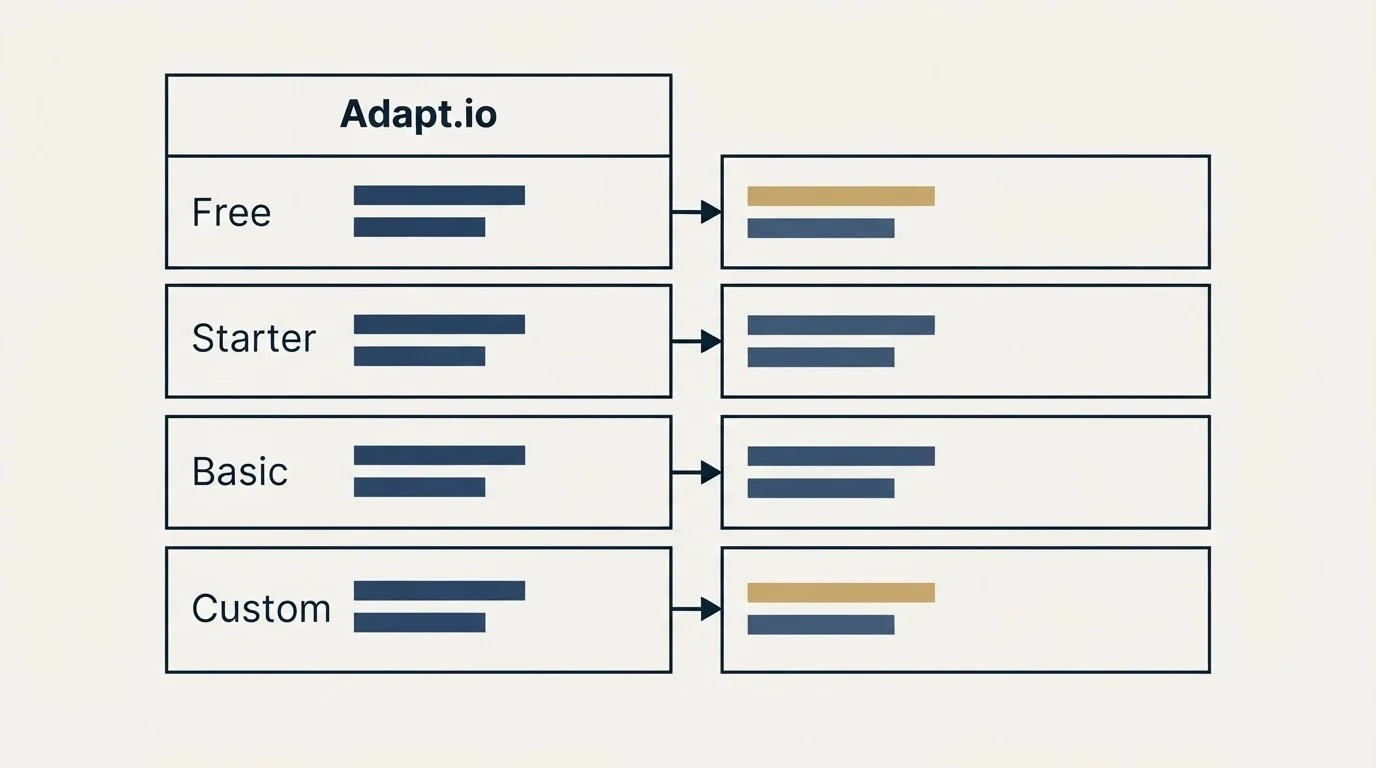
Four details decide what that ladder costs in practice.
Credits, never seats. The pricing FAQ puts it in one line: "Pricing based on number of contact credits and not number of user licenses". A team of five can share one account, so headcount does not move the bill. Volume does.
A daily cap sits under every monthly allowance. Each plan limits contacts per day, at 25 on Free, 50 on Starter and 100 on Basic, and Custom has no daily limit. A Starter account cannot pull its 500 credits in one afternoon: at 50 a day it takes at least ten days.
The yearly toggle pays the year's credits up front. Switched to Yearly, the page displays Starter at $490 a year with 6,000 email credits and Basic at $990 a year with 12,000, which is twelve months of the monthly allowance at once. The toggle is labelled "Save 20%", while $490 against twelve monthly payments of $49, or $588, is a saving of 16.7%. Basic works out the same.
Phone numbers start at Basic. Free and Starter carry no phone credits, so a team that dials is buying the $99 plan for 100 phone credits a month. Basic also adds CRM export and a limit on contacts per company, and the Custom plan adds a suppression list, job change alerts and API access. There is a 7-day free trial with no credit card required, and the FAQ says a trial account can take up to 50 contacts while every filter is open to test.
| Plan | Credits and daily cap | What it adds |
|---|---|---|
| Free $0 | 25 email and 25 enrichment credits, 25 contacts a day | Chrome extension, advanced filters, list building |
| Starter $49 a month or $490 a year | 500 email and 500 enrichment credits, 50 a day | CSV export, saved search, ABM list building |
| Basic $99 a month or $990 a year | 1,000 email, 1,000 enrichment and 100 phone credits, 100 a day | Phone numbers, CRM export, a limit on contacts per company |
| Custom Talk to sales | Custom credits, no daily limit | Suppression list, job change alerts, API access |
What 11x costs: three entry prices on one page
11x does publish a price, and its pricing page states it three ways. The Growth plan card reads "Starting at $3,750 / mo" and "Billed annually". The FAQ answers "How much does 11x cost?" with "11x starts at $36,000 per year on the Growth plan". The page's own meta description, the text served to search engines and never shown on the page, says "Plans from $2,000/mo." Pro and Enterprise are custom.
Those figures do not describe one contract. Twelve months at $3,750 is $45,000, which is $9,000 more than the FAQ's $36,000, and twelve months at $2,000 would be $24,000. The card and the FAQ are the two a buyer actually reads, so the figure to establish in writing is the one the order form carries. The 11x pricing breakdown covers the renewal terms and the diligence questions in more depth.
The Growth card lists up to 5 end users, 2,000 new prospects per month, 11x managed Gmail mailboxes with domain setup, warmup, inbox rotation and monitoring, bi-directional CRM sync, and onboarding and support. Pro raises that to up to 10 end users and 5,000 new prospects per month and adds multi-language outreach, listed as 105+ languages. Enterprise lists unlimited end users, 10,000+ prospects per month, custom integrations and an API, SSO, a custom DPA and a custom SLA. The billing unit is stated plainly: "We charge per lead, not per send." Whether Alice runs three touchpoints or thirty, the page says, the price stays the same.
Why the two prices sit so far apart
An Adapt.io credit reveals a contact. Everything after that, the research, the message, the mailbox it goes out from, the reply and the meeting, is your own team's work in your own other tools. The 11x FAQ lists what its plan price covers instead: "Every plan bundles contact data, email deliverability, warmup, inbox rotation, meeting scheduling, CRM sync, and onboarding. You only need to bring your own CRM license."
The arithmetic below is illustrative. It divides published list prices by published allowances, compares units rather than value, and describes no real deployment. At the FAQ's $36,000 a year for 2,000 new prospects a month, or 24,000 a year, 11x costs $1.50 per new prospect. At the card's $45,000 it is $1.88. Adapt.io Basic billed yearly is $990 for 12,000 email credits, about 8 cents per email address found. The distance between 8 cents and $1.50 is the price of the work that happens after the address, and of the mailboxes it is sent from.
Capacity is the other half. Adapt.io's largest published plan finds 1,000 email addresses a month, half the 2,000 new prospects 11x's Growth plan works each month. A team matching Growth's volume with Adapt.io data alone lands on the Custom plan, whose price is not published.
What is 11x, and what do Alice and Julian do?
11x describes two AI digital workers. Alice handles outbound, and the platform menu on its pricing page lists what she runs on: a real-time company and lead database, live web search and AI prospecting, deep research, AI personalization, multi-channel sequences, a sequence builder, smart replies, multi-lingual outreach, consented outbound calling, and signals and triggers. The plan table adds managed mailboxes with warmup and rotation, meeting scheduling and CRM sync. Julian handles inbound. Its page says it engages across phone, chat, SMS and WhatsApp, and that for form fills and inbound requests it calls back within 60 seconds.
Mapped onto the six stages of one outbound run, the difference is scope. Adapt.io covers finding the people and verifying and enriching the record, then hands the list on by CSV or CRM export. 11x's pages list something at every stage: the database to find people, enrichment and research, writing, sending from managed mailboxes, smart replies, and meeting scheduling with CRM sync.
That database line is the practical point. Alice arrives with its own contact data, so a team buying 11x is not also buying Adapt.io to feed it. The two belong in one stack only when human reps prospect alongside the AI worker, or when reps who dial want Adapt.io's phone numbers.
A per-lead price that stays flat whatever the number of touchpoints also makes extra touches feel free. RevenueFlow runs the opposite practice, one message per campaign with no bump sequences and no thread replies, because every later message reaches only people who already chose not to answer, and its reputation cost lands on the sending domain. The AI SDR category guide sets out what this class of product replaces and what it leaves to you.
What features does Adapt.io provide for sales prospecting and data enrichment?
Adapt.io provides a B2B contact database that its Our Data page puts at 250M+ contacts and 12M+ company profiles, a Chrome extension that finds verified contact data on LinkedIn or a company website, advanced search filters and list building, and enrichment of CSV files, CRM records and API calls with 50+ data attributes. Phone numbers, CRM export, job change alerts and API access sit on the higher plans.
On the prospecting side, the pricing page describes the filters as job title, department, level, employee count, revenue and location. The homepage counts over 3,000 specialized tech sectors to target, and the prospecting page adds funding insights on recently funded companies. ABM list building, from Starter, searches for contacts across many companies at once by uploading a list of company websites. Job change alerts appear on the prospecting page, and the pricing page places them on the Custom plan.
On the enrichment side, the enrichment page names three routes: CSV Enrichment, CRM Enrichment and API Enrichment. The Our Data page also lists 16M+ decision makers and 5M+ records refreshed daily, and describes real-time verification of contacts as the guard against hard bounces. Those are the vendor's own figures, and coverage in any one market is worth testing on accounts you already know rather than taking on trust.
Readers weighing Adapt.io against other data vendors rather than against an AI worker will find a fuller Adapt.io review and its alternatives on a separate page, and the credit arithmetic for a five-person team is worked through in Adapt.io against the Close CRM.
Integrations: where the two meet
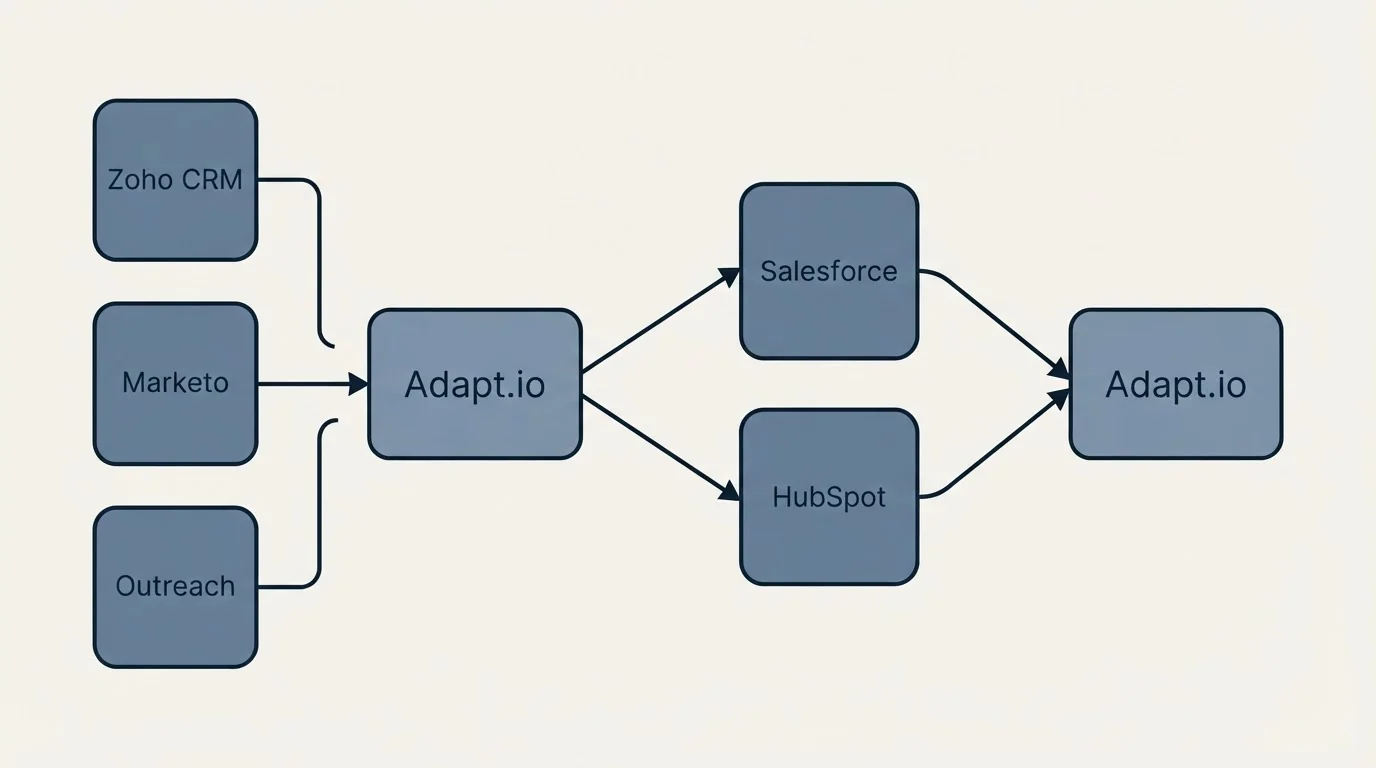
11x's CRM integration page lists "Native Salesforce, HubSpot, Pipedrive, and Zoho connectors" with bi-directional sync, and an API for other CRMs. Its menu also lists Slack and G2 integrations. Adapt.io's pricing page lists CRM export to Salesforce, Hubspot, Pipedrive, Zoho, Outreach and Salesgear, from the Basic plan. The four CRMs appear on both lists, so where a company runs both tools, the CRM is where their records meet.
That meeting point is where a combined stack quietly goes wrong. Two data sources writing to one record will overwrite each other's job titles and company names unless one of them is named the owner of each field before the first sync. 11x's CRM page also says Julian creates the CRM record and populates it automatically when an unknown prospect calls in, so the dedupe rule has to exist before either tool is switched on, or one person becomes two records.
Which one does your team need?
Adapt.io fits a team whose own reps write and send. It is the cheaper tool by a wide margin because it does less: it finds and enriches contacts and leaves the outreach to you. Start on Free to test coverage, move to Starter at $49 a month for CSV export and 500 credits, and pay for Basic at $99 only if the reps dial, because phone credits start there.
11x fits a team buying the outbound work itself. Its plans bundle the data, the mailboxes and the booking, priced per new prospect. Annual is the default, and the FAQ says Pro and Enterprise support two- and three-year commitments with discount tiers. The largest thing to settle before signing is who owns the sending domains and mailboxes, and what happens to their reputation when the contract ends.
Neither fits a team with a few hundred named target accounts. A list that small is a research problem, and buying tooling for it changes nothing. The work there is the offer.
Getting started with either
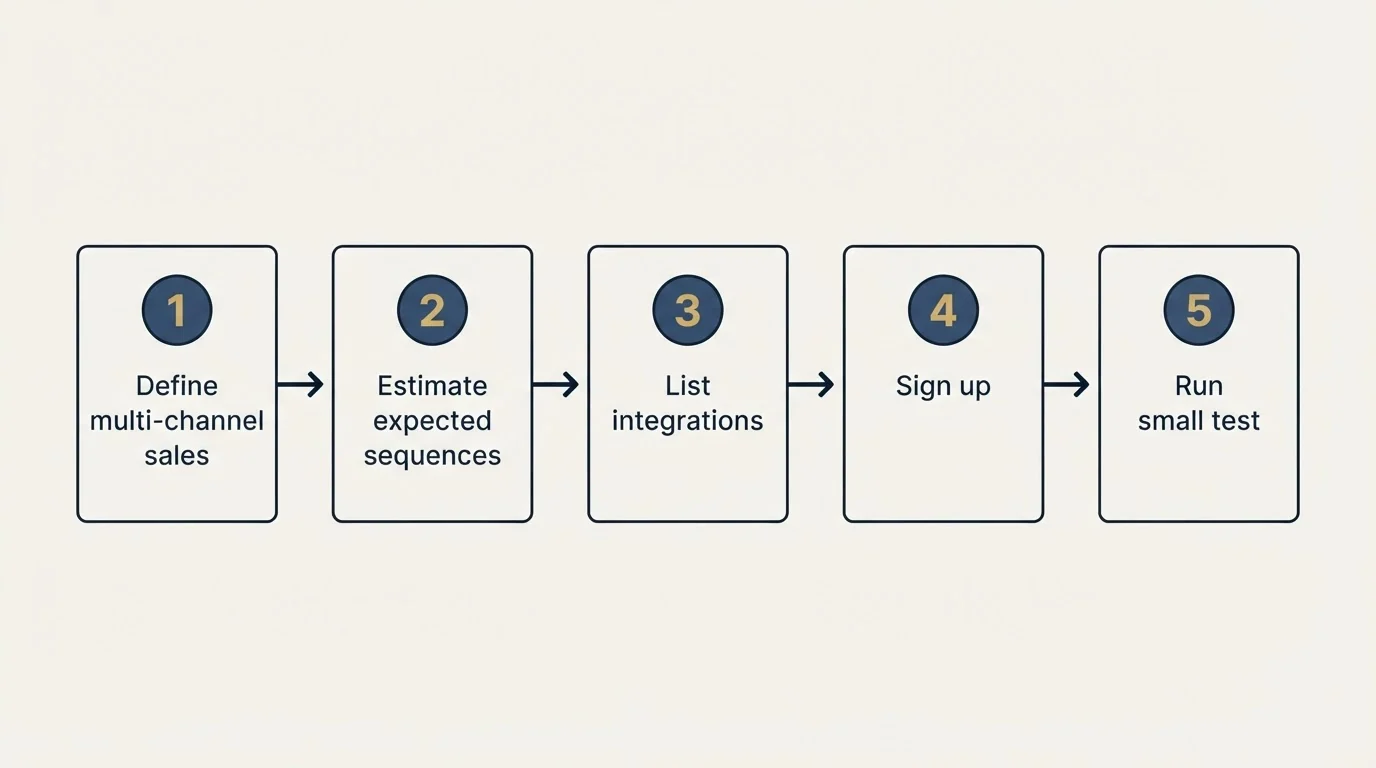
For Adapt.io, the 7-day free trial is the right test, and the right sample is fifty accounts you already know. Pull them through the trial, score the result on the fields your campaigns actually use, and compare that coverage with what the database headline suggests. Coverage varies by country, company size and job function far more than any total can show.
For 11x there is no self-serve trial on the pricing page; every plan card leads to a sales call. The FAQ says onboarding is included in every tier with no implementation fee, configuration charge or per-integration cost, and that price increases at renewal are capped. Ask what they are capped at, in a number, and which of the page's three entry prices the order form will carry.
If what you want is booked meetings rather than a data tool or an AI worker to run, RevenueFlow runs outbound as a service against meeting criteria agreed in writing before launch. See what a campaign would look like for your market.
Pricing and features are taken from the vendors' own pages. Verify current terms with the vendor before relying on them.
Sources: 11x Alice pricing, 11x CRM integration, 11x Julian, Adapt.io pricing, Adapt.io data, Adapt.io enrichment
Frequently asked questions.
Frequently asked questions- How much does Adapt.io cost?
- Adapt.io's pricing page lists four plans. Free is $0 with 25 email credits. Starter is $49 a month with 500 email and 500 enrichment credits. Basic is $99 a month with 1,000 email, 1,000 enrichment and 100 phone credits. Custom is quoted by sales. Billed yearly, Starter is $490 and Basic $990, and pricing is by contact credits rather than user licenses.
- How much does 11x cost?
- 11x's pricing page shows the Growth plan starting at $3,750 a month, billed annually, while its FAQ says 11x starts at $36,000 per year on the Growth plan. Twelve months at $3,750 is $45,000, so the two figures disagree. Pro and Enterprise are custom. Confirm which figure the order form carries before signing.
- What features does Adapt.io provide for sales prospecting and data enrichment?
- Adapt.io provides a contact database its Our Data page puts at 250M+ contacts and 12M+ company profiles, a Chrome extension for LinkedIn and company websites, advanced filters, list building and ABM list building. Enrichment runs on CSV files, CRM records and an API with 50+ data attributes. Phone numbers and CRM export start at Basic, and job change alerts and API access sit on Custom.
- Do I need Adapt.io if I buy 11x?
- Usually not. The 11x FAQ says every plan bundles contact data, email deliverability, warmup, inbox rotation, meeting scheduling, CRM sync and onboarding, so Alice arrives with its own data. Adapt.io earns a place beside it only where human reps prospect alongside the AI worker, or where reps who dial want Adapt.io's phone numbers, which start on its $99 Basic plan.
About the author.

Tim Carden is CMO / CTO at RevenueFlow, which builds and operates outbound revenue engines for B2B companies. Studied at McGill University.
Tim Carden · CMO / CTO
Connect on LinkedIn →Explore more.
Ready to scale your outreach?
We build GTM engines that book real meetings. See the receipts.
Related articles.
11x vs Scrupp: Sales Engagement Platform vs Data Enrichment Tool Comparison
Scrupp exports and enriches LinkedIn, Sales Navigator and Apollo leads from $29 a month; 11x's Alice starts at $3,750 a month. What each one buys.
AroundDeal vs Leadspicker: Data Enrichment Tool vs Sales Engagement Platform Comparison
Compare AroundDeal (data enrichment tool) and Leadspicker (sales engagement platform) side by side. See pricing, features, and integrations to decide which one, or both, your stack needs.
Gong vs NeverBounce: Sales Engagement Platform vs Data Enrichment Tool Comparison
Gong vs NeverBounce: what Gong's own pages say about enrichment, what NeverBounce's API returns about an address, and how each vendor prices.
ContactOut vs Luru: Data Enrichment Tool vs Sales Engagement Platform Comparison
Compare ContactOut (data enrichment tool) and Luru (sales engagement platform) side by side. See pricing, features, and integrations to decide which one, or both, your stack needs.
Enrich Layer vs La Growth Machine: Data Enrichment Tool vs Sales Engagement Platform Comparison
Compare Enrich Layer (data enrichment tool) and La Growth Machine (sales engagement platform) side by side. See pricing, features, and integrations to decide which one, or both, your stack needs.
Leadspicker vs NeverBounce: Sales Engagement Platform vs Data Enrichment Tool Comparison
Compare Leadspicker (sales engagement platform) and NeverBounce (data enrichment tool) side by side. See pricing, features, and integrations to decide which one, or both, your stack needs.