Outbound for Founders: Build It, Buy It, or Sell It Yourself
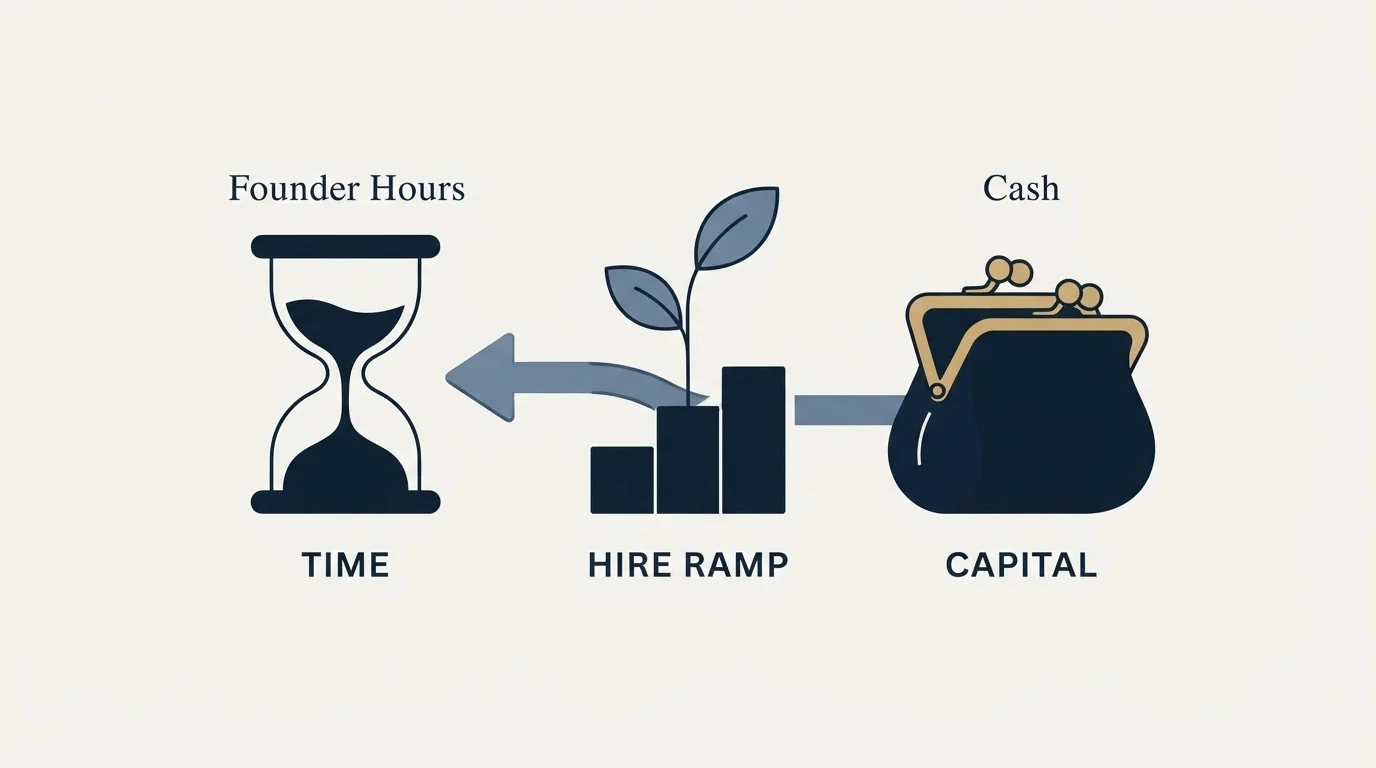
The founder outbound decision is rarely about the channel. It is about which scarce thing you spend: your own hours, a hire's ramp, or cash.
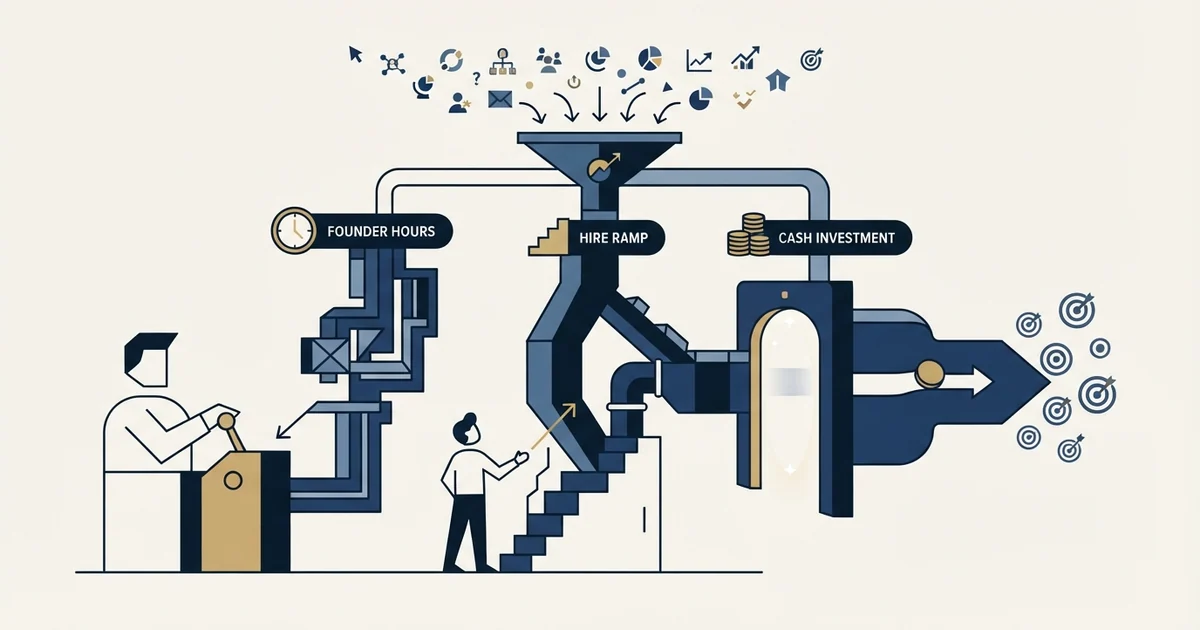
Outbound built around what the buyer needs to sign off on starts from the approval: who at the target company says yes, what makes it urgent for them, and what makes them say no. Founders write that down first, then choose between spending their own hours, a first hire's ramp and risk, or cash paid to a provider.
Key takeaways
- Outbound built around what the buyer needs to sign off on is written backwards from the approval: the approving role, the situation that makes it urgent, and what makes them say no.
- Outbound is the wrong next spend when deals still die on the pitch or when nobody has written down who the company refuses to sell to, because more conversations then produce more losses faster.
- The founder outbound decision is a resource choice, and the dominant term is usually founder hours or the chance a first hire does not work out, neither of which appears on a pricing page.
- RevenueFlow's documented policy is one message per campaign with no bumps or thread replies, client copy sign-off before sending, and qualification criteria agreed in writing before launch.
Reviewed and updated September 21, 2026
A founder who is still closing every deal usually hits a calendar problem long before a pipeline problem. The conversations convert, and the constraint has quietly moved from whether anyone wants this to how many hours exist in a week. Outbound is the obvious thing to reach for at that point, and the easiest to underestimate: the visible part is writing emails, and the expensive part is everything else, from the list to outbound built around what the buyer needs to sign off on.
This page is for the founder or CEO who personally runs the selling and is deciding what to do about the top of the funnel. It covers what the decision looks like from that seat, how to write down the sign-off your deals already depend on, the arithmetic underneath build, buy or wait, what a done-for-you outbound motion involves, and what to ask any provider before signing anything.
The seat you are actually sitting in
Founder selling has a property nothing that follows it can reproduce. In a live conversation the founder can change the scope, the price, the roadmap and the terms, and the buyer reads that as competence rather than as improvisation. That advantage is the reason early deals close, and it is also the reason the phase is hard to leave. The general anatomy of the period, including what has to be written down before any of it transfers to someone else, is covered in founder-led sales.
What that means for outbound specifically is narrower. Three things tend to be true at once at this stage, and each one changes the answer.
The audience is a hypothesis, not a definition. Most founders can name the last five customers and cannot name the shape of the next fifty without arguing with themselves. That is normal, and it makes the first outbound list an experiment as much as a list. Running lead generation while the ideal customer profile is still being worked out is a real discipline with its own rules, and the biggest one is that volume is the wrong first dial.
The message has never been written down. Founders reconstruct the pitch live, tuned to whoever is in front of them. Cold outbound cannot do that. It has to commit to one premise in writing and find out whether that premise survives contact with strangers, which is a genuinely useful thing to learn and a slightly uncomfortable one.
Every hour spent on the top of the funnel is an hour not spent closing. This is the part that decides the question. A founder who takes on sourcing, list building, deliverability and sending is not adding a channel, they are moving their own time from the highest-value thing they do to the most delegable thing in the company.
The tree asks three questions in the order that settles most cases. If deals still die on the pitch, more conversations produce more losses faster, so the pitch is the next job. If nothing has been written about who you refuse, any outbound motion, in-house or bought, will spend its first month generating meetings you did not want, so the refusals get written first. Only then does the calendar decide it. If the week still has hours to spare, the constraint is somewhere other than the top of the funnel, and outbound can wait.
A common objection is that founder sourcing is already strong and the constraint sits on the inbound side instead, which is a legitimate reading and is exactly what the tree above is for: where conversations already convert and the week runs out of hours before it runs out of interest, the constraint has moved to the top of the funnel whatever the current motion is called.
Outbound built around what the buyer needs to sign off on
Outbound built around what the buyer needs to sign off on is written backwards from the approval. Before a list is pulled, the founder writes down who at the target company has to say yes, the situation that makes the purchase urgent for that person, and what would make them say no. The one message then carries that premise, and the list is filtered to companies where it holds.
A founder already owns this knowledge, in a form nobody else can use yet. Every deal closed so far ended with somebody approving something, and the founder watched what that person needed first: the scope, the price, the terms, sometimes a roadmap promise. In a live call all of that gets adjusted on the spot. A cold email cannot adjust anything, so what the approver needs has to be settled on paper before the first send.
That produces three short documents, and in a bought motion each one is also something the founder signs off on before launch.
- The buyer. The company shape, the role that approves, the situation that makes this urgent, and the disqualifiers. The list is built from it.
- The premise. The one reason a stranger in that role would take the meeting, written as the single message of the campaign. The founder approves the copy before anything sends.
- The finish line. What counts as a qualified meeting, agreed in writing before launch rather than argued about after a meeting lands.
| Document | What goes in it | Signed off |
|---|---|---|
| The buyer | Company shape, the role that approves, the situation that makes this urgent, the disqualifiers | By the founder, before the list is built |
| The premise | The one reason a stranger in that role would take the meeting, as the campaign's single message | By the founder, as copy approval before anything sends |
| The finish line | What counts as a qualified meeting | In writing, before launch |
The two sign-offs mirror each other. The approver at the prospect is deciding whether a problem is worth their time; the founder is deciding whether the campaign describes that problem accurately enough to put the company's name on it. When the same three documents serve both, every reply can be read against a single premise.
Build, buy, or wait
The starting position this page assumes is no dedicated sales team at all, with the founder carrying the whole cycle, and that is a real seat rather than a transitional one: the choice below is being made without any internal capacity to redeploy, which removes one of the three options before the question is even asked.

There are three real options and a fourth that pretends to be one.
Keep it founder-led and add volume by hand. Cheapest in cash, most expensive in the only resource that is actually scarce. This works while the audience is still being discovered, because the founder reading raw replies is doing product research that nobody else can do.
Hire. A first sales development hire, or a generalist who does outbound alongside other work. This buys capacity and buys a training problem at the same time. The costs that get left out of the hiring plan are ramp, tenure and the failed hire, and they are the ones that change the answer, which is the subject of the hire more reps arithmetic.
Buy the motion. An agency, a fractional resource or an outcome-based provider runs the sourcing, sending and infrastructure and hands you conversations. The models differ more than the category name suggests, and SDR outsourcing separates the four that get sold under one phrase.
The go-to-market consulting deliverable explains why the document itself, not just the analysis behind it, is what should be interrogated before signing.
The fourth option, buying software and assuming it constitutes a motion, is the one that fails quietly. Tools execute a decision. They do not make the targeting decision, and a bad list executed faster is worse than no list at all.
Here is the arithmetic, and every number in the next two paragraphs is invented for the worked example. These are not benchmarks and they are not RevenueFlow results. Substitute your own before deciding anything.
Suppose a founder values their own time at 200 units an hour and outbound consumes 10 hours a week. Over a four-week month that is 8,000 units of founder time before a single tool is paid for, and the hours come out of selling. Suppose instead a first hire costs 4,000 units a month fully loaded, ramps for three months at partial output, and has a one in three chance of not working out. The honest cost of the hire is 4,000 a month plus three months of partial output plus a one in three chance of paying for the whole exercise twice. Suppose a bought motion costs 5,000 units a month and produces conversations from month one. On invented figures like these, the buy option looks worse per month and better per conversation in the first two quarters, and the in-house option overtakes it only if the hire works and stays.
The point of running it is to see which term dominates. In almost every version of this arithmetic the dominant term is the founder's own hours or the failed-hire probability, and neither of those appears on a pricing page. The comparison method in outsourced SDR versus in-house is the same exercise with the cost lines set out properly.
Founders frequently want to reconsider outbound after the product launch rather than before it, and the arithmetic above is what decides whether that is prudent or expensive: a bought motion produces conversations from month one while a hire does not, so the launch date matters less than how many quarters of runway the decision has.
What a done-for-you motion actually is
Worth being concrete, because the phrase covers wildly different things. Here is how our own motion is structured, stated as policy rather than as a performance claim.
One message per campaign. Every campaign carries a single message with one premise, sent once. There are no bumps and no thread replies. A later approach to the same person exists as a separate campaign with its own reason to exist, which keeps the read clean: a response belongs to one premise and one audience rather than to an accumulation of attempts. For a founder testing whether a positioning hypothesis works on strangers, that is the difference between a signal and a fog.
Copy sign-off before anything sends. The client approves the message. That is the gate, and it exists because the message is the part a founder has the strongest opinion about and the part where being wrong is most expensive.
Qualification agreed in writing before launch. What counts as a qualified meeting is defined before the first send, not argued about after a meeting shows up. Budget, timing and authority are not billing conditions, which matters because a definition that quietly excludes work is how two quotes stop being comparable. The pricing units that sit on top of this are separated in outsourced SDR pricing.
Email and LinkedIn, not phone. That is the channel set. A founder expecting cold calling should know that up front rather than discover it in month two.
Separate sending infrastructure. Campaigns go out from sending domains and mailboxes kept apart from the company's main domain, so a bad campaign never touches the address the business runs on.
What to ask any provider, including us
These questions are provider-neutral. They are the ones that reveal what is actually being sold, and a good answer to all of them from a competitor is a better outcome than a bad answer from anyone.
Who writes the list, and can you see the criteria? A provider who will not show you the targeting logic is selling volume. Ask what disqualifies a company, not just what qualifies one.
What exactly counts as a delivered outcome? A booked meeting, an attended meeting, and a qualified attended meeting are three different products at three different prices. Get the definition in writing before the number matters.
Whose domains are the sends going out on? If a provider sends from your primary domain, a bad campaign damages an asset you cannot replace. If they send from shared infrastructure, ask how many other senders share it.
What happens to the replies? Somebody has to read, sort and answer them within the hour. A motion that produces replies nobody owns produces nothing.
What is the exit? Contract length, notice period, and who keeps the list, the domains and the copy when the engagement ends. This is the question most often skipped and the one that determines what you are left with.
When is your own service the wrong answer? Any provider worth hiring can name the cases. Ours: a market of a few hundred named accounts where relationship depth beats volume, a product that genuinely needs the founder in the first conversation, a regulated or consent-only channel, or a company that wants an in-house bench to promote from later. That last one is a legitimate reason to accept a worse cost per conversation, and it never appears in an agency pitch.
The short version

The founder outbound decision is rarely about the channel. It is about which scarce thing you are willing to spend: your hours, a hire's ramp, or cash. Run the arithmetic with your own numbers and watch which term dominates, because it will usually be your own time or the probability that a first hire does not work out, and neither is printed on anyone's pricing page.
Write down the buyer, the message and the refusals first, whichever route you take. An in-house hire without those spends their ramp discovering what you already know. A provider without those books meetings you did not want. The documents are the actual prerequisite, and they take an afternoon.
If the constraint is your calendar rather than your message, we run outbound end to end and are paid on attended meetings that meet criteria agreed in writing before launch. You can see what a campaign would look like for your market.
Frequently asked questions.
Frequently asked questions- What does outbound built around what the buyer needs to sign off on mean?
- It means writing the campaign backwards from the approval. Before a list is pulled, write down who at the target company has to say yes, the situation that makes the purchase urgent for them, and what would make them say no. The single message carries that premise, the list is filtered to companies where it holds, and a qualified meeting is defined in writing before launch.
- How do I know if it is too early for outbound?
- Two signals say wait. If deals are still lost on the pitch rather than on volume, more conversations produce more losses. If nobody has written down which companies you refuse to sell to, any motion you start will spend its first month booking meetings you did not want. Once both are settled, the test is whether your week runs out of hours before it runs out of interest.
- Should I do outbound myself or hire someone?
- Run the comparison with your own hours priced in. Doing it yourself is cheapest in cash and most expensive in the scarcest resource you have, and it is useful while the audience is still a hypothesis, because reading raw replies is product research. A first hire adds ramp and the chance it does not work out. Hand it over once the buyer, the message and the refusals are written down.
- What should I ask an outbound provider before signing?
- Ask who writes the list and what disqualifies a company, exactly what counts as a delivered outcome, whose sending domains the campaign runs on, who reads and answers replies and how fast, and the exit terms covering the list, domains and copy. Then ask when their own service is the wrong answer. A provider worth hiring can name the cases.
About the author.

B2B cold email experts helping companies generate qualified leads through done-for-you outreach campaigns.
RevenueFlow Team
Explore more.
Ready to scale your outreach?
We build GTM engines that book real meetings. See the receipts.
Related articles.
Sales Enablement Charters: What the Published Ones Ask For
Six publishers set out what a sales enablement charter should contain. Five describe a document nobody can check, and one writes a definition with inspection in it.
Sales Cycle Length Benchmarks: What Each Figure Counts
The published B2B sales cycle benchmarks, sorted by what each page says it counted. The same number means two different things in two of them.
Appointment Setting for Business Brokers: The Seller Meeting
What a bought meeting with a business owner has to be for a brokerage: the three-part qualification, the confidentiality rules, the licence line and the owner's reasons.
SDR Outsourcing for Logistics Companies: The Brokerage Line
What an outside sales development team may do in a freight company's name, the calling and email rules it inherits, and which arrangement survives a bid-shaped market.
SDR Outsourcing for Business Brokers: The Fee Timing
Whether a success-fee brokerage should rent sales development at all: the fee timing, the texts that limit what an outside person may say about value, and who signs.
Sales Kickoff Agendas: Five Published, Session by Session
Five publishers print a sales kickoff agenda. They agree on four blocks and disagree on session length, rehearsal and where the agenda comes from.