Outbound for SDR Managers: Finding the Constraint
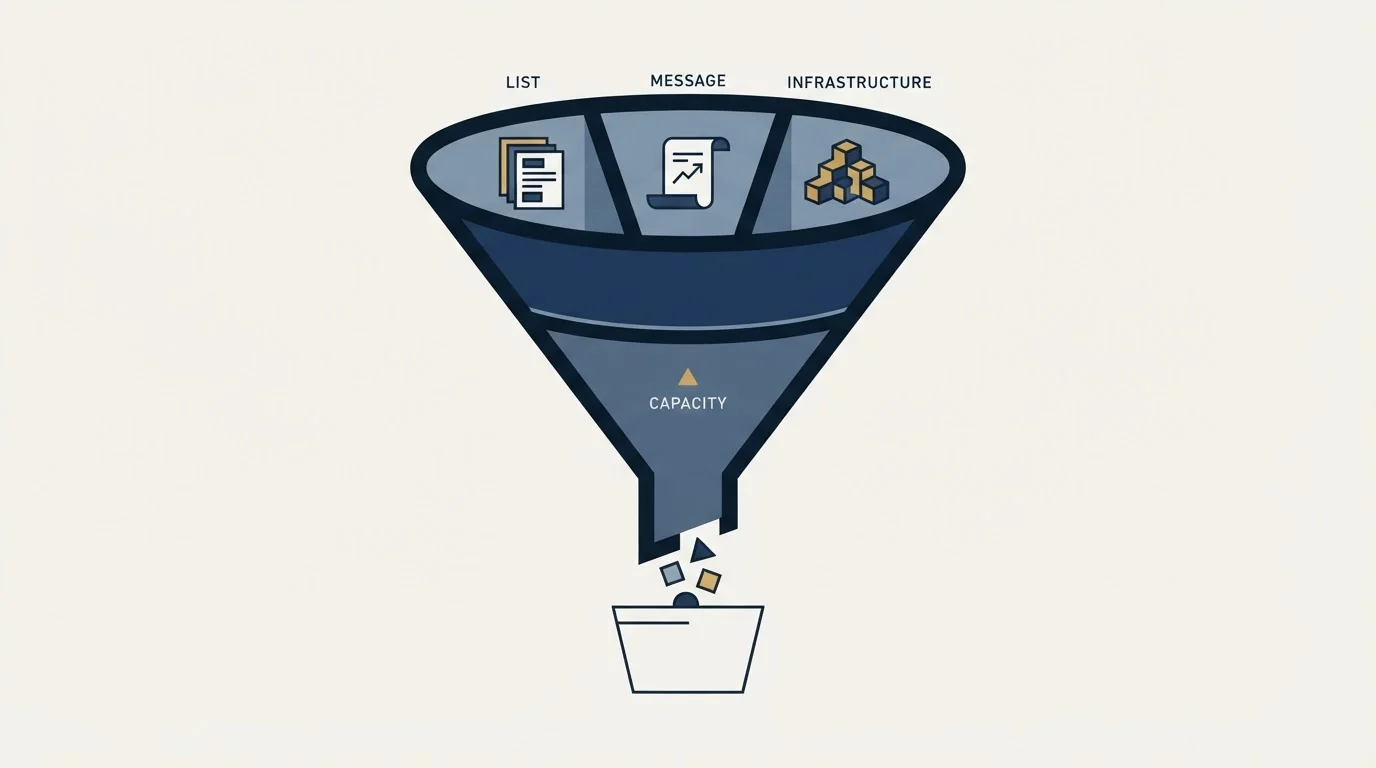
A short month is usually the list, the message or the infrastructure. Capacity is the least common cause and the only one more people actually fix.

Four things cause a short outbound month: the list, the message, the sending infrastructure, and genuine capacity. Only the last is fixed by adding people or a provider, and it is the least common. Diagnose first, then decide by coaching hours rather than by span of control on an org chart.
Key takeaways
- Activity is the only input a rep can raise alone, which means it is usually the input that has already been raised. Checking contact coverage and segment-level reply rates comes before any capacity request.
- Deliverability decline shows up as a slow fall in replies rather than an error, so reps experience an infrastructure problem as a bad month and frequently blame themselves for it.
- Coaching capacity, not org-chart span of control, is the number that should decide a headcount request. A hire who does not fit inside the coaching week is paid for by the reps already on the team.
- Buying the top of the funnel changes what a manager coaches rather than removing the coaching. Routing, no-show follow-up and segment feedback stay on the manager's desk.
Reviewed and updated September 1, 2026
An SDR manager is the only person in the building who sees the whole machine running. The list, the message, the sending infrastructure, the replies, the coaching and the handoff to sellers all pass through one desk, and the manager is usually the first to know which of those six is currently the constraint. That visibility is the job's real asset, and it is why proposals to add capacity should be tested against the manager's read before anyone signs anything.
This page is for the manager running an outbound team day to day and facing a capacity question: more reps, more tooling, an outside provider, or a rebuild of the inputs the current team is working with. It covers how to tell which one you actually need, what an external motion does to your week, and what to ask a provider before your team has to live with them.
Find the constraint before adding anything
The instinctive response to a short month is more activity. It is almost always the wrong first move, because activity is the only input a rep can increase alone, which means it is usually the one that has already been increased.
Four constraints produce a short month, and they need opposite responses.
The list. Contact coverage collapsed, a data source changed quietly, or the segment was wrong from the start. This is the highest-leverage thing the role owns, and the one input a rep cannot fix from inside the job. It is worth checking first every time, and the case for it is set out in what an SDR manager owns that the rep does not.
The message. One premise stopped working, or was never tested cleanly enough to know. If the same message has been running for several months against the same segment, a flat month is information rather than a performance problem.
Because a cold message must earn its own attention and timing, what outbound prospecting actually requires explains why a dated reason for contact matters more than polish.
The infrastructure. Deliverability degraded, and nobody noticed because the symptom is a slow decline in replies rather than an error message. Reps experience this as a bad month and blame themselves.
Genuine capacity. The accounts exist, the message works, the infrastructure is healthy, and there are not enough hours to work the list. This is the only one of the four that more capacity fixes, and it is the least common.
- Yes: Contact coverage on the current list is what it was three months ago
- Yes: Reply rate by segment is stable, not just the team total
- Yes: Bounce and spam signals are where they were before the decline
- Yes: The qualification standard has been applied consistently under pressure
- No: The same message has been running unchanged for several months
- No: Reps are routing around a data problem themselves rather than reporting it
- Depends: Whether the accounts worth contacting outnumber the hours available
If the honest answer is the last row, the capacity conversation is real. If it is any of the others, adding people or a provider adds cost to a problem they cannot solve, and it will look like the provider failed.
Managers often name this as not having enough sales bandwidth for lead generation, and it is worth testing against the four constraints above before it is treated as one, because a list, a message or an infrastructure problem all present as a team with no time.
The same four constraints explain most of what a rep experiences as a sales slump, and reading one from the seat rather than from this desk is covered in why a slump is arithmetic before it is confidence.
The four ways to add capacity, from this seat

A manager rarely writes the cheque, and the manager's read is what determines whether the money works. Four routes, and each one changes the week differently.
Hire another rep. Adds contact hours and adds coaching hours, which come out of the same week you already do not have enough of. The coaching load is the part that gets underestimated: a weekly recorded-call review plus a message review per rep is a real number of hours, and a manager who takes on an extra rep without giving something up drops the coaching first.
Automate part of the role. The five jobs inside an SDR role each have a mature tooling category behind them now, and which SDR tasks genuinely automate separates the ones that move from the ones that do not. Automation reduces the hours per account rather than adding hours, which is a different shape of relief and often the right one when the list is large and the accounts are similar.
A related version is that a small team limits how far outbound can scale, which is a real constraint and a different one: it is answered by moving hours out of the role rather than by adding people, since coaching capacity rather than headcount is what actually caps a team.
Add a shared or fractional resource. A part-time seat keeps the machinery around the person and gives up exclusive ownership of them. The conditions under which that trade works, and what you have to supply for it to work at all, are in fractional SDR.
Buy the output. A provider runs sourcing, infrastructure and sending and delivers meetings against a written standard. Your team keeps the conversations and gives up the top of the funnel. The four arrangements sold under one phrase are separated in SDR outsourcing, and the billing units that sit on top are in outsourced SDR pricing.
Every figure in the next paragraph is invented for the worked example. None of it is a benchmark and none of it is a RevenueFlow result.
Suppose the standard is one hour of coaching per rep per week, and the manager has 6 hours a week that are genuinely protected. Four reps fit. A fifth does not, and the arithmetic does not care how motivated anyone is. Suppose the fifth rep would add 20 meetings a quarter, and suppose the coaching that gets dropped to fit them in costs the other four reps 8 meetings each over the same period. On those invented figures the fifth hire is net negative by 12 meetings and looks positive on every individual scorecard, because the loss is distributed and the gain is attributed. That distribution is the reason coaching capacity, rather than span of control on an org chart, is the number that should decide a headcount request.
- Capacity arrives after a ramp you manage
- Coaching load rises immediately
- Long-term asset if they stay
- Competes with your existing reps for your hours
- Relief without a coaching obligation
- Executes a bad list faster if targeting is wrong
- Needs someone to own the tooling
- Leaves judgement work with the humans
- Top of funnel becomes somebody else's operation
- Your team keeps conversations and handoff
- Definition of qualified becomes the critical clause
- Provider risk replaces hiring and ramp risk
What an external motion does to your week
If the decision is to buy output, the manager's job changes shape rather than shrinking. Stated as policy rather than as a performance claim, here is how our own motion is structured and what it leaves on your desk.
Qualification agreed in writing before launch. What counts as a qualified meeting is written down before the first send. Budget, timing and authority are not billing conditions. For a manager this is the clause that matters most, because you are the person who will be asked to accept a borderline meeting at the end of a tight month, and a standard settled in advance is the only thing that survives that pressure. The two questions qualification actually asks, fit and timing, get bundled together constantly, and lead qualification separates them.
One message per campaign, sent once. Each campaign carries one premise. No bumps, no thread replies. A later approach is a separate campaign. The practical effect for a manager is that segment results are readable: a flat segment is visible in weeks and can be cut, rather than being defended for a quarter on the grounds that the follow-ups had not landed yet.
Copy approved before anything sends. The client signs off on the message.
Email and LinkedIn, not phone.
What stays with you: routing meetings to the right seller, no-show follow-up on your side of the handoff, feeding segment-level reply patterns back so the targeting improves, and coaching your team on the conversations that arrive. That last one is the reason a bought motion does not remove the coaching obligation. It changes what you coach, from opening conversations to running them.
What to ask a provider before your team has to live with them

Ask to see the targeting criteria, including the disqualifiers. You will spot a bad segment faster than anyone in the room. Ask to see the logic rather than a sample list.
What is the definition of the outcome, in writing, and what happens to a no-show? Booked, attended, and qualified-and-attended are three different products at three different prices.
Whose domains and mailboxes are the sends running on? Outbound must not run on the domain your team's real email runs on.
Who reads and answers the replies, and inside what response time? Reply handling is where most of the value sits and the first thing a thin provider hands back.
What does the handoff look like operationally? Calendar ownership, notice before a meeting lands, what context arrives with it, and what happens when a meeting is misqualified. Get the disagreement process agreed before the first disagreement.
When is your service the wrong answer? Ours: a market of a few hundred named accounts where relationship depth beats reach, a team that already has capacity and needs coaching rather than volume, regulated or consent-only channels, and a company that specifically wants a development bench to promote sellers from. That last one is a legitimate reason to accept a worse cost per meeting and it never appears in an agency pitch.
The short version
Diagnose before adding. A short month is usually the list, the message or the infrastructure, and only occasionally capacity. Adding people or a provider to any of the first three buys a more expensive version of the same problem and makes the new spend look like the failure.
If it is genuinely capacity, decide by coaching hours rather than by org chart. The cost of a hire who does not fit inside your coaching week is paid by the reps you already have, and it is invisible on every individual scorecard.
If you buy output, spend your attention on the qualification definition and the handoff. Those two decide whether the arrangement works, and both are settled before the first send or not at all.
If the constraint is genuinely capacity at the top of the funnel, we run outbound end to end and are paid on attended meetings that meet criteria agreed in writing before launch. You can see what a campaign would look like for your market.
Frequently asked questions.
Frequently asked questions- My team's numbers dropped this month. Where do I look first?
- Look at the inputs before the people. Check contact coverage on the current list against three months ago, reply rate by segment rather than the team total, and bounce and spam signals. Reps cannot fix any of those from inside the job, and coaching someone through a data problem wastes the quarter.
- Should I ask for another rep or for an outsourced provider?
- Decide by protected coaching hours. A weekly recorded-call review plus a message review per rep is a real number of hours, and a hire who does not fit inside that week costs the existing team output that no individual scorecard shows. A provider adds capacity without adding coaching load.
- What happens to my job if we outsource the top of the funnel?
- It changes shape rather than shrinking. Routing meetings to the right seller, no-show follow-up on your side, feeding segment-level reply patterns back so targeting improves, and coaching your team on the conversations that arrive all remain yours. The coaching subject moves from opening conversations to running them.
- What should I insist on before an outbound provider starts?
- The qualification definition in writing, agreed before the first send, and the operational handoff: calendar ownership, how much notice you get before a meeting lands, what context arrives with it, and how a misqualified meeting is resolved. Agree the disagreement process before the first disagreement.
About the author.

B2B cold email experts helping companies generate qualified leads through done-for-you outreach campaigns.
RevenueFlow Team
Explore more.
Ready to scale your outreach?
We build GTM engines that book real meetings. See the receipts.
Related articles.
Sales Prospecting: Most of the Job Happens Before You Send
Prospecting is selection, not sending. The five decisions inside the motion, the one most teams never make, and what changes when you buy it as a service.
Readymode Pricing: The Seat Is Dear for What Is Inside It
Readymode publishes $199 and $249 per licence per month, near the top of the dialer range. What the seat includes that others bill separately, and when that pays.
PhoneBurner Pricing: What the Seat Price Covers
PhoneBurner publishes all three seat prices in both billing states. The metered resource is contact imports, not minutes, and the spam layer is an add-on at every tier.
Koncert Dialers: Line Counts Published, Price Is Not
Koncert publishes the parallel line ceiling on every tier, which most of this category will not. It publishes no price. What its pages state, and what the quote decides.
Sales Motivation Quotes: Seven Lines, and Who Said Them
Ford's most quoted line first appeared months after he died, with no source. Seven sales-floor staples, checked against the earliest printed record.
The Agoge Sequence: What Sam Nelson Actually Built
A documented 15-touch, 27-day cadence built by Sam Nelson at Outreach. What the primary sources say, which part transfers, and where our own practice differs.