Best Email Sending Tools for Agencies (2026)
The five email sending tools worth comparing for Agencies in 2026, with prices read off each vendor's own pricing page and an honest read on fit.
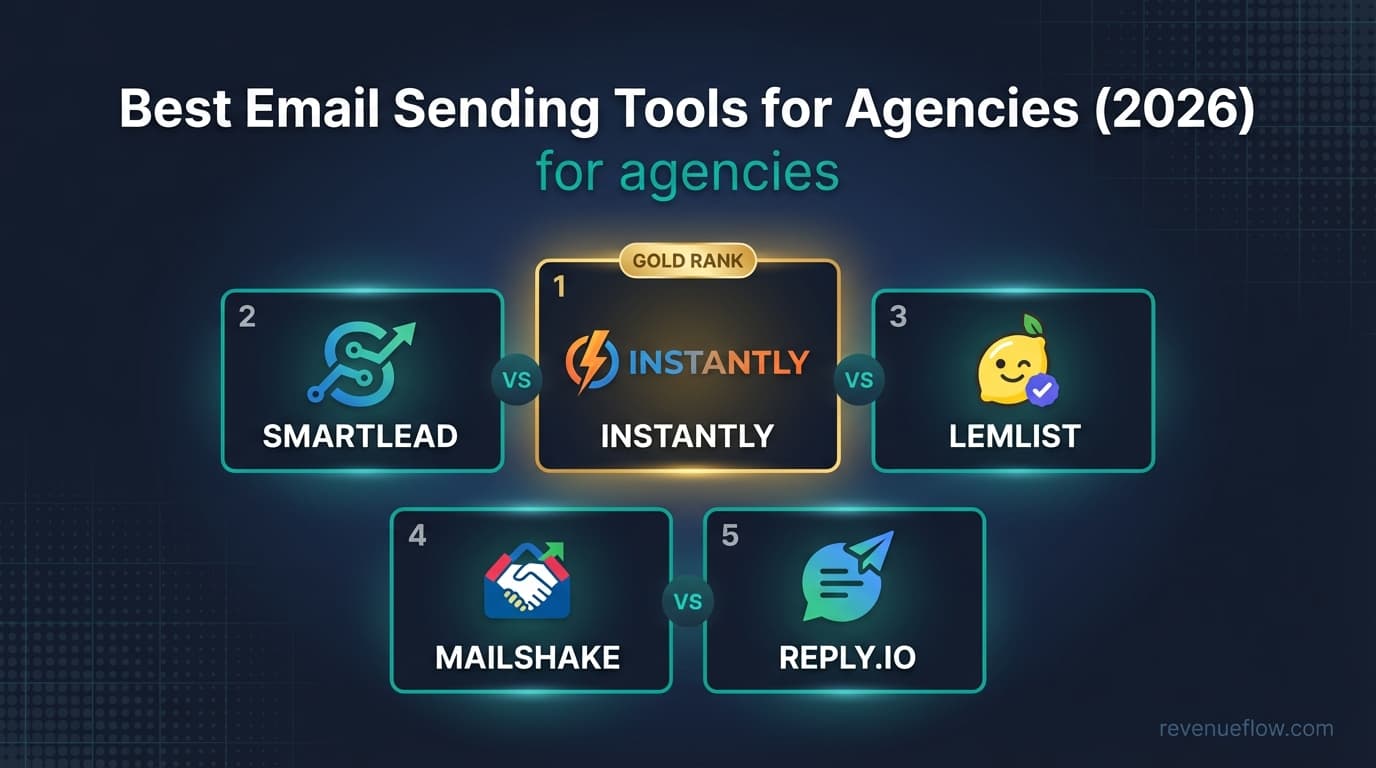
The best email sending tools for Agencies in 2026 are Mixmax, Lemlist, Snov.io, Saleshandy and Woodpecker. Mixmax and Snov.io publish free plans, Saleshandy starts at $34 a month billed annually, Lemlist at $55 yearly, and Woodpecker charges $7.00 per 100 contacted prospects. For agencies, the deciding factor is whether client reputations can be isolated cheaply.
Key takeaways
- An agency's margin on outbound is decided by what an additional inbox costs, because every client needs its own domains, inboxes and suppression list.
- Mixmax publishes a Free plan at $0/mo and Snov.io publishes a renewable free Trial plan, so two of the five tools can be started without a card.
- Saleshandy's pricing page starts at $34/mo billed annually and $41/mo paid monthly, and Lemlist's starts at $55/mo on yearly billing and $69/mo billed monthly.
- Woodpecker prices on people contacted rather than seats, publishing $7.00 per 100 Contacted prospects with warm-up, verification and unlimited email accounts included.
Reviewed and updated September 2, 2026
Best Email Sending Tools for Agencies (2026)
An agency running outbound for ten clients is running ten separate reputations on one operations team. The tool decision is therefore mostly a question of isolation: whether one client's aggressive campaign can damage another client's deliverability, and whether the answer to that is architecture or hope.

What Agencies Need From an Email Sending Tool
- Multi-client management
- White-label options
- Bulk operations
- Reporting per client
Isolation is the requirement everything else follows from. Each client needs its own sending domains, its own inboxes and its own suppression list, so the first number to look at is what an additional inbox costs. A per-inbox charge multiplied across a client roster is the difference between a healthy margin and an unprofitable service line.
Bulk operations matter for a reason agencies feel and rarely articulate: the work is repetitive across clients and the margin lives in the repetition. Judge a tool on how quickly a proven campaign structure can be cloned to a new client, since that is the operation an agency performs most often.
Per-client reporting is the commercial requirement. An agency has to show a client what happened without exposing other clients, and the honest metrics are replies and meetings rather than opens, which modern mail security inflates. A platform that leads its reporting with open rates will hand you a number you have to explain away later.
Sequencing platforms answer that requirement differently, and engagement tools judged on client isolation are the ones whose seat model has to survive a client roster.
How This Guide Was Put Together
Every price, plan name and database size on this page was read off the vendor's own pricing page, from a dated snapshot taken while the guide was written, and each figure is attributed to the page it came from rather than to the vendor in general. That distinction earns its keep: vendors contradict themselves across their own surfaces, and Lemlist does it inside a single page, as the note under its entry explains.
No lab test sits behind this. Nobody here ran a controlled send across five platforms, so the guide makes no claim about which tool lands in more inboxes. What it does judge is fit: what each pricing model rewards, what it punishes, and which shape of team the published plans were drawn for.
Top 5 Email Sending Tools for Agencies

- AI-powered email sequences
- Email tracking and analytics
- Meeting scheduling (1-click)
- and 7 more listed below
- 650M+ lead database
- AI personalization
- Email warmup and deliverability boost
- and 5 more listed below
- Email finder and verifier
- Unlimited email sending
- Drip campaign sequences
- and 7 more listed below
1. Mixmax
Sales engagement platform that lives inside Gmail, with AI-powered sequences, email tracking, meeting scheduling and conversation intelligence.
Starting price on the Mixmax pricing page: $0/mo, on the Free plan. Top per-user price on that page: $105/mo on monthly billing, above which Mixmax for Teams is quoted as Custom.
| Plan (Mixmax pricing page) | Monthly billing | Annual billing |
|---|---|---|
| Free | $0/mo | $0/mo |
| Inbox Copilot | $34/mo | $29/mo |
| Meeting Copilot | $34/mo | $29/mo |
| Engagement Copilot | $65/mo | $49/mo |
| Mixmax Suite | $105/mo | $89/mo |
| Mixmax for Teams | Custom | Custom |
Key Features:
- AI-powered email sequences
- Email tracking and analytics
- Meeting scheduling (1-click)
- Conversation intelligence
Integrations: Gmail, Google Workspace, Salesforce, HubSpot, Pipedrive, Slack, Zoom, Calendly (+1 more)
Mixmax is the weakest fit here, because a per-seat model priced for internal sales teams does not map onto an agency running many client identities, and warm-up is not part of the published plans. It remains useful for the agency's own new business rather than for client delivery.
2. Lemlist
Multichannel outreach platform built around a 650M+ lead database, with email and phone finding, LinkedIn automation, and built-in warm-up.
Starting price on the Lemlist pricing page: $55/mo on yearly billing, or $69/mo billed monthly. Top named price on that page: $87/mo per user on yearly billing, with Enterprise quoted as Custom.
| Plan (Lemlist pricing page) | Yearly billing | Monthly billing |
|---|---|---|
| $55/mo | $69/mo | |
| Multichannel | $87/mo | $109/mo |
| Enterprise | Custom | Custom |
Worth knowing before you budget: the Email plan card on that page advertises unlimited users, while the compare-plans table further down the same page prices Email from $55 per user per month. Those two statements sit on one page and do not agree, so confirm which applies before committing a team.
Key Features:
- 650M+ lead database
- AI personalization
- Email warmup and deliverability boost
- Unlimited email follow-ups
Integrations: HubSpot, Salesforce, Pipedrive, Close.io, Zoho CRM, Zapier, Make, n8n (+5 more)
Lemlist suits an agency delivering multichannel programmes, bundling a 650M+ database, LinkedIn, warm-up and a unified inbox so a client campaign needs fewer separate subscriptions. The published per-user Multichannel pricing is the constraint to model against a delivery team touching many client accounts.
3. Snov.io
Sales automation and lead generation platform with an email finder, an email verifier, campaign automation and a built-in CRM.
Starting price on the Snov.io pricing page: free, on the renewable Trial plan. Top named price on that page: $738/mo on Ultra.
| Plan (Snov.io pricing page) | Monthly price |
|---|---|
| Trial | Free |
| Starter | $39 |
| Pro S | $99 |
| Pro M | $189 |
| Pro L | $369 |
| Ultra | $738 |
Two details on that page shape the real bill. Annual subscriptions are marked Save 25%, so those figures are the top of the range, and LinkedIn automation is not bundled: the page prices LinkedIn account slots separately at $69/mo per slot.
Key Features:
- Email finder and verifier
- Unlimited email sending
- Drip campaign sequences
- Built-in sales CRM
Integrations: HubSpot, Pipedrive, Zapier, Make, Calendly, Phantombuster, Gmail, Outlook
Snov.io fits an agency that builds client lists as part of the service, since finding, verification and sending share one subscription and the tiers scale on credits and recipients. Managing many client accounts inside one subscription is the operational question to resolve during a trial.
4. Saleshandy
Cold email outreach platform with unlimited sending mailboxes, AI-powered sequences, built-in warm-up and a large B2B contact database.
Starting price on the Saleshandy pricing page: $34/mo billed annually, or $41/mo if paid monthly. Top named price on that page: $149/mo billed annually, or $189/mo paid monthly.
| Plan (Saleshandy pricing page) | Billed annually | Paid monthly | Active prospects | Users |
|---|---|---|---|---|
| Starter | $34/mo, $408/year | $41/mo | 2,000 | 1 User |
| Pro | $76/mo, $912/year | $99/mo | 30,000 | 10 Users |
| Scale | $149/mo, $1,788/year | $189/mo | Unlimited | Unlimited |
Seats are the limit that catches people out. The same page states that Starter is a single seat, Pro covers a team of ten and Scale has no seat limit, while sending mailboxes are unlimited on all three with no per-inbox fees. Every plan carries a 7-day free trial, and the page sizes the bundled data at 852M+ contacts and 42M+ companies.
Key Features:
- Unlimited email accounts, with no per-inbox fees
- Unlimited Email Warm-up
- AI-powered email sequences
- Multichannel sequences across email, calls, LinkedIn and WhatsApp
Integrations: HubSpot, Salesforce, Pipedrive, Zoho CRM, Zapier, Make, n8n, Slack (+2 more)
Saleshandy is the strongest structural fit for the agency model, because unlimited sending mailboxes are published on every tier, so adding a client's domains and inboxes does not add to the bill. Warm-up is included, which removes a per-client subscription that agencies commonly carry separately.
5. Woodpecker
Cold email automation platform priced on the number of people you contact rather than on seats, with warm-up, inbox rotation and email verification included.
Starting rate on the Woodpecker pricing page: $7.00 per 100 Contacted prospects. How the top is published: that page runs a slider rather than named tiers, so there is no ceiling price to quote.
| Woodpecker pricing page | Published figure |
|---|---|
| Contacted prospects, entry rate | $7.00 per 100 Contacted prospects |
| Annual billing | SAVE 33% |
| LinkedIn outreach add-on | $29 /monthly per LinkedIn account connected |
| Extra Lead Finder credits | Starts at 500 credits for $10 |
That page also lists free email verification, free warm-up, inbox rotation, adaptive sending, unlimited team members and unlimited email accounts as included rather than as add-ons. That is what changes the comparison: costs other vendors meter separately sit inside the contacted-prospect rate.
Key Features:
- Unlimited team members
- Unlimited email accounts
- Email warmup included
- Catch-all email address verification
Integrations: HubSpot, Salesforce, Pipedrive, Zapier, Make, n8n, Google Sheets, Calendly (+1 more)
Woodpecker suits an agency whose clients are volume-heavy, since the published rate charges per contacted prospect with unlimited seats, verification, warm-up and inbox rotation included, and it names an agency panel among its add-ons. The cost rises directly with delivery volume, which is easy to price into a retainer and hard to absorb inside a fixed one.
Comparison Table
| Tool (entry price from its own pricing page) | Entry price | Free option | What the price scales with |
|---|---|---|---|
| Mixmax | $0/mo Free plan | Yes | Seats, per plan tier |
| Lemlist | $55/mo yearly, $69/mo monthly | 14-day free trial | Seats on Multichannel |
| Snov.io | Free Trial plan | Yes | Credits and recipients |
| Saleshandy | $34/mo annually, $41/mo monthly | 7-day free trial | Active prospects and email volume |
| Woodpecker | $7.00 per 100 Contacted prospects | Free trial | People contacted |
Recommendation by Budget

Starting at zero. Mixmax publishes a Free plan at $0/mo and Snov.io publishes a renewable Trial plan at no cost, so both let you send something real before any card is entered.
The cheaper seats. Saleshandy Starter is published at $34/mo billed annually, Mixmax Inbox Copilot at $34/mo on monthly billing, and Lemlist Email at $55/mo on yearly billing.
Volume rather than seats. Woodpecker's pricing page charges $7.00 per 100 Contacted prospects with unlimited team members included, the cheapest shape when a small team contacts many people and the most expensive when a large team contacts few.
The upper published tiers. Snov.io Pro S is published at $99, Saleshandy Pro at $99/mo paid monthly, Lemlist Multichannel at $109/mo billed monthly. Above that the pages stop naming prices: Mixmax for Teams and Lemlist Enterprise are both quoted as Custom.
How to Choose
What does an additional inbox cost? Multiplied across a client roster this is the single largest determinant of whether the service line is profitable. Included inboxes change the economics entirely.
Can client reputations be isolated? Separate domains, separate inboxes, separate suppression lists. Confirm the platform enforces the separation rather than merely permitting it.
How fast can a proven campaign be cloned to a new client? Agency margin lives in repetition. Time this operation during the trial, because it is the one performed most often.
Does reporting segment cleanly per client? A client report must show that client and nothing else, and it should lead with replies and meetings rather than with open rates that mail security inflates.
Does the pricing shape match the retainer? Volume pricing inside a fixed retainer transfers risk to the agency. Either price the retainer against expected volume or choose a model that does not move with it.
Setting It Up Without Burning Your Domains
- Step 1Dedicated domains
Buy sending domains that are separate from the domain carrying client, billing and product mail
- Step 2Warm-up
Run each new inbox at low volume until it has sending history, which is the slow step
- Step 3List and verification
Build and verify the list while the domains warm, so neither waits on the other
- Step 4One message
Send a single message per campaign, then read replies rather than opens
Build the client architecture before the first campaign. Dedicated domains per client, inboxes attached to those domains, and a suppression list that never crosses a client boundary. An agency that shares infrastructure across clients is one aggressive campaign away from a deliverability problem it has to explain to everybody at once.
Warm every new client's domains before their programme launches, and build that lead time into the onboarding schedule rather than treating it as a delay. Warm-up is included in the published Saleshandy and Woodpecker plans and is a named Lemlist feature, which removes a per-client purchase.
One message per campaign, across every client. This is easier to sell to a client than it sounds, because the alternative is a bump sequence whose incremental replies never justify the reputation cost, and the reputation being spent belongs to the client. Set the expectation during onboarding rather than after the first campaign.
Where the Tool Stops Mattering
The tool stops mattering at the client's offer. An agency can build perfect infrastructure and write clean copy, and a weak offer will still produce nothing, which then becomes a retention conversation. The uncomfortable version of this is that offer quality is a client-side variable and the agency owns the result anyway.
The second limit is the qualification definition. Meetings booked against criteria nobody wrote down get disputed at invoice time. Agree what counts in writing before launch, and never accept budget, timing or authority as billing conditions after the fact.
The Decision Shortcut
Many clients, many inboxes, protecting the margin: Saleshandy, on the published unlimited accounts. Volume-heavy client delivery priced into the retainer: Woodpecker. Multichannel programmes with data bundled: Lemlist. List building as part of the service: Snov.io. The agency's own new business rather than client delivery: Mixmax.
Related Reading
- Best Lemlist Alternatives in 2026
- Best Saleshandy Alternatives in 2026
- Best Woodpecker Alternatives in 2026
- Email warmup tools for agencies
- Data enrichment tools for agencies
- Outbound for agency owners
If you would rather have this run for you, RevenueFlow books qualified meetings on a pay-per-meeting basis and publishes client results.
Pricing and features are taken from the vendors' own pages. Verify current terms with the vendor before relying on them.
Frequently asked questions.
Frequently asked questions- What should an agency look for in a cold email platform?
- Isolation and unit cost. Every client needs separate sending domains, separate inboxes and a suppression list that never crosses a client boundary, so the price of an additional inbox multiplied across the roster decides whether the service line is profitable. Saleshandy and Woodpecker both publish unlimited email accounts, which changes that arithmetic substantially.
- How should an agency report outbound results to a client?
- On replies and meetings rather than opens, and against a qualification definition agreed in writing before launch. Modern mail security inflates open rates, so a report leading with them creates a number you have to explain away later. Budget, timing and authority should never be billing conditions, because those disputes arrive at invoice time.
- Which of these tools can I use without paying anything?
- Mixmax publishes a Free plan at $0 a month and Snov.io publishes a renewable Trial plan at no cost, so both let you send something real before entering a card. Lemlist and Saleshandy publish trials rather than free tiers, at 14 days and 7 days respectively, and Woodpecker offers a free trial. Only the first two are ongoing free plans.
- Why do the prices on the vendor pages not match what I remember?
- Every figure in this guide was read from the vendor's own pricing page on a dated snapshot, and several of these vendors repriced during 2026. Saleshandy and Woodpecker in particular now publish different plan structures from their earlier ones. Check the page itself before budgeting, because a price quoted anywhere else, including here, is a snapshot rather than a contract.
About the author.

B2B cold email experts helping companies generate qualified leads through done-for-you outreach campaigns.
RevenueFlow Team
Explore more.
Ready to scale your outreach?
We build GTM engines that book real meetings. See the receipts.
Related articles.
Best Time to Cold Call: What the Studies Counted
The best time to cold call figures traced to their originals: one inbound study from six companies, three vendor call datasets, and what survives the read.
Best Time to Send a Sales Email: What Was Measured
The send time studies behind the midweek morning answer, what each one actually counted, and why a broadcast finding does not transfer to a sales email.
Video Prospecting Tools by Job: What Each One Is For
Ten video prospecting tools sorted by the job each vendor's own page describes: record and share, personalise at volume, avatars, hosting and interactive demos.
Seamless.AI Email Finder: How It Works, What a Credit Buys
How Seamless.AI's email finder resolves a contact in real time, what one Universal Credit buys, the Total AI score on every address, and what the Chrome extension reads.
Social Selling Tools by Job, and the Account-Risk Line
Fourteen social selling tools sorted into six jobs, split by whether each acts through your LinkedIn account or beside it, from the vendors' own pages.
Is Clay Free? The Free Plan, the Trial and Where Each Stops
Clay's free plan, its 14-day trial and the no-charge-on-a-miss rule are three different things. What each holds and where it stops, from clay.com on 19 September 2026.