Best Data Enrichment Tools for Startups (2026)
At seed stage the ICP changes every few weeks, so reversibility beats capability. Compare Apollo.io, Lusha, UpLead, Clay and LeadIQ on free tiers and niche coverage.
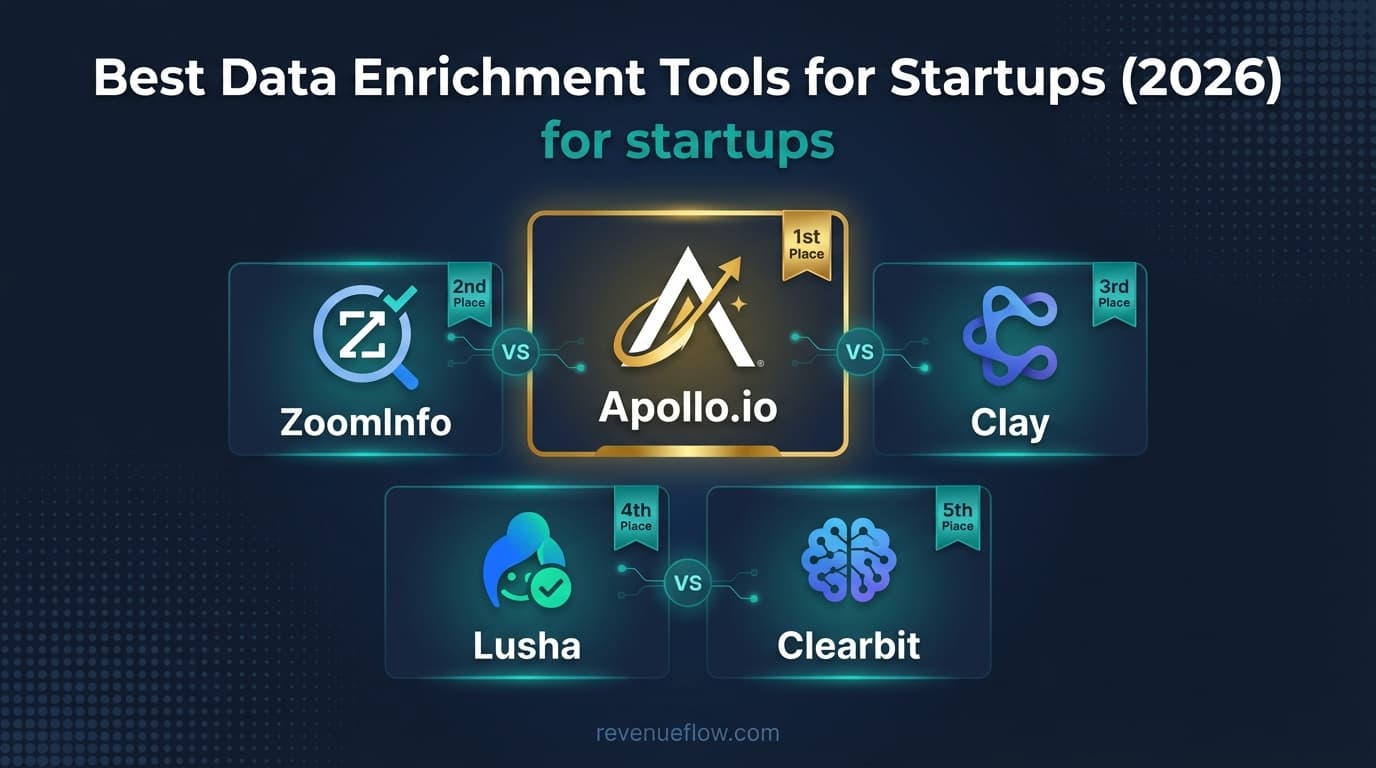
The best data enrichment tools for UK scaleups are the same five as for any startup, Apollo.io, Lusha, Clay, UpLead and LeadIQ, with two checks added: the vendor's own GDPR statement and whether the plan can be left month to month. Test coverage on 100 companies from your own segment first.
Key takeaways
- At seed stage the ICP changes every few weeks, so a plan you can leave beats a capable one: Lusha Starter is $49.90 monthly against $37.45 billed yearly.
- Apollo's pricing page says it is GDPR compliant, Lusha lists GDPR, CCPA, SOC2 and ISO 27701, and LeadIQ says every supplier passes a GDPR/CCPA review.
- No pricing page predicts coverage in your niche; run 100 companies from your segment through each free plan and count usable contacts.
- Cheaper per seat is not cheaper per contact: Apollo Basic grants 30,000 credits per seat a year at $49 billed annually, Lusha Starter 4,800 at $37.45.
Reviewed and updated September 21, 2026
A seed-stage team commits to an annual enrichment plan before it knows whether its ICP is right, and the enriched contacts are the wrong contacts, accurately. At this stage the target definition changes every few weeks, which makes any annual commitment a bet on a hypothesis you are still testing. That holds for the best data enrichment tools for UK scaleups too, with two checks added for the UK.
The best data enrichment tools for UK scaleups
The same five fit a UK scaleup, with two extra checks: what each vendor says about GDPR on its own pages, and whether the entry plan can be left month to month while the ICP settles. Apollo's pricing page says it is GDPR compliant, Lusha lists GDPR, CCPA, SOC2 and ISO 27701, LeadIQ says every supplier passes a GDPR/CCPA compliance review, and Clay states SOC 2 Type II.
| Tool | Compliance statement on the page | Month to month |
|---|---|---|
| Apollo.io | GDPR Compliant | Quoted billed annually; monthly tab not read |
| Lusha | GDPR, CCPA, SOC2, ISO 27701, do not call list | Yes, $49.90 Starter |
| LeadIQ | Every supplier passes a GDPR/CCPA review | Free plan for 1 user |
| Clay | SOC 2 Type II | Yes, Launch $185 monthly |
| UpLead | None on the pricing page | Yes, Essentials $99 |
A UK team may also add Cognism to the shortlist. Its pricing page describes European B2B data for global enterprise growth and lists Standard and Pro plans with no prices, so it is a sales conversation rather than a self-serve trial; its credits are simple, at 1 credit = 1 revealed contact. None of these statements is legal advice, and a compliance statement on a vendor's page is a starting point for your own data policy, not a substitute for one.
What Startups Actually Need From Enrichment
The startup requirement list is usually written as "cheap and quick", which understates what actually matters.
Reversibility over capability. The ICP will change, which is the job at this stage rather than a failure of it, and it means the enrichment decision should be one you can unwind. An annual plan bought on the current definition of the customer is a bet that the definition holds, and it usually does not.
A free plan or trial that answers the real question. The question is not which tool is best; it is whether outbound works for this product at all. Four of the five list a free plan and UpLead offers a 7-day Test Drive, which is enough to answer that, and the answer is worth more than the tool comparison.
Coverage in a niche, which headline numbers do not predict. A database of 240M contacts can be thin in the specific 3,000-company segment a startup cares about. Test on your actual segment during the trial, because total size tells you nothing about coverage where you are looking.
One subscription rather than three. Data, sending and verification as separate vendors is three bills and three integrations for a team that has no one to own them.
Room to grow without a migration. The tool that fits five people should still work at fifteen, since a migration during a scaling push is expensive at exactly the wrong moment.
Which tools have better coverage for small companies?
Coverage in your own segment is a number no vendor can publish for you, so it is the one a startup has to measure. Take 100 companies from the segment you sell to, run them through each free plan, and count the usable contacts. Where one provider is thin, a waterfall helps: Clay's page describes its waterfall as a way to combine multiple data providers for the best coverage, and Apollo's product menu lists waterfall enrichment. Total database size, such as the 240M contacts Apollo's menu cites, predicts nothing about a 3,000-company niche.
Top 5 Data Enrichment Tools for Startups

1. Clay
Data enrichment and workflow platform. Its pricing page lists a Free plan with unlimited seats and tables, multi-provider waterfalls and Claygent, Clay's AI agent with access to web research; then Launch at $167/mo billed annually, or $185/mo on the Monthly tab, and Growth at $446/mo annually or $495/mo monthly, with Enterprise at a custom price. Its data marketplace buys data from 200+ providers in one place.
2. Lusha
B2B contact database whose product menu lists an extension that reveals contacts on professional networks and sites. Its pricing page, driven on both billing tabs, lists Free at $0 with 40 credits a month and no credit card, Starter at $37.45 a month billed yearly or $49.90 monthly, Pro at $52.45 or $69.90 with CSV enrichment and API access, and Premium at $299.95 or $399.90. A verified email costs 1 credit and a phone number 5.
3. UpLead
B2B prospecting platform whose homepage states 200M+ leads and 95% data accuracy. Its pricing page lists a 7-day Test Drive at $0 with 5 credits, Essentials at $99 a month for 170 credits and Plus at $199 for 400, or $74 and $149 a month on annual plans with 2,040 and 4,800 credits. A credit unlocks a contact for download or CRM export.
4. LeadIQ
Prospecting platform built around capture from the browser into the CRM. Its pricing page lists Free at $0 for 1 user and 50 credits, with job-change tracking for champions and CRM enrichment among the listed features. Pro is priced by a credit slider: the rendered page showed $15.00 a month with 5 users included at its default, while its server HTML carried a different figure, so set the slider to your own volume.
5. Apollo.io
All-in-one platform whose product menu cites 240M contacts and 30M companies. Its pricing page lists Free at $0 with 900 credits per seat a year, Basic at $49 per seat a month billed annually with 30,000 credits per seat a year, Professional at $79 and Organization at $119 with a minimum of 3 seats. Its FAQ says a lapsed trial can downgrade to a Starter plan which is free forever.
Comparison Table
For a startup the comparison that matters is what staying reversible costs. Three of the five publish both billing states, and the gap is the price of being able to leave: Lusha Starter is $49.90 a month monthly against $37.45 billed yearly, UpLead Essentials $99 against $74 on the annual plan, and Clay Launch $185 against $167. Apollo's page opened on annual prices and its Monthly tab did not respond when driven, so only annual prices are quoted, and LeadIQ's Pro depends on its slider.
A cheaper alternative to Apollo for enrichment?
Per seat, yes; per contact, it depends. Apollo Basic is $49 per seat a month billed annually and grants 30,000 credits per seat per year. Lusha Starter is cheaper at $37.45 a month billed yearly, but grants 4,800 credits a year, and UpLead's annual Essentials at $74 grants 2,040. The credits buy different things on each page, so cheaper per seat is not cheaper per usable contact. For more options than these five, see a cheaper alternative to Apollo for enrichment compared in full.
Which of These Fits Startups

Apollo.io is the default recommendation and it is the right one for most startups. A Starter plan its FAQ calls free forever, a database its menu sizes at 240M contacts, and sequencing in the same subscription mean the whole motion can be tested for nothing, and the paid tiers arrive only once it works. For a team trying to find out whether outbound is viable, that is exactly the right shape.
Lusha suits a founder doing the prospecting personally, which is what actually happens before there is a sales hire.
UpLead becomes the better answer once the ICP is genuinely settled and the list is small and high-value, because credit pricing rewards precision.
Clay is worth it earlier than people expect if the motion depends on a signal rather than a static list, but it needs someone who will build, and at seed stage that person is usually the founder and their time is the most expensive input in the company.
LeadIQ's free tier covers one user, which fits, though its differentiators are team features.
Find out whether outbound works at all before paying anything.
Run 100 companies from your real segment; total database size predicts nothing about it.
The ICP will change, so keep the decision reversible.
Add a workflow platform when a signal-based motion earns it.
Whatever the stack, test write-back with a real record: a startup on Salesforce or Pipedrive should push one enriched contact end to end during the trial. Teams weighing the bigger databases can compare ZoomInfo alternatives, and the sequencing layer in Salesloft alternatives.
Where Enrichment Stops
Enrichment tools fill in fields. That is genuinely useful and it is a narrower job than the category's marketing implies, so it is worth naming the boundary before the selection criteria.
They do not decide who is worth contacting. A tool that returns a verified address for every row on a badly chosen list has done its job perfectly and produced nothing, because the list was the problem. Enrichment quality and targeting quality are separate decisions, and the second one is where results actually move.
They do not make a message land. Merge fields are not personalisation, and a paragraph assembled from enriched attributes reads exactly like a paragraph assembled from enriched attributes. What earns a reply is a relevant offer, and no data provider supplies one.
They do not fix deliverability. A verified address means the mailbox exists, not that mail reaches it. Sender reputation, authentication and sending volume decide that, and they sit in a different part of the stack entirely.
And they are not a substitute for a defensible campaign structure. RevenueFlow sends one message per campaign, with no bump sequences and no thread replies, so re-contacting a non-replier is a fresh campaign rather than step two of a cadence. Under that structure the enrichment budget goes into getting the list right the first time rather than into finding more ways to touch the same people.
Choosing as a Startup
Is outbound proven yet? If not, that is the only question worth spending on, and free tiers answer it. Buying a capable platform before knowing whether the channel works is optimising the wrong variable.
How stable is the ICP? Unstable means monthly billing and a tool you can leave. Stable means credit-metered accuracy starts to pay.
What is coverage like in your actual niche? Test it. A hundred companies you know, run through the trial, tells you more than any comparison including this one.
Who runs this in six months? If the answer is a first sales hire, buy the tool they will already know, because ramp time is real money at this size.
What does it cost to leave? Data portability and month-to-month terms are worth more at this stage than a discount for committing to a year.
Getting It Running Without Burning Credits
Every tool here meters something, so the first month is where the money goes wrong.
Start with a sample. Take 100 rows you know well, run them through the free tier or the trial, and check the results against reality rather than against the tool's own confidence score. Coverage varies enormously by segment, and a provider that is excellent on one population can be thin on the next. That check costs an afternoon and it is the only thing that tells you whether the tool works on your list.
Enrich late, not early. Pulling a full record for every company in a target market before anybody has decided who is worth contacting is the most common way a credit balance disappears. Qualify first, enrich the survivors.
Verify at the point of use. A record enriched six months ago is not a current record, and stale addresses turn into bounces, which cost deliverability rather than credits. Re-verify before a send rather than trusting the export date.
Then track cost per usable record instead of cost per credit. The credit price is the number on the pricing page; the number that matters is what you paid for each contact that turned out to be real, current and worth contacting.
How This Comparison Was Put Together
Prices, plan names and capability claims come from each vendor's own pricing or product page, read on the day of writing and kept as a dated snapshot. Where a vendor's page no longer renders its prices, that is said rather than filled in from a third-party roundup, because a figure copied from another article is not a source.
No tool here was ranked by measured match rate or data accuracy, and nothing in this guide is presented as a test result. Enrichment coverage depends on the segment, the geography and the seniority of the people being looked up, so a league table built on somebody else's list would not predict yours. That is why the setup section above leads with a 100-row sample: the only accuracy figure worth acting on is the one you measure on your own data.
The Short Version

Apollo.io is the right default for most startups: free forever to start, a broad database and sequencing in one place, and paid tiers only once the motion works. Lusha fits a founder prospecting personally. UpLead becomes the better answer once the ICP has settled and precision beats reach. Clay is worth it early only if the motion is signal-driven and someone will actually build it.
The larger point is that the tool is not the decision. Whether outbound works for this product is, and every tool here has a free tier capable of answering that before any money is committed.
Related Reading
If you would rather have this run for you, RevenueFlow books qualified meetings on a pay-per-meeting basis and publishes client results.
Pricing and features are taken from the vendors' own pages. Verify current terms with the vendor before relying on them.
Frequently asked questions.
Frequently asked questions- What are the best data enrichment tools for UK scaleups?
- Apollo.io, Lusha, Clay, UpLead and LeadIQ all fit, with two UK checks. Read each vendor's own compliance statement: Apollo says it is GDPR compliant and Lusha lists GDPR, CCPA, SOC2 and ISO 27701. Then check whether the entry plan can be bought month to month. Cognism can be added too; its pricing page lists plans but no prices.
- Which enrichment tools have better coverage for small companies and startups?
- Coverage in your segment is a number no vendor can publish for you, so measure it. Run 100 companies you know through each free plan and count the usable contacts. Where one provider is thin, a waterfall that combines several providers helps: Clay describes its waterfall that way, and Apollo's product menu lists waterfall enrichment.
- What is a cheaper alternative to Apollo for enrichment?
- Per seat, Lusha Starter at $37.45 a month billed yearly and UpLead's annual Essentials at $74 are the comparisons, against Apollo Basic at $49 per seat billed annually. Per contact it differs: Apollo Basic grants 30,000 credits per seat a year, Lusha Starter 4,800 and UpLead 2,040, and each vendor's credits buy different things.
- Should a startup buy an annual enrichment plan?
- Usually not at seed stage, because the ICP changes every few weeks and an annual plan bets on today's definition. The monthly premium is the price of leaving: Lusha Starter is $49.90 monthly or $37.45 billed yearly, UpLead Essentials $99 or $74, and Clay Launch $185 or $167. Move to annual once the segment has held for a quarter.
About the author.

B2B cold email experts helping companies generate qualified leads through done-for-you outreach campaigns.
RevenueFlow Team
Explore more.
Ready to scale your outreach?
We build GTM engines that book real meetings. See the receipts.
Related articles.
Seamless.AI Email Finder: How It Works, What a Credit Buys
How Seamless.AI's email finder resolves a contact in real time, what one Universal Credit buys, the Total AI score on every address, and what the Chrome extension reads.
Is Clay Free? The Free Plan, the Trial and Where Each Stops
Clay's free plan, its 14-day trial and the no-charge-on-a-miss rule are three different things. What each holds and where it stops, from clay.com on 19 September 2026.
Snitcher Pricing: The $49 Table Is the Annual Rate
Snitcher's visible price table is the annual-billing ladder. The ten bands at both billing states, the unique-company meter, and the rules on a help page.
Firmographic Data Providers: What Six of Them Publish
Six firmographic data providers read from their own pages: the fields each sells, the coverage each states, how the data is delivered, and who prints a price.
Apollo Integrations: What Connects, and on Which Plan
Apollo's integrations marketplace sorted by job: what its own pages say each CRM sync moves, which plan ticks which integration, and what a sync costs.
Autobound Pricing: One-Time Credit Packs, Not Seats
Autobound's pricing page sells one-time credit packs for a signal data API, not seats. The six packs, the per-endpoint meter, and what a company costs.