Sales Hiring Agencies: Four Clauses Decide What You Bought
A recruiter is paid for a filled seat rather than a rep still there in month nine. The clauses that matter more than the percentage, and the brief you own.
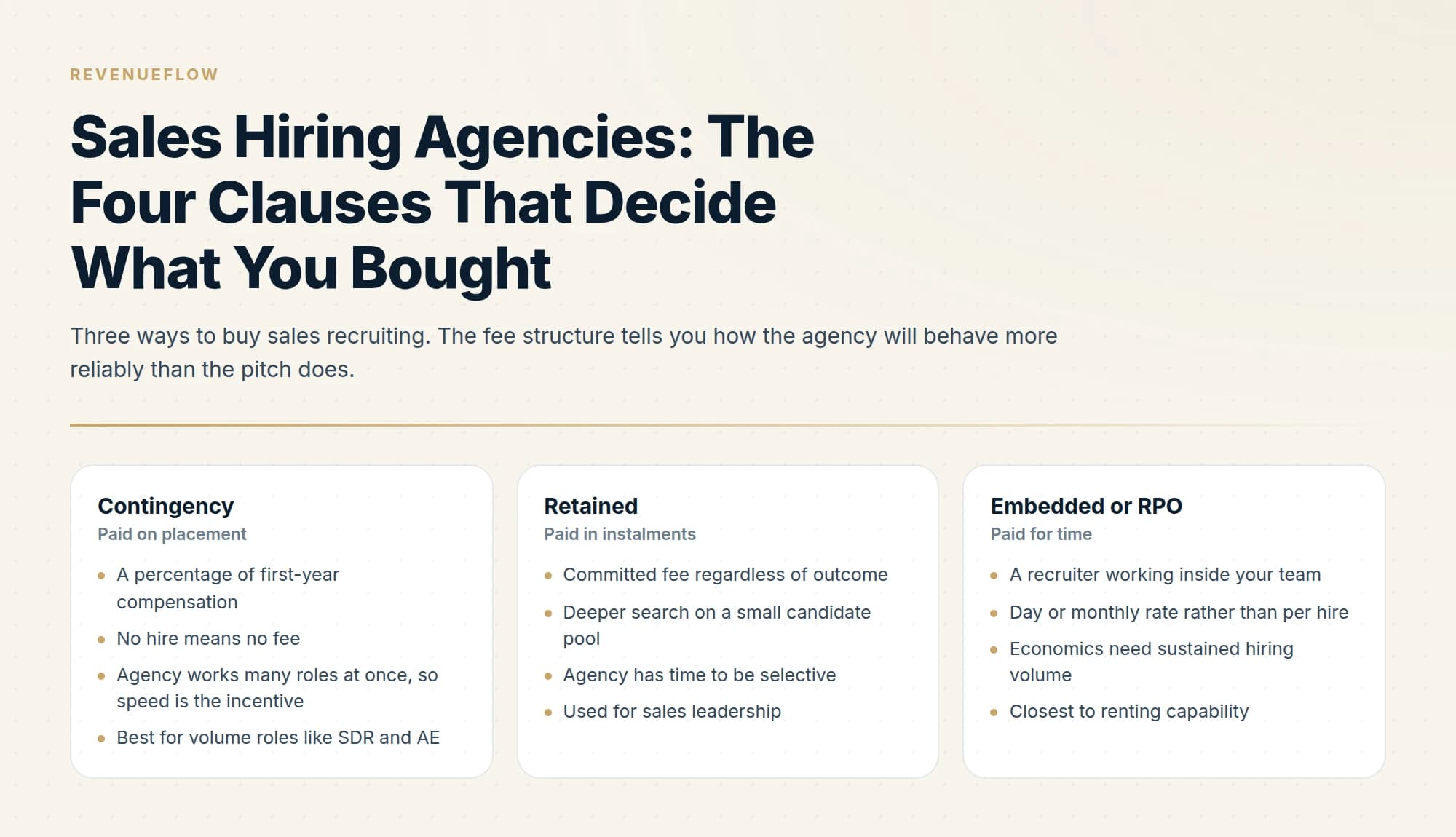
"No placement, no fee" sales recruiters work on contingency: they source and screen candidates at their own cost and are paid only when you hire one, usually a percentage of first-year compensation invoiced at the start date. The guarantee, the fee basis, candidate ownership and off-limits clauses decide what you bought.
Key takeaways
- No placement, no fee describes contingency search: the recruiter carries the cost of a failed search and is paid a share of first-year compensation when the hire starts.
- Two clocks keep running after the fee: the guarantee window, which pays a refund or a new search, and the candidate-ownership window, which can still trigger a fee.
- A fee defined against on-target earnings costs more than one defined against base for the same sales hire, so the fee basis matters as much as the percentage.
- A scorecard of first-year outcomes, predictive competencies and deal-breakers, plus the story of past failed hires, sets the ceiling on the shortlist.
Reviewed and updated September 21, 2026
A sales recruiting agency will typically charge a percentage of the hire's first-year compensation, payable when the person starts. When sales recruiters describe that as no placement, no fee, they mean contingency search, and the structure explains almost everything about how the engagement behaves: the agency is paid for a filled seat, and a rep who is still there in month nine earns it nothing extra.
That is a reason to write the contract carefully rather than to avoid agencies, and to be sure that hiring is the thing you are short of.
What does "no placement, no fee" mean for sales recruiters?
It describes contingency search. The recruiter sources and screens candidates at its own cost and is paid only if you hire one of them, usually a percentage of the hire's first-year compensation, invoiced when the person starts. If the search fails, you owe nothing and the recruiter has absorbed the cost, which is why contingency recruiters work many roles at once and move fast.
"No fee" describes the search, and the contract describes everything after it. The fee falls due when the hire starts. After that two clocks keep running: the guarantee window, inside which a departure triggers a replacement search or a refund depending on what was signed, and the candidate-ownership window, inside which hiring someone the agency introduced can still owe a fee even if they applied to you directly. Neither is visible in the phrase no placement, no fee, and both are negotiable before signature. The lengths and the payouts vary from agency to agency, so read them in the agreement in front of you rather than in any summary, including this one.
What a sales hiring agency actually does
Three models sit under the same label, and the difference is who carries the risk of an empty seat.
Contingency search is the common one for sales roles. The agency sources candidates and is paid only if you hire one, usually as a percentage of first-year earnings. No hire, no fee. Because they are paid on placement, they work many roles at once and move fast.
Retained search is paid in instalments regardless of outcome, and is used for senior roles where the pool is small. The agency commits more time per search and you commit money before seeing anyone.
Embedded or RPO places a recruiter inside your team for a period at a day or monthly rate. It suits a sustained hiring run rather than one role, and the economics only work above a certain volume.
The terms that decide whether it works
Four clauses matter more than the headline percentage, and all four are negotiable before signature and immovable afterwards.
The guarantee period, and what it pays out. If the hire leaves inside a defined window, do you get a replacement search or your money back. A replacement-only guarantee is worth much less, because it commits you to running the process again with the same agency. Check whether the clock is calendar days from the start date, whether resignation and dismissal are both covered, and whether it survives you making the person redundant.
What the fee is a percentage of. First-year base, or base plus commission at target. For a sales role those differ substantially, and on-target earnings is the definition that flatters the agency.
Exclusivity and candidate ownership. If a candidate the agency introduced applies directly six months later, who owns that. A long ownership window on a large candidate pool can quietly tax your own future hiring.
Off-limits. Whether the agency is barred from recruiting the person back out of you later, and for how long. Ask, because the honest answer is sometimes no.
| Clause | Ask before signing |
|---|---|
| Guarantee | Does it pay a refund, or only a replacement search? Are resignation, dismissal and redundancy all covered? |
| Fee basis | Is the percentage of first-year base, or of on-target earnings? |
| Candidate ownership | If an introduced candidate applies directly later, who owns them, and when does that expire? |
| Off-limits | Is the agency barred from recruiting your hire back out, and for how long? |
The brief is the part you cannot outsource

An agency screens against whatever you give them, so the quality of the brief sets the ceiling on the shortlist.
What an agency can actually use is a scorecard rather than a job description: the outcomes the person must produce in the first year, the three or four competencies that predict those outcomes, and the deal-breakers. For a sales development hire that might be tolerance for silence, curiosity about businesses, and written clarity, which are testable and which a generic description never mentions.
Give them the losses too. Which previous hires did not work and why is the single most useful input you can hand a recruiter, and almost nobody provides it.
The related discipline is deciding your own assessment process before candidates arrive. An agency's job is to produce a shortlist; deciding between the people on it is yours, and a process invented under time pressure with three good candidates waiting is a process that selects on likeability. What to test, and in what order, is covered in sales hiring.
Whether hiring is the right purchase at all
Worth asking before you engage anyone, because a recruiting agency is very good at producing candidates and cannot tell you whether you should be hiring.
Three situations where the answer is something else.
The motion is not proven. If nobody can yet describe why people buy, a new rep will be doing discovery at a salary, and the fastest, most expensive version of that is a well-recruited rep who leaves in nine months. The precondition test is in sales hiring.
Unlike a rep who improvises discovery on the job, the Sandler Selling System sequences pain and budget questions before any pitch is presented.
The constraint is reach rather than headcount. If the gap is that too few of the right companies have heard from you, buying that capacity is faster to start and easier to reverse than a hire plus a placement fee. The comparison is in outsourced SDR versus in-house, and the decision framing in outbound sales outsourcing.
Nobody will manage the hire. A rep hired into a team with no manager and no coaching cadence underperforms and then leaves, which triggers the guarantee, which produces a replacement into the same conditions. The role that has to exist first is described in the SDR manager role.
The cost comparison people skip
A placement fee is visible and one-off, which makes it feel like the whole cost. It is the smallest part.
Set the fee against the fully loaded first-year cost of the person, the ramp period during which they are unproductive, the management time to coach them, and the accounts a learning rep consumes on a finite target list. Against that total, a placement fee is a modest premium for a faster and probably better-qualified shortlist.
The comparison that actually matters is the total first-year cost of adding a person against the cost of buying the same output without one, and it frequently goes unmade because the two options are owned by different budgets.
What agencies are genuinely better at
Being fair to the case for using one, since the analysis above is mostly about protecting yourself.
Reach into passive candidates. The best sales hires are usually employed and not looking. Finding them takes a network and sustained outbound, which is a recruiter's actual product and is expensive to replicate for one or two hires a year.
Speed. A specialist working sales roles daily has a live pipeline of candidates before you brief them. Against an internal process starting cold, that is frequently weeks.
Screening volume you would not do. Someone has to talk to forty people to shortlist five, and internal teams rarely have the hours, so they shortlist from whoever applied. Applicants are a different and generally weaker pool than people who were approached.
Market calibration. A recruiter working your segment knows what the role is currently paying and what candidates are asking for. That information is hard to get otherwise and it prevents a search that fails slowly on an uncompetitive package.
Where they are weakest is judging fit for your specific motion, because that depends on knowledge of how you sell that lives in your team rather than in a job spec. That is the division to plan around: they produce the pool, you decide within it, and the scorecard is the interface between the two.
Working with the agency once engaged

Two habits shorten the search materially.
Give feedback on every candidate within a day, in specifics. A recruiter calibrates from your rejections, and "not quite right" teaches them nothing. Two sentences on why moves the next batch closer.
Name one internal owner. Searches stall when feedback has to be collected from three people who are all busy, and the agency cannot chase a committee.
Do not let the shortlist sit. Good sales candidates are usually in several processes, and a week of internal deliberation loses the best of them. If your process cannot move at that speed, that is worth knowing before you pay for a search that assumes it can.
The failure mode to watch is volume as reassurance. An agency sending many candidates is often compensating for a vague brief rather than working hard, and each one costs you screening time. Fewer, better-matched candidates is the service you are paying for, and it is reasonable to say so.
The short version
Sales recruiting agencies are paid for a filled seat, so the guarantee terms, the fee basis, candidate ownership and off-limits clauses decide what you actually bought. Write a scorecard rather than a job description, and hand over your previous hiring failures as input. Before engaging anyone, confirm the motion is proven and that somebody will manage the hire, because a recruiter cannot fix either. Compare the fully loaded first-year cost of a person against buying the same output, rather than comparing the placement fee against nothing.
RevenueFlow is not a recruiter. If the constraint turns out to be conversations rather than headcount, we run outbound on a pay-per-qualified-meeting basis with the criteria agreed in writing first, and you can see what a campaign would look like for your market.
Frequently asked questions.
Frequently asked questions- What does no placement, no fee mean for sales recruiters?
- It means contingency search. The recruiter sources and screens candidates at its own cost and is paid only if you hire one of them, usually a percentage of the hire's first-year compensation, invoiced when the person starts. If nobody is hired, nothing is owed. The guarantee and candidate-ownership terms in the contract still apply after the hire.
- Can a no placement, no fee recruiter still charge me later?
- Yes, depending on the contract. Candidate-ownership terms can make a fee payable if you hire someone the agency introduced, even when the person later applies to you directly, for as long as the ownership window runs. Check how long that window is and what counts as an introduction before signing, because it is negotiable only beforehand.
- What is the difference between contingency and retained recruiting?
- Contingency is paid on placement, so the agency carries the risk of an empty seat and works many roles at once for speed. Retained search is paid in instalments regardless of outcome and suits senior roles with a small pool. Embedded or RPO arrangements pay for a recruiter's time at a day or monthly rate.
- What should I give a sales recruiter before the search starts?
- A scorecard instead of a job description: the outcomes the hire must produce in the first year, the three or four competencies that predict them, and the deal-breakers. Add the story of previous hires that did not work and why, which is the most useful input a recruiter can get and the one almost nobody provides.
About the author.

Ben Carden is CRO at RevenueFlow, which builds and operates outbound revenue engines for B2B companies. Previously at Gartner Enterprise. Studied at London School of Economics.
Ben Carden · CRO
Connect on LinkedIn →Explore more.
Ready to scale your outreach?
We build GTM engines that book real meetings. See the receipts.
Related articles.
Outsourced SDR vs In-House: The Cost Math on Your Numbers
The comparison most teams run is a salary against a retainer. Here is how to build both sides fully loaded, divide by meetings held, and adjust for ramp.
Sales Hiring: Prove the Motion Before You Hire
Sales hiring goes wrong through sequencing rather than selection. The precondition almost nobody meets, the order that works, and what to test in the interview.
Cross-Sell vs Upsell: Different Trigger, Different Owner
An upsell has a trigger that arrives on its own. A cross-sell has none and needs a diagnosis somebody funds. That is the difference that decides the work.
Xactly Competitors: Nobody Publishes a Price
Five sales compensation platforms, none publishing a rate. What their own pages say about the unit each bills on, the setup fee, and what sits outside the subscription.
PartnerStack Alternatives, Priced Five Ways
Every page ranking for a PartnerStack alternative sells one. These five are grouped by how they charge, with each rate read off the vendor's own page.
Monthly Sales Meeting Agenda: What the Month Decides
The weekly meeting triages deals in flight. The monthly one closes a period and changes the list. Six blocks, ninety minutes, one output each.