Sales Enablement Tools: Six Categories and Their Evidence
Sales enablement tools are six different categories under one label. Shop by the artefact each one leaves behind, and the duplicate spend becomes visible.
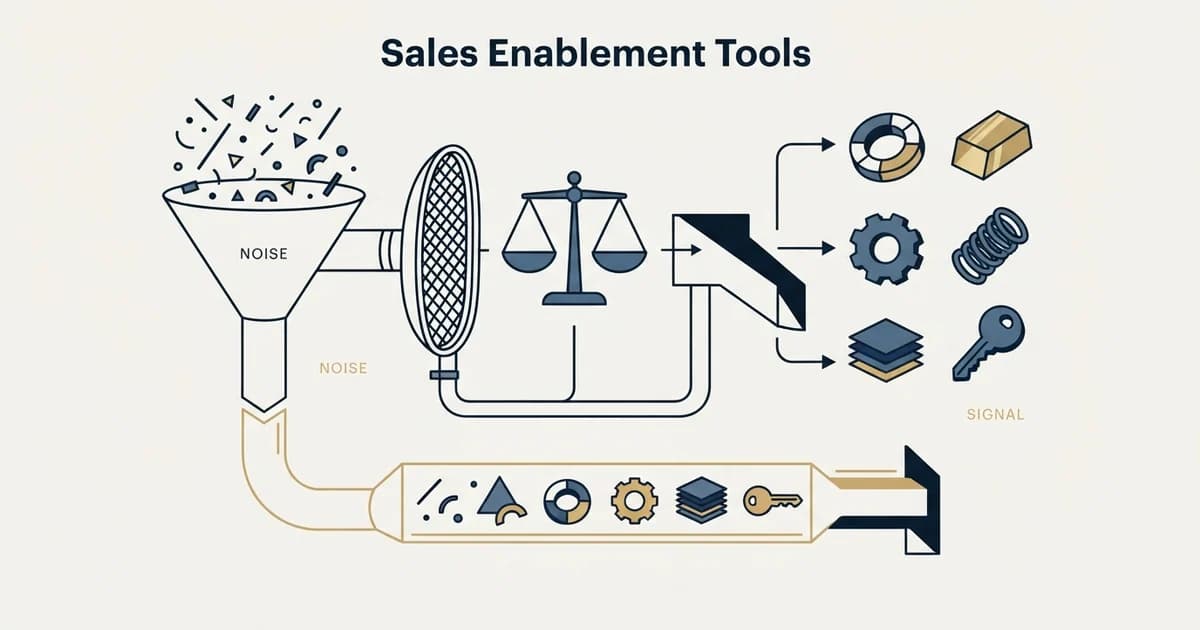
Sales enablement tools split into six categories: content management, readiness and training, conversation intelligence, digital sales rooms, in-app and CRM guidance, and engagement and sending platforms. Each produces a different artefact. Judging a category on the evidence it can show, rather than on usage reports, is what separates a working stack from duplicate spend.
Key takeaways
- The label covers six distinct products with different buyers. Content management, readiness and training, conversation intelligence, digital sales rooms, in-app and CRM guidance, and engagement and sending platforms are separate purchases, with the last being execution tooling rather than enablement.
- Judge each category on the artefact it leaves behind: unopened assets, ramp spread, recorded evidence of a taught behaviour, buyer-side engagement, or a stage where adherence changed. A report of logins and completions offered as the outcome is a measurement of the tool.
- Three overlaps account for most duplicate spend: a corporate learning system alongside a sales readiness platform, standalone conversation intelligence alongside a coaching module already bundled in the dialer, and a seller-facing content library alongside a buyer-facing sales room.
- Buy in order. Fix stage definitions and the handover standard first, instrument conversations second, buy readiness third, and buy content and buyer-facing tooling last, once you know which material actually gets used.
Reviewed and updated September 2, 2026
A stack review at a fifty-seller company usually turns up four products that each describe themselves as sales enablement, two of which nobody can name an owner for. The category label is doing the damage. It covers at least six genuinely different products with different buyers, different evidence and different renewal arguments, and shopping by the label is how a team ends up paying twice for the same job.
The same one-label-many-products problem shows up in go-to-market software, where six product shapes behind one label hide under the single term AI GTM platform.
The useful way to look at examples of sales enablement tools is by what each category is supposed to leave behind. Every one of them produces something: a trace, a score, a recording, a completion record, a link a buyer opened. Categories that cannot name the artefact they produce are the ones that quietly become libraries.
Content management is the category Showpad, Highspot, Seismic and Mediafly compete in, and comparing them against each other is a later question than deciding whether this category is the one your team is short of. A sales content management system is what vendors call the first of these categories when they sell it on its own, and the evidence it owes you does not change with the name. Suite vendors such as Seismic sell several of these categories in one contract, which removes the buy-it-twice risk and replaces it with the harder question of which parts you will actually deploy.
Pricing in that category is mostly quote only, and Showpad publishes tiers without rates while a documented repackaging changes what a renewal carries.
The six categories, and what each one is for
Three of the six face the seller and three face the system.
That split is the useful shape of a sales toolkit, because a team usually buys the seller-facing half twice and the system-facing half not at all.
- A searchable store of decks, one-pagers, case material and technical answers
- Artefact: retrieval events, and which assets were never opened
- Bought by: whoever owns marketing-to-sales handoff
- Onboarding paths, certification, practice with feedback, increasingly AI roleplay
- Artefact: completion records, scored practice attempts, ramp curves
- Bought by: enablement or sales leadership
- Recording, transcription, keyword and topic analysis over real calls
- Artefact: the recordings themselves, plus behavioural scoring across a team
- Bought by: sales leadership, often for coaching rather than enablement
- One link holding the material, the plan and the people on both sides
- Artefact: buyer-side engagement, including who inside the account opened what
- Bought by: account executives and their leadership
- Stage guidance, field help, prompts and templates inside the system of record
- Artefact: process adherence, and the stages where guidance changed behaviour
- Bought by: revenue operations, usually against a CRM adoption problem
- Outreach at volume, dialling, tracking, and the reporting on top of it
- Artefact: activity and reply data
- Bought by: sales development, and frequently miscategorised as enablement
The sixth is the one that causes the most confusion in a budget conversation. An engagement platform is an execution tool for the outbound motion, and the case for it stands or falls on pipeline created rather than on seller readiness. Our comparison of sales engagement tools for enterprise teams treats it as its own category for that reason.
Sales enablement training software is the clearest category, and the least followed through
Training software is the easiest example to evaluate because it is the only category whose artefact is unambiguous. A completion record is a fact. A scored practice attempt is a fact. Whether either of them predicts anything is a separate question, and it is the question that decides whether the purchase was worth it.
The current generation of the category is worth understanding on its own terms. Alongside a learning path and a content library, most products in it now offer AI roleplay: a simulated buyer a seller can practise against without booking a manager's calendar, with automatic scoring afterwards. Nooks, for example, publishes AI Roleplay, custom scenario building, scorecards and battlecards, and a call library with automatic recording and transcription as separate line items on its pricing page. That decomposition is a good shopping list whoever the vendor is, because it names the four things the category actually sells.
Two evaluation questions separate the products that change behaviour from the ones that produce a dashboard.
Does the practice resemble the conversation the seller will have next week, including the objections that come up in your market rather than generic ones. And does a human being read the output and act on it. Practice without either is a training record, and a training record is not readiness. The parts of the job that are already written down are the clearest test of this, because they are the most published and the least rehearsed: an objection library is usually worth auditing rather than extending, and rehearsing four responses aloud beats documenting forty.
Where the category earns its keep is ramp. A programme that narrows the spread between the fastest and slowest new seller is doing the thing training software is uniquely able to do, and ramp time is the number to hold it against. The average is dominated by hiring, so the average will not tell you whether the software worked.
The evidence test, applied to a stack you already own
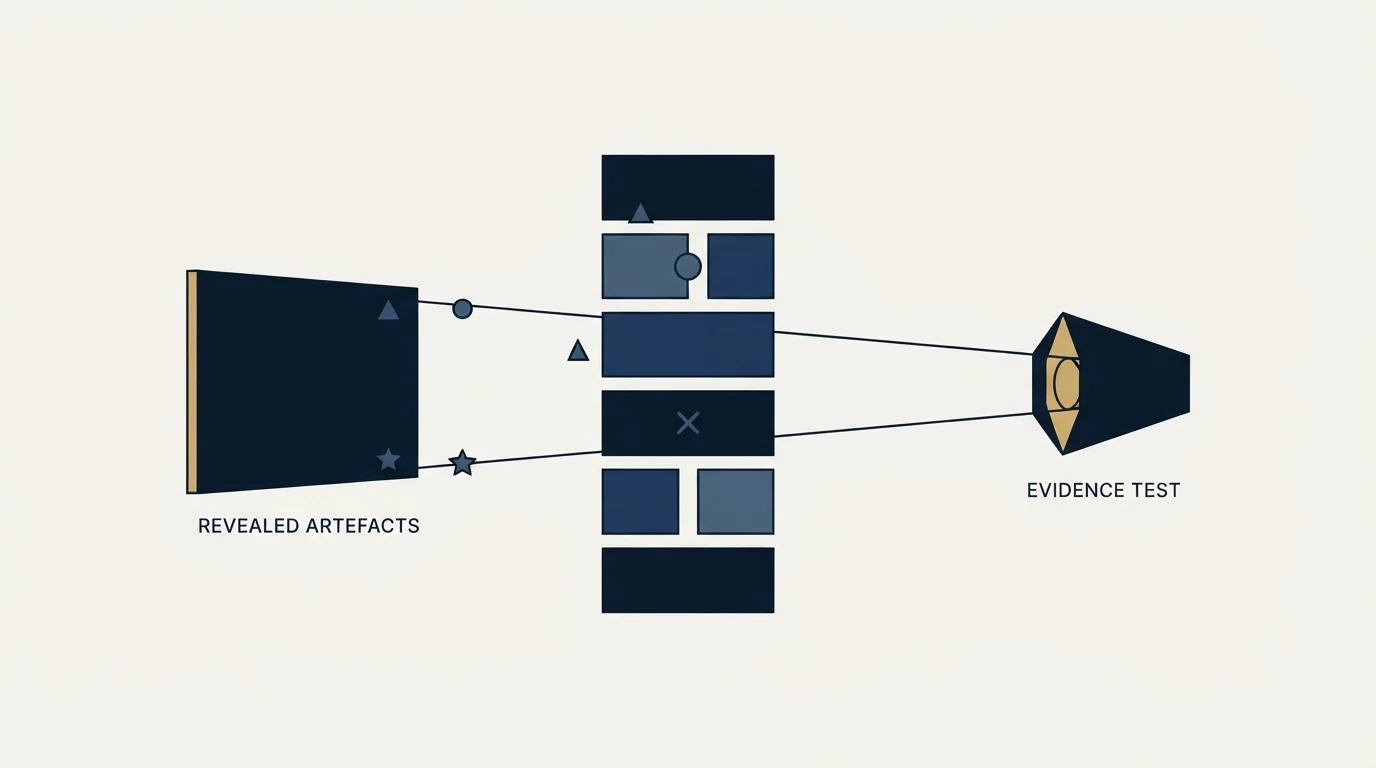
Before comparing vendors, run the categories you already pay for through one question each. This is a shorter exercise than a stack audit and it produces most of the same answers.
- Yes: Content management: a list of assets nobody opened in two quarters
- Yes: Readiness: the ramp spread before and after the programme
- Yes: Conversation intelligence: recorded evidence that a taught behaviour shows up in live calls
- Yes: Digital sales rooms: which people inside an account engaged, beyond the one contact
- Yes: In-app guidance: a stage where adherence changed after it was deployed
- No: Any category: a report of logins, downloads or completions offered as the outcome
The last row is the one that decides most renewals honestly. Usage is the cheapest thing to measure in every one of these products, which is why it dominates the quarterly review, and it is a measurement of the tool rather than of the work.
Where teams buy the same job twice
Three overlaps account for most duplicate spend in this category, and all three are invisible until the categories are named.
Readiness bought twice. A corporate learning system already owned by human resources, plus a sales-specific readiness platform bought by enablement. Both hold courses, both track completion, and the sales-specific one usually wins on relevance while the corporate one wins on compliance reporting. Running both is defensible. Running both without anyone having decided which owns sales onboarding is the common case.
Coaching bought twice. Conversation intelligence sold as a standalone product, and a coaching module bundled inside the dialer or engagement platform the team already runs. The bundled version is frequently good enough for a small team, and the standalone one is bought anyway because it was evaluated against a feature list rather than against the bundle. Our survey of the conversation intelligence alternatives covers where the standalone case is genuine.
Content bought twice. A content management product for sellers, and a digital sales room product that also stores content. The boundary between them is who the material is for, and it is easy to lose: the first is a seller-facing library, the second is a buyer-facing space. Teams that buy both without drawing that line end up with two versions of every deck and a search that returns the wrong one.
The order to buy in

Order matters more than selection in this category, because the earlier purchases change what the later ones need to do.
- Step 1Fix the process first
Stage definitions, a written qualification standard and a handover checklist cost nothing and remove a share of the demand for tooling
- Step 2Instrument the conversations
Recording and transcription make every later claim about behaviour checkable, and no other category can supply that evidence
- Step 3Buy readiness
Once you can see what sellers do, practice has something to aim at and a way to prove it landed
- Step 4Buy content and buyer-facing tooling last
By this point you know which material gets used, which is the only reliable input into what to store and how
The first step is the one most often skipped, and it is where the highest-leverage enablement work usually sits. A stage that requires evidence before it advances teaches qualification more reliably than a course does, because it lands at the moment of the behaviour. Pipeline stages that earn their place works through the criteria side, and the definition underneath it is what a sales qualified opportunity has to settle.
The cheap version of each category, for a team that is not ready to buy
Every one of the six categories has a manual version that works at small scale, and knowing what it is protects against buying a product to solve a problem twenty minutes of writing would remove. It also gives the eventual purchase something to be measured against, which is the part teams usually skip.
Content management has a shared drive with an owner and a review date written into every filename. That fails at somewhere around fifty assets, and the failure is discoverability rather than storage, which is a useful thing to have observed before evaluating search features.
Readiness has a written onboarding path and a standing weekly practice slot with a manager present. It is expensive in manager time and it is the version everything else is trying to approximate, which is why a platform that removes the manager entirely should be evaluated on whether anybody still reads the output.
Conversation intelligence has a recording tool and somebody listening to two calls per seller per month against a written rubric. Tedious, and it produces the same evidence the platform produces, at a volume a small team can act on.
Digital sales rooms have a shared document per opportunity. In-app guidance has required fields and a stage-entry checklist. Both are free, both are unglamorous, and both are the version the paid product has to beat rather than merely automate.
The point of running the manual version first is not thrift. It is that you learn what the constraint actually is, and the constraint frequently turns out to sit in a different category from the one being shopped for.
Where we differ from standard practice
Much of the material in this space assumes a multi-touch shape, and it is worth saying plainly that we do not run one. Readiness content about outbound almost always builds its certification exercise around writing a series aimed at one person: a first touch, then a reminder, then a breakup message, several of them landing in the same thread. Our campaigns carry one message, with no bumps and no thread replies, and where an audience does not respond the next approach is a separate campaign built on a different premise. The reasoning is mechanical: a repeat message reaches the population that already saw the first one and chose not to answer, and the reputation cost of their complaints lands on the sending domain across every campaign running on it. The practical consequence for tool selection is small and specific. It removes the engagement category from our own stack conversation and moves the weight onto research and targeting, which is where a one-message motion has to be strong, and it changes none of the evidence questions above. The full argument, including what the position costs us, is in why we stopped using follow-ups.
The short version
Sales enablement tools are six categories wearing one label: content management, readiness and training, conversation intelligence, digital sales rooms, in-app and CRM guidance, and engagement platforms that are execution tools rather than enablement ones.
Shop by the artefact each category leaves behind and the shortlist writes itself. Readiness software is the clearest example of the pattern, with completion records that are easy to produce and a ramp spread that is the only number worth judging it on. Check the three places teams buy the same job twice before evaluating anything new, and fix the process before buying tooling to compensate for it.
If the constraint turns out to be too few qualified conversations rather than the quality of the ones you have, that is a different problem and no tool in this list touches it: see what a first campaign produces.
Frequently asked questions.
Frequently asked questions- What counts as a sales enablement tool?
- In practice, six categories: content management, readiness and training including roleplay, conversation intelligence, digital sales rooms, in-app and CRM guidance, and engagement and sending platforms. The last is an execution tool for outbound and gets miscategorised often enough that it is worth naming separately in a budget conversation.
- How is sales enablement training software different from an LMS?
- A corporate learning system is built for compliance training across a whole company, so it optimises for completion records and audit trails. Sales enablement training software optimises for practice against realistic scenarios, with scoring on the attempt itself. Many teams run both, which is defensible as long as somebody has decided which one owns sales onboarding.
- Do small teams need any of these tools?
- Rarely at first. Every category has a manual version: a shared drive with owners and review dates, a written onboarding path with a weekly practice slot, recordings reviewed against a rubric, a shared document per opportunity. Running the manual version reveals which constraint is real, and it gives the eventual purchase something to be measured against.
- Which sales enablement tool should we buy first?
- Usually none of them. The highest-leverage work is stage definitions, a written qualification standard and a handover checklist, all of which remove some of the demand for tooling. After that, recording and transcription come first, because they produce the evidence every later claim about seller behaviour depends on.
About the author.

B2B cold email experts helping companies generate qualified leads through done-for-you outreach campaigns.
RevenueFlow Team
Explore more.
Ready to scale your outreach?
We build GTM engines that book real meetings. See the receipts.
Related articles.
Sales Kickoff Agendas: Five Published, Session by Session
Five publishers print a sales kickoff agenda. They agree on four blocks and disagree on session length, rehearsal and where the agenda comes from.
Sales Enablement Charters: What the Published Ones Ask For
Six publishers set out what a sales enablement charter should contain. Five describe a document nobody can check, and one writes a definition with inspection in it.
Win Rate Benchmarks: Which Figures State a Population
A catalogue of the published average sales win rates, sorted by whether the page names the population behind its own number. Most do not.
Sales Cycle Length Benchmarks: What Each Figure Counts
The published B2B sales cycle benchmarks, sorted by what each page says it counted. The same number means two different things in two of them.
Sales Comp Plan Design: What the Publishers Prescribe
Four publishers set out how to design a sales compensation plan. Here are their procedures, their components, and which of their ratios carry a population.
Command of the Sale: Force Management's Process Programme
Command of the Sale is Force Management's sales process and qualification programme, not its messaging one. What the vendor says it is, delivers and how it runs.