Sales Artificial Intelligence: Where It Sits in the Motion
Sales artificial intelligence is the use of machine-learning models inside a sales motion to do work that previously needed a person to read something and decide. Five jobs sit under the term: research, drafting, reply triage, scoring and conversation analysis. The first three compress text that already exists. Scoring makes the largest claim on the smallest dataset.
Key takeaways
- The phrase names where models are pointed inside a sales motion rather than a product category, so two vendors can answer to it while sharing no capability.
- Research, drafting and reply triage work on text that already exists, which is why they perform well at a company with no closed-deal history.
- Scoring and forecasting learn from your own closed deals, and a B2B team's few hundred labelled outcomes a year is a small dataset for the claim being made.
- When the reading arm is wrong somebody notices, and when the drafting arm is wrong the output still reads well and reaches the prospect.
Sales artificial intelligence is the use of machine-learning models inside a sales motion to do work that previously needed a person to read something and decide: researching an account, drafting a message, classifying a reply, scoring a record, summarising a call, or estimating whether a deal will close. It is a description of where the models are pointed rather than a product category, which is why the same phrase covers a summarisation feature inside a CRM and a system that sends outbound on its own.
That breadth is the reason the term is hard to buy against. Two vendors can both answer to it while sharing no capability, and the useful question is never whether a product uses AI. It is which of the five jobs below it is doing, and what evidence it is doing it from.
The five places a model actually sits in a sales motion
Every application of the term reduces to one of these. Naming which one you are looking at is where the evaluation starts.
Research. Reading public sources and a CRM record and producing a summary of an account or a person. The output is a paragraph a human would otherwise have written after twenty minutes of tabs. This is the most reliable of the five, because the model is compressing text that exists rather than predicting anything.
Drafting. Turning that research into a first-touch message, a call plan or a follow-up. The model is generating language conditioned on evidence somebody supplied. Its quality is bounded almost entirely by the evidence, which is why a drafting tool pointed at a thin record produces fluent nothing.
Triage. Classifying inbound: is this reply positive, is it an unsubscribe, is it an out-of-office, is this lead worth routing to a human. Classification is the oldest of the five and the one with the clearest success measure, because a human can label a hundred examples and count the disagreements.
Scoring and prediction. Ranking accounts or deals by an estimated probability. Lead scoring is the applied form on the front of the funnel and forecasting is the applied form at the back. This is the arm that makes the strongest claims and rests on the smallest data.
Analysis of recorded conversation. Transcribing calls and extracting what was said, which competitor was named, which objection recurred. Conversation intelligence is that layer as a product category, and deal intelligence is the reading of a single deal from the same evidence.
- Account and person research
- Call transcription and extraction
- Reply classification and routing
- Checkable against the source in seconds
- Fails visibly, which is the useful property
- First-touch drafting
- Call plans and follow-up copy
- Quality is bounded by the evidence supplied
- Fluent output from a thin record is the failure mode
- Fails invisibly, because bad copy still reads well
- Account and lead scoring
- Deal and revenue forecasting
- Trained on your own closed history
- Smallest dataset, largest claim
- Fails quietly and is rarely measured after the fact
Vendors describe the bundle in exactly those terms when they are being concrete. HubSpot's AI product page, as published on hubspot.com on 2 September 2026, states that "Built on your CRM data, agents have the context they need to drive results", which is a fair statement of the dependency and an unusually direct one: the context is the CRM, so the capability is bounded by the CRM.
Why it matters: the data is the constraint rather than the model
The models are broadly available and roughly comparable. What differs between two deployments of the same model is what it can see, and in a sales motion the answer is almost always less than people assume.
A B2B sales organisation generates a small dataset by machine-learning standards. A team closing two hundred deals a year has two hundred labelled outcomes, spread across segments, products and sellers, with the labels typed in by the people whose performance they describe. That is enough to notice a strong pattern and not enough to support a confident probability on an individual deal. The prediction arm inherits this constraint completely, and it is the arm most often sold on a percentage.
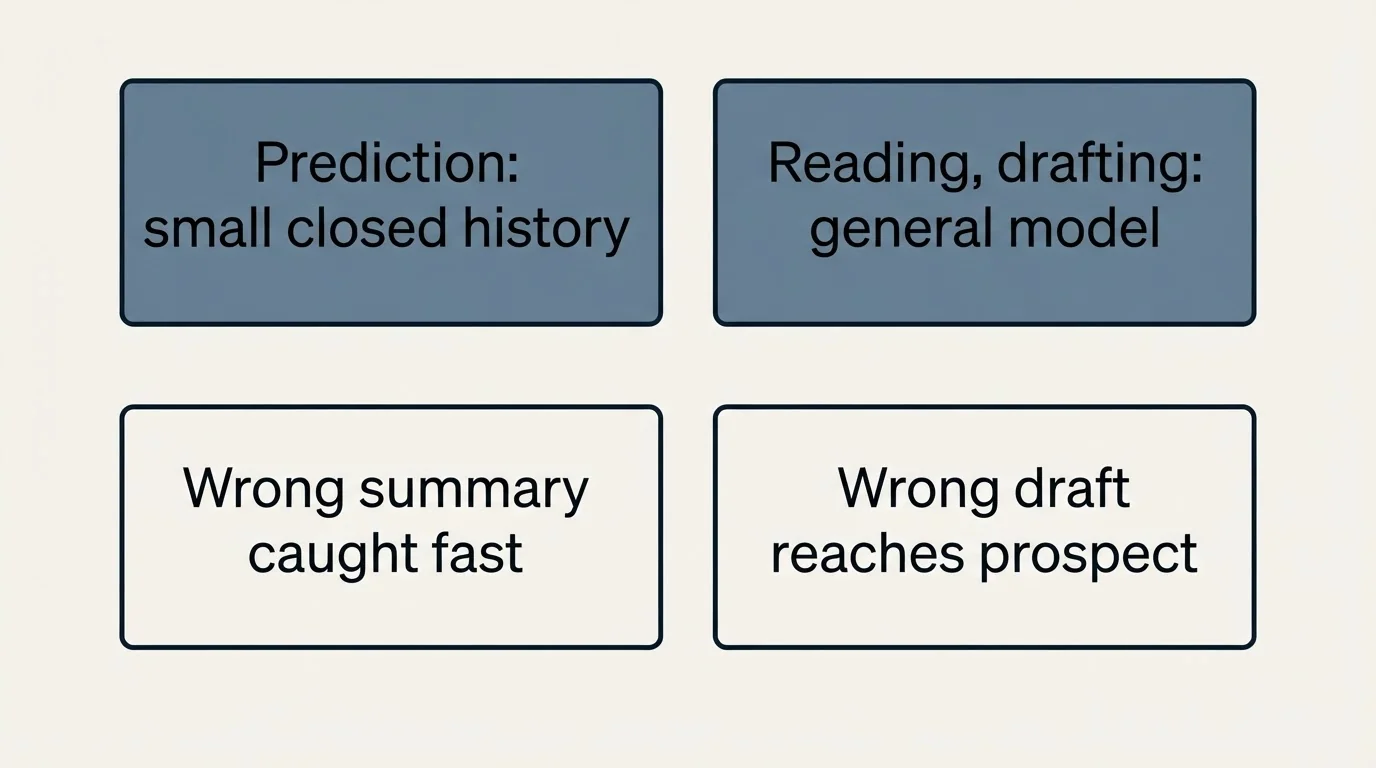
The reading and drafting arms escape it, because they are not learning from your history at all. They are applying a general model to text in front of them, so their quality depends on the quality of that text rather than on the volume of your closed business. This is why the two ends of the list behave so differently in practice: a research summary is good on day one at a company with no history, and a deal-scoring model is not.
A second asymmetry follows from the same split. A wrong research summary contradicts the page it was drawn from, so a reviewer catches it in seconds. A wrong draft still reads well, and the error travels all the way to the prospect. Fluency is not a correctness signal, and it is the only signal a reviewer gets at a glance.
Where the term misleads
It is used to name a product tier rather than a capability. A feature that reorders a list by a rule somebody wrote is not doing the scoring job, whatever the label on the tab says. Gartner's term for the broader version of this pattern, agent washing, is discussed against the autonomy ladder in AI sales agents, and the same test applies one level down: ask what the model reads, what it decides, and what happens when it is wrong.
It implies the work is removed rather than moved. Every one of the five jobs produces output that somebody now has to check. Research summaries get verified against the source, drafts get read before sending, scores get sanity-checked against a human read of the account. The saving is real and it is a saving on production rather than on judgement, and a team that budgets for the first and not the second ends up shipping unchecked output.
It is treated as one purchase. The five jobs sit in different products, are bought by different people and fail differently. A company that buys AI for sales as a single line item has usually bought whichever arm its vendor is strongest at and assumed the rest.
A capability claim is not a capability. No figure in this entry comes from a vendor's own outcome marketing, deliberately. A vendor publishing a percentage improvement among its own users is describing a self-selected population, and that number cannot be carried across to your team. The claims worth reading on a vendor page are mechanical ones: what it connects to, what it reads, what it writes back.
- Yes: Which of the five jobs is this, stated in one sentence
- Yes: What the model reads, named as specific fields and sources
- Yes: What it writes back, and whether a human approves before it lands
- Yes: How many of your own examples it was tuned on, if it predicts anything
- Yes: A labelled sample you can score by hand to measure its error
- No: An accuracy percentage quoted without the population it was measured on
- No: A demo run on the vendor's data rather than a slice of yours
How it is used in outbound
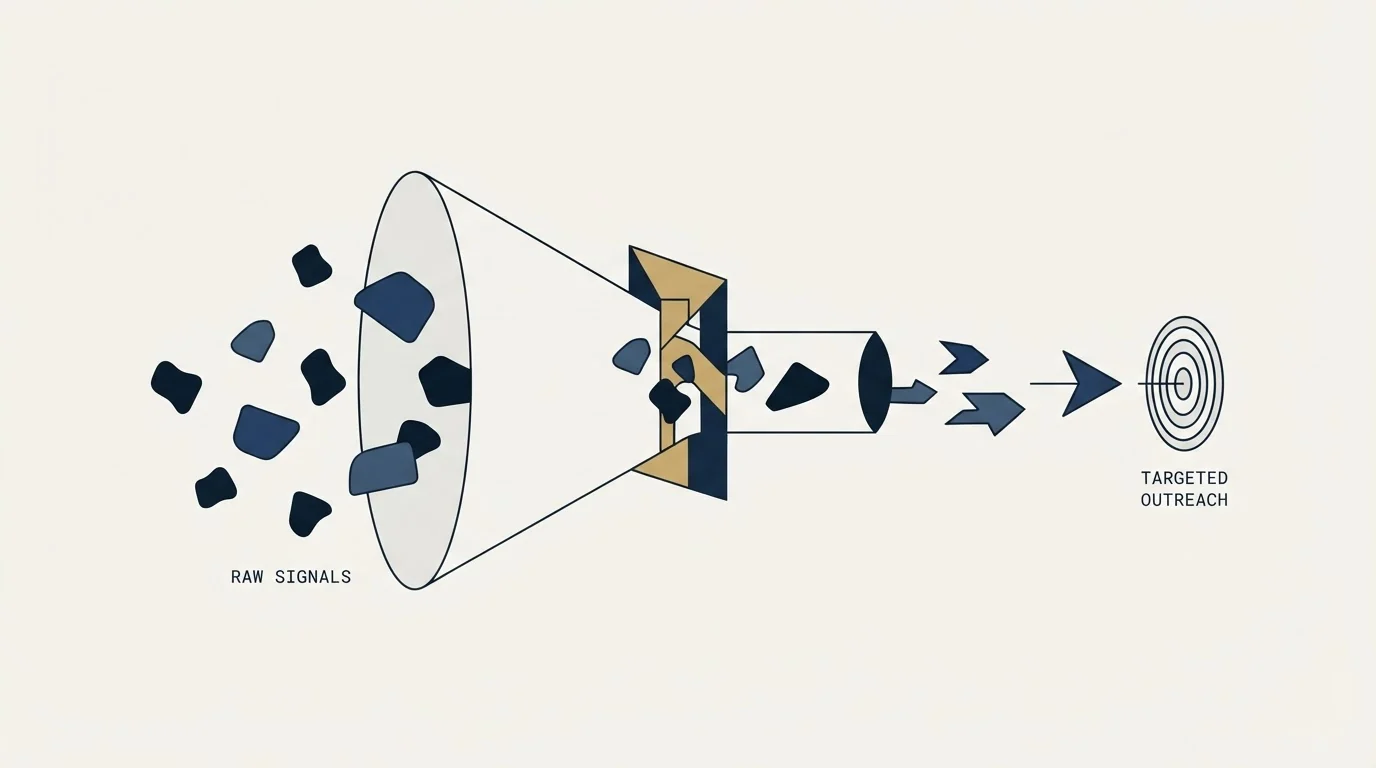
Outbound is where the five jobs are easiest to separate, because the motion is short and every step produces an artefact you can inspect.
Research and drafting carry the value. The expensive part of a first-touch message has always been finding the specific reason this account should hear from you this week and saying it in two sentences. A model reading a job posting, a funding announcement or a product page produces that raw material at a rate a person cannot match, and the resulting message is only as good as the evidence: a hiring signal is a real reason to write, a generic company description is not. The list-building decision still belongs to a person, because a model asked to expand an audience will find companies that resemble the good ones on attributes that had nothing to do with why they were good.
Triage carries the rest. Reply classification at outbound volumes is genuinely tedious and genuinely learnable, and the cost of an error is bounded because a human reads anything ambiguous.
Prediction carries the least, and this is the part that surprises people. Scoring a cold list means predicting from data about companies that have never interacted with you, which is a much weaker problem than scoring inbound behaviour. The honest version is segmentation from firmographic and technographic attributes plus a timing signal, which is a rule you can read rather than a model you cannot.
Our own practice puts a hard boundary around the generating arm. We send one message per campaign, with no bumps and no thread replies, so there is no second touch to repair a message the model got wrong. That raises the review bar rather than lowering it: every drafted message is read against the evidence it was drawn from before the campaign sends, and where the evidence is thin the row comes off the list instead of getting a vaguer sentence. A model that lets a team send more messages faster is only an improvement if the premise under each one is still true, and checking that is the job automation has not removed.
The short version
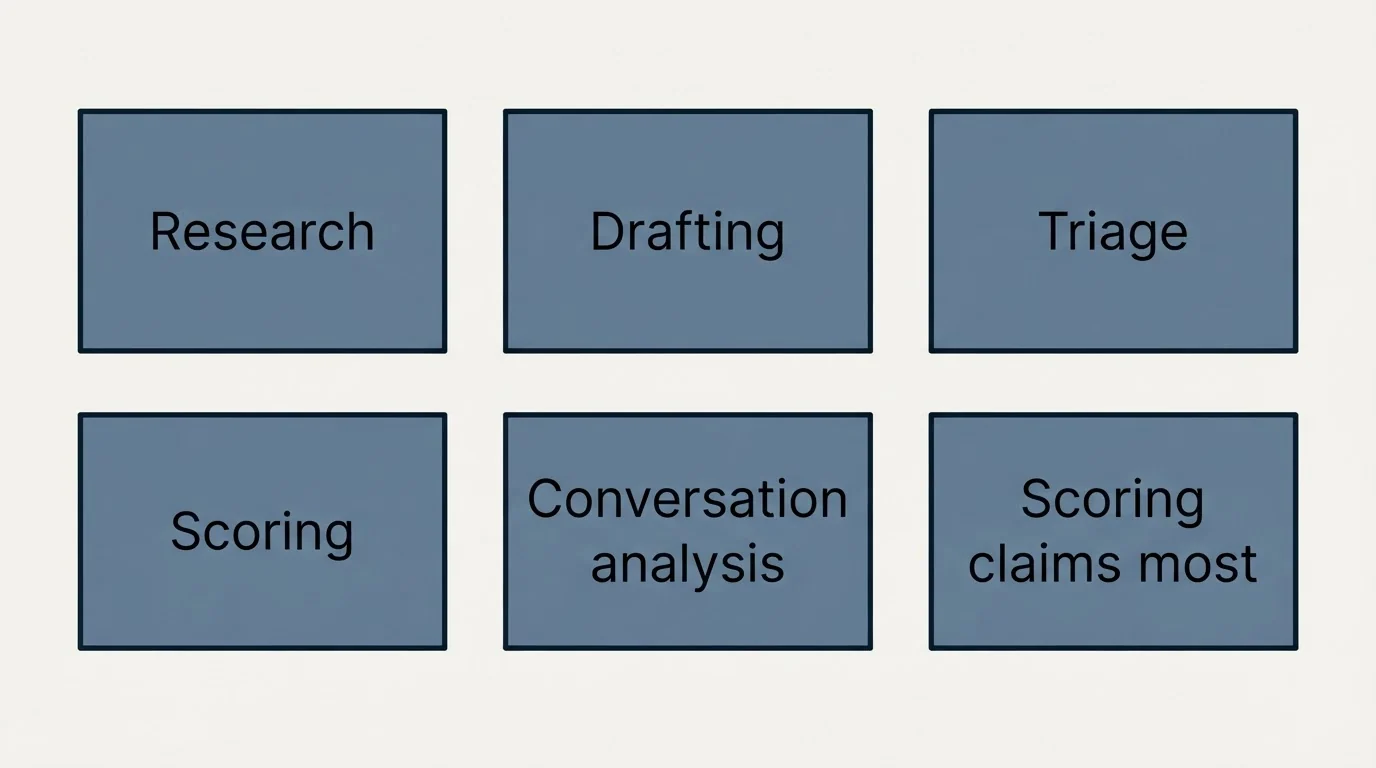
Sales artificial intelligence names where machine-learning models are pointed inside a sales motion rather than a product category. Five jobs sit under it: research, drafting, triage, scoring and conversation analysis. The first three are reliable now, because they compress or classify text that already exists. Scoring and forecasting make the largest claims on the smallest dataset, since a B2B team's closed history is small by the standards of the method.
Evaluate one job at a time, ask what the model reads and what it writes back, and insist on a labelled sample of your own data you can score by hand. In outbound the value concentrates in research, drafting and reply triage, and it is bounded by the quality of the evidence rather than by the model.
The neighbouring definitions are agentic workflow, which is the control-flow property that separates an agent from an automation, AI-guided selling, which is the recommendation layer aimed at a seller in the moment, and deal intelligence, which is the reading of one deal from its own evidence. The product categories are covered in AI SDR and AI sales forecasting tools, and what the models can and cannot be trusted with is set out in AI sales agents.
RevenueFlow runs outbound on its own stack, with research and drafting assisted and every premise checked by a person before anything sends. See what a first campaign produces.
Vendor statements quoted here were verified against the publisher's own page on 2 September 2026. Verify current terms with the vendor before relying on them.
Sources: HubSpot AI
Frequently asked questions.
Frequently asked questions- What is the difference between sales AI and an AI SDR?
- Sales artificial intelligence is the broad description of models doing work inside a sales motion. An AI SDR is one product shape built from several of those jobs at once: list building, research, drafting, sending and reply classification, packaged as a worker. The first is a category of capability and the second is something you buy, so a product can use AI heavily without being an AI SDR.
- Can AI predict which deals will close?
- It can rank deals by an estimated probability, and the ranking is usually more useful than the number attached to it. The constraint is data volume. A team closing a few hundred deals a year produces a small set of labelled outcomes, recorded by the people whose performance they describe, so an individual deal probability carries more uncertainty than a percentage suggests.
- Which sales AI jobs are worth adopting first?
- Research and reply triage. Both compress or classify text that already exists, both are checkable against their source in seconds, and neither depends on how much closed history you have. Drafting is next and needs a review step, because fluent output from a thin record still reads well. Scoring and forecasting are worth the least at the start.
- How do you test a vendor's AI claim before buying?
- Ask which single job the product does, what fields and sources the model reads, what it writes back, and whether a human approves before anything reaches a customer. Then ask for a labelled sample of your own data you can score by hand. An accuracy percentage quoted without the population it was measured on describes a self-selected group of the vendor's users.