Mutual Action Plan Template: The Commitment It Tests
The template is nine rows and six columns. The signal is not the plan, it is whether the buyer edits it, and that arrives before any of the dates do.
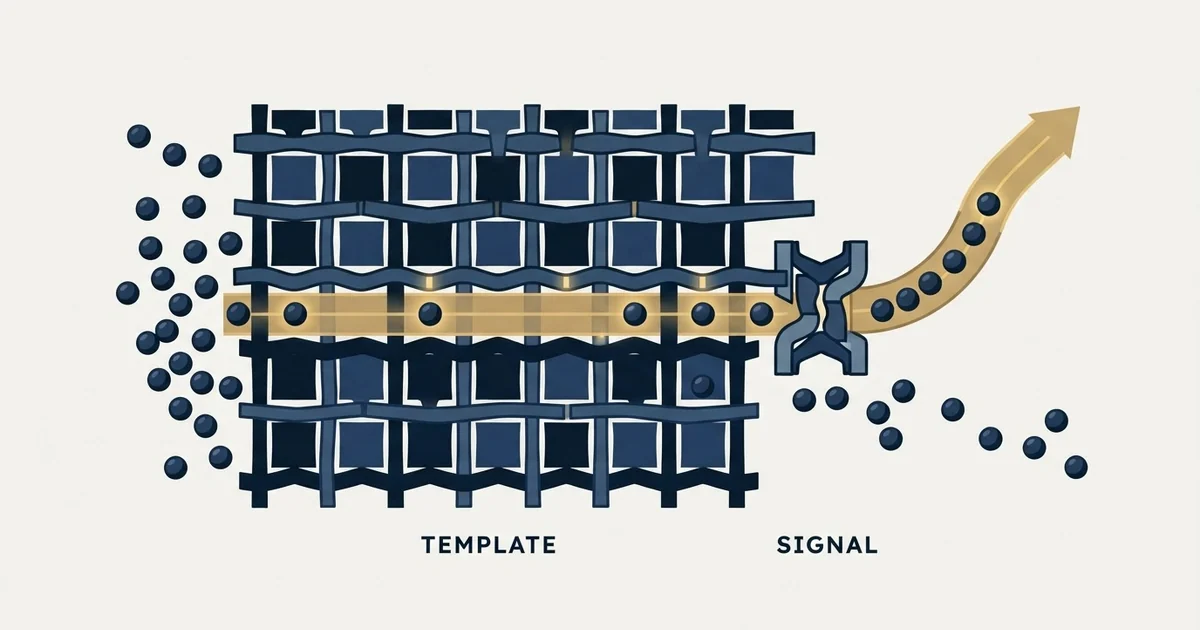
A mutual action plan lists every step between today and a signed contract, with a named owner and a date on each, agreed by both sides. The template matters less than the response to it: a buyer who edits the plan, adds stakeholders and pushes dates is qualifying themselves in a way no transcript can.
Key takeaways
- Every row needs a named individual as owner, because a step owned by a company or a department is a step nobody has agreed to do.
- Roughly half the rows should belong to the buyer; a plan where the seller owns most steps describes a sales process rather than a purchase.
- Work the dates backwards from when the buyer wants value, not forwards from today, so the deadlines follow from something the buyer already wants.
- The buyer returning the plan unchanged is itself a finding: usually a lack of standing to commit, insufficient urgency, or a competing option still in play.
Reviewed and updated September 2, 2026
A mutual action plan is a shared document listing every step between today and a signed contract, with a named owner and a date against each one, agreed by both the buying side and the selling side. The template below is short on purpose. The value is almost entirely in whether the buyer will co-own it, and a longer template makes that test harder to run rather than easier.
Most published mutual action plan templates are downloads: a spreadsheet, a slide, a workspace page. The artefact is not the hard part. Any competent seller can produce a timeline. The hard part is that a plan the buyer has not agreed to is a seller's wish list with dates on it, and it forecasts exactly as well as one.
The same document travels under other names, mutual close plan and close plan among them, and the publishers who use those names, Highspot and Smartsheet on 19 September 2026, treat them as the mutual action plan by another name, with Smartsheet adding that a sales close plan can also be an internal document a sales team uses to outline its own steps.
The template
Six columns, one row per step. Anything beyond this belongs in a linked document rather than in the plan.
| Step | Owner | Side | Target date | Depends on | Status |
|---|---|---|---|---|---|
| Confirm the problem statement in writing | Named buyer contact | Buyer | |||
| Technical review session | Named engineer | Buyer | Problem statement | ||
| Security questionnaire returned | Named seller contact | Seller | Technical review | ||
| Pricing scenarios circulated | Named seller contact | Seller | Problem statement | ||
| Internal business case reviewed | Named economic buyer | Buyer | Pricing scenarios | ||
| Legal and procurement opened | Named buyer contact | Buyer | Business case | ||
| Redlines returned | Named seller contact | Seller | Legal opened | ||
| Signature | Named economic buyer | Buyer | Redlines | ||
| Kickoff and onboarding start | Both | Both | Signature |
Three rules make the difference between this and a project plan nobody reads.
Every owner is a person, not a company. A row owned by the vendor or by IT is unowned. The name is what turns a step into an obligation and, more usefully, into a question you can ask: is this still your step, or has it moved to somebody else.
Ownership structure like this mirrors the discipline behind a runnable go-to-market play, where each play also names one accountable owner and a measurable cadence.
Roughly half the rows belong to the buyer. A plan where the seller owns most steps has been written to describe a sales process rather than a purchase, and that is the most common version in circulation. The buyer's internal work is the part of a deal a seller cannot see and the part most likely to slip, so it is the part that most needs to be visible.
Ownership on the selling side needs the same discipline, and the trigger that earns a second seat is a question the current owner cannot answer with authority.
Work backwards from the date the buyer wants value, not forwards from today. Buyers rarely have an opinion about when to sign and frequently have a hard opinion about when the thing needs to be working. Anchoring on that date and stepping backwards produces deadlines the buyer owns, because they follow from something the buyer already wants.
What the plan is actually testing
The document is a forecasting instrument disguised as a project artefact, and the signal it produces arrives long before any of the dates do.
The signal is the response to the request itself. A buyer who is genuinely trying to solve a problem, and who has some internal standing, will edit the plan. They will correct your assumption about who signs, add the compliance review nobody mentioned, and push a date. That editing behaviour is the strongest qualification evidence available in a late-stage deal, and it costs one email to collect.
A buyer who says the plan looks great and returns it unchanged has told you something too, and it is usually one of three things: they do not have the standing to commit to any of it, the problem is not urgent enough to justify the coordination, or they are being polite while another option is being evaluated. None of those is fatal in itself. All of them change the forecast.
That is why a plan is worth building even in deals that never sign. It converts a slow no into an early one, and it does so without the seller having to ask an awkward question directly.
- Yes: They edited the steps and corrected an assumption
- Yes: They named a stakeholder you had not identified
- Yes: They pushed a date and gave a reason for it
- No: They returned it unchanged with warm words
- No: They agreed verbally and never opened the document
- No: They said the plan was unnecessary because it is basically done
The four ways mutual action plans fail
The seller writes it alone and calls it mutual. The word in the name is the whole mechanism. A plan built without the buyer in the room records the seller's beliefs about the buyer's organisation, which are frequently wrong in specific ways nobody discovers until procurement appears two weeks before the target date.
Dates without dependencies. A flat list of dated steps hides the thing that actually decides the timeline, which is what has to finish before something else can start. The moment a dependency slips, every downstream date is wrong, and a plan without the dependency column will happily show nine green rows and one red one when the real position is that nothing after the red row can happen.
It becomes a management artefact. A plan that exists so a sales manager can inspect the deal, rather than so the two sides can coordinate, gets maintained for the review meeting and abandoned between them. The tell is that the buyer never opens it. Shared editing access is worth insisting on for this reason alone: a document only one side can change is not a shared plan.
Everyone confuses agreement with commitment. A buyer agreeing that a step makes sense is not the same as that buyer having booked the meeting, opened the ticket, or told their legal team it is coming. Where a step depends on the buyer starting an internal process, the useful version of the row is the one that names the trigger action rather than the outcome.
- Step 1Discovery
Establish the problem and the date value is wanted by; too early for a plan
- Step 2After the technical fit is proven
Introduce the plan while there is still work left to coordinate
- Step 3Co-editing
The buyer adds stakeholders, steps and constraints you could not see
- Step 4Maintenance
Update it at each interaction; a stale plan is worse than none
- Step 5Handover
The last rows become the onboarding plan, so the document survives the signature
- Steps describe the sales process
- Owners are companies or departments
- Dates count forward from today
- Buyer receives it as an attachment
- Forecast is unchanged by it
- Steps describe the purchase
- Owners are named individuals on both sides
- Dates count back from the buyer's go-live
- Both sides can edit the same copy
- The buyer's edits are the forecast
There is one more reason to keep the artefact plain. A plan rendered as a polished deliverable invites the buyer to receive it rather than change it, and receiving is the behaviour you least want. A rough table in a shared document, visibly unfinished, asks to be completed. That is a small design choice with a disproportionate effect on whether anyone else touches it.
When to introduce it, and how to ask

Too early and it reads as presumptuous, because nobody plans a purchase they have not decided to consider. Too late and it becomes an administrative formality attached to a decision already made.
The workable moment is after the buyer has confirmed the solution could work and before the internal machinery starts. The ask that lands best is framed around their own risk rather than your process: something close to asking what has to be true internally for this to be live by their target date, and offering to write it down so nothing gets missed. That is a genuinely useful service to a buyer who has not run a purchase like this before, which is most buyers on most purchases.
The plan then belongs in one place both sides can edit, not in an email attachment that forks into six versions. Where the buying organisation is large enough that different people own different rows, the buying committee view of who holds which veto is the map the plan should reflect, and the sales champion is usually the person who will actually maintain it on their side.
Where it fits against qualification frameworks
A mutual action plan overlaps with the paper-process element that MEDDPICC adds to MEDDIC, and it is the practical instrument for gathering it. The framework tells you the paper process matters; the plan is how you find out what it is without interrogating anyone.
It sits after the qualification work rather than instead of it. The problem, the authority and the timing should already be understood from the discovery call, and the plan is where the understanding gets tested against the buyer's willingness to schedule their own side of it. In deals where the buyer already has a vendor, the switching work belongs in the plan explicitly, and the wider argument about positioning against an incumbent explains why that work is usually underestimated.
It is also a better instrument than conversation analytics for the specific question of whether a deal is real. A recording layer reads what was said on the calls it captured, which is a subject we cover in what the recording layer can and cannot tell you. A mutual action plan asks the buyer to commit to something in writing, and the answer to that request is information no transcript contains.
The broader design question, of writing sales stages as steps a buyer has to complete rather than as internal milestones, is the same idea applied to the pipeline as a whole, and it sits in our piece on the sales process. For deals where several people must agree, the B2B sales process when nobody can decide alone is the companion read.
Our own version of this

RevenueFlow agrees qualification criteria in writing before a campaign launches, which is the same instrument applied to a service engagement: a written statement of what counts as a qualified meeting, agreed by both sides before any work starts, so nobody discovers a definitional disagreement after the invoices have gone out. The mechanism transfers because the value is identical. Writing it down converts an assumption into a decision somebody has to actually make.
If the gap is earlier in the funnel, and there are not enough late-stage deals for a plan like this to be the constraint, we will build the first campaign and you can apply this to a fuller pipeline.
Frequently asked questions.
Frequently asked questions- What is a mutual action plan in sales?
- A shared document listing every step between the current moment and a signed contract, with a named owner, a target date and a dependency against each one, agreed by both the buying and selling sides. It covers the buyer's internal work as well as the seller's, which is the part of a deal that most often slips unseen.
- When should you send a mutual action plan?
- After the buyer has confirmed the solution could work and before the internal machinery starts. Earlier reads as presumptuous, since nobody plans a purchase they have not decided to consider. Later turns it into paperwork attached to a decision already made, which produces no signal at all.
- What should a mutual action plan include?
- Six columns are enough: the step, a named owner, which side owns it, a target date, what it depends on, and status. The dependency column is the one usually missing and the one that matters most, because it shows which slipped date invalidates everything downstream of it.
- What if the buyer will not engage with the plan?
- Treat that as the answer rather than as an obstacle. Non-engagement usually means the contact cannot commit to internal steps, the problem is not urgent enough to justify coordination, or another option is being evaluated. Each changes the forecast, and finding out early is the point of asking.
About the author.

B2B cold email experts helping companies generate qualified leads through done-for-you outreach campaigns.
RevenueFlow Team
Explore more.
Ready to scale your outreach?
We build GTM engines that book real meetings. See the receipts.
Related articles.
Sales Enablement Charters: What the Published Ones Ask For
Six publishers set out what a sales enablement charter should contain. Five describe a document nobody can check, and one writes a definition with inspection in it.
Win Rate Benchmarks: Which Figures State a Population
A catalogue of the published average sales win rates, sorted by whether the page names the population behind its own number. Most do not.
Sales Kickoff Agendas: Five Published, Session by Session
Five publishers print a sales kickoff agenda. They agree on four blocks and disagree on session length, rehearsal and where the agenda comes from.
Sales Cycle Length Benchmarks: What Each Figure Counts
The published B2B sales cycle benchmarks, sorted by what each page says it counted. The same number means two different things in two of them.
Sales Comp Plan Design: What the Publishers Prescribe
Four publishers set out how to design a sales compensation plan. Here are their procedures, their components, and which of their ratios carry a population.
Sales Prospecting for SEO Agencies: Four Public Signals
How an SEO agency builds its own prospect list from signals Google documents: the index check, position, core update dates and site moves, under the warning owners read.