Discovery Call Frameworks: The Published Ones, Side by Side
The named discovery call frameworks from their publishers: Winning by Design's AxNOT and SP3V, 30MPC's four steps, SPIN, POWERFUL and PACT, side by side.
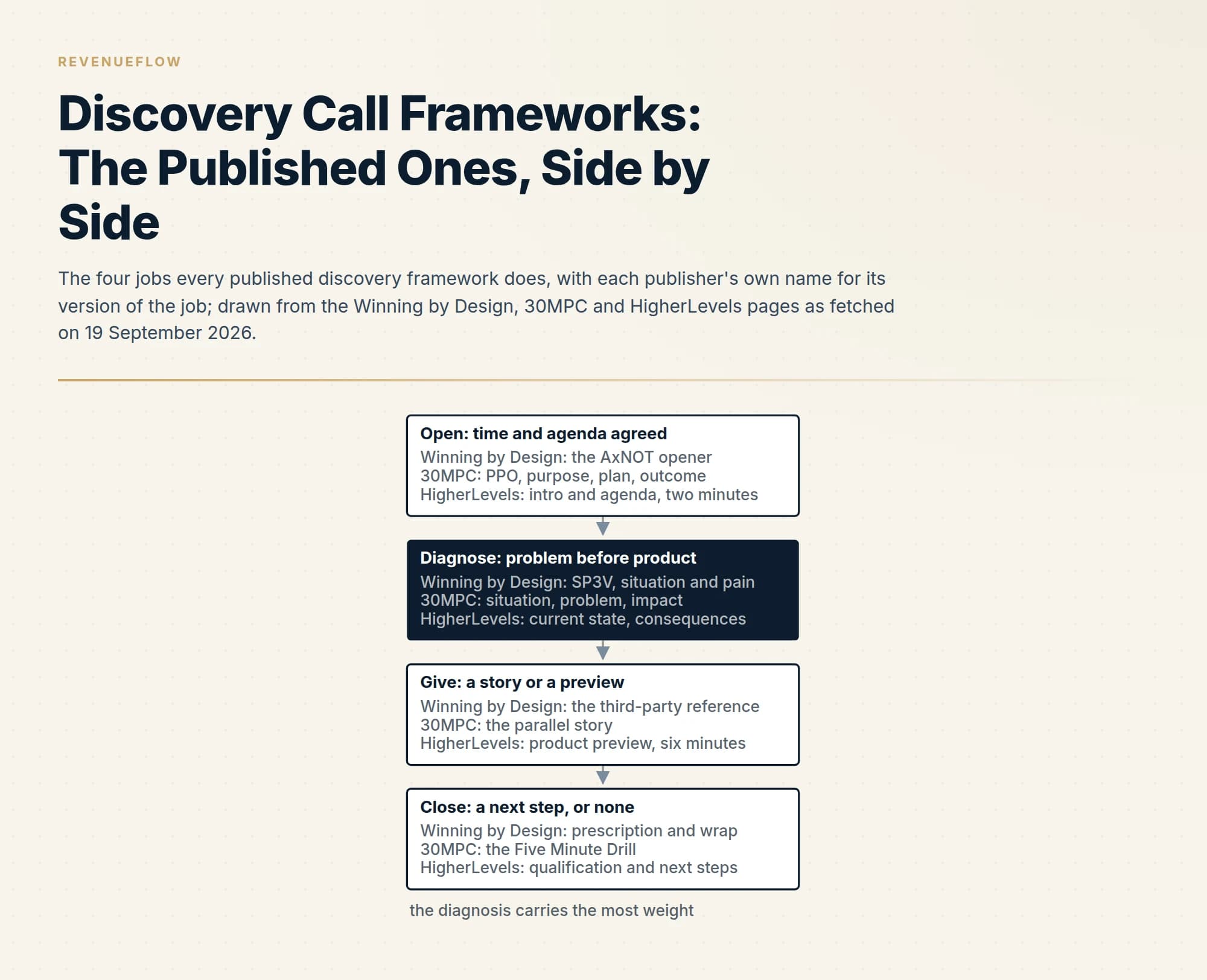
Every published discovery call framework does four jobs: agree the time and agenda, reach the problem before the product, give the buyer a peer's story or a preview, and close on a next step the deal earned. Winning by Design names AxNOT and SP3V; 30MPC names PPO and the Five Minute Drill; SPIN, POWERFUL and PACT supply questions and lenses.
Key takeaways
- Winning by Design's five-step anatomy names a 45-second opener, AxNOT, and a diagnosis, SP3V, under the heading that prescription before diagnosis is malpractice.
- 30MPC's four-step minimum viable framework runs PPO, Situation-Problem-Impact, a parallel story and the Five Minute Drill, on the premise that not every deal deserves a next step.
- The frameworks differ in what the middle is built from: a question order (SPIN), a problem-to-impact chain, a story, or a qualification lens (Salesforce's POWERFUL, Bertuzzi's PACT).
- All of them are written for an inbound call and none says how the call was obtained; a call booked from a cold message starts further back and has to establish the problem first.
Reviewed and updated September 19, 2026
A discovery call framework is a published, named structure for the first real conversation with a prospect, and the useful ones have authors. Winning by Design's five-step anatomy has a named opener and a named diagnosis; 30 Minutes to President's Club's four-step minimum viable version has a named agenda and a named close; the question frameworks that run inside the call, SPIN and the qualification lenses, have publishers of their own. Most pages about discovery frameworks blend these into one anonymous list. This page keeps the names on them, sets them side by side from the publishers' own text, and says what they agree on and where they differ.
The structure we run ourselves, five stages with the minutes attached, the questions that change the answer and the case for treating disqualification as an output, is on the discovery call, and it is not restated here. The definition, and why a clean no is a good outcome, is the discovery call entry. This page is about the published frameworks a reader meets when they search for one.
Winning by Design: five steps, two acronyms
Winning by Design's post The Anatomy of a Perfect Discovery Call (published 14 December 2016, last modified 31 December 2025, fetched 19 September 2026) is the oldest framework in the search results and the most fully named. Its premise is a heading: "Prescription before Diagnosis is Malpractice". Its five steps are preparation, an opener, confirming the agenda, diagnosis, and prescription with a wrap.
The opener has a name, AxNOT, and a duration: "Your opener should take about 45 seconds". The letters are the first words of five lines: appreciate the time, confirm the time available, say the customer will naturally have questions, say the seller obviously has questions, and say what the call typically ends with, including the invitation to stop it. The post's own reason for spending the first minute this way: "Discovery calls need to be conversations, and not 1-way sales pitches. The customer needs to know they have control, and their concerns will be addressed." Step three asks everyone on the call what they want from it, with the instruction to "Write down their names, and make sure you address their top priorities before the end."
The diagnosis has a second acronym, SP3V: Situation, Pain, a third-party reference, and Value. Situation questions "show you have done some research, but also help you qualify the customer on basic minimal requirements." After the pain is summarised, the seller shares a customer story, because "Early in the sales conversations, customer's care more about how their peer's solved a similar challenge." Value is where the seller begins "to transition from emotional to rational decision making and quantify the value of your solution." The post's closing diagnosis of what goes wrong is one sentence: "Most new sales professionals offer feature-based solutions way too early into the conversation."
30MPC: four steps, a drill at the end
Armand Farrokh's post for 30 Minutes to President's Club (published 12 July 2024, fetched 19 September 2026) is the newest named framework in the results and the most deliberately small. Its design principle: "Control the beginning, control the end, find 1-2 big problems... then you can layer on all the fancy tricks from there." The four steps are an agenda, a problem-finding question set, stories, and a close.
The agenda is PPO, Purpose, Plan and Outcome, which the post credits to Doug Landis. The question set is Situation-Problem-Impact, and the post is explicit about why it exists: "Situational and process questions lead to discovery fatigue because they feel like doctor's checklist questions. They lead to surface level discussions that rarely unveil a problem." The seller's job is to "find their situation quickly, turn that situation into a problem, then figure out why that problem impacts the business." The third step is the parallel story, told whenever the buyer shares a problem, and it is the post's answer to the interrogation complaint.
The close is the Five Minute Drill, three questions asked at the end of every discovery call, and it begins from a premise the other frameworks leave implicit: "Believe it or not, not every deal deserves a next step." The three questions establish whether the prospect wants to buy, when, and how, and the post's rule for the third is a line worth keeping: "Okay sellers ask for next steps. Good sellers suggest next steps to steer the sales cycle in the right direction."
The rest of the field, and what each is built from
The other named structures in the results are variations on the same four jobs. HigherLevels' step-by-step framework for tech sales (fetched 19 September 2026) puts minutes on each part, headed "PART 1: INTRO + AGENDA (2 MINUTES)" and "PART 2: DISCOVERY (18 MINUTES)", with the discovery split into current state, negative consequences, future state and business outcomes, then a six-minute product preview and four minutes of qualification and next steps. UserGems' three-step structure (published 6 February 2026) starts with what it calls a menu of pain, digs into it with open-ended questions, and closes with prompts that encourage transparency. Avoma's nine-step version (published 27 June 2025) runs from a professional introduction through agenda, open-ended questioning, active listening, qualification, objections, a summary and next steps to a post-call reflection.
What separates the frameworks is what the middle is built from, because everyone agrees on the opener and the close.
A question order. SPIN, as Huthwaite International publishes it, is four question types, Situation, Problem, Implication and Need-Payoff, which its guide (published 24 June 2021, modified 19 June 2026, fetched 19 September 2026) describes as "a logical framework rather than a rigid sequence". Winning by Design's post recommends studying it by name. The four types and the order they depend on are defined in the SPIN Selling entry.
A problem-to-impact chain. 30MPC's Situation-Problem-Impact and HigherLevels' current state, consequences, future state, outcomes are the same instrument with different labels: a difficulty is found, then followed to what it costs.
A story. Winning by Design's third-party reference and 30MPC's parallel story both insert a customer's account of solving the same problem at the moment the buyer has named it, and both publishers give the same reason, that the buyer will believe a peer before a claim.
A qualification lens. Salesforce's guide to discovery calls (published 11 October 2023, modified 14 October 2025, fetched 19 September 2026) defines the call as "a conversation with a prospect early in the sales process, meant to determine if a customer is right for a product and find motivations that will help you make the sale." and offers an eight-letter checklist, POWERFUL, for what to listen for: problem, opportunity cost, wants, executive influence, resources, fear of failure, trust and the little things. Trish Bertuzzi's PACT, published on LinkedIn on 14 September 2016 and rendered on 19 September 2026, is the lens written for sales development teams handing calls to closers: "I recommend a qualification methodology called PACT", which stands for pain, authority, consequence and target profile. Her case against the older lens is one line: "Qualifying for BANT is like going on a first date and asking to see a credit report." The wider family of qualification checklists, and the blind spot each one carries, is on sales qualification frameworks.
| Instrument | Who publishes it | The named parts |
|---|---|---|
| A question order | Huthwaite International, SPIN | Situation, Problem, Implication, Need-Payoff |
| A problem-to-impact chain | 30MPC; HigherLevels | Situation, problem, impact; current state, consequences, future state, outcomes |
| A story | Winning by Design; 30MPC | The third-party reference; the parallel story |
| A qualification lens | Salesforce, POWERFUL; Trish Bertuzzi, PACT | Problem, opportunity cost, wants and five more; pain, authority, consequence, target profile |
One published opener, taken apart
The opener is where the frameworks are most alike and where a named version helps most, because it is the part a new seller can rehearse word for word. Winning by Design's AxNOT is the fullest published example. The five parts below are the post's own lines, paraphrased into the jobs each one does; the wording on the page is the seller's, and a team should write its own.
The fifth part is the one the other frameworks lack. It hands the customer a way to end the evaluation early and legitimises a no in the first minute, which is the same job the up-front contract does in Sandler's system and the same job our own structure gives its opening frame. A framework whose opener does not include that line has left the most useful sentence out.
What the frameworks agree on, and the one thing they cannot do
Read together, the published frameworks agree on more than their acronyms suggest. Every one opens by agreeing the time and the agenda. Every one is built to diagnose before it prescribes, putting the problem before the product in wording that ranges from Winning by Design's malpractice heading to 30MPC's discovery fatigue. Every one ends with a next step that has a shape, and the two most-cited close on a test of whether the deal deserves one at all. And every one is silent on the same thing: none of them says how the call was obtained.
That silence matters for an outbound team because the call a framework is written for is an inbound one. Salesforce's definition says the discovery call "happens after the prospect has shown interest in your company and converted from a cold lead to a warm opportunity." A call booked from a cold message starts further back: the prospect took it out of mild interest, and the first job is establishing that the problem the message assumed actually exists. Our own page on the discovery call makes that distinction between inbound and outbound calls its last section, and a published framework applied without it reads as presumptuous in its first five minutes.
- Yes: An opener that agrees the time and the agenda before any question
- Yes: A named way to reach the problem before the product is mentioned
- Yes: A question that follows the problem to its cost or consequence
- Yes: A close that tests whether the deal deserves a next step
- Depends: A way for the customer to say it is not a fit, early
- No: A source of calls to run it on
- No: Criteria for what counts as qualified, agreed before the call
Where our own practice differs
Two of the frameworks above carry a qualification lens with authority and resources in it, and PACT's author adds timing for mature markets. We keep budget, timing and decision authority out of the definition of a qualified meeting, and the reason is commercial: we are paid on attended qualified meetings, so the definition has to be one both sides can check. A meeting qualifies when the company is in the agreed audience, the person has real responsibility for the area, they agreed to a relevant business conversation and they attended, against criteria written down before the campaign launches. Every lens on this page is a fine thing to run on the call. None of them is a condition on whether the call counted.
The other difference is upstream of the call. The frameworks describe a conversation; we send one message per campaign to get it, on one premise, sent once, and a later approach is a separate campaign rather than a reminder. The reasoning, and what it costs, is set out where we take apart a published fifteen-touch cadence, the Agoge sequence.
The short version
The published discovery frameworks share four jobs: agree the time and agenda, reach the problem before the product, give the buyer a peer's story or a preview, and close on a next step that the deal has earned. Winning by Design names its opener AxNOT and its diagnosis SP3V; 30MPC names its agenda PPO, its questions Situation-Problem-Impact and its close the Five Minute Drill; HigherLevels puts minutes on each part; SPIN supplies a question order, Salesforce's POWERFUL and Bertuzzi's PACT supply lenses for what to listen for. They differ in what the middle is built from and they agree on almost everything else. None of them obtains the call.
If the constraint is the number of calls to run a framework on, that is the half we do, with the qualification criteria agreed in writing first, and a first campaign is the cheapest way to see what your market returns.
Every quotation above is from the named page as fetched on 19 September 2026: Winning by Design's The Anatomy of a Perfect Discovery Call (published 14 December 2016, modified 31 December 2025); Armand Farrokh's 30MPC post (published 12 July 2024); Huthwaite International's complete guide to SPIN Selling (published 24 June 2021, modified 19 June 2026); Salesforce's discovery call guide (published 11 October 2023, modified 14 October 2025); Trish Bertuzzi's LinkedIn article Qualification 2.016 (published 14 September 2016); HigherLevels, UserGems and Avoma as fetched. Publishers revise these pages; confirm the current text before relying on it.
Frequently asked questions.
Frequently asked questions- What is a discovery call framework?
- A published, named structure for running the first real conversation with a prospect. The ones with authors include Winning by Design's five-step anatomy, with its AxNOT opener and SP3V diagnosis, and 30MPC's four-step minimum viable framework, with PPO, Situation-Problem-Impact, a parallel story and the Five Minute Drill. Question orders such as SPIN and lenses such as PACT run inside those structures rather than replacing them.
- What do the published discovery frameworks have in common?
- Four jobs. They open by agreeing the time and the agenda, reach the problem before the product is mentioned, give the buyer a peer's story or a preview once the problem is named, and close on a next step with a shape. The two most-cited frameworks also test whether the deal deserves a next step at all, and Winning by Design's opener invites the customer to stop the call if it is not a fit.
- Which discovery call framework is best for outbound calls?
- None of them was written for one. Salesforce's definition places the discovery call after the prospect has shown interest and converted to a warm opportunity, and the other publishers assume the same. A call booked from a cold message starts further back, so the first job is establishing that the problem the message assumed actually exists, before any of the named diagnoses is run. The opener and the close transfer as they are.
- Is PACT better than BANT for discovery calls?
- Trish Bertuzzi, who published PACT in 2016, argues that qualifying for BANT is like asking for a credit report on a first date, and proposes pain, authority, consequence and target profile instead, adding timing for mature markets. PACT is a lens for what to listen for on the call rather than a call structure. Whether any lens should decide if a meeting counted is a separate question, and our answer is no.
About the author.

B2B cold email experts helping companies generate qualified leads through done-for-you outreach campaigns.
RevenueFlow Team
Explore more.
Ready to scale your outreach?
We build GTM engines that book real meetings. See the receipts.
Related articles.
Command of the Sale: Force Management's Process Programme
Command of the Sale is Force Management's sales process and qualification programme, not its messaging one. What the vendor says it is, delivers and how it runs.
Gap Selling vs SPIN Selling: What Each Method Diagnoses
Gap Selling and SPIN Selling from their authors' own pages: four question types that develop a stated need, against a measured gap between two states.
MEDDIC vs BANT: What Each Qualifies and When to Use Which
MEDDIC and BANT from the originators' own text: IBM's BANT form as a gate after the first call, PTC's six themes as an audit of a live deal, and when to run each.
MEDDIC vs SPICED: What Each Qualifies, From Both Publishers
MEDDIC and SPICED from their own publishers: six themes that audit an existing deal against five elements written to carry across a subscription customer's whole journey.
LinkedIn Outreach for Machine Shops
How a job shop or CNC machine shop uses LinkedIn to win OEM work: the four buyer titles, the RFQ gate, the ISO, AS9100 and ITAR facts, and LinkedIn's own rules.
The Columbo Close: One More Thing, and Where It Works
The Columbo close is the question asked from the door once the buyer thinks the selling is over. Its two readings, the buyer it suits, and where it fails.