Freight Broker Lead Lists: The Shipper Row and Its Sources
What a usable shipper row contains for a freight broker, which sources hold each field, what list vendors say they sell, and how to check a list before contact.
A freight broker's shipper list is worth what its freight fields are worth: commodity, equipment, shipping sites, a volume signal and where loads are tendered. The trade association says contact data on sold lists is the weakest part. Build from shipment history, customers' trade bodies, directories and satellite views, and treat vessel manifest data as partial.
Key takeaways
- The Transportation Intermediaries Association says traffic managers are engaged by 6 to 10 new sales reps every week and often give list companies an email address that goes directly to spam folders.
- A broker in a 12 August 2020 r/FreightBrokers thread sizes a worthwhile shipper at 100 to 1000+ trucks per week and calls finding who tenders loads, across offices and third parties, quite a maze.
- CBP quotes 19 C.F.R. 103.31: the public may request information from vessel manifests, and importers or consignees may request confidential treatment, so import-record lists are partial by design.
- IndustrySelect's page advertised nearly 350,000 freight shippers and 850,000 executive contacts on 18 September 2026, with direct contacts and data exports split across four subscription tiers.
Reviewed and updated September 18, 2026
Freight Broker Lead Lists: The Shipper Row and Its Sources
A new broker buys a list of twenty thousand shippers on a Monday. By Thursday the first three hundred rows have produced forty wrong numbers, sixty front desks that have never heard of the named contact, and one traffic manager who says she gets this call eight times a week and has used the same two brokers for years. The list was not fake. Every company on it ships something. What it could not say was which of them ships the broker's freight, on the broker's lanes, through a person who can tender a load.
This page is for the freight broker, the agent and the small 3PL buying or building a list of shippers to contact. It covers what a usable shipper row contains, which sources hold each field, what the list vendors in this market say they sell, and how to check a list before anyone calls or writes. The live guide to logistics lead generation argues that a list is only a snapshot of who ships and that the reason to contact a shipper comes from a change at that shipper. This page agrees, and treats the list as the account layer that argument needs. The general anatomy of a list row is in the glossary entry for a lead list. Every outside source was fetched on 18 September 2026.
What the trade association says about bought lists
The Transportation Intermediaries Association published its own answer, Where to Find the Best Freight Shipper Leads, and it is not kind to the product this search is looking for. Decision makers, which the piece calls traffic managers, "are engaged by 6 to 10 new sales reps every week." They often wear multiple hats, managing docks, warehouses, or facilities, so they are already overwhelmed and difficult to reach. On purchased data the piece is blunt: executives are fatigued from spam generated by their address sitting in a database "that is sold to the masses", so they often supply the list company with an email address that goes directly to spam folders. "Managers reserve their direct contact information for people who earn their trust and respect."
That is the association's view, and it has a preference for the phone built in. It is still the most useful framing a list buyer can start from: the contact column is the weakest part of any bought shipper list, and the company and freight columns are the part worth paying for.
The fields that make a shipper row usable
A broker in the r/FreightBrokers thread Are there any good databases for leads?, opened on 12 August 2020, states the sizing rule nobody puts on a vendor page. "as a broker we're looking for a shipper that has a lot of trucks to load," the reply says, and it puts the range at 100 to 1000+ trucks per week, because a shipper with 10 to 40 loads a week has too much time to find the cheapest carriers possible. The same reply explains why the contact is hard: between regional offices, headquarters, and third parties handling procurement, finding who tenders loads "can be quite a maze". Another reply adds that the decision maker is usually at a head office, or the shipper runs a request for proposal or quote once a year.
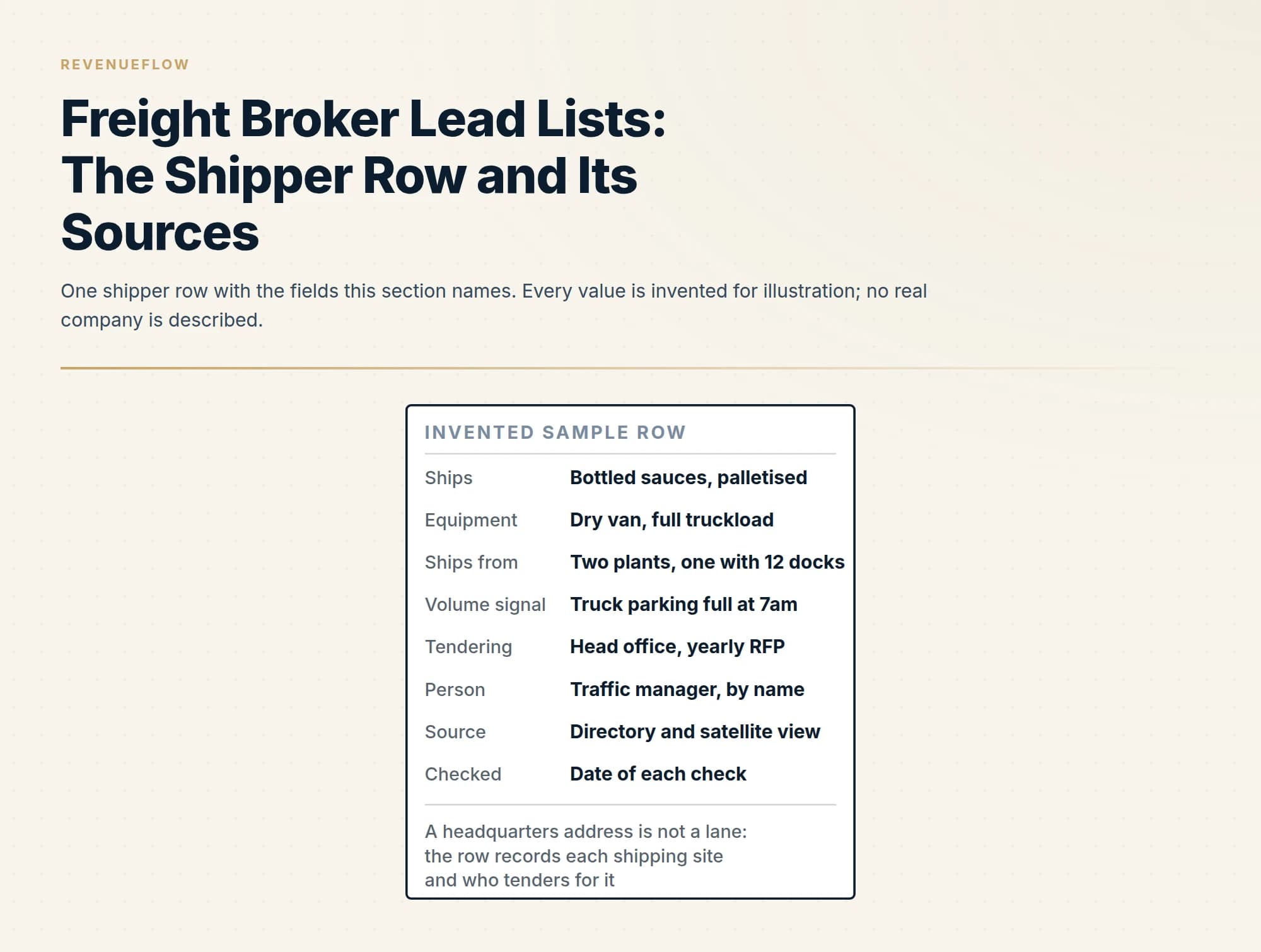
Those two replies, with the association's piece, give the fields that matter. What the company ships and on what equipment. Where it ships from, site by site, because a broker sells lanes and a headquarters address is not a lane. A volume signal. Where tendering is decided, which may be a different address from the dock. The person: TIA's traffic manager, or the shipping manager and shipping coordinator titles that SalesDash, a freight CRM vendor, uses as its example search in how freight brokers find shipper leads. And, as the glossary entry insists, where each field came from and when.
The sample row in the figure is invented to show the shape: a maker of bottled sauces, palletised, shipping dry van full truckload from two plants, one with 12 docks and truck parking full at 7am, with tendering at head office through a yearly RFP. The source is a directory and then the satellite view, and every check carries its date.
Which sources hold which field
No single source holds the whole row. The sources below are the ones the vertical's own voices name, plus one federal record.
The broker's own system. TIA's first recommendation is past shipping data in the transportation management system. The best leads, it says, are former paying parties, shippers, consignees, or brokers, who have not recently booked a shipment, and it suggests agreeing a definition of a lost customer, such as no shipments in the past six months. These rows arrive with lanes, commodity and a name already filled in.
The customer's trade bodies. TIA's second: ask the best customers which industry-specific organisations they belong to and which trade shows they attend, then join as an affiliate member to gain access to the membership lists. That yields companies that ship the same commodity as freight the broker already handles.
Manufacturer directories. The thread's opening post names MNI, the publisher behind IndustrySelect, whose shipper database page for freight brokers advertised, on the fetch date, nearly 350,000 freight shippers and 850,000 executive contacts. A reply dated 17 April 2026 notes that various databases are free through most local library websites.
The satellite view. A truck driver in the thread describes the cheapest field source there is: pull up an industrial area in a map's satellite view and read the size of the dock area and the truck parking to judge how much business a site does, and whether it is mainly a shipper or mainly a receiver. A broker replies that map search by industry and state has worked well, and another calls it the greatest prospecting tool.
Vessel manifests, with a hole in them. For importers, U.S. Customs and Border Protection's page on vessel manifest confidentiality quotes the regulation, 19 C.F.R. 103.31: members of the public may not examine vessel manifests, but "they may request and obtain from Customs, information from vessel manifests". The same regulation lets an importer or consignee request confidential treatment of its name and address. Import-record products are built on that disclosure, and so they are blind to every importer that asked to be hidden.
What the federal motor carrier registry is for. The Federal Motor Carrier Safety Administration's broker registration page concerns brokers and carriers. It is where a shipper checks the broker, and where a broker checks a carrier. It lists no shippers.
What the vendors in this search say they sell
Three kinds of seller appear in the results, and each one's own page says what it is.
IndustrySelect sells directory access by subscription. Its page describes four tiers that differ on two things: whether direct executive emails, phones and LinkedIn profiles are included, and whether data can be exported. The lowest tier is view-only with no direct contacts, and only the highest includes both exports and direct contacts. A buyer should read the tier before the row count.
FreightLeads describes two products on its home page: direct shipper data the broker works alone, which it says can be searched by lane, equipment, volume, and industry, and a service that brings live rate requests. Primax Freight Leads is not a list at all by its own description. It is an appointment setting service that says it makes cold calls on the broker's behalf and speaks directly to shipping managers. These are the vendors' statements about themselves on the fetch date, and this page has tested none of them.
The question to put to any of them is the glossary's: for a given row, which source produced each field, and when was it last checked. TIA's warning about addresses that route to spam folders is an argument for buying company and freight fields and building the contact field by hand.
Check the list before anyone is contacted
Order matters here, because each check is cheaper than the one after it.
- Step 1Is it a shipper?
Remove carriers, brokers and sites that are mainly receivers.
- Step 2Does it ship your freight?
Commodity, equipment and lanes against what the brokerage can quote.
- Step 3Is the volume there?
Dock area and truck parking, or past loads in the broker's own system.
- Step 4Is the person real and current?
Name and role confirmed from the company's own pages, then the address verified.
The first check exists because of a trap the live logistics guide names: the industry classification that says logistics covers both the companies that buy freight services and the companies that sell them, so an unfiltered list puts competitors in front of the broker's own message. The last check is ordinary list hygiene, and what verification can and cannot tell you is covered in email list cleaning.
The rules that touch this list
Two channels, two sets of rules. For email, the Federal Trade Commission's CAN-SPAM compliance guide covers commercial messages to business addresses as well as consumer ones, and requires among other things a valid physical postal address in the message and a way to opt out. For the phone, the federal position on business-to-business calls, and the separate statute on autodialers and mobile numbers, are quoted in is cold calling against the law. A bought list often cannot say which numbers are mobiles, which that page treats as a data problem before it is a legal one. On the data itself, the manifest regulation above is the one rule specific to this trade: the record is public by request and any party to it may ask to be hidden. This page gives no legal advice.
Three reasons to write, each from a source
A list row becomes a reason to make contact when something on it is dated. Three that the sources above support, none of which names a real recipient:
A lost customer. TIA's definition, no shipments in the past six months, produces a row whose opening sentence writes itself: the broker moved this shipper's freight on a named lane and wants to know what changed.
A site with visible volume on a lane the broker already runs. The satellite view gives the dock count and the truck parking, and the broker's own carriers give the lane. The opening names the lane and asks for one quote.
An importer newly visible at a port the broker serves. The manifest disclosure gives a consignee name and a port. The opening asks who handles drayage and inland moves from that port, and nothing else.
When a bought list is the wrong play
When the broker has years of shipment history and has never worked it, the list to build is already in the system, and the association says so. When the brokerage is strong on a few lanes, a national list is mostly rows it cannot quote. And when the plan is to send the same sentence to every row, the live logistics guide has already explained the result: every shipper has a provider, and only a change at the shipper reopens the question.
Where this sits in our own work
RevenueFlow builds lists and runs email and LinkedIn for clients. We do not cold-call, and the calling in this trade is described here as the trade's own practice. Our campaigns send one message per list, with no bumps behind it, so the list has to carry the reason. The arithmetic of why a smaller, tighter list tends to reply better is in the lead list entry, and what a bought contact file is and is not is set out in what you are actually buying with an email list. If a lane-specific shipper list and a first message are the part you would rather have built, see what a first campaign would target.
The short version
A freight broker's list is worth what its freight columns are worth: commodity, equipment, shipping sites, a volume signal and where loads are tendered. The contact column is the part bought lists get worst, by the trade association's own account. Build from shipment history, customers' trade bodies, directories and the satellite view, treat manifest data as partial by design, check that each row is a shipper that ships your freight before checking the address, and contact a row when something on it has a date.
Frequently asked questions.
Frequently asked questions- Where do freight brokers get shipper lead lists?
- From five kinds of source named by the trade itself: the brokerage's own shipment history, membership lists of the trade bodies its best customers belong to, manufacturer directories such as IndustrySelect, map satellite views of industrial areas, and vessel manifest information for importers. Federal motor carrier registration data covers brokers and carriers and lists no shippers.
- What fields should a shipper lead list include?
- What the company ships and on what equipment, each shipping site with a dock or volume signal, where load tendering is decided, the traffic or shipping manager by name, and the source and date of every field. A broker in the r/FreightBrokers thread sizes a worthwhile shipper at 100 to 1000+ trucks per week and notes the decision maker is often at a head office.
- Are bought shipper lists worth it for a freight broker?
- For the company and freight fields, often yes; for contacts, the trade association is sceptical. TIA writes that executives tired of spam give list companies an address that goes directly to spam folders and reserve direct contact details for people who earn their trust. Read a vendor's tier for whether direct contacts and exports are included before reading its row count.
- Can import records be used to find shippers?
- Partly. U.S. Customs and Border Protection quotes 19 C.F.R. 103.31: the public may not examine vessel manifests but may request and obtain information from them, and an importer or consignee may request confidential treatment of its name and address. Products built on that disclosure therefore miss every importer that asked to be hidden.
About the author.

B2B cold email experts helping companies generate qualified leads through done-for-you outreach campaigns.
RevenueFlow Team
Explore more.
Ready to scale your outreach?
We build GTM engines that book real meetings. See the receipts.
Related articles.
B2B Lead Lists for Collection Agencies: Fields and Sources
What a creditor prospect list needs for a collection agency: the fields that matter, the FDIC, NCUA, CMS and court sources behind them, and the rules that apply.
Sales Outsourcing for SaaS Companies: What to Hand Over
For SaaS companies weighing an outside sales team: what the industry's own survey found, what a third party cannot hold in a software sale, and what can go out.
Cold Calling Scripts for SEO Agencies: After Google's Warning
Six call scripts for SEO agencies calling local businesses, written around what Google and the FTC tell owners about this call: no Google tie, no ranking guarantee.
Lead Generation for Telecommunications Companies: Four Lead Sources
For carriers, ISPs, UCaaS providers and MSPs: the installed base, the advisor channel, dated outbound and the funded network map as lead sources, with FCC rules.
Cold Calling Scripts for 3PL Companies: One Lane at a Time
Six call scripts for brokers and 3PLs calling shippers: the front office line, the one-lane opener, the incumbent answer, the email brush-off and the voicemail.
LinkedIn Outreach for Machine Shops
How a job shop or CNC machine shop uses LinkedIn to win OEM work: the four buyer titles, the RFQ gate, the ISO, AS9100 and ITAR facts, and LinkedIn's own rules.