LinkedIn Lead Generation for Commercial Insurance Agencies
LinkedIn lead generation for a commercial insurance agency: where the buyers are sourced, what a licensed producer may say in a note, and the three rules that reach it.
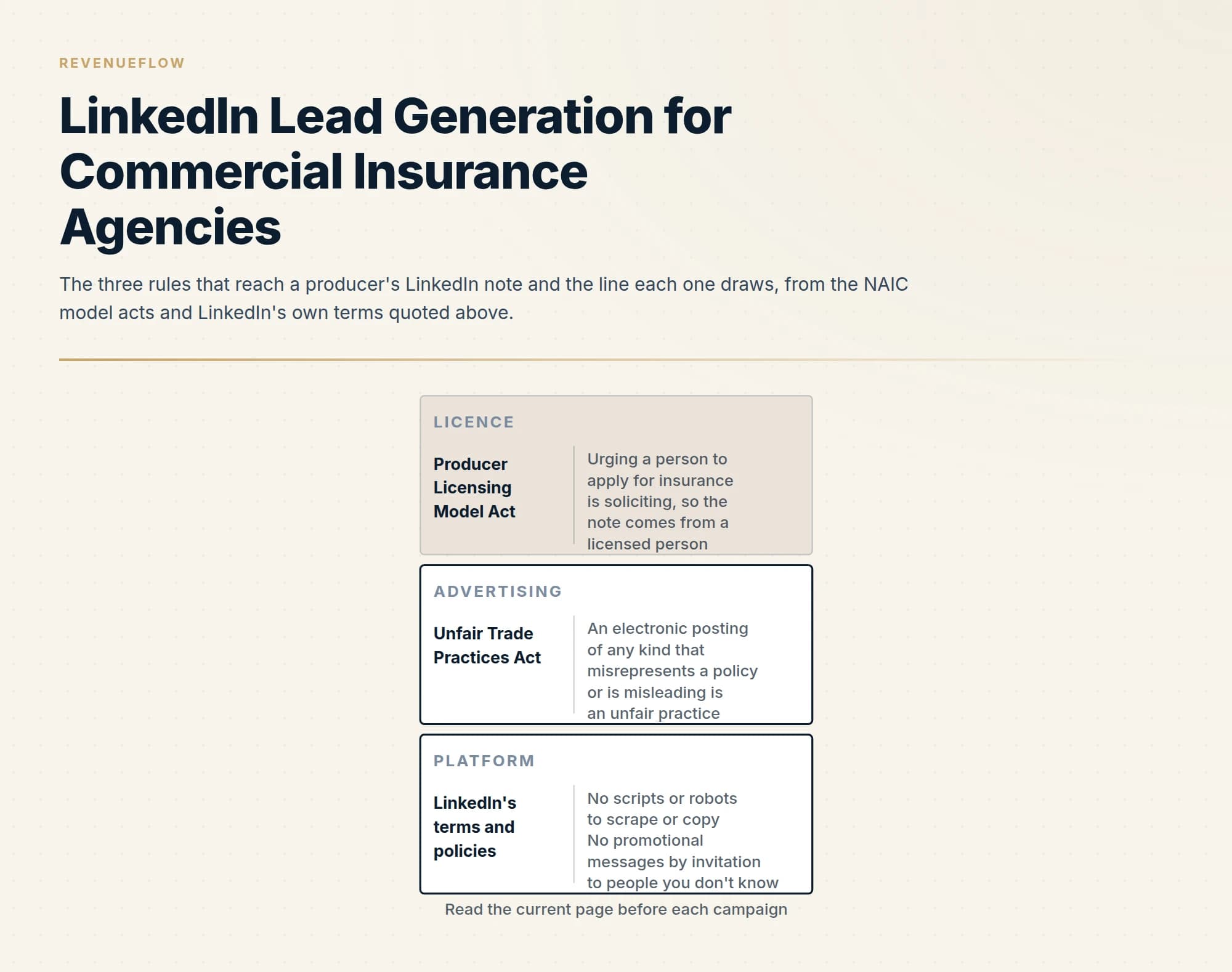
A commercial insurance agency sources buyers by role on LinkedIn: risk managers through RIMS, finance and HR leads through the company, owners one profile at a time. A producer's note is solicitation under the NAIC licensing model and a posting under its advertising model, and LinkedIn forbids promotional invitations, so the note names the renewal and asks one question.
Key takeaways
- The NAIC Producer Licensing Model Act defines solicit as attempting to sell insurance or asking or urging a person to apply for a particular kind of insurance from a particular company, which is what a pitching note does.
- The NAIC Unfair Trade Practices Act (Spring 2024 edition) treats an electronic posting of any kind that misrepresents a policy's terms or is misleading as an unfair practice, so the first message promises nothing a quote has not established.
- LinkedIn's User Agreement, effective 3 November 2025, forbids scraping and automated means, and its Professional Community Policies forbid using the invitation feature to send promotional messages to people you do not know.
- RIMS says it serves more than 200,000 risk practitioners and business leaders from over 75 countries, which makes the risk manager the easiest commercial buyer to source as a list.
Reviewed and updated September 21, 2026
A commercial lines producer sends forty connection requests on a Tuesday, each with a note about saving the recipient money on their business insurance. Eleven accept. Two reply, both to say they are happy where they are, and one of the two asks which state the producer is licensed in. That question is the whole subject of this page, because the answer decides what the producer was allowed to say in the note, and the note is where the producer lost the other thirty-eight.
This page is LinkedIn lead generation for the commercial insurance agency: the producer, the commercial lines manager and the principal of an independent agency trying to win business accounts on LinkedIn. It is written for the people inside the agency, not for vendors selling to them. It covers where commercial buyers sit on LinkedIn and how to source them, what a connection request and a first message look like when a licensed producer writes them, the rules that reach a LinkedIn message in this trade (producer licensing, the advertising rule, LinkedIn's own terms), what practitioners say against it, and when LinkedIn is the wrong play. The renewal date as the organising fact of the trade, the market cycle and the appetite of the agency's carriers are covered in lead generation for commercial insurance agencies and are linked, not repeated; the general method of LinkedIn outreach, the three routes and their limits, is in LinkedIn prospecting and LinkedIn lead generation services. Every outside page below was fetched on 21 September 2026 and is dated where it publishes a date.
What a search for this returns
Seven of the eight readable results address the agency: Agency Performance Partners on setting up a producer's profile, Openly and Cleverly writing for agents, CUFinder's industry guide, Abstrakt's list of insurance lead-gen companies, a LinkedIn showcase page and a practitioner's own LinkedIn article. Two results are noise, a federal flood insurance page and a carrier's homepage. What the seven share is a claim that the buyers are on LinkedIn and an absence of any account of the rules a producer's message sits under, which is the gap this page fills.
Where the commercial buyer sits, and how to source the list
The agency's own trade describes what it does in one sentence, from the Bureau of Labor Statistics: "Insurance sales agents contact potential customers and sell one or more types of insurance", with the first duty listed as "Contact potential clients to expand their own customer base", and the constraint beside it: "Agents must be licensed in the states where they work" (BLS, insurance sales agents, as fetched). Prospecting is in the job description; the licence is the boundary of the territory.
Who to contact depends on the account's size, and the live guide linked above sets out the three buyers, the owner at a small account, the controller or finance lead with HR pulled in at a medium one, and a named risk manager at a large one. What this page adds is where each of those people can be sourced as a list rather than found one at a time.
The risk manager is the easiest, because the role has a society. RIMS, which calls itself the risk management society, says it "empowers risk professionals to make the world safer, more secure, and more sustainable", says it "serves more than 200,000 risk practitioners and business leaders from over 75 countries", and produces RISKWORLD, which it calls "the largest annual gathering of global risk professionals" (RIMS about us, as fetched). A person who holds a risk title at a company of any size has a professional identity that is public by design, and RIMS chapters, its member directory and its conference are where that identity is declared.
The controller and the HR lead at a medium account are sourced from the company itself: its page, its posted roles and its people. The owner at a small account is the hardest, because whether that person is on LinkedIn at all is a fact about one person, and it is checked in thirty seconds from a profile that is complete, recent and tied to a company page. Cleverly's guide, dated 10 December 2025, makes the general claim: "Commercial insurance buyers, business owners, and corporate decision-makers are actively on the platform" (Cleverly). Treat it as a claim about the platform, not about your list; the test is per person.
| Buyer | Where the list comes from | What to check |
|---|---|---|
| Risk manager, large account | RIMS chapters, member directory, RISKWORLD | Risk title, company, renewal |
| Controller or finance lead, medium account | The company page and its posted roles | Whether HR is pulled in |
| Owner, small account | The person's own profile, tied to a company page | Complete, recent, on LinkedIn at all |
| Any of the three | Inside the states where the producer holds a licence | The licence line on the producer's profile |
What a licensed producer may say in the note
Three bodies of rules reach a connection request and a first message from an agency, and none of them is optional.
The first is the producer licence, and its reach is wider than the word licence suggests. The NAIC's Producer Licensing Model Act, the model most states adopt in some form, defines the activity that requires the licence: "Solicit" means "attempting to sell insurance or asking or urging a person to apply for a particular kind of insurance from a particular company" (NAIC Producer Licensing Model Act, January 2005 edition). A note that urges a business owner to apply for a particular kind of cover is solicitation as the model defines it, which is why the note is written by, and in the name of, a licensed person, and why the licence line belongs on the profile the note comes from. State pages carry the state's version; Illinois, for example, runs a producer portal with a public agent lookup (Illinois Department of Insurance, producers, as fetched), which is also where a prospect who asks the question in the opening scene can check the answer.
The second is the advertising rule. The NAIC's Unfair Trade Practices Act, in its Spring 2024 edition, defines as an unfair practice the making or circulating of "any estimate, illustration, circular or statement, sales presentation, omission or comparison" that "Misrepresents the benefits, advantages, conditions, or terms of any policy", and its section on false information and advertising generally reaches statements placed before the public by "electronic mail, internet advertisement or posting" or "electronic posting of any kind" that are "untrue, deceptive or misleading" (NAIC Unfair Trade Practices Act). A LinkedIn post or message is an electronic posting, and a claim about what a policy covers or costs is a statement about the benefits and terms of a policy. The practical rule for the first message follows: name the line and the renewal, ask a question, and promise nothing about coverage or price that a quote has not yet established.
The third is LinkedIn's own contract. Its User Agreement, effective 3 November 2025, lists among the things a member agrees not to do: "Develop, support or use software, devices, scripts, robots or any other means or processes (such as crawlers, browser plugins and add-ons or any other technology) to scrape or copy the Services, including profiles and other data from the Services" (LinkedIn User Agreement). Its Professional Community Policies say "Do not spam members or the platform", define what that means, "untargeted, irrelevant, obviously unwanted, unauthorized, inappropriate commercial or promotional, or gratuitously repetitive messages or similar content", and add "Do not use our invitation feature to send promotional messages to people you don't know or to otherwise spam people" (Professional Community Policies, as fetched). A connection request that is a pitch is the case the policy names.
None of that is legal advice, and the pages change; the habit that matters is reading the regulator's page and LinkedIn's before a campaign starts.
The connection request and the first message
Under those three rules the shape of the outreach is narrow, and the narrowness helps. The request carries the producer's identity and reason, and no pitch, because the invitation feature is the one LinkedIn's policy names. The first message, after acceptance, names the line and the renewal, asks one question the buyer can answer without a quote, and stops; the question that fits is whether the incumbent is remarketing the account at this renewal or rolling it over, which the renewal guide explains is the moment money moves between agencies, and the certificate a landlord or lender required is where the renewal date is often visible. The renewal guide linked above explains why the renewal is the only vocabulary the three buyers share; here it is simply the reason the message exists.
Connection request, then a first message after acceptance
Request: We write commercial property and casualty for manufacturers in two states, and your firm's risk role is public through RIMS. Happy to connect. 1
Message: Your property programme renews in the spring, by the certificate your landlord filed. We are licensed in your state and would like to compete at that renewal. 2
Is the incumbent remarketing it this year, or rolling it over? 3
- 1The request states who the producer is and why the connection is professional, with no offer in it, which is the line LinkedIn's invitation policy draws.
- 2The message names the line, the renewal and the licence, and promises nothing about coverage or price, which is the line the advertising rule draws.
- 3One question the buyer can answer without a quote, and then silence: one message per campaign, with no bump under it.
The example is invented and makes no claim about results. What it demonstrates is that the rules, read together, produce a better message than the pitch they forbid: a licensed person, a named renewal, a question.
What the trade says against it
The trade's own advice on LinkedIn is older than the platform's current policies and worth reading for that reason. Agency Performance Partners, writing for producers on 17 January 2018, put networking at the centre: "Any good producer will tell you that networking is at the core of driving new leads", and claimed that among online platforms "LinkedIn by far is the most direct and produces the most results of any of them today for insurance lead generation for commercial lines" (Agency Performance Partners). That is a consultancy's claim with no population behind it, and it is quoted as the trade's own view rather than as a measurement.
The objection sits inside the same page: the advice is about the profile and about commenting on other people's content, not about sending messages, because the producers it was written for were building a reputation rather than a list. Openly, a carrier writing for its agents, puts referrals first: "Referrals hold immense value because they represent a pre-qualified insurance lead" (Openly, last updated 11 September 2026). And the renewal guide's summary of the agency channel's own study records that agencies call social media a top marketing activity while using it mainly to build the brand. Read together, the trade's objection to LinkedIn outreach is that the trade already uses LinkedIn for something else, and a message that arrives cold from a producer the buyer has never seen post is the pattern the community policy calls unwanted.
The answer is the one the rules already imposed: the message is not the first thing the buyer sees. A producer whose profile carries the licence line and whose activity is visible has done the networking the 2018 advice describes; the message then arrives from a known quantity, at a renewal, with a question.
Where LinkedIn sits, and when it is the wrong play
LinkedIn fits the medium and large account, where the buyer has a title, a public identity and a renewal that is a corporate event. It is the wrong play in three cases. Personal lines: the buyer is a consumer, the account is a household, and none of the sourcing above applies. The micro account: an owner who is not on LinkedIn cannot be reached there, and the thirty-second profile test says so before any message is sent. And the unlicensed producer: a note that solicits in a state where the producer holds no licence is the case the model act defines, and no platform makes it otherwise.
RevenueFlow runs LinkedIn and email for clients, one message per campaign, with no second message under the one that was ignored, because on LinkedIn a follow-up lands in the same thread and reads as a bump whatever the campaign structure. That constraint suits this trade: the renewal supplies a new reason every year, and a new reason is a new campaign. If you would rather have the buyer list built from the sources above and the licensed first message prepared with you, see what a first campaign would target.
The short version
Commercial insurance buyers are sourced by role: risk managers through RIMS, finance and HR leads through the company, owners one profile at a time. A producer's note is solicitation under the NAIC's licensing model, an electronic posting under its advertising model, and an invitation under LinkedIn's policies, so it comes from a licensed person, names the line and the renewal, claims nothing about coverage or price, and asks one question. The trade's own advice favours the profile and referrals over cold messages, which is an argument for making the message the second thing the buyer sees. Personal lines, micro accounts and unlicensed states are where LinkedIn is the wrong play.
Frequently asked questions.
Frequently asked questions- Are commercial insurance buyers actually on LinkedIn?
- By role, and the answer differs. Risk managers at large accounts hold a public professional identity through RIMS, its chapters and its RISKWORLD conference, so they are the easiest to source. Controllers, finance leads and HR at medium accounts are found through the company page and its posted roles. Whether the owner of a small business is on LinkedIn at all is a fact about one person, checked from a complete, recent profile tied to a company page.
- What can an insurance producer say in a LinkedIn message?
- A note urging someone to apply for a kind of insurance is solicitation under the NAIC licensing model, so it comes from a licensed person in a state where the licence is held. Under the NAIC advertising model an electronic posting that misrepresents a policy's terms is an unfair practice, so the message names the line and the renewal and promises nothing about coverage or price before a quote. Nothing here is legal advice; read the state's own page.
- Can an agency automate LinkedIn connection requests?
- LinkedIn's User Agreement, effective 3 November 2025, says members agree not to develop, support or use software, devices, scripts, robots or other means to scrape or copy the Services, and its Professional Community Policies say not to use the invitation feature to send promotional messages to people you do not know. An agency that automates requests or pitches inside them is doing the thing the platform's own pages name.
- When is LinkedIn the wrong channel for an insurance agency?
- For personal lines, where the buyer is a consumer and none of the sourcing applies. For micro accounts whose owner is not on the platform, which a thirty-second profile check shows before any message. And for any state where the producer holds no licence, because the note is solicitation there whatever the platform. The trade's own advice favours the profile and referrals, so the message works best as the second thing a buyer sees.
About the author.

B2B cold email experts helping companies generate qualified leads through done-for-you outreach campaigns.
RevenueFlow Team
Explore more.
Ready to scale your outreach?
We build GTM engines that book real meetings. See the receipts.
Related articles.
Commercial Insurance Lead Lists: Four Fields, Four Records
The anatomy of a commercial insurance lead list for an agency: class, exposure, renewal month and carrier, the public records that hold each, and what vendors sell.
LinkedIn Lead Generation for Financial Services Firms
A LinkedIn message from a regulated firm is a communication the rulebook already defines, and the definition turns on how many people receive it within thirty days.
Sales Prospecting for Consulting Firms: Find the Event
Prospecting for a consulting firm: where triggers are published by practice, who inside the firm reads them, why alumni and referrals come first, when to skip it.
Physician Email Lists: The Row, Its Sources and Its Gaps
The anatomy of a physician email list: the six field groups, which CMS, AMA and state board records hold each, what vendors claim, the rules, and the order to verify.
B2B Lead Lists for Travel Agencies: Registers and Gaps
The travel trade is written down in state consumer protection registers, not industry directories, and an exemption inside one decides who is missing from your file.
Sales Prospecting for Utilities: Read the Filings First
Prospecting utilities from the proceedings that announce their spend: rate cases, resource plans and procurement decisions, who owns each, and the supplier gate.