Lead Generation for Commercial Insurance Agencies: The Renewal List
How a commercial P and C agency generates business leads: the X date as the list, the 2026 soft market by line, licensing and outreach rules, three openers.
Commercial insurance lead generation starts from the expiration date, because the renewal is the only moment an account changes agencies. Build the list from carrier appetite outward, use the first quarter 2026 market split, property falling and commercial auto rising, to choose the argument, and send one licensed, compliant message that asks for the renewal month rather than a meeting.
Key takeaways
- Independent agents wrote 87.7 percent of commercial lines premiums in 2025 per the Big I 2026 Market Share Report, so the account you prospect already has an agent and your message is a request to compete at renewal.
- The Council's first quarter 2026 survey reported the first all-size average premium decrease since 2017, with commercial property down 5.5 percent and commercial auto up 5.8 percent, which makes the line carried a targeting variable.
- NIPR defines a producer as a person licensed to sell, solicit or negotiate insurance, so the named sender of any prospecting message is a licensed person in the prospect's state; the FTC's CAN-SPAM and Telemarketing Sales Rule guides and 47 CFR 64.1200 govern the channels.
- The 2024 Agency Universe Study found 56 percent of agencies name carrier commitment as their top challenge and average 17 appointments, so the prospect list is built from what your carriers will write, not from a purchased file.
Reviewed and updated September 18, 2026
Lead Generation for Commercial Insurance Agencies: The Renewal List
Every commercial policy in your book expires on a date the insured wrote on a form, and every policy you do not hold expires on a date somebody else's agency wrote on a form. That second set of dates is the whole of commercial insurance lead generation. A business with a general liability policy renewing on 1 March is a prospect in December and January and nothing at all in June, however good the message.
This page is written for the people inside the agency: the producer, the commercial lines manager and the principal of an independent property and casualty agency trying to win business accounts. It is not about selling software or services to agencies, which the cold email for insurance guide covers from the other side of the desk. Everything below is sourced from the channel's own bodies and regulators, fetched on 18 September 2026, and each figure is dated beside itself.
Who is on the other side of a commercial account
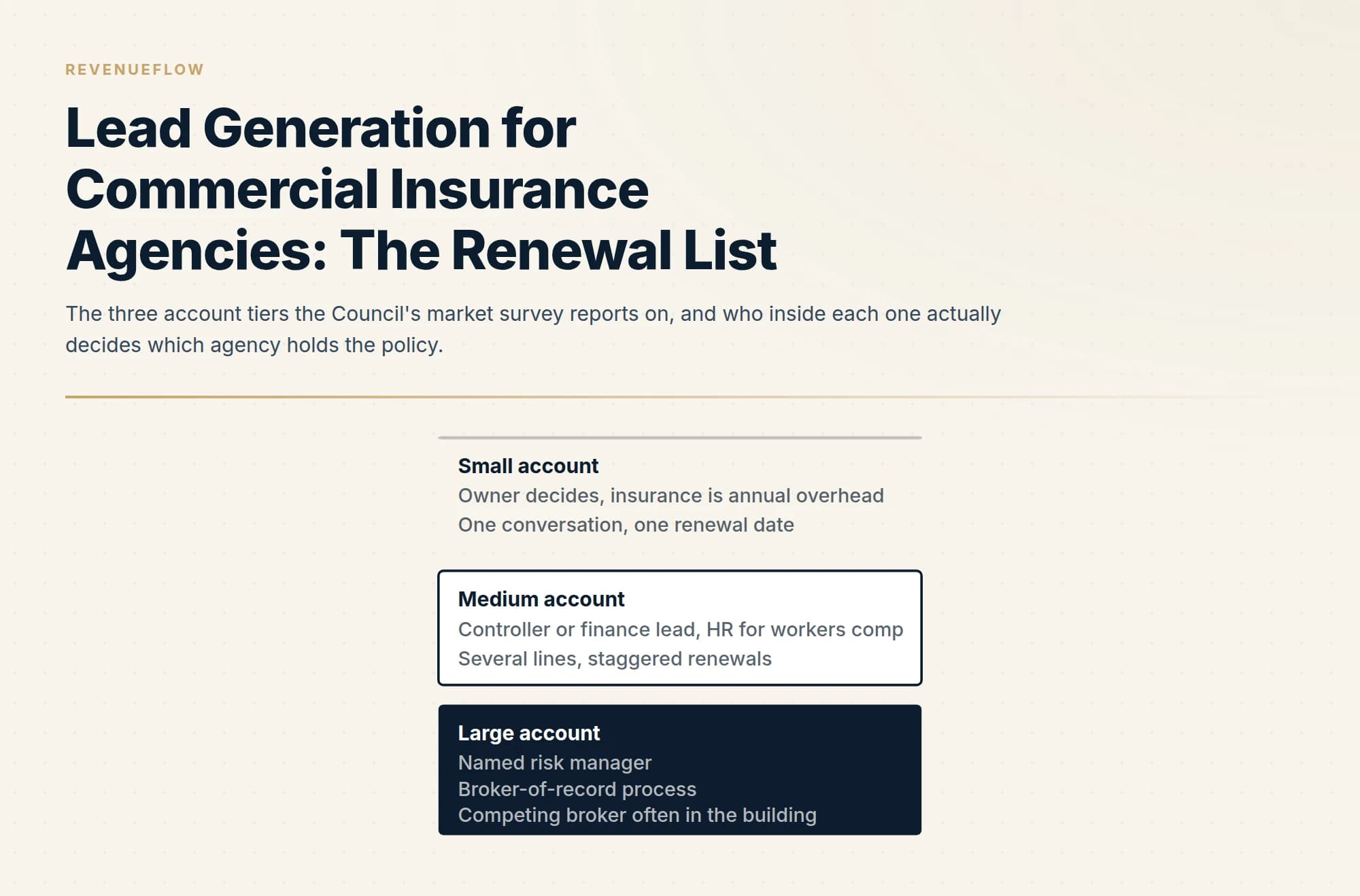
The Council of Insurance Agents and Brokers sorts commercial business by account size, and its quarterly market survey reports premium movement for small, medium and large accounts separately. Agency Checklists, summarising the Council's first quarter 2026 survey on 8 June 2026, records that large accounts saw the biggest average decrease at 2.7 percent, medium accounts declined 1.9 percent and small accounts still increased by 1.1 percent. Those three tiers describe three different buyers.
At a small account the buyer is the owner, who also runs payroll and signs the lease, and who experiences insurance as a line of overhead that arrives once a year. At a medium account the decision usually sits with a controller or finance lead, with the person who runs HR pulled in for workers' compensation and employment practices coverage, both of which appear in the Council's line list. At a large account there is a named risk manager, a broker-of-record process and often a competing broker already in the building. The message that reaches all three is the one that names the line and the renewal, because that is the only vocabulary the three buyers share.
The channel you are competing inside is large and mostly independent. The Big I's 2026 Market Share Report, reported by Insurance Journal on 23 June 2026, states that independent agents wrote 87.7 percent of commercial lines written premiums in 2025 and that the independent agency channel placed 62 percent of all property and casualty insurance written in the United States that year. The practical meaning is that the account you are prospecting almost certainly has an independent agent already, and your first message is a request to compete at the next renewal rather than an introduction to a category.
The X date is the budget cycle
Commercial insurance has no fiscal year in the way a school district or a hospital does. It has the expiration date, which producers call the X date, and the renewal is the only moment money moves between agencies. Two things decide what happens at that moment: the market cycle and the incumbent's remarketing.
The market cycle in 2026 is soft, and softening changes the conversation. The Council's first quarter 2026 survey, per Agency Checklists on 8 June 2026, reported an average premium decrease across all account sizes for the first time since the third quarter of 2017, with commercial property and casualty premiums down an average of 1.2 percent against a 0.2 percent increase the prior quarter. Commercial property fell the most, which the Council's executive summary put at 5.5 percent; workers' compensation declined 3.7 percent and cyber 3.5 percent. The Council's summary also records that 72 percent of respondents observed an increase in property underwriting capacity. Commercial auto ran the other way in the Council's survey, up 5.8 percent, its 59th consecutive quarter of increases.
That split is a targeting variable. A property-heavy account whose incumbent has not remarketed it will renew above what the market now offers, and a fleet-heavy account is watching its auto premium rise for a fifteenth year. Both are reasons to write, and they are different reasons. A single message about saving money on insurance says neither.
The incumbent's behaviour is the other half. An agency holding an account has a renewal to remarket or to roll over, and an account rolled over without remarketing in a softening market is the account most likely to take a call. You cannot see remarketing from outside, but you can see the X date, the lines carried and the account's size, and those three fields are the list.
What the regulators require of the agency before it writes
Three bodies of rules touch outreach from an agency, and none of them is optional.
Licensing comes first. The National Insurance Producer Registry defines an insurance producer as a person required to be licensed under the laws of the state to sell, solicit or negotiate insurance, and its state requirements page distinguishes individual licences from business entity licences for an agency, partnership or LLC. Solicitation is inside that definition, which means the person whose name goes on a prospecting message is a licensed person in the state where the prospect sits. The Texas Department of Insurance agent licensing page, updated 13 April 2026, lists general lines property and casualty among its licence types and notes that most licences renew every two years, and it is one example of the pattern every state runs in its own form.
Then the federal outreach rules. The Federal Trade Commission's CAN-SPAM compliance guide sets the requirements for commercial email: accurate header and routing information, a subject line that reflects the content, a clear disclosure that the message is an advertisement, a valid physical postal address, a clear opt-out that is honoured within ten business days, and monitoring of anyone sending on your behalf. The guide states that both the company whose product is promoted in the message and the company that actually sends the message may be held legally responsible. For calling, the Commission's Telemarketing Sales Rule guide lists among its exemptions business-to-business solicitation calls, unless they involve the sale of nondurable office or cleaning supplies, and separately lists the business of insurance; the Federal Communications Commission's rules at 47 CFR 64.1200 govern calls and texts made with automated equipment or a prerecorded voice, including the prior express consent those require to a wireless number. Read the regulator's own pages before a programme starts, and treat a business owner's mobile number as a wireless number whatever the CRM calls it.
| Row | Phone | Text | |
|---|---|---|---|
| State producer licence covers solicitation | Yes | Yes | Yes |
| FTC CAN-SPAM guide | Yes | No | No |
| FTC Telemarketing Sales Rule guide | No | Yes | Partial |
| FCC rules at 47 CFR 64.1200 | No | Yes | Yes |
None of that is legal advice, and the pages change: the eCFR timeline for section 64.1200 shows amendments applied in March 2026. What the agency owes itself is the habit of reading the current page before each campaign.
What agencies themselves say gets in the way
The channel's own study is the honest place to find objections. Future One and the Big I's 2024 Agency Universe Study, summarised by Independent Agent magazine, put the number of independent property and casualty agencies in the United States at 39,000, down from 40,000 in 2022, with one in three agencies expecting an ownership change in the next five years. In the Agency Universe Study three in four agencies reported revenue gains, and 68 percent reported growth in commercial lines revenue, up from 57 percent in 2022. The Big I's study page, read on 18 September 2026, announces the 2026 edition for 23 September.
The objections sit in the challenge findings. When the Agency Universe Study asked their number one challenge, 56 percent of agencies said it was finding carriers that will maintain their commitment to their market, up from 31 percent in 2022, and agencies reported being appointed with an average of 17 carriers. On technology, the study records that dealing with multiple carrier interfaces was the number one issue, followed by marketing their agency effectively on the internet. And one third of agencies believed their agency would be affected by personal and small commercial lines bought directly through insurance companies, non-insurance websites and emerging online channels.
Read those three findings as a producer would. The first is the appetite problem: a lead in a class of business none of your 17 carriers wants is a lead you cannot write, so the list has to be built from carrier appetite outward. The second is why so many agencies buy leads instead of generating them. The third is the fear that the small end of the market is leaving the channel, which is an argument for prospecting up the account-size ladder rather than down it.
Channel reality, and when this is the wrong play
The study reports that 56 percent of agencies call social media a top marketing activity, down slightly from 62 percent in 2022, and that agencies use it mainly to build the brand and attract prospects. That is the channel's default, along with referrals from existing insureds and from the accountants and lenders who see a business's coverage.
The search results for this topic are dominated by a different model: purchased leads and outsourced appointment setting. SalesGenie and AWL sell lead lists to agencies, Superhuman Prospecting and Abstrakt sell outbound programmes, Smart Choice publishes lead tips for its network agencies, and a thread on the insurance agent forum on Reddit asks how to get commercial leads. None of those vendors is endorsed here, and the Reddit thread could not be read on 18 September 2026 because the site refused the request; they are named as what the market sells. What separates a bought lead from a generated one is the X date: a purchased list without expiration dates is a list of businesses, and a business is a prospect only in the months before its renewal.
Direct outbound, one email and one LinkedIn message per campaign, fits this vertical when three things are true. The account is medium or large, because the small end is the segment agencies themselves expect to lose to direct channels. The agency holds carrier appetite for the class, so a reply can become a quote. And the renewal falls inside the next quarter, so the conversation has somewhere to go. It is the wrong play for a personal lines book, for classes your carriers have exited, and for any agency without a licensed producer to answer the reply.
To a warehouse operator with a property-heavy schedule
The brokers' council reported commercial property premiums falling in the first quarter for the first time since 2017. If your property renewal was rolled over without a remarket, it may be above the current market. 1
To a regional delivery company running its own fleet
Commercial auto rose again in the first quarter, the 59th quarter in a row by the council's count. Which month does your auto policy renew, and would a second market on it be useful? 2
To a manufacturer at a medium account size
Most commercial policies in the country are placed through independent agents, so you have one already. If your workers comp renews before the year end, we can run it past our carriers alongside your current quote. 3
- 1The fact is the Council's first quarter 2026 finding as reported on 8 June 2026; the ask is whether the account was remarketed, which the owner knows and the agent cannot see.
- 2Commercial auto is the one line rising in the same survey; the message asks for the renewal month, which is the only thing that decides whether to keep talking.
- 3The market share figure comes from the Big I's report as published on 23 June 2026; the line named is one the Council's survey reported falling.
Each of those makes no promise, names no rate, and asks a question only the buyer can answer. Our position on cadence is one message per campaign, sent once, with a new campaign when a new premise exists; in this vertical the calendar creates the new premise, because every account has a renewal a year after the last one.
How to build the list from appetite outward
Start with the carriers. The 17 appointments an average agency holds each come with classes the carrier wants and classes it will decline, and the list of prospects is the intersection of what your carriers write and what your territory contains. Layer the lines in, using the market direction to choose the argument: property and workers' compensation where the message is that a remarket may come in lower, auto where the message is that a second market is worth having. Then find the X dates, which live on certificates of insurance, in lender and landlord requirements, and in the answer to the single question every opener above asks.
The B2B lead generation guide covers the general list mechanics and the outbound lead generation guide covers sending; neither needs restating here. What is specific to this vertical is that a lead without a renewal date is not yet a lead, and that the licensed producer who will answer the reply is part of the list, because the reply will be a coverage question. If you are weighing a lead vendor, qualified lead generation services sets out what any provider should deliver, and lead generation companies for small business covers the smaller end of that market.
If the constraint is building that list and getting the first message out under the rules above, RevenueFlow builds the renewal-dated list and books the qualified conversations on a pay-per-meeting basis, on email and LinkedIn only, with qualification agreed in writing before launch. Whether the quote gets written is, as it always was, a question of carrier appetite.
Market share figures per Insurance Journal's report of 23 June 2026 on the Big I's 2026 Market Share Report; premium movements per Agency Checklists' 8 June 2026 summary of the Council of Insurance Agents and Brokers first quarter 2026 survey; agency counts and challenge findings per Independent Agent magazine's summary of the 2024 Agency Universe Study; licensing definitions per NIPR and the Texas Department of Insurance; outreach rules per the FTC's CAN-SPAM and Telemarketing Sales Rule guides and 47 CFR 64.1200 on eCFR. All fetched 18 September 2026. Confirm current rules with the regulator before relying on them.
Sources: Independent Agencies Market Share Up Slightly in 2025, Insurance Journal, Latest CIAB Survey Says Soft Market Conditions Reigned in Q1 2026, Agency Checklists, 7 Findings From the 2024 Agency Universe Study, Independent Agent, Agency Universe Study, the Big I's study page, State Requirements, NIPR, Agent and Adjuster Licensing, Texas Department of Insurance, CAN-SPAM Act Compliance Guide, FTC, Complying with the Telemarketing Sales Rule, FTC, 47 CFR 64.1200, eCFR
Frequently asked questions.
Frequently asked questions- How do commercial insurance agencies get leads?
- Mostly through referrals, social media and purchased lead lists, and the channel's own 2024 study found 56 percent of agencies call social media a top marketing activity. Generated leads differ from bought ones by carrying the expiration date, because a business is only a prospect in the months before its renewal, and by matching the classes your appointed carriers will actually write.
- When is the best time to prospect a commercial account?
- Before its expiration date, which producers call the X date, because that is the only moment the account can move between agencies. In a softening market such as the first quarter of 2026, when the Council reported the first all-size premium decrease since 2017, an account rolled over without a remarket is the one most likely to take a call from a second agency.
- What rules apply when an insurance agency emails or calls businesses?
- State producer licensing covers solicitation, so the sender is a licensed producer in the prospect's state. The FTC's CAN-SPAM guide sets email requirements including an opt-out honoured within ten business days, its Telemarketing Sales Rule guide lists exemptions for business-to-business calls and the business of insurance, and the FCC's rules at 47 CFR 64.1200 govern automated calls and texts to wireless numbers. Read the current pages first.
- Is outbound the wrong play for some agencies?
- Yes. It is the wrong play for a personal lines book, for classes your carriers have exited, for the small commercial end that agencies themselves expect to lose to direct channels, and for any agency without a licensed producer free to answer a coverage question. It fits medium and large accounts with a renewal inside the next quarter and carrier appetite for the class.
About the author.

B2B cold email experts helping companies generate qualified leads through done-for-you outreach campaigns.
RevenueFlow Team
Explore more.
Ready to scale your outreach?
We build GTM engines that book real meetings. See the receipts.
Related articles.
Lead Generation for Telecommunications Companies: Four Lead Sources
For carriers, ISPs, UCaaS providers and MSPs: the installed base, the advisor channel, dated outbound and the funded network map as lead sources, with FCC rules.
Lead Generation for Material Handling Companies
How a forklift dealer, racking maker or integrator finds plants with a dated reason to talk: OSHA evaluation cycles, dealer consolidation, MHI show rosters.
Merchant Services Cold Calling Scripts: The Honest Version
Six call scripts for merchant services agents and ISO reps, built around what the FTC alleged about this exact call: no affiliation claim, no rate before a statement.
Appointment Setting for 3PL Companies: Fit Before the Calendar
For 3PLs, warehousing operators and brokers wanting shipper meetings: the five fit gates, the bid calendar, contract terms, the trade's rules and three openers.
LinkedIn Outreach for Machine Shops
How a job shop or CNC machine shop uses LinkedIn to win OEM work: the four buyer titles, the RFQ gate, the ISO, AS9100 and ITAR facts, and LinkedIn's own rules.
Sales Outsourcing for SaaS Companies: What to Hand Over
For SaaS companies weighing an outside sales team: what the industry's own survey found, what a third party cannot hold in a software sale, and what can go out.