Best Sales Engagement Tools for Recruiters (2026)
The five sales engagement tools worth comparing for Recruiters in 2026, with every price attributed to the page it came from and every absence checked.
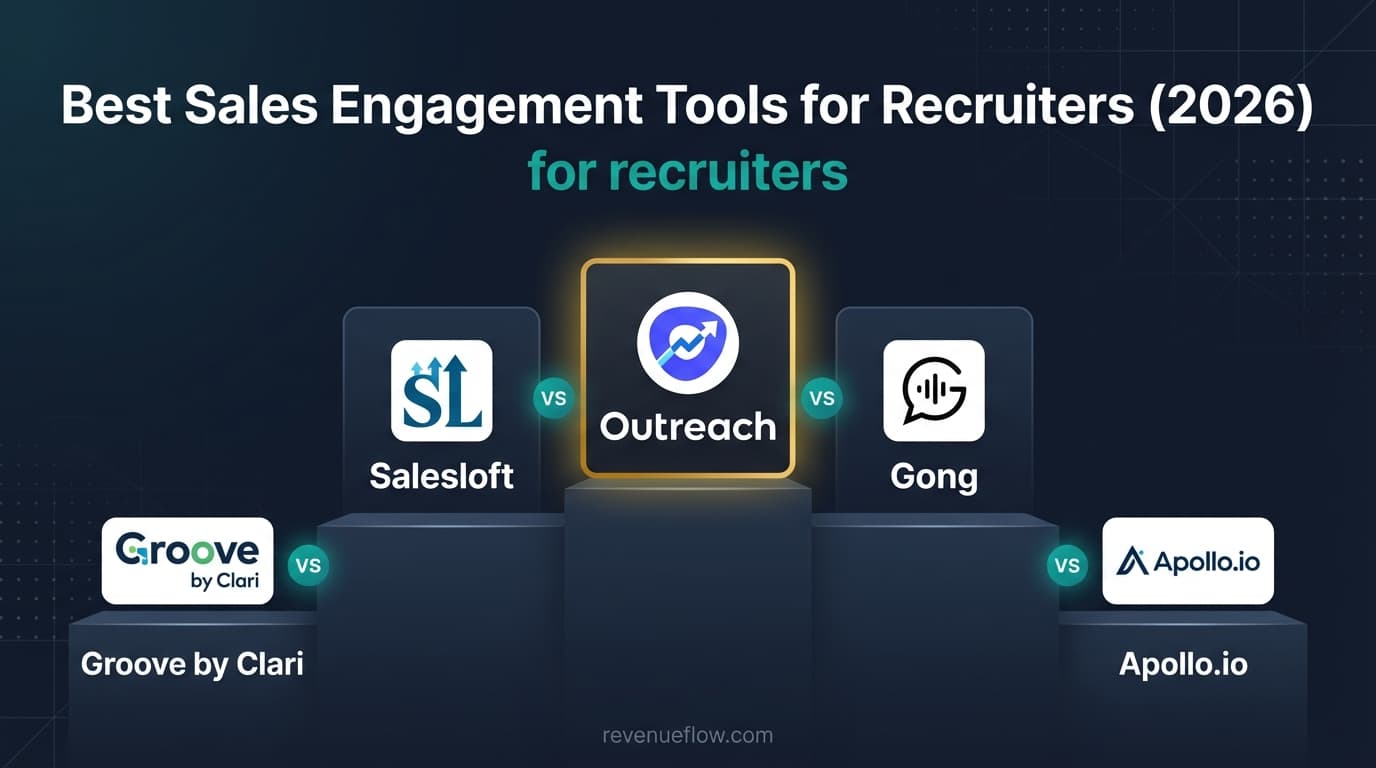
The top business development tools for recruiters price one seat for winning roles from hiring managers: Saleshandy's single seat is $34 a month on annual billing, Apollo is $49 a seat with contact data included, and Reply.io is $49 a user with LinkedIn automation at $69 a month per account. Candidates belong in the ATS.
Key takeaways
- Most recruiters do business development and candidate work from one seat, so compare single-seat prices: $34 on Saleshandy, $49 on Apollo, $49 on Reply.io.
- Reply.io prices LinkedIn automation at $69 a month per account, which can be the biggest line for a recruiter who works from LinkedIn.
- Check every list against the ATS before any sequence: a placed candidate contacted as a cold lead is the fastest way to lose them.
- Outreach, Salesloft and Gong publish no price and suit staffed business development teams rather than a recruiter doing both jobs.
Reviewed and updated September 19, 2026
The top business development tools for recruiters are the ones that keep a recruiter's two jobs apart. Winning roles from hiring managers is ordinary B2B outbound and suits a sequencer; approaching candidates is personal and belongs in the ATS. Most recruiters do both jobs from one seat, so the useful comparison is one seat's price: Saleshandy's single-seat Starter at $34 a month on annual billing, Apollo at $49 a seat with hiring-manager data included, and Reply.io at $49 a user with LinkedIn automation at $69 a month per account. The most common tooling mistake in the category is running both audiences through the same sequence logic.
A version of that split appears in software, where product-led and sales-led outreach can land on the same trial user twice.
What Are the Top Business Development Tools for Recruiters?
For a recruiter or a small desk winning roles from hiring managers:
- Apollo.io when the recruiter needs to find hiring managers and sequence them in one product, from $49 a seat a month on annual billing, $65 monthly.
- Saleshandy for the lowest published single seat, $34 a month on annual billing, when the contact data comes from elsewhere.
- Reply.io when LinkedIn is where the recruiter works: email sequencing from $49 a user, with LinkedIn automation priced at $69 a month per account and calls at $29.
- Outreach, Salesloft or Gong only for a staffed business development team, since none of them publishes a price.
| Tool | Best for | Entry price |
|---|---|---|
| Saleshandy | Cheapest single seat for email sequencing | $34 a month |
| Apollo.io | Hiring-manager data and sequencing in one seat | $49 a seat |
| Reply.io | Email plus LinkedIn and calls from one sequence | $49 a user, LinkedIn $69 |
| Outreach | A staffed business development team | Request pricing |
| Salesloft | A staffed team buying forecasting too | Talk to sales |
| Gong | Call coaching across a large desk | Per user plus a platform fee |
What Recruiters Need From a Sales Engagement Tool
- Personalization on the client side. One real detail about the role or the company per message, at the volume a desk sends.
- ATS integration in both directions. A one-way sync that never writes back leaves two records of one relationship.
- LinkedIn priced before you rely on it. Reply.io prices LinkedIn automation per account; check what any other tool charges for it.
- Separate sequencing for clients and candidates, and a placement-history check before any sequence.
Candidate data access came off this list because it is a sourcing function that belongs to an ATS or a dedicated sourcing tool; none of these is a candidate database, and Apollo's contact data is B2B. Client-side outreach is ordinary B2B outbound. Candidate-side outreach is a personal approach about somebody's career, and a candidate who receives what reads as a bulk sequence is a candidate lost, along with anyone they mention it to.
Who Gets Which Message
The check that protects a recruiter's reputation runs before the sequence, not after it: is this person already in the ATS as a candidate or a placement? If so, they are approached by hand or not at all. Only hiring managers who are not already in the relationship get the one-message sequence, and a reply stops every remaining step.
The Options, Priced

Apollo.io
Apollo prints a full ladder, per seat per month: Basic $49, Professional $79 and Organization $119 on annual billing, or $65, $99 and $149 monthly, with Organization needing three seats. Basic includes 30,000 credits per seat per year; its pricing page charges 1 credit for an email and 8 for a phone number, so a recruiter who calls hiring managers spends credits eight times faster than one who only emails.
Fit for recruiters. The default for the client side, because data and sequencing sit in one seat.
Saleshandy
Saleshandy publishes Starter at $34 a month on annual billing or $41 monthly, and its own page says "Starter is a single seat". Pro, at $76, covers a team of ten, which suits a small desk.
Fit for recruiters. The lowest published entry point when the recruiter already has the contacts.
Reply.io
Reply.io starts at $49 a user a month for 1,000 active contacts on annual billing, and prices channels separately: LinkedIn automation $69 a month per account, calls and SMS $29. It also publishes a recruiting page pitched at candidate outreach; keep that use away from the client-side sequences.
Fit for recruiters. The one to price if LinkedIn is the working channel, because the LinkedIn cost is on the page.
Outreach
Outreach publishes a model without a number: "a combination of seat-based pricing and consumption-based pricing powered by AI credits", four Amplify packages from 10,000 to 100,000 AI credits, each "Request pricing". Suited to a staffed business development team, less so to a recruiter doing both jobs.
Salesloft, and What Happened to Groove
Salesloft's pricing page is a "Talk to Sales" form with no figure. Groove by Clari, the Salesforce-centred tool this guide used to list separately, is no longer a separate purchase: Clari and Salesloft completed their merger (the newsroom post is dated December 3, 2025), and the Groove address now serves Salesloft's own sales engagement page.
Gong
Gong publishes "Licenses are priced per user" and "a platform fee based on the number of users supported". Call recording is useful for coaching a desk; the platform fee is worth checking against a large consultant roster.
Check the Placement History Before Any Sequence
Every imported list of hiring managers contains people the recruiter already knows as candidates or placements. Contacting a candidate you placed last year as though they were a cold lead is the fastest way to lose them. Run the list against the ATS, then against the do-not-contact list, and sequence what is left.
The people the check removes are not dead contacts. A candidate placed last year is often the best source of the next role, because they now sit inside a hiring team and know the recruiter's work first-hand. They deserve a personal note from the recruiter who placed them, written about their situation, not a slot in a hiring-manager sequence. The same applies in reverse: a hiring manager who was once a candidate remembers how they were treated, and the first message should acknowledge the history rather than pretend it away.
LinkedIn Is Where the Cost Hides
Recruiters work from LinkedIn more than almost any other sales role, and it is the channel most likely to be priced separately. Reply.io prints it: $69 a month per LinkedIn account, on top of the $49 user price, which more than doubles one recruiter's bill to $118. For a desk of five recruiters that is $345 a month for LinkedIn automation alone. Other pricing pages are less explicit, so ask every vendor what LinkedIn steps cost and whether they are automated or created as manual tasks for the recruiter to complete, before the channel becomes the part of the process nobody budgeted for.
How to Choose as a Recruiter
- Split the two motions explicitly. Different sequences, different tone, and ideally different tooling for the candidate side.
- Check the ATS integration in both directions. Watch one reply land on the ATS record before the first live campaign.
- Price LinkedIn before relying on it. If the recruiter works from LinkedIn, the per-account charge may be the biggest line.
- Watch the placement history. Run every list against the ATS before it reaches a sequence.
- Keep one message per client campaign. A recruiter's market is small and reputation travels quickly in it.
Getting It Adopted
Start with the client side only. It is ordinary outbound, the success measure is clear, and it does not risk the candidate relationships that are the harder asset to rebuild. Add candidate sequencing later, if at all, and keep it to a low-volume personal approach.
Client-side outbound is ordinary cold email, and whether it arrives is decided by the sending infrastructure underneath a sequencer rather than by the platform.
A firm with several consultants selling faces the seat arithmetic at a larger scale, and what a staffing desk pays per consultant works it through for a team of ten.
Where the Tool Stops Mattering
A recruiter's outcome depends on the roles being real and the candidates being available, and no platform influences either. Sequencing gets a first conversation with a hiring manager. Everything that decides the placement happens afterwards.
Final Thoughts

Most recruiters should run client-side business development on Apollo, or on Saleshandy when the contacts come from elsewhere, price Reply.io if LinkedIn is where they work, integrate the ATS in both directions, and handle candidate approaches by hand rather than through any tool on this list.
Related Reading
- Best Apollo.io Alternatives in 2026
- Best Salesforce Alternatives in 2026
- Best Outreach Alternatives in 2026
- Best CRM Tools for Recruiters in 2026
If you would rather have this run for you, RevenueFlow books qualified meetings on a pay-per-meeting basis and publishes client results.
Pricing and features are taken from the vendors' own pages. Verify current terms with the vendor before relying on them.
Frequently asked questions.
Frequently asked questions- What are the top business development tools for recruiters?
- For winning roles from hiring managers: Apollo when you need contact data and sequencing in one seat, from $49 a month on annual billing; Saleshandy for the lowest single seat at $34; Reply.io when LinkedIn is where you work, with LinkedIn automation at $69 a month per account. Keep candidate outreach in the ATS.
- Should recruiters use the same sequences for clients and candidates?
- No. Hiring managers get a short, one-message business development sequence; candidates get a personal approach about their career, written by hand. A candidate who receives what reads as a bulk sequence is lost, and every list should be checked against the ATS for candidates and placements before anyone is sequenced.
- How much does a sales engagement tool cost for one recruiter?
- On annual billing, Saleshandy's single-seat Starter is $34 a month, Apollo Basic is $49 a seat with data included, and Reply.io is $49 a user at 1,000 active contacts, with LinkedIn automation another $69 a month per account. Outreach, Salesloft and Gong do not publish prices.
- Does it matter if the tool integrates with my ATS?
- Yes, in both directions. A sync that reads contacts in but never writes activity back leaves two records of one relationship, and consultants then contact people the firm already knows. Ask for the integration by name and watch one reply land on the ATS record before the first live campaign.
About the author.

B2B cold email experts helping companies generate qualified leads through done-for-you outreach campaigns.
RevenueFlow Team
Explore more.
Ready to scale your outreach?
We build GTM engines that book real meetings. See the receipts.
Related articles.
Outbound Lead Generation Tools, Layer by Layer
Outbound tools do six jobs and price on different units: contacts, credits, seats, sends. Thirteen vendors read from their own pages on 18 September 2026, by layer.
Twain Pricing: Credits per Lead, Three Research Modes
Twain sells credits, not seats, and a lead costs 1 to 14 of them depending on the research mode. The two ladders, the four expiry clocks and the cap.
Lavender Pricing: Two Products, No Pricing Page
Lavender has no pricing page. The Email Coach ladder per seat at both billing states, the free routes, and the separate per-agent price for Ora.
Gong Engage vs Salesloft Cadence: How They Differ
Gong Engage and Salesloft Cadence compared from each vendor's own pages: where each starts, six jobs side by side, and what the pricing pages disclose.
Zeliq Pricing: One Seat Rate and a Credit Meter
Zeliq prices one self-serve seat in dollars with a credit meter that never expires. Both billing states, the three credit rates, the top-up ladder and the Custom floor.
Salesgear Pricing: Two Ladders Under One Plan Title
Salesgear's page is titled as one plan and carries a Data ladder and an Outreach ladder. Both at both billing states, what each meters, and the two vendor-side conflicts.