Best Sales Engagement Tools for Cold Email Teams (2026)
The five sales engagement tools worth comparing for Cold Email Teams in 2026, with every price attributed to the page it came from and every absence checked.
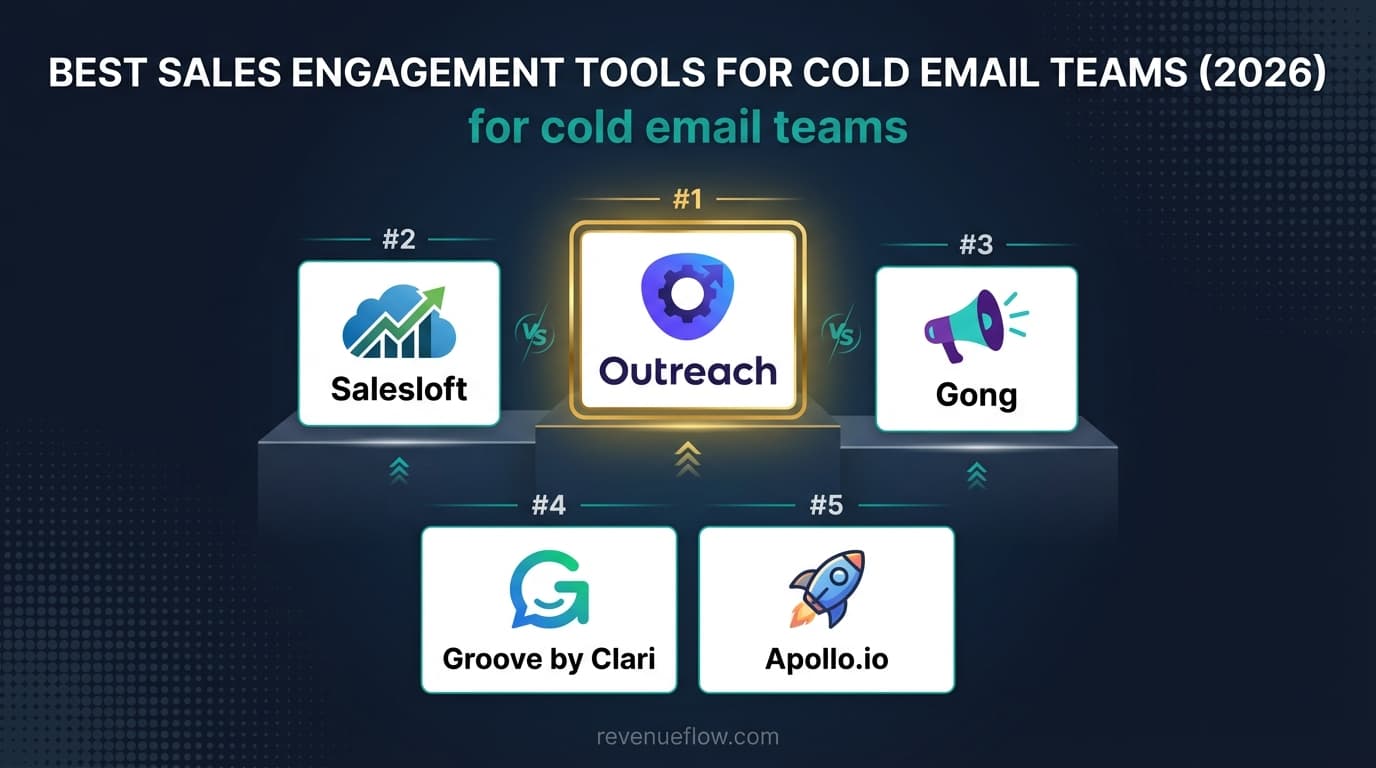
The top cold email platforms for sales engagement are Instantly, Smartlead and Saleshandy, which price by emails a month with unlimited mailboxes and cost 76 to 87 cents per thousand sends at their middle tiers on annual billing. Reply.io suits teams adding LinkedIn; Apollo adds lead data from $49 a seat.
Key takeaways
- Instantly, Smartlead and Saleshandy all connect unlimited mailboxes and price by emails a month; their middle tiers cost $76 to $78 a month on annual billing.
- Reply.io prices by active contacts and adds LinkedIn automation at $69 a month per account; Apollo prices per seat from $49 with lead data included.
- No sequencer fixes inbox placement: domains, mailboxes and volume per mailbox decide whether mail arrives, so buy sending and sequencing separately.
- Judge variant tests on replies, not opens, and check that a human reply stops every remaining step for that person on every channel.
Reviewed and updated September 19, 2026
The top cold email platforms for sales engagement are the ones built around sending volume across many mailboxes: Instantly, Smartlead and Saleshandy price by emails a month with unlimited mailboxes, and Reply.io prices by active contacts. The enterprise platforms, Outreach, Salesloft and Gong, are built for staffed sales teams and publish no price. A cold email team's main risk sits outside all of them: sequencing decides who gets contacted and when, but whether the message arrives is decided by the sending infrastructure underneath, and no tool here changes that.
What Are the Top Cold Email Platforms for Sales Engagement?
For a team whose motion is cold email at volume:
- Instantly, Smartlead or Saleshandy for sending at volume. All three connect unlimited mailboxes without a per-inbox fee and price by emails a month, and on annual billing their middle tiers land within two dollars of each other.
- Reply.io if the team also runs LinkedIn and calls from the same sequences. It prices by active contacts, with LinkedIn automation at $69 a month per account.
- Apollo.io if the team needs its lead data and sequencing in one product, from $49 a seat a month on annual billing.
- Outreach once the team is large and staffed enough that the sequencing model, rather than the price, is the constraint.
What Cold Email Teams Need From a Sales Engagement Tool
- Sending volume across many mailboxes, without a fee per inbox.
- Reply detection that stops every remaining step for that person, on every channel.
- Replies per variant, not just opens.
- A clean handoff to whatever owns your sending reputation.
Deliverability tools came off this list deliberately. It is the most reasonable-looking bullet and the one that misleads a buyer most, because an engagement platform that reports opens is reporting on mail that already arrived. Inbox placement is owned by the domains, the mailboxes and the sending volume per mailbox, and a team that buys a sequencer expecting a deliverability fix has bought the wrong category. Judge the tool on sequencing, reply capture and variant reporting, and solve sending separately.
The same category judgement removes a different bullet elsewhere, since enrichment belongs with a data provider rather than with the sequencer a regulated firm is buying.
The Volume Platforms, Priced

Instantly
Instantly's outreach plans are Growth at $47 a month, Hypergrowth at $97 and Light Speed at $358, each with "Unlimited Email Accounts" and warm-up; annual billing brings them to $37.60, $77.60 and $286.30. Read the allowance carefully: the monthly Hypergrowth card lists 125,000 emails a month, while the annual card and the page's own comparison table list 100,000.
Smartlead
Smartlead publishes Base at $39 a month, Pro at $94, Unlimited Smart at $174 and Unlimited Prime at $379, with annual billing 17% less (Pro is $78). Sends run from 6,000 a month on Base to 90,000 on Pro and 500,000 on Prime, and every plan includes unlimited email accounts, which its own FAQ calls "a significant cost advantage over most outbound tools".
Saleshandy
Saleshandy publishes Starter at $34 a month, Pro at $76 and Scale at $149 on annual billing, or $41, $99 and $189 paid monthly, with 6,000, 100,000 and 200,000 emails a month. Its pricing page says you can "Connect as many sending mailboxes as you want, with no per-inbox fees."
Reply.io
Reply.io counts active contacts rather than emails: from $49 a user a month at 1,000 active contacts on annual billing, dropping the user count from 10,000 active contacts at $159. Mailboxes are unlimited, subject to its fair usage policy. LinkedIn automation is $69 a month per account and calls and SMS $29, so a team running email, LinkedIn and calls from one sequence prices all three here.
The Enterprise Platforms: Apollo, Outreach, Salesloft and Gong
Apollo.io
Apollo prints a full ladder, per seat per month: Basic $49, Professional $79 and Organization $119 on annual billing, or $65, $99 and $149 monthly. Professional adds unlimited Gmail and Microsoft mailboxes. Its case for a cold email team is the data: consultants and SDRs find contacts and sequence them in one product.
A staffed desk judges the same product differently, because the queue a rep lives in decides adoption more reliably than any feature comparison does.
Outreach
Now at outreach.ai, Outreach publishes a model and no number: "a combination of seat-based pricing and consumption-based pricing powered by AI credits", with four Amplify packages from 10,000 to 100,000 AI credits, each marked "Request pricing". A high-volume team's bill moves with AI usage, so quote it at expected usage.
Salesloft, and What Happened to Groove
Salesloft's pricing page is a "Talk to Sales" form with no figure. Groove by Clari, which used to sit fifth on this list, is no longer a separate purchase: Clari and Salesloft completed their merger (the newsroom post is dated December 3, 2025), and the Groove product address now serves Salesloft's own sales engagement page.
Searching for Apollo against Salesloft usually means choosing between a published per-seat price with data included and an enterprise sales process with none published; Apollo and Salesloft compared head to head covers that choice in detail.
Gong
Gong is bought for conversation intelligence rather than sending: "Licenses are priced per user" plus "a platform fee based on the number of users supported". A team whose problem is outbound volume is paying for call analysis it will not use.
Replies Per Variant, Not Opens
A/B testing that reports opens tells you which subject line got opened, which is not the question. The question is which message got answered, and the two can point in opposite directions.
Buy the Tool, or Buy the Outcome

A platform leaves the whole job with the team: data, domains, copy, sending and every reply. The alternative is a provider that charges per meeting and handles data, outreach and reply management itself, so the bill follows meetings that happen rather than seats or sends. RevenueFlow works this way. It suits a team that wants the pipeline without building the sending operation; a team that already runs that operation well usually keeps the tool.
| Who handles it | A platform | Pay per meeting |
|---|---|---|
| Lead data | You, or a data add-on | The provider |
| Domains and mailboxes | You | The provider |
| Copy and sending | You | The provider |
| Reply handling | You | The provider, until the meeting |
| What you pay for | Seats, sends or contacts | Meetings that happen |
Where This Sits Against Your Sending Setup
A sales engagement platform decides who gets contacted, in what order, and what gets recorded when they reply. It does not protect your ability to land in an inbox, and buying one does not change your sending reputation in either direction.
Two rules survive whichever tool wins. Run sequencing from one system, not two: a platform sequencing a contact that your CRM is also sequencing is the ordinary mechanism behind duplicate sends. And a platform's willingness to schedule a fourth touch is not an argument for sending one. The house rule is one message per campaign, no bumps and no thread replies, because the reputation a bump spends is not the platform's to spend.
How to Choose for a Cold Email Team
- Separate the two purchases. Decide what sends your mail and what decides your sequences, and buy them independently.
- Check what a reply actually stops. A human reply should halt every remaining step for that person automatically, on every channel. Ask to see it in a demo rather than assuming it.
- Look at replies per variant before you buy. A report of opens per variant answers the wrong question.
- Read the allowance, not the plan name. Emails a month, active contacts and mailboxes are counted differently on every page here, and on Instantly's page the same plan lists two different numbers.
- Hold the sending doctrine whatever the tool allows. One message per campaign, no bumps and no thread replies.
Getting It Adopted
Start with one sequence, one audience and one variant pair, and resist widening until the reply capture is proven. The most common failure in this category is not a bad tool but an unattributed one: replies landing in a shared inbox the platform never sees, so the reporting understates results and the team tunes against a number that is wrong.
Browser tooling sprawls the same way, and LinkedIn extensions sorted by the job separates reveal, CRM capture, automated actions and bulk export so a team stops buying three that overlap.
Where the Tool Stops Mattering
None of this fixes an unclear offer. A team with excellent sequencing, clean variant reporting and a message that says nothing specific to the reader will get a low reply rate that no amount of tooling explains. The platform decides who and when. It does not decide whether the email is worth answering.
Final Thoughts

Most cold email teams should buy sending volume from Instantly, Smartlead or Saleshandy, which price almost identically at the middle tier, choose between them on reply handling and variant reporting, and add Apollo only if the team needs its data in the same tool. Move to Outreach when the team is large enough that the sequencing model is the binding constraint, and solve inbox placement separately.
Related Reading
- Best Apollo.io Alternatives in 2026
- Best Outreach Alternatives in 2026
- Cold Email Software: How to Choose
If you would rather have this run for you, RevenueFlow books qualified meetings on a pay-per-meeting basis and publishes client results.
Pricing and features are taken from the vendors' own pages. Verify current terms with the vendor before relying on them.
Frequently asked questions.
Frequently asked questions- What are the top cold email platforms for sales engagement?
- Instantly, Smartlead and Saleshandy for sending at volume: all three connect unlimited mailboxes and price by emails a month, at $76 to $78 a month for their middle tiers on annual billing. Reply.io suits teams that also run LinkedIn from the same sequences, and Apollo suits teams that want lead data in the same tool.
- Apollo or Salesloft for a cold email team?
- Apollo publishes per-seat prices from $49 a month on annual billing and includes lead data, so a team can start without a sales process. Salesloft publishes no price and is built for staffed enterprise teams. For a cold email team whose constraint is sending volume, neither is the first purchase; a volume platform is.
- Which providers offer pay-per-meeting models that handle data, outreach and replies?
- Outbound agencies that charge per meeting take on the whole operation: lead data, domains and mailboxes, copy, sending and reply handling until a meeting is booked. RevenueFlow works this way. It suits a team that wants pipeline without building a sending operation; a team that already runs one well usually keeps its own tool.
- Can a sales engagement platform fix deliverability?
- No. Inbox placement is decided by the sending domains, the mailboxes and the volume per mailbox, not by the sequencer. A platform that reports opens is reporting on mail that already arrived. Solve sending separately and judge the platform on reply capture and variant reporting.
About the author.

B2B cold email experts helping companies generate qualified leads through done-for-you outreach campaigns.
RevenueFlow Team
Explore more.
Ready to scale your outreach?
We build GTM engines that book real meetings. See the receipts.
Related articles.
Lavender Pricing: Two Products, No Pricing Page
Lavender has no pricing page. The Email Coach ladder per seat at both billing states, the free routes, and the separate per-agent price for Ora.
Gong Engage vs Salesloft Cadence: How They Differ
Gong Engage and Salesloft Cadence compared from each vendor's own pages: where each starts, six jobs side by side, and what the pricing pages disclose.
Twain Pricing: Credits per Lead, Three Research Modes
Twain sells credits, not seats, and a lead costs 1 to 14 of them depending on the research mode. The two ladders, the four expiry clocks and the cap.
Outbound Lead Generation Tools, Layer by Layer
Outbound tools do six jobs and price on different units: contacts, credits, seats, sends. Thirteen vendors read from their own pages on 18 September 2026, by layer.
La Growth Machine Pricing: Per Identity, Euros First
La Growth Machine prices per identity and loads in euros on annual billing. The full matrix from the page's own script: four periods, three currencies, three plans.
Overloop Pricing: Two Seat Rates and No Annual Toggle
Overloop publishes Starter and Growth per user with a credit allowance and no annual rate on the page. What each seat carries, and what the page leaves out.