Best Sales Engagement Tools for FinTech (2026)
The five sales engagement tools worth comparing for FinTech Companies in 2026, with every price attributed to the page it came from and every absence checked.
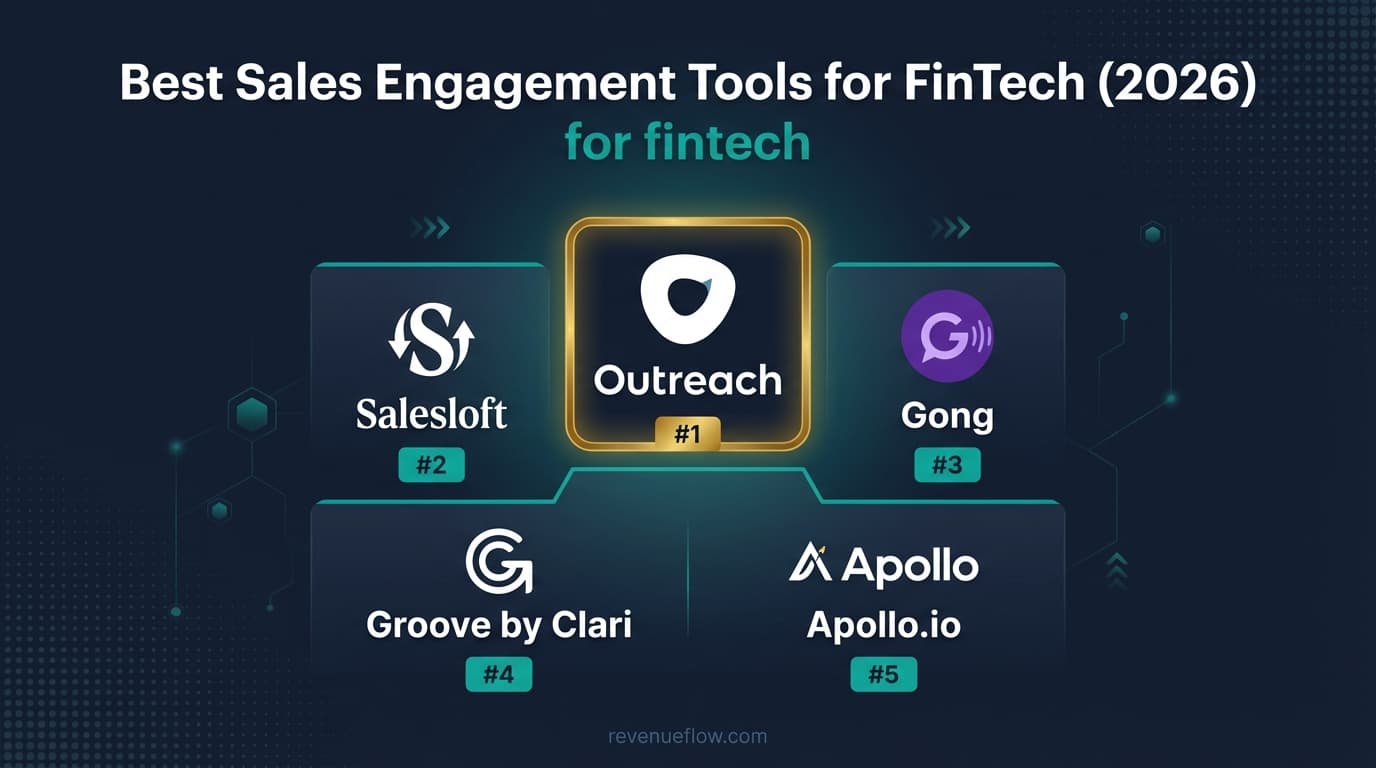
The best sales engagement tools for FinTech Companies in 2026 are Apollo.io, Outreach, Salesloft, Gong and Groove by Clari. Only Apollo publishes a price: free, then $49/mo, $79/mo and $119/mo billed annually. Outreach and Gong publish a pricing model without a number; Salesloft and Groove publish neither. For fintech, retention and supervision decide the purchase before capability does.
Key takeaways
- None of these platforms is a compliance product; what they can provide is supervision, meaning a retained exportable record of what was sent and a limit on what a representative can send without review.
- Apollo.io is the only tool on this list that publishes a price: a free plan, Basic at $49/mo, Professional at $79/mo and Organization at $119/mo, each per seat and billed annually.
- Outreach and Gong publish a pricing model without a number. Outreach charges for seats plus consumption on AI credits across four packages; Gong charges per-user licences plus a platform fee that scales with the number of users supported.
- Salesloft and Groove by Clari publish neither a price nor a pricing model, so the only route to a comparable number is to complete both sales processes.
Reviewed and updated September 21, 2026
Financial services buyers evaluate this category on controls before capability. A sales engagement platform sends regulated communications on behalf of a regulated entity, and the questions that decide the purchase are about retention, supervision and access rather than about sequencing.
What FinTech Companies Need From a Sales Engagement Tool
- Regulatory compliance
- Data security
- Archiving and retention that satisfies your regulator
- Control over what a rep can send without review
Financial data enrichment came off this list. Enrichment is a data-provider function, and buying a sequencer to get it produces a worse version of both. Apollo is the partial exception because it bundles a contact database with engagement, which is a real argument for it here, but the requirement belongs in the data purchase rather than in the engagement one. What replaces it are the two controls a regulated firm is actually judged on: a retained, exportable record, and a limit on what a representative can send unreviewed.
Healthcare removes the equivalent bullet with more force, because an enrichment field is the likeliest route for information to arrive somewhere it should never be.
The Compliance Position
Nothing on this list is a compliance product, and none of the five should be described as making a firm compliant. What they can do is make supervision possible: recording what was sent, to whom and when, restricting who can send outside an approved template, and exporting that record when somebody asks for it. Confirm retention periods and export formats against your own obligations rather than against a vendor's compliance page, and treat any security questionnaire as the gating step it is.
How This Guide Was Put Together
Every pricing page on this list was fetched on 2026-08-28 and read directly. That matters more than usual here, because only one of the five vendors publishes a price at all.
Apollo.io does publish a full ladder, and on a 1 September 2026 read it is exactly where a reader would look for it: the plan cards render every tier once the page is loaded in a browser. Its structured data carries a different and older ladder, so the cards are what is quoted below.
Outreach and Gong publish no dollar figure and do publish a pricing MODEL, which is genuinely useful and is quoted below. Salesloft and Groove by Clari publish neither, and the only thing on either page is a form.
Where this guide says a vendor publishes no price, that is a measurement taken on the page fetched and searched on 2026-08-28, rather than an inference from a page that failed to load. On the Outreach, Salesloft, Gong and Clari or Groove pages fetched 2026-08-28, the rendered text of each carried zero currency figures, and the raw markup of each carried zero schema.org priced offers. Apollo is the control that shows the pair is not vacuous, and a re-read on 1 September 2026 corrected how: its ladder renders on the page after all, in a United States browser context, and the structured data that an earlier pass read instead disagrees with what a visitor is shown. The figures below are the rendered ones.
Top 5 Sales Engagement Tools for FinTech Companies

- Publishes a full ladder on its own rendered pricing cards
- Free plan, Basic $49/mo, Professional $79/mo, Organization $119/mo
- Those are the annual-billed rates; monthly is $65, $99 and $149
- 240M+ contacts in its own homepage claim
- Publishes the pricing MODEL, never a number
- Seat-based plus consumption-based on AI credits
- Four packages: Essentials, Core, Plus, Pro
- 10,000 to 100,000 AI credits across them
- Publishes the pricing MODEL, never a number
- Licenses priced per user
- Platform fee scales with users supported
- Integrations included at no extra charge
1. Apollo.io
The only tool on this list that publishes what it charges, and the usual starting point for a team that wants prospecting data and sequencing from one product rather than paying for both.
Published plans, from Apollo's own pricing page, rendered cards read 1 September 2026:
| Plan (Apollo.io pricing page, rendered cards, 1 September 2026) | Billed annually | Billed monthly |
|---|---|---|
| Free | $0 | $0 |
| Basic | $49/mo | $65/mo |
| Professional | $79/mo | $99/mo |
| Organization | $119/mo | $149/mo |
Every paid rate is per seat per month, and Organization asks for a minimum of three seats. The page opens on the annual state, which it labels "Save 24%". Apollo's structured data still advertises a Free, Basic $49 and Professional $99 ladder with an Enterprise tier that the page itself does not have, and it stamps both $49 and $99 as monthly although only $99 is. A comparison quoting $49 beside $99 is mixing the two billing bases.
Apollo's homepage claims 240M+ contacts and 30M+ companies in its database. Treat a database size claim as a vendor's own marketing number rather than an audited one, but it is at least a number the vendor is willing to print.
Key Features:
- B2B contact and company database
- Multi-channel sequences (email, phone, LinkedIn)
- AI-assisted email writing
- Built-in dialer with call recording
Fit for fintech. The one that combines data and engagement, which is convenient and concentrates two vendor risks into one review.
Early stage teams reach the same vendor by a different route, where the cheapest thing that works matters more than any capability while the motion is still unsettled.
2. Outreach
The enterprise standard for sequencing, and the vendor that explains its pricing model most clearly without ever printing a number.
What Outreach publishes, read from its pricing page 2026-08-28: pricing is "a combination of seat-based pricing and consumption-based pricing powered by AI credits", across four packages. Every one of them says "Request pricing".
| Package | Published AI credits | Price |
|---|---|---|
| Amplify Essentials | 10,000 | Request pricing |
| Amplify Core | 25,000 | Request pricing |
| Amplify Plus | 50,000 | Request pricing |
| Amplify Pro | 100,000 | Request pricing |
The credit ladder is the part worth planning against. A consumption component means the bill moves with usage rather than only with seat count, so a team that adopts the AI features heavily does not stay on the price it was quoted at signature.
Key Features:
- Multi-Channel Engagement and Sequences
- Conversation intelligence with call recording
- Deal health scoring and pipeline management
- AI credit allocation per package
Fit for fintech. Enterprise controls and a published pricing model, with the security review as the real gate.
3. Salesloft
A direct competitor to Outreach on capability, and the least forthcoming vendor on this list about money.
What Salesloft publishes, read from its pricing page 2026-08-28: nothing. No figure, no tier list, and no description of how the charge is structured. The pricing page's only pricing content is an invitation to "Talk to Sales" and a form requesting a 15-minute intro call.
That is worth stating plainly rather than dressing up as "custom pricing". A buyer cannot budget from this page, cannot compare it against Outreach without entering both sales processes, and should expect to spend calendar time before seeing a number at all.
Key Features:
- Cadence automation
- Conversation intelligence with AI call summaries
- Deal pipeline tracking and management
- Forecasting on the higher tiers
Fit for fintech. Comparable on controls, opaque on cost, so expect to complete a security review before you learn the price.
4. Gong
Bought primarily for conversation intelligence rather than for sequencing, and the second vendor here that publishes a model without a number.
What Gong publishes, read from its pricing page 2026-08-28: "Licenses are priced per user", "There is a platform fee based on the number of users supported", and "You can integrate your existing tech stack for free". The quote form segments by team size, offering 1-50, 51-1,000, 1,001-9,999 and 10,000+.
The platform fee is the line to notice. A per-seat number alone will understate the bill, because there is a second charge that scales with how many users the platform supports, and a small team pricing this against a pure per-seat tool is not comparing like with like.
Key Features:
- Call recording and transcription
- Deal intelligence and risk alerts
- Revenue forecasting with pipeline analytics
- Sequences through Gong Engage
Fit for fintech. Records and transcribes calls, which is either exactly the supervision you need or an additional retention obligation you have just created. Decide which before buying.
5. Groove by Clari
The Salesforce-centred option, now part of Clari, and the right answer for a team whose real requirement is that activity data never leaves Salesforce.
What Groove publishes, read from its product page 2026-08-28: no pricing of any kind. The page offers a demo booking and nothing else. Clari's own pricing page carries no figure either.
Key Features:
- Salesforce integration that captures every sales activity into the CRM
- Multi-channel engagement flows
- Automatic activity logging into Salesforce
- Email open and click tracking
Fit for fintech. Keeps activity inside Salesforce, which is often the shortest path through an internal data-residency review.
Groove's page on clari.com now redirects to Salesloft's sales engagement page, after Clari and Salesloft completed their merger in December 2025.
Where This Sits Against Your Sending Setup
A sales engagement platform is the system that decides who gets contacted, in what order, and what gets recorded when they reply. It is not the thing that protects your ability to land in an inbox, and buying one does not change your sending reputation in either direction.
Two rules survive whichever tool wins. Run sequencing from one system, not two: a platform sequencing a contact that your CRM is also sequencing is the ordinary mechanism behind duplicate sends, and it is a configuration decision rather than an accident. And the platform's willingness to schedule a fourth touch is not an argument for sending one. The house rule is one message per campaign, no bumps and no thread replies, because the reputation a bump spends is not the platform's to spend.
Comparison Table
| Tool | What it publishes | Entry price | Pricing model |
|---|---|---|---|
| Apollo.io | Full ladder | $0 free plan | Per-seat tiers, published |
| Outreach | Model only | Not published | Seat-based plus AI-credit consumption |
| Gong | Model only | Not published | Per-user licences plus a platform fee |
| Salesloft | Nothing | Not published | Not published |
| Groove by Clari | Nothing | Not published | Not published |
Recommendation by Budget
If you need a number before you can start. Apollo is the only option on this list you can buy without a sales call. Its published ladder, read from the rendered pricing cards on 1 September 2026, is a free plan, then $49/mo, then $79/mo, then $119/mo, every paid rate per seat and billed annually. There is no contact-for-pricing tier on the page.
If you are budgeting for an enterprise platform. Assume a sales process, and assume the first number you hear is not the number you will pay in year two. Outreach's own page says the model combines seats with AI-credit consumption, and Gong's says there is a platform fee on top of per-user licences. Ask both vendors to quote the second year at your expected usage, not just the first.
If nothing is published at all. Salesloft and Groove publish neither a price nor a model, so the only way to compare them is to run both sales processes far enough to get a written quote. Budget the calendar time for that, and start it earlier than feels necessary.
How to Choose in FinTech
-
Start with retention and export. If the platform cannot produce a complete record in a format your compliance team accepts, no feature elsewhere recovers it.
-
Decide whether call recording helps or hurts. Gong's core function creates a supervisable record and an obligation to retain it.
-
Check who can send unreviewed. Template locking and approval workflows sit at different tiers across this roster.
-
Run the security questionnaire first. It eliminates vendors faster than any commercial conversation.
-
Keep the data purchase separate. Enrichment belongs with a data provider, judged on accuracy and licensing rather than on sequencing.
Getting It Adopted
- Step 1Agree the bar first
Write down what a qualified reply is and what a meeting has to satisfy, before any sequence exists
- Step 2Name the sequencer
Decide whether the CRM or the platform owns sequencing, because two systems on one contact is how duplicate sends happen
- Step 3Prove one pod
Ramp a single team and let their numbers set the sequence library for everyone else
- Step 4Then scale
Add seats once the queue experience and the reply handling are proven, not before
Bring compliance into the pilot rather than the procurement. The failure pattern in regulated firms is a platform bought on capability, then restricted so heavily after review that reps stop using it, which leaves the firm paying for shelfware and the team back on personal mailboxes where nothing is supervised at all.
Where the Tool Stops Mattering
A supervised, retained, fully logged sequence into the wrong audience is still the wrong audience. Controls decide whether you can operate; they do not decide whether the outreach works. Both problems need solving, and the second one is not a procurement question.
Final Thoughts

Most fintech teams land on Outreach or Salesloft for the controls, with Apollo as the pilot that proves the motion before a longer review, and Gong added only where call supervision is a requirement rather than a byproduct.
Related Reading
- Best Apollo.io Alternatives in 2026
- Best Salesforce Alternatives in 2026
- Best Outreach Alternatives in 2026
- Best CRM Tools for FinTech in 2026
If you would rather have this run for you, RevenueFlow books qualified meetings on a pay-per-meeting basis and publishes client results.
Pricing and features are taken from the vendors' own pages. Verify current terms with the vendor before relying on them.
Frequently asked questions.
Frequently asked questions- Are these tools compliant for financial services?
- No tool is compliant on its own. What matters is whether it supports your obligations: retention periods you can meet, an export format your compliance team accepts, and controls over who may send outside an approved template. Confirm those against your own requirements rather than against a vendor compliance page.
- Should a fintech buy enrichment from its engagement platform?
- Generally no. Enrichment is a data-provider function judged on accuracy and licensing, and bundling it into a sequencer produces a weaker version of both. Apollo is the partial exception because it ships a contact database, but the requirement still belongs in the data purchase.
- Why do most sales engagement tools not publish pricing?
- Four of the five here price through a sales process, which assumes a negotiated enterprise contract. Checked on 2026-08-28, the pricing pages for Outreach, Salesloft, Gong and Groove carried no currency figure in their rendered text, their raw bytes or their structured data. Only Apollo publishes a ladder.
- Does a sales engagement platform improve email deliverability?
- No. These platforms decide who gets contacted, in what order, and what gets recorded when somebody replies. Whether the mail arrives is decided by your sending domains, mailbox warmup, list quality and volume per mailbox. Buying a sequencer to fix inbox placement is buying the wrong category of tool.
About the author.

B2B cold email experts helping companies generate qualified leads through done-for-you outreach campaigns.
RevenueFlow Team
Explore more.
Ready to scale your outreach?
We build GTM engines that book real meetings. See the receipts.
Related articles.
Outbound Lead Generation Tools, Layer by Layer
Outbound tools do six jobs and price on different units: contacts, credits, seats, sends. Thirteen vendors read from their own pages on 18 September 2026, by layer.
Twain Pricing: Credits per Lead, Three Research Modes
Twain sells credits, not seats, and a lead costs 1 to 14 of them depending on the research mode. The two ladders, the four expiry clocks and the cap.
Lavender Pricing: Two Products, No Pricing Page
Lavender has no pricing page. The Email Coach ladder per seat at both billing states, the free routes, and the separate per-agent price for Ora.
Gong Engage vs Salesloft Cadence: How They Differ
Gong Engage and Salesloft Cadence compared from each vendor's own pages: where each starts, six jobs side by side, and what the pricing pages disclose.
PersistIQ Pricing: A Demo Form Where the Ladder Was
PersistIQ's pricing address serves a demo form and no platform price. What the site does publish, the Luka add-on ladder at both billing states, and how to read a quote.
Salesgear Pricing: Two Ladders Under One Plan Title
Salesgear's page is titled as one plan and carries a Data ladder and an Outreach ladder. Both at both billing states, what each meters, and the two vendor-side conflicts.