Best Data Enrichment Tools for B2B SaaS Companies (2026)
Top data enrichment tools for b2b saas companies. Compare pricing, features, and recommendations for software companies selling to other businesses.
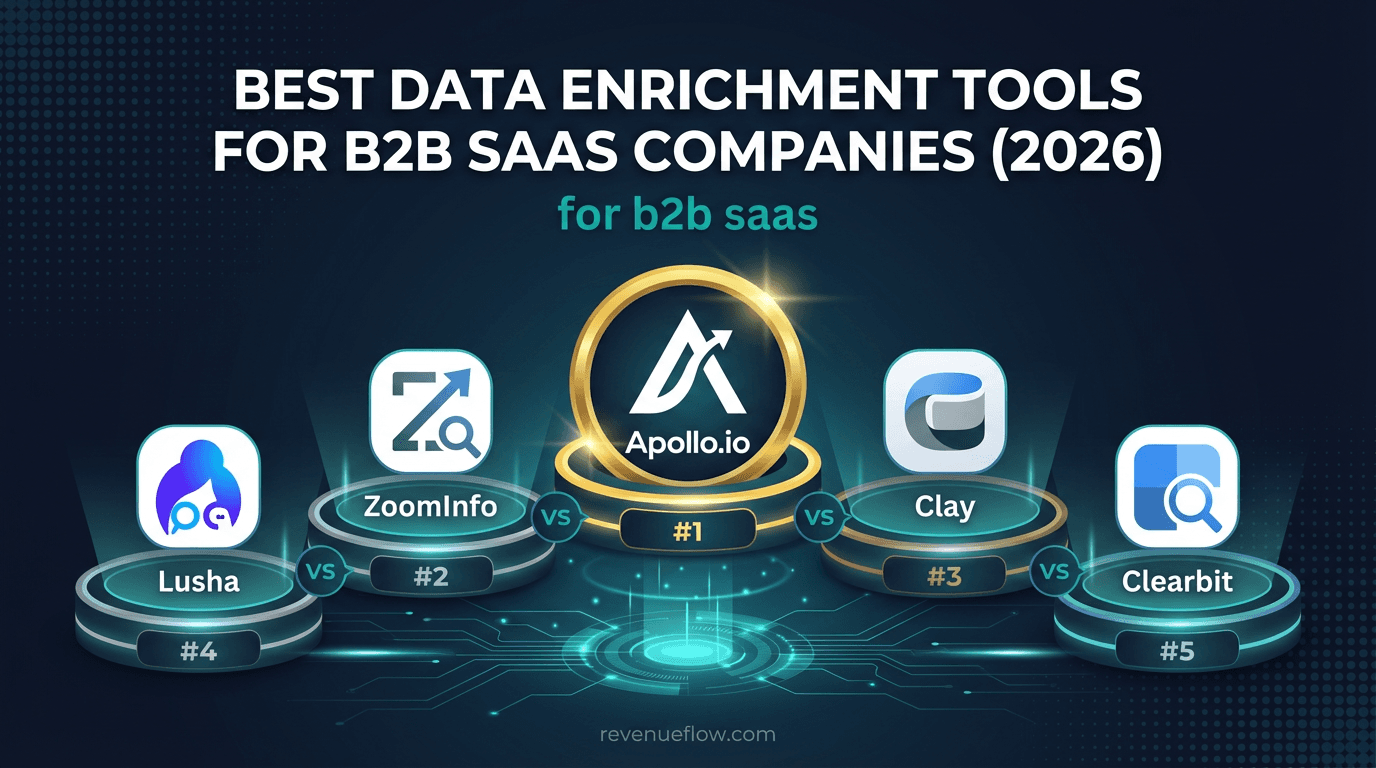
For B2B SaaS companies whose pipeline starts with a signup, Apollo.io is the best default: its pricing page lists real-time form enrichment and API access on the Free plan. Clay suits teams building their own signup workflow on its Growth plan, and LeadIQ ticks webform enrichment on Free and Pro.
Key takeaways
- Apollo.io's Free plan lists real-time form enrichment (5 limit) and API access; Basic at $49 per seat billed annually adds 3 inbound routers.
- Clay's webhooks, HTTP API integrations and CRM auto-sync start on Growth, at $446/mo on the annual view or $495/mo billed monthly.
- Credits are different units on each page: LeadIQ charges 3 for an account enrichment, Lusha 1 for a company profile via API, Apollo up to 9 per record.
- Enrich the company before the person and flag free-mail signups rather than guessing, because company fields decide routing.
Reviewed and updated September 21, 2026
A B2B SaaS company cuts its signup form down to a single work email field, trial signups rise, and the sales team starts receiving a stream of addresses with no company, role or size attached. That trade is why lead enrichment for B2B SaaS is its own job: the form stays short, and a tool fills in the rest before anybody decides whether the account deserves a human.
This guide covers the best data enrichment tools for SaaS companies selling B2B from that inbound side: which of the five usual names, Clay, Lusha, UpLead, LeadIQ and Apollo.io, can enrich a trial signup automatically, on which plan that starts, and what each enriched record costs in credits. Every figure comes from the vendor's own pricing page.
What Is the Best Data Enrichment for SaaS Companies Selling B2B?
For most early B2B SaaS teams it is Apollo.io, because its pricing page lists real-time form enrichment and API access even on the Free plan, with inbound routers from Basic. Teams that want a signup to trigger a multi-provider workflow should look at Clay, whose Growth plan adds webhooks and HTTP API integrations. LeadIQ's plan cards tick webform enrichment on both Free and Pro.
The choice turns less on whose database is biggest than on where automatic enrichment begins on each price list, which is also the fairest way to compare the best sales data enrichment software for an inbound motion.
What B2B SaaS Companies Need From a Data Enrichment Tool
Enrichment at the moment of signup. A trial signup is worth most in its first hour, so the enrichment has to run without a person: through a form integration, a webhook or an API call that the signup itself triggers. A tool that only enriches a spreadsheet somebody uploads on Friday is an outbound tool.
A company match that survives free-mail addresses. Enrichment keys on the email domain. A work address resolves to a company; a personal address from a free-mail provider resolves to nothing useful, and the pipeline has to say so rather than guess.
Routing on the enriched fields. Company size, industry and the person's role decide whether a signup goes to sales, to a nurture track or nowhere yet, so the enriched fields have to reach the CRM or the router quickly and in a consistent format.
Usage data from your own product. Trial conversion tracking and product usage live in your analytics, not in any enrichment vendor's database. Enrichment adds company and role context around a user who already exists in your system; it never tells you whether they activated.
What the form collects
- A work email address
- Nothing else a tool can fill in
What enrichment adds
- The company, from the email domain
- Company size and industry, which decide routing
- Role and seniority, which decide the message
- A flag when the address is free-mail
Enrich Free Trial Signups: B2B SaaS Best Practices
The practices that hold across every tool on this page are about sequence rather than vendor.
- Keep the form short and enrich after submit. Ask for a work email and nothing else the tool can fill in. The enrichment call runs once the signup is saved, so a slow provider never delays the account being created.
- Resolve the company before the person. Company fields decide routing and person fields decide the message. On LeadIQ's credit table an account enrichment costs 3 credits, and Apollo's FAQ says data enrichment uses up to 9 credits per record, so enriching only the fields routing reads keeps the bill in proportion.
- Flag free-mail signups instead of guessing. A personal address has no company domain to match. Send it down a lighter path, or ask for a work address at activation, rather than paying for a lookup that cannot resolve it.
- Write back once, to one record. Enrichment that creates a second contact beside the one the signup created is a reconciliation job somebody has to own. LeadIQ's Enterprise card lists Salesforce duplicate detection for exactly this problem.
- Re-check on conversion, not on a timer. Re-verify a record when the trial converts or asks for a demo, which is the moment the data is about to be used.
Top 5 Data Enrichment Tools for B2B SaaS Companies

The table sets out where automatic enrichment first appears on each price list. The entries after it add the prices and the credit rules.
| Tool | First plan listing it | What the card lists |
|---|---|---|
| Apollo.io | Free, $0 | Real-time form enrichment (5 limit) and API access; Basic adds 3 inbound routers |
| LeadIQ | Free, $0 | Webform enrichment, CRM enrichment and API access, ticked on Free and Pro |
| Lusha | Pro, $52.45 a month yearly | API, webhooks and CSV enrichment |
| Clay | Growth, $446/mo annual | Webhooks, HTTP API integrations and CRM auto-sync |
| UpLead | Professional, annual only | Full API access and bi-directional CRM sync |
1. Clay
Clay is a workflow platform: it buys from many data providers, runs them in a waterfall and lets its AI agent, Claygent, research whatever the providers leave blank. For signups, the relevant line on its pricing page is the Growth plan, which adds webhook automation, HTTP API integrations and CRM auto-sync; the comparison table marks all three as not included on Free and Launch. Growth is $446/mo on the default annual view and $495/mo billed monthly, Launch $167/mo or $185/mo, and the Free plan carries 100 data credits and 500 actions a month. Tables and users per workspace are unlimited on every plan, and the FAQ says a lookup that returns no result costs neither data credits nor actions. The CRM sync matters most when the destination is Salesforce, HubSpot or Pipedrive.
2. Lusha
Lusha is best known for its browser extension, and its API sits on the Pro plan, whose card lists API, CSV enrichment, signals and webhooks. Pro is $52.45 a month billed yearly for 7,200 credits a year, or $69.90 billed monthly for 600 credits a month. Starter, at $37.45 yearly or $49.90 monthly, and the Free plan with 40 credits a month do not list the API. Its credit table charges 1 credit for a company profile via the API and 1 credit per enriched data point, which makes company-only enrichment of signups easy to model.
3. UpLead
UpLead sells verified contacts one credit at a time: its pricing page says one credit equals one contact, with the email and mobile direct dial included. Essentials is $99 a month for 170 credits and Plus $199 for 400 on monthly billing, or $74 and $149 a month billed annually. Plus is the first plan to list data enrichment of company and contact records, while Full API Access and bi-directional CRM sync appear on Professional, which is annual billing only and priced on a call. The page states a 95% data accuracy rate for its email verification.
Contact accuracy claims aside, if ZoomInfo is on your shortlist, see how its enrichment credit system works before comparing costs.
Its CRM list names Salesforce, Hubspot, Pipedrive, Outreach and SalesLoft, among others, so a Professional account can push enriched records both ways.
4. LeadIQ
LeadIQ's Free and Pro plan cards both tick webform enrichment, CRM enrichment and API access, which makes it the cheapest way on this list to test signup enrichment without a sales call. Free is 1 user with 50 credits. Pro shows $15.00 a month billed annually or $20.00 monthly at the default 2,400 credits a year, with 5 users included; its credit slider could not be driven here, so higher volumes are not quoted. An account enrichment costs 3 credits and an email 1. Its champion job-change tracking matters in SaaS as well, because a user who moves to a new company is a warm account.
5. Apollo.io
Apollo.io lists the most inbound features at the lowest entry point. Its Free plan, with 900 credits per seat per year, includes real-time form enrichment (5 limit), website visitor identification for 20 companies a month and API access. Basic, at $49 per seat a month billed annually or $65 monthly, raises the form enrichment limit to 10 and adds 3 inbound routers and automated CRM enrichment. A separate Inbound add-on at $119 per team a month billed annually, $149 monthly, covers 5,000 enriched form contacts a month, with credit usage applying. Its FAQ says data enrichment uses up to 9 credits per record.
What Enriching One Signup Costs
A credit is not the same unit on any two of these price lists. LeadIQ charges 3 credits for an account enrichment, Lusha 1 credit for a company profile via its API, UpLead one credit per contact, and Apollo's FAQ says data enrichment uses up to 9 credits per record. Clay charges nothing for a lookup that returns no result, and its FAQ says data credits start at $0.05 each.
So the honest comparison is your own monthly signup count multiplied by each vendor's rule, checked against the credits the plan includes. A team with a few hundred signups a month and company-only routing needs a very different plan from one enriching every person on every form.
Recommendation by Budget

Free: Apollo.io's Free plan and LeadIQ's Free plan both list form or webform enrichment, so a team can wire a signup form to either before paying anything. Clay's Free plan and Lusha's 40 monthly credits suit testing enrichment quality rather than running inbound, and UpLead offers a 7-day Test Drive with 5 credits instead of a free tier.
Under $50 a month: LeadIQ Pro at its default volume ($15.00 billed annually, $20.00 monthly), Lusha Starter at $37.45 billed yearly, and Apollo.io Basic at $49 per seat billed annually. UpLead's lowest paid price is $74 a month billed annually, so it sits above this line.
When inbound is the whole motion: Clay Growth or Apollo's Inbound add-on, depending on whether the team wants to build the workflow or buy it packaged.
Choosing for an Inbound Motion
- Count signups, not seats. Inbound enrichment volume follows the form, so price each tool on monthly signups multiplied by its credits per record.
- Find the plan where automation starts. A tool whose API sits on an annual-only tier is, for a small team, an outbound tool.
- Test on last month's signups. Run 100 real signups through a free tier and count how many resolve to a company you would actually sell to.
- Check the write-back. The enriched fields have to land on the record the signup created, in the CRM the team already uses.
Final Thoughts

For B2B SaaS companies whose pipeline starts with a signup, the best data enrichment tool is the one whose price list puts automatic enrichment within reach: Apollo.io and LeadIQ list it on their free plans, Lusha on Pro, Clay on Growth and UpLead on Professional. Clay leads for teams that want to build the workflow themselves, and Apollo.io is the better fit for teams watching their spend that want it packaged.
Start with 100 of last month's signups on the free tier of your top two, and judge them on how many resolve to a company worth routing.
Related Reading
- Best Lemlist Alternatives in 2026
- Best Apollo.io Alternatives in 2026
- Best ZoomInfo Alternatives in 2026
If you would rather have this run for you, RevenueFlow books qualified meetings on a pay-per-meeting basis and publishes client results.
Pricing and features are taken from the vendors' own pages. Verify current terms with the vendor before relying on them.
Frequently asked questions.
Frequently asked questions- What is the best data enrichment for SaaS companies?
- For a B2B SaaS company whose pipeline starts with trial signups, Apollo.io is the usual default, because its pricing page lists real-time form enrichment and API access even on the Free plan. Clay fits teams that want a signup to trigger a multi-provider workflow, which its Growth plan supports with webhooks. LeadIQ ticks webform enrichment on Free and Pro.
- How do you enrich free trial signups in B2B SaaS?
- Keep the form to a work email, then enrich after submit so a slow provider never delays the signup. Resolve the company first, because size and industry decide routing, and flag free-mail addresses instead of guessing. Write the enriched fields back to the one record the signup created, and re-check the data when the trial converts.
- How much does it cost to enrich one lead?
- It depends on each vendor's credit rule. LeadIQ's pricing page charges 3 credits for an account enrichment, Lusha 1 credit for a company profile via its API, UpLead one credit per contact, and Apollo's FAQ says data enrichment uses up to 9 credits per record. Multiply your monthly signups by that rule and compare it with the credits each plan includes.
- Which enrichment tools have a free plan for B2B SaaS?
- Apollo.io, LeadIQ, Lusha and Clay all list a free plan, and Apollo and LeadIQ are the two whose free cards list form or webform enrichment. UpLead offers a 7-day Test Drive with 5 credits instead. A free plan is the right place to run 100 of last month's signups before paying for anything.
About the author.

B2B cold email experts helping companies generate qualified leads through done-for-you outreach campaigns.
RevenueFlow Team
Explore more.
Ready to scale your outreach?
We build GTM engines that book real meetings. See the receipts.
Related articles.
Seamless.AI Email Finder: How It Works, What a Credit Buys
How Seamless.AI's email finder resolves a contact in real time, what one Universal Credit buys, the Total AI score on every address, and what the Chrome extension reads.
Is Clay Free? The Free Plan, the Trial and Where Each Stops
Clay's free plan, its 14-day trial and the no-charge-on-a-miss rule are three different things. What each holds and where it stops, from clay.com on 19 September 2026.
Snitcher Pricing: The $49 Table Is the Annual Rate
Snitcher's visible price table is the annual-billing ladder. The ten bands at both billing states, the unique-company meter, and the rules on a help page.
Firmographic Data Providers: What Six of Them Publish
Six firmographic data providers read from their own pages: the fields each sells, the coverage each states, how the data is delivered, and who prints a price.
Apollo Integrations: What Connects, and on Which Plan
Apollo's integrations marketplace sorted by job: what its own pages say each CRM sync moves, which plan ticks which integration, and what a sync costs.
Autobound Pricing: One-Time Credit Packs, Not Seats
Autobound's pricing page sells one-time credit packs for a signal data API, not seats. The six packs, the per-endpoint meter, and what a company costs.