Appointment Setting for ERP Vendors: Inside the Selection
How an ERP vendor or implementation partner books first meetings into a selection: the committee, the consultant, the published lifecycle triggers and the rules.
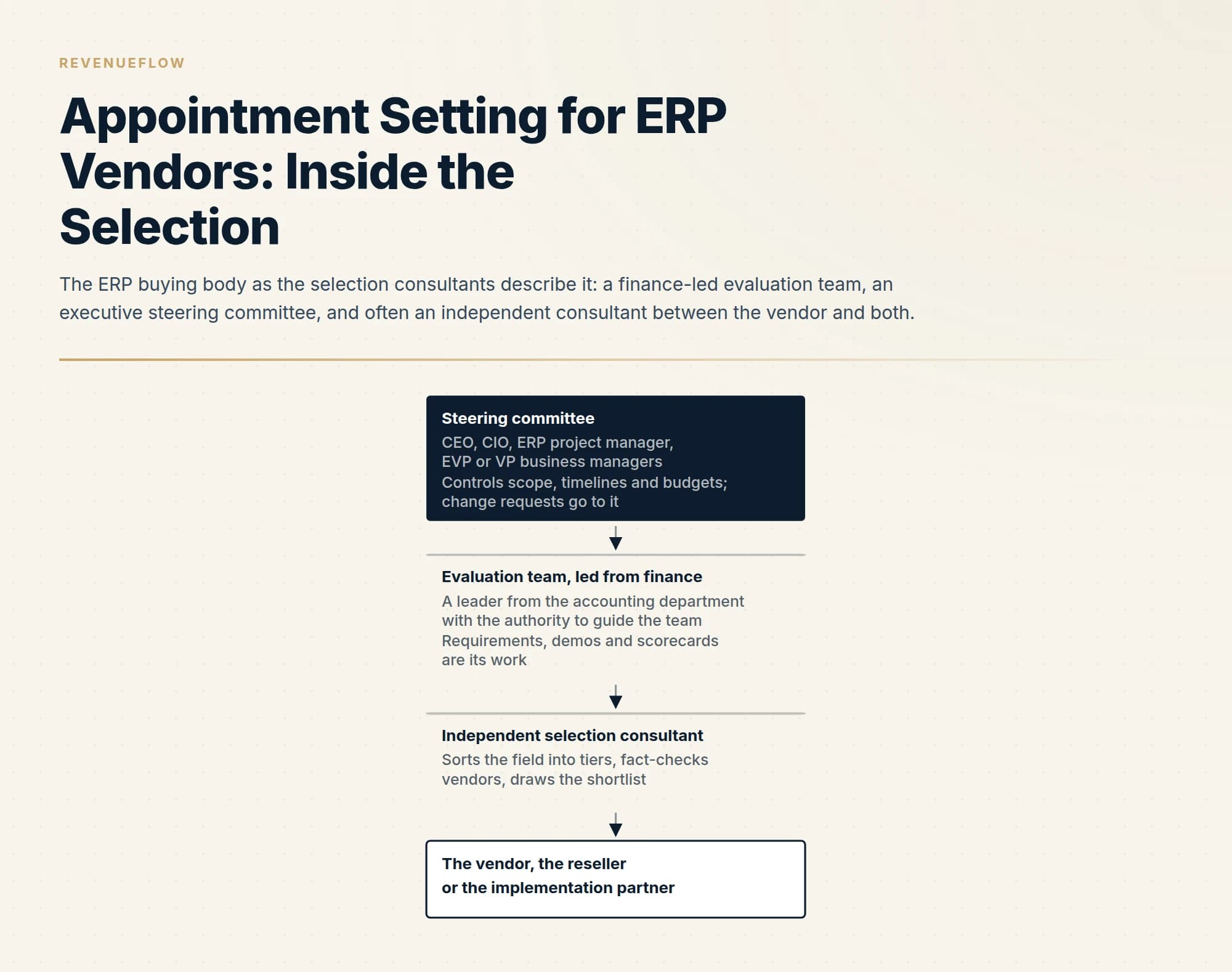
Appointment setting for an ERP vendor works when the meeting is booked before the buyer's shortlist exists. Selection consultants describe a finance-led evaluation team, a steering committee and a consultant who sorts the field into tiers and caps demos at about four, so the setter's window is a trigger: a published end-of-support date, an acquisition or a new finance leader.
Key takeaways
- Panorama names the steering committee as the CEO, the CIO, the ERP project manager and EVP or VP business managers; Cherry Bekaert says the evaluation is led by a leader from the accounting department, so finance titles are real targets.
- ERP Advisors Group tells buyers to send requirements to only three or four vendors and to demo no more than four, so outbound has to make a vendor known before the consultant draws the shortlist.
- The triggers are published by the vendors: Microsoft ends Dynamics GP support on 31 December 2029 with patches to April 2031, and SAP ends mainstream maintenance for Business Suite 7 core applications at the end of 2027.
- The FTC's CAN-SPAM guide makes no exception for business-to-business email, and the FCC's rules address autodialed or prerecorded calls to wireless numbers, so a setter's channel choice carries obligations.
Reviewed and updated September 18, 2026
An ERP vendor's appointment setter has a harder job than most, and the reason is written into the vertical's own selection guides. ERP Advisors Group, a selection consultancy, warns buyers in its published guide: "Some software companies will be aggressive at getting back to you, while with others it can take weeks to reach a real person who can meet with you to discuss your opportunity." It tells them not to send their requirements to vendors until the field is narrowed to about three or four (ERP Advisors Group, ERP selection guide, read 18 September 2026). Read from the vendor's side, the problem is plain: the buyer expects to find you, expects a shortlist to exist before you demonstrate anything, and often has a consultant between you and the committee.
This page is written for the ERP vendor, the value-added reseller and the implementation partner who want qualified first meetings with companies selecting a system. Selling to ERP vendors is a different page, and this one is not a list of agencies. The generic mechanics live on the head pages linked at the end; this page is about what changes when the product is an ERP system and the buyer is a selection committee that a consultant draws the shortlist for.
Who is in the room when an ERP gets chosen
Panorama Consulting Group, an ERP selection consultancy, describes the buying body as a steering committee with ultimate authority over every aspect of the implementation and names its members: the CEO, the CIO, the ERP project manager and business managers at the EVP or VP level (Panorama, ERP steering committee roles, 26 July 2021). The same page gives the committee three jobs: it provides project direction, it keeps the project aligned with corporate strategy, and it controls timelines and budgets, with every change request going to the committee for approval.
Cherry Bekaert, an advisory firm with an ERP practice, lays the selection out as six steps in an article dated 16 December 2025: executive buy-in, a leader from the accounting department with the authority to guide the evaluation team, requirements, a project team and governance, a schedule, and system evaluations (Cherry Bekaert, the ERP selection process). So the evaluation is led from finance, the CFO or controller is a real title to write to, that leader is appointed before any vendor is contacted, and requirements, demos and scorecards are the evaluation team's work.
ERP Advisors Group adds the figure most vendor outreach ignores: the outside consultant. Its guide describes a vendor vetting stage in which the consultant sorts the field into four tiers, from systems that run the entire business (Oracle Cloud, SAP S/4HANA, Infor M3, Workday, Microsoft Dynamics 365 Finance and Supply Chain) down to entry-level packages such as QuickBooks, and confines the shortlist to the right tier. Cherry Bekaert lists what ERP consultants help with, and one item is: "Fact-check and validate statements vendors make regarding capabilities." Panorama's 2026 ERP Report tells buyers that "it's essential to work with an independent ERP consultant" with "no financial ties to software vendors" (Panorama, The 2026 ERP Report, 170 respondents, data collected January 2025 to January 2026).
When the door is open
ERP buying is triggered rather than seasonal, and the biggest triggers are published by the vendors themselves.
Microsoft announced on its Dynamics 365 blog on 25 September 2024 that it would end product support and updates for Dynamics GP, and updated the post on 15 January 2025 to say that product support and updates will now end on 31 December 2029, with security patches continuing until 30 April 2031 (Microsoft, Announcing End of Support for Dynamics GP). Microsoft's lifecycle page lists the same retirement (Microsoft Learn, Dynamics GP lifecycle).
SAP's support site states that mainstream maintenance for SAP Business Suite 7 core applications runs until the end of 2027, that optional extended maintenance runs from 2028 until the end of 2030 at a premium, and that customers who do not take it move to customer-specific maintenance; the same page records the innovation commitment for SAP S/4HANA until the end of 2040, announced on 4 February 2020 (SAP, Maintenance 2040).
Those dates are the buyer's own obligation, and every company on an affected version belongs to a population a setter can enumerate. ERP Advisors Group's guide names the other triggers: growth past a system (its example is a company moving out of QuickBooks), an acquisition, and a new leader who arrives with a preferred system. Panorama's 2026 report adds one more: more than a quarter of its 170 respondents reported a project over budget, most often because of an unexpected need for additional technology, which the report attributes to "poor system selection."
- End of 2027End of mainstream maintenance for SAP Business Suite 7 core applications
SAP's Maintenance 2040 page; its innovation commitment is for SAP S/4HANA
- 2028 to end of 2030SAP's optional extended maintenance window
After it, customer-specific maintenance
- 31 December 2029End of product support and updates for Dynamics GP
Microsoft's blog post of 25 September 2024, updated 15 January 2025
- 30 April 2031End of security patches for Dynamics GP
The last date on Microsoft's post
- End of 2040SAP's innovation commitment for SAP S/4HANA
Announced 4 February 2020
What the rules require of the sender
Most ERP appointment setting in the United States runs on email and, according to the agencies that publish on it, on the phone. The rules differ by channel.
For email, the Federal Trade Commission's compliance guide is the text: the CAN-SPAM Act "makes no exception for business-to-business email," each separate email in violation is subject to penalties of up to $53,088, and a commercial message carries accurate header information, a non-deceptive subject line, identification as an advertisement, the sender's valid physical postal address and a clear way to opt out (FTC, CAN-SPAM Act: A Compliance Guide for Business, read 18 September 2026). An ERP vendor's email to a controller at a distribution company is commercial email under that definition, so the postal address and opt-out line that the guide requires belong in the footer of every send.
For calls, the FTC's Telemarketing Sales Rule guidance states that most phone calls between a telemarketer and a business are exempt from the rule (FTC, Complying with the Telemarketing Sales Rule), while the FCC's consumer guide states that its rules require a caller to obtain prior written consent before a prerecorded telemarketing call to a home or wireless number, and oral or written consent before an autodialed or prerecorded call or text to a wireless number (FCC, Stop Unwanted Robocalls and Texts). RevenueFlow runs email and LinkedIn and does not cold-call, so the phone is described here as the vertical's reality rather than as our motion. Whether a practice is compliant is a question for counsel.
The objections the vertical actually raises
The objections to ERP vendor outreach come from the consultants who advise the buyer, and they are published.
ERP Advisors Group advises buyers not to run a blind RFP, not to demo more than four vendors, to limit a first demonstration to two hours, and to move only two finalists to a full-day final demonstration. It also warns: "Vendors may exert some pressure for closing by month/quarter/year-end, but this is not a time to rush or to skip over the fine print." A setter who books by promising a quarter-end discount confirms that warning.
The same guide explains why an implementation partner is in the room from the start: some software companies, like Microsoft or Oracle, "will only work with implementation partners, so you will meet them at the beginning of the deal. Other companies, like NetSuite, can go either way." NetSuite's own pages describe Solution Providers, which "Sell and deliver NetSuite, perform implementation and provide ongoing support and consulting to their customers," and Alliance Partners, which "Work in concert with NetSuite sales team to provide consulting, integration and implementation services to customers," and state that Alliance Partners perform 40 percent of NetSuite implementations (NetSuite, Become a Partner and Alliance Partner Program, read 18 September 2026). Acumatica's partner page describes a network of resellers that handle "the evaluation, implementation, training and ongoing support" (Acumatica Partner Program). Oracle's PartnerNetwork page describes three programme levels with joint account planning among the benefits (Oracle PartnerNetwork). The objection is a routing one: a prospect that already works with a partner of the brand you represent has an owner, and a meeting booked over that partner's head costs the vendor the relationship.
The third objection is the reference. ERP Advisors Group notes: "Sales teams are eager for you to be happy with your final outcome because they want you as a reference." A setter who promises a peer-customer call that cannot be produced has spent the vendor's credibility on the one thing the buyer checks.
Channel reality, and when this is the wrong play
The selection path the consultants describe has two doors a setter can aim at, and it is drawn below.
Door 1 is the only door outbound opens by itself. A company that has appointed a finance leader to run an evaluation, runs a version with a published end-of-support date, or has just acquired a business on a second system is at step one, and a first meeting is a conversation about whether the vendor belongs in the tier the buyer will shortlist from. Door 2 is where the buyer or the consultant invites a vendor in, and outbound's job there is to have made the vendor known before the shortlist was drawn. Step four, where the implementation partner is in the room, and step five, the estimate form, contract negotiation and board approval that ERP Advisors Group's guide walks through, belong to the account team.
Two more facts belong in the list build. Panorama's 2026 report puts the median project timeline among its respondents at nine months and the median annual revenue at 200.5 million dollars, so a first meeting sits a long way from revenue and the buyer is usually mid-sized or larger. And ERP Advisors Group's guide has the consultant remove vendors from the wrong tier before demos, so a setter targeting outside the tier the vendor serves books meetings the consultant later cancels.
This is the wrong play in three cases, and the fit test below puts them in order. It is wrong where a channel partner owns the account; there the meeting to book is with the partner's practice lead, not the buyer. It is wrong where the selection has already reached its shortlist, because demos are capped at about four and you are late. And it is wrong where the published trigger is not inside this year: Microsoft's own post gives Dynamics GP customers until the end of 2029, and a message that dresses that up as an emergency costs trust, because it is the quarter-end pressure the consultants warn about. All four questions the right way and the meeting is worth an hour.
Three openers, each grounded in a page the buyer can check
Three sample first lines, each tied to one fetched source. None claims a result, names a real person or carries contact details.
To a controller at a company running Dynamics GP. The opener taken apart below. It is a legitimate reason to write because the date is on Microsoft's own pages and the message names a planning window rather than an emergency.
To the ERP practice lead at a selection consultancy. ERP Advisors Group's guide has the consultant sort the field into tiers before a shortlist of three or four is drawn, and notes that some vendors take weeks to put a real person on the phone. We are a mid-market vendor that answers a consultant's questions the same day, and twenty minutes to show your team where we sit in your tiers, before a client's requirements go out, is the whole ask. The sort is the consultant's own published process and the message asks to be placed in it rather than around it.
To a newly appointed finance leader. Cherry Bekaert's selection guide says an ERP evaluation should be led by a leader from the accounting department with authority over the team. If that is you this year, we would like to be one of the vendors you sort into a tier before the shortlist is drawn, and we can send our implementation partner's references ahead of any call. The trigger is a public appointment and the message accepts the consultant's process.
To: Controller, a distribution company running Dynamics GP
Microsoft's January 2025 update to its end-of-support post moved the last day of product support for Dynamics GP to 31 December 2029, with security patches to April 2031. 1
If your finance team is planning a migration path before the 2028 budget is set, we run implementations for distributors your size and would rather compare notes now than in the last year. 2
Postal address and opt-out line in the footer. 3
- 1A dated fact from Microsoft's own blog post and lifecycle page, with a planning window rather than an emergency.
- 2Names the companies served and the planning window; the ask is a conversation.
- 3The postal address and opt-out line the FTC's CAN-SPAM guide requires of every commercial email.
Where the generic play still applies
What a qualified meeting has to mean is in appointment setting versus lead generation; the eight stages and what a meeting costs are in B2B appointment setting; the scope ladder is in appointment setting services; the five terms to score a vendor on are in how to compare B2B appointment setting companies; and the build-versus-buy arithmetic is in outsourced appointment setting versus in-house.
What an ERP vendor adds to the written definition of a meeting is specific: a published lifecycle date or a comparable trigger, the right tier, no partner owning the account, the finance leader or a steering committee member in the seat, and no shortlist drawn yet. A setter paid on that definition is paid to read the vendors' lifecycle pages and the consultants' guides before writing.
RevenueFlow books meetings on email and LinkedIn against criteria agreed in writing before launch and is paid on attended meetings that meet them. If your market is companies on a clock the vendors themselves published, you can see what a campaign would look like for your market.
Lifecycle dates, partner programme descriptions and regulator guidance were fetched from the pages linked above on 18 September 2026; survey figures are Panorama's own with its stated population. Terms change; confirm them on the vendor's page. Nothing here is legal advice.
Sources: ERP Advisors Group, ERP selection guide, Panorama, ERP steering committee, Panorama, The 2026 ERP Report, Cherry Bekaert, ERP selection process, Microsoft, Dynamics GP end of support, Microsoft Learn, Dynamics GP lifecycle, SAP, Maintenance 2040, NetSuite, Become a Partner, NetSuite Alliance Partner Program, Acumatica Partner Program, Oracle PartnerNetwork, FTC, CAN-SPAM compliance guide, FTC, Telemarketing Sales Rule, FCC, robocalls and texts
Frequently asked questions.
Frequently asked questions- Who should an ERP vendor's appointment setter write to?
- The people the selection consultants name. Panorama's steering committee page lists the CEO, the CIO, the ERP project manager and business managers at EVP or VP level, and Cherry Bekaert's selection article says the evaluation team should be led by a leader from the accounting department with authority over it. The finance leader running the evaluation is the most useful first contact, because that person is appointed before any vendor is contacted.
- When is the right moment to book a meeting with a company selecting an ERP?
- Before the shortlist. ERP Advisors Group's guide tells buyers not to send requirements until the field is narrowed to about three or four vendors and not to demo more than four, so a vendor that is unknown when the consultant tiers the field is usually out. The workable triggers are published: a vendor lifecycle date such as Dynamics GP's end of support on 31 December 2029, an acquisition, growth past a system, or a newly appointed finance leader.
- Why do implementation partners matter to ERP appointment setting?
- Because the channel decides who owns the account. ERP Advisors Group notes that some software companies, naming Microsoft and Oracle, work only through implementation partners, while NetSuite can go either way. NetSuite's own pages describe Solution Providers who sell and implement and Alliance Partners who work alongside its sales team, and Acumatica describes a reseller network. A meeting booked over a partner's head costs the vendor the relationship, so the list has to be routed first.
- What rules apply to an ERP vendor's outreach in the United States?
- For email, the FTC's CAN-SPAM compliance guide states that the law makes no exception for business-to-business email and requires accurate headers, a non-deceptive subject line, identification as an advertisement, a valid physical postal address and a working opt-out. For calls, the FTC says most business-to-business calls are exempt from the Telemarketing Sales Rule, while the FCC requires consent for autodialed or prerecorded calls to wireless numbers. None of this is legal advice.
About the author.

B2B cold email experts helping companies generate qualified leads through done-for-you outreach campaigns.
RevenueFlow Team
Explore more.
Ready to scale your outreach?
We build GTM engines that book real meetings. See the receipts.
Related articles.
Sales Strategy for Logistics Companies: Segment, Seat, Cycle
How a broker, forwarder, carrier or 3PL sets its sales strategy: Armstrong's segments and contract terms, the four provider seats shippers keep, and the rate cycle.
Appointment Setting for 3PL Companies: Fit Before the Calendar
For 3PLs, warehousing operators and brokers wanting shipper meetings: the five fit gates, the bid calendar, contract terms, the trade's rules and three openers.
Sales Strategy for Manufacturing Companies: Direct or Reps
How a manufacturer decides whose salespeople carry its line: the published definition of a representative, MANA's agreement clauses and the split commission problem.
Appointment Setting for Manufacturers: Who a Setter May Call
For the manufacturer hiring a setter: the ranked titles to hand over, the rep and distributor map that decides which accounts may be called, and the meeting types.
Lead Generation for Trucking Companies: Three Routes
How a motor carrier finds freight customers: the load board, the broker relationship and the shipper's annual bid, with the calendar and the rules on outreach.
Appointment Setting for Material Handling Companies
Appointment setting in material handling starts with whose appointment it is: dealer territories, the ProMat and MODEX calendar, and OSHA's dated duties.